Introduction
 Cloud Computing provides us a means by which we can
access the applications as utilities, over the Internet. It
allows us to create, configure, and customize applications
online.
 With Cloud Computing users can access database resources
via the internet from anywhere for as long as they need
without worrying about any maintenance or management of
actual resources.
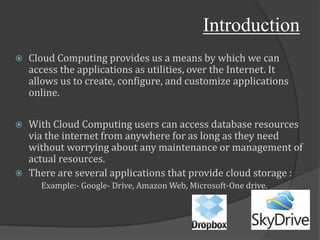
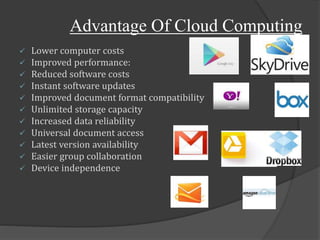
 There are several applications that provide cloud storage :
Example:- Google- Drive, Amazon Web, Microsoft-One drive.
What is Cloud Computing ?
 The word cloud refers to the network or connections
over internet, used to connect number of computers and
server at a time.
 Computing refers to manipulating, configuring, and
accessing the applications online.
 Hence cloud computing can be described as the
computation of data that are stored on cloud storage and
access of those data via internet connection .It offers
online data storage, infrastructure and application.
 Cloud Computing is both a combination of software and
hardware based computing resources delivered as a
network service.
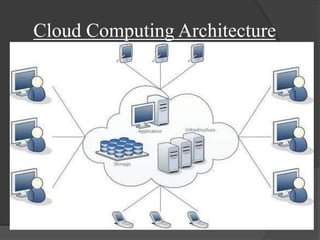
Cloud Computing Architecture
Concept behind cloud Computing
 There are certain services and models encapsulated behind the
scene making the cloud computing feasible and accessible to
end users.
 Following are the working models for cloud computing:
Deployment model
Service Model
 These models perform as to provide better end users
performance and experience.
Deployment Model
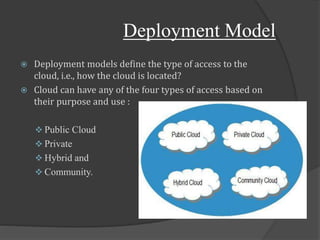
 Deployment models define the type of access to the
cloud, i.e., how the cloud is located?
 Cloud can have any of the four types of access based on
their purpose and use :
 Public Cloud
 Private
 Hybrid and
 Community.
PUBLIC CLOUD :
The Public Cloud allows systems and services to be easily accessible to the
general public. Public cloud may be less secure because of its openness, e.g.
Electronic-mail.
PRIVATE CLOUD :
The Private Cloud allows systems and services to be accessible within an
organization. It offers increased security because of its private nature.
COMMUNITY CLOUD :
The Community Cloud allows systems and services to be accessible by
group of organizations.
HYBRID CLOUD :
 The Hybrid Cloud is mixture of public and private cloud. However, the
critical activities are performed using private cloud while the non-critical
activities are performed using public cloud.
Service Models
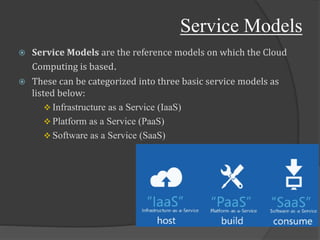
 Service Models are the reference models on which the Cloud
Computing is based.
 These can be categorized into three basic service models as
listed below:
 Infrastructure as a Service (IaaS)
 Platform as a Service (PaaS)
 Software as a Service (SaaS)
Infrastructure as a Service (IaaS) :
IaaS model is a third party provider host hardware, software, storage
and other infrastructure components on behalf of its user.
Iaas platforms offers highly scalable resources that can be adjusted on
demand. This makes IaaS well-suited for workloads that are temporary,
experimental or changes unexpectedly.
Software as a Service (SaaS):
SaaS model is a software delivery method that provides access to
software and its function remotely as a web-based services. SaaS allows
organizations to access business functionality at a cost typically less then the
cost for licensed software.
Platform as a Service (Paas):
PaaS model delivers applications over the internet. PaaS model cloud
providers provides hardware and software tools that are necessary for
software development to its user as a service.
Advantage Of Cloud Computing
 Lower computer costs
 Improved performance:
 Reduced software costs
 Instant software updates
 Improved document format compatibility
 Unlimited storage capacity
 Increased data reliability
 Universal document access
 Latest version availability
 Easier group collaboration
 Device independence
Disadvantage Of Cloud Computing
 Requires a constant Internet connection
 Does not work well with low-speed connections
 Features might be limited
 Can be slow
 Stored data can be lost
 Stored data might not be secure
Cloud Computing

Cloud Computing

  • 2.
    Introduction  Cloud Computingprovides us a means by which we can access the applications as utilities, over the Internet. It allows us to create, configure, and customize applications online.  With Cloud Computing users can access database resources via the internet from anywhere for as long as they need without worrying about any maintenance or management of actual resources.  There are several applications that provide cloud storage : Example:- Google- Drive, Amazon Web, Microsoft-One drive.
  • 3.
    What is CloudComputing ?  The word cloud refers to the network or connections over internet, used to connect number of computers and server at a time.  Computing refers to manipulating, configuring, and accessing the applications online.  Hence cloud computing can be described as the computation of data that are stored on cloud storage and access of those data via internet connection .It offers online data storage, infrastructure and application.  Cloud Computing is both a combination of software and hardware based computing resources delivered as a network service.
  • 4.
  • 5.
    Concept behind cloudComputing  There are certain services and models encapsulated behind the scene making the cloud computing feasible and accessible to end users.  Following are the working models for cloud computing: Deployment model Service Model  These models perform as to provide better end users performance and experience.
  • 6.
    Deployment Model  Deploymentmodels define the type of access to the cloud, i.e., how the cloud is located?  Cloud can have any of the four types of access based on their purpose and use :  Public Cloud  Private  Hybrid and  Community.
  • 7.
    PUBLIC CLOUD : ThePublic Cloud allows systems and services to be easily accessible to the general public. Public cloud may be less secure because of its openness, e.g. Electronic-mail. PRIVATE CLOUD : The Private Cloud allows systems and services to be accessible within an organization. It offers increased security because of its private nature. COMMUNITY CLOUD : The Community Cloud allows systems and services to be accessible by group of organizations. HYBRID CLOUD :  The Hybrid Cloud is mixture of public and private cloud. However, the critical activities are performed using private cloud while the non-critical activities are performed using public cloud.
  • 8.
    Service Models  ServiceModels are the reference models on which the Cloud Computing is based.  These can be categorized into three basic service models as listed below:  Infrastructure as a Service (IaaS)  Platform as a Service (PaaS)  Software as a Service (SaaS)
  • 9.
    Infrastructure as aService (IaaS) : IaaS model is a third party provider host hardware, software, storage and other infrastructure components on behalf of its user. Iaas platforms offers highly scalable resources that can be adjusted on demand. This makes IaaS well-suited for workloads that are temporary, experimental or changes unexpectedly. Software as a Service (SaaS): SaaS model is a software delivery method that provides access to software and its function remotely as a web-based services. SaaS allows organizations to access business functionality at a cost typically less then the cost for licensed software. Platform as a Service (Paas): PaaS model delivers applications over the internet. PaaS model cloud providers provides hardware and software tools that are necessary for software development to its user as a service.
  • 10.
    Advantage Of CloudComputing  Lower computer costs  Improved performance:  Reduced software costs  Instant software updates  Improved document format compatibility  Unlimited storage capacity  Increased data reliability  Universal document access  Latest version availability  Easier group collaboration  Device independence
  • 11.
    Disadvantage Of CloudComputing  Requires a constant Internet connection  Does not work well with low-speed connections  Features might be limited  Can be slow  Stored data can be lost  Stored data might not be secure