Plane and Applied Surveying -2
Theodolite Theoretical part -1
1
Prepared by
Asst. Prof. Salar K. Hussein
Asst. Lecturer Mr. Kamal Yaseen
Technical Engineering College
Civil Engineering Department
Overview
v Introduction About Theodolite Instrument
v Theodolite and its classification
v Parts of Theodolite
v Theodolite Axis and conditions
v Setting up the Theodolite
v Levelling & Centring - the Theodolite
v Readings in the Theodolite
v Theodolite – Instrument Checks
v Sources of errors
2
Introduction About Theodolite Instrument
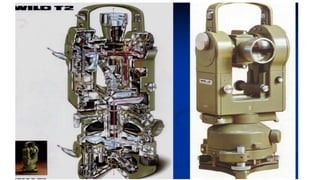
theodolite is a precise Surveying instrument used for
measuring angles both (horizontally and vertically). Theodolite
can rotate along their horizontal axis as well as their vertical
axis.
. Theodolites can also be used to mark out straight and curved
lines in the field. Determining the difference in elevation,
setting out curves… etc.
3
The following are the different purposes for which the
theodolite can be used:
1- Measuring horizontal angles.
2- Measuring Vertical angles.
3- Measuring deflection angles.
4- Measuring magnetic bearing.
5- Measuring the horizontal distance between two points.
6- Finding the vertical height of an object.
7- Finding the difference in elevation between various points.
8- Ranging a line.
4
Parts of a Theodolite
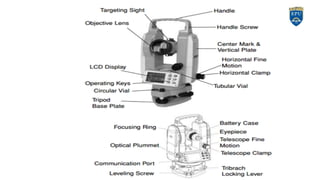
1 - Tripod
It should be of a rigid type capable of fixing the position of the instrument with a small
lateral movement on its top when required.
2 - Foot screws
These are provided for leveling the instruments.
3 - Plate level
Provided for checking the level of the instrument.
4 - Horizontal clamp
Provided to clamp the movement in horizontal plane.
5 - Vertical clamp
For clamping movement in vertical plane.
5
6 - Telescope
In a telescope vertical hair is used for horizontal angle measurement while horizontal hair is
used for vertical angle measurement. Focusing arrangement for the object glass is usually
provided in the body of the telescope. Collimator is provided to bring the object in the field
of view.
7 - Vertical axis
It is the axis around which the telescope rotates in horizontal plane.
8 - Horizontal axis
It is the axis around which telescope rotates in vertical plane.
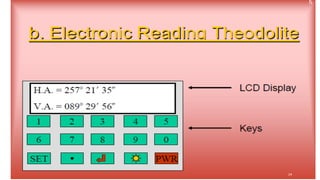
9 - Angle reading arrangement
In screen display you can note angle measurements taken with Theodolite
6
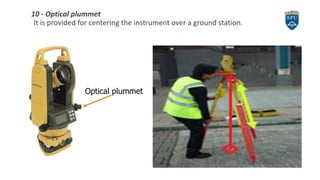
10 - Optical plummet
It is provided for centering the instrument over a ground station.
7
Optical plummet
8
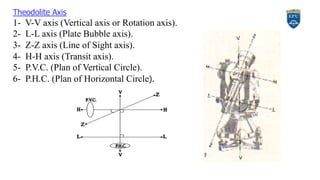
Theodolite Axis
1- V-V axis (Vertical axis or Rotation axis).
2- L-L axis (Plate Bubble axis).
3- Z-Z axis (Line of Sight axis).
4- H-H axis (Transit axis).
5- P.V.C. (Plan of Vertical Circle).
6- P.H.C. (Plan of Horizontal Circle).
9
Components of theodolite
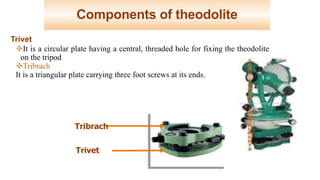
Trivet
vIt is a circular plate having a central, threaded hole for fixing the theodolite
on the tripod
vTribrach
It is a triangular plate carrying three foot screws at its ends.
10
Trivet
Tribrach
Components of theodolite
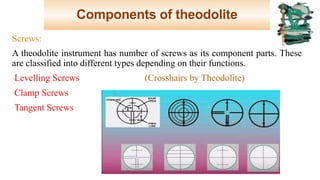
Screws:
A theodolite instrument has number of screws as its component parts. These
are classified into different types depending on their functions.
Levelling Screws (Crosshairs by Theodolite)
Clamp Screws
Tangent Screws
11
Components of theodolite
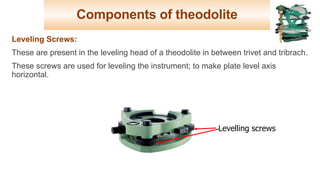
Leveling Screws:
These are present in the leveling head of a theodolite in between trivet and tribrach.
These screws are used for leveling the instrument; to make plate level axis
horizontal.
12
Levelling screws
13
14
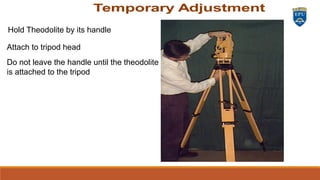
Hold Theodolite by its handle
Attach to tripod head
Do not leave the handle until the theodolite
is attached to the tripod
Temporary Adjustment
At each station point, before taking any observation, it is required to carry out some
operations in sequence. The set of operations those are required to be done on an
instrument in order to make it ready for taking observation is known as temporary
adjustment.
Temporary adjustment of a Vernier theodolite consists of following operations:
Ø Setting out,
Ø Centring,
Ø Levelling
Ø Focussing.
16
Temporary Adjustment
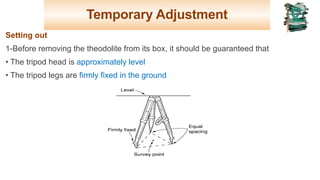
Setting out
1-Before removing the theodolite from its box, it should be guaranteed that
• The tripod head is approximately level
• The tripod legs are firmly fixed in the ground
17
Temporary Adjustment
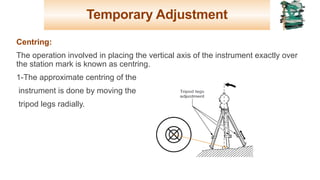
Centring:
The operation involved in placing the vertical axis of the instrument exactly over
the station mark is known as centring.
1-The approximate centring of the
instrument is done by moving the
tripod legs radially.
18
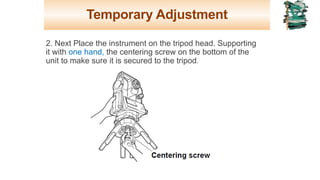
Temporary Adjustment
2. Next Place the instrument on the tripod head. Supporting
it with one hand, the centering screw on the bottom of the
unit to make sure it is secured to the tripod.
19
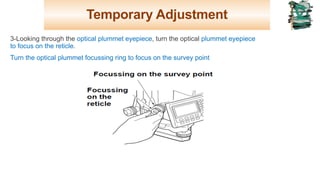
Temporary Adjustment
3-Looking through the optical plummet eyepiece, turn the optical plummet eyepiece
to focus on the reticle.
Turn the optical plummet focussing ring to focus on the survey point
20
Temporary Adjustment
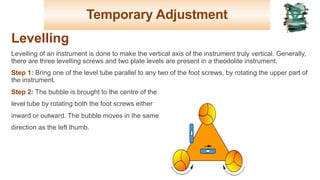
Levelling
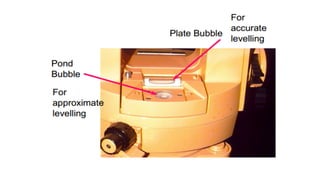
Levelling of an instrument is done to make the vertical axis of the instrument truly vertical. Generally,
there are three levelling screws and two plate levels are present in a theodolite instrument.
Step 1: Bring one of the level tube parallel to any two of the foot screws, by rotating the upper part of
the instrument.
Step 2: The bubble is brought to the centre of the
level tube by rotating both the foot screws either
inward or outward. The bubble moves in the same
direction as the left thumb.
21
Temporary Adjustment
Step 3: The bubble of the other level tube is then brought to the centre of the level
tube by rotating the third foot screw either inward or outward. [In step 1 itself, the
other plate level will be parallel to the line joining the third foot screw and the centre
of the line joining the previous two foot screws.]
Step 4: Repeat Step 2 and step 3
in the same quadrant till both the
bubble remain central.
22
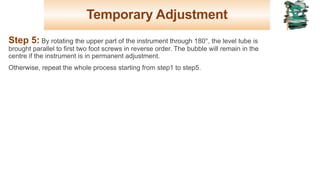
Temporary Adjustment
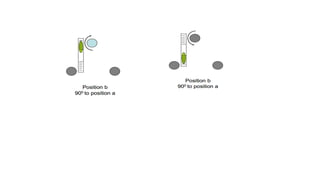
Step 5: By rotating the upper part of the instrument through 180°, the level tube is
brought parallel to first two foot screws in reverse order. The bubble will remain in the
centre if the instrument is in permanent adjustment.
Otherwise, repeat the whole process starting from step1 to step5.
23
24
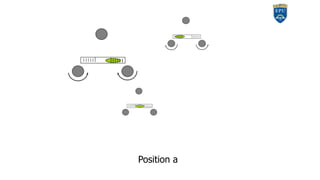
Position a
25
26
Temporary Adjustment
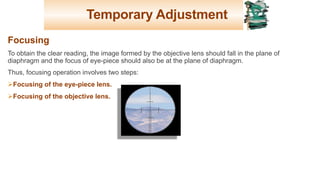
Focusing
To obtain the clear reading, the image formed by the objective lens should fall in the plane of
diaphragm and the focus of eye-piece should also be at the plane of diaphragm.
Thus, focusing operation involves two steps:
ØFocusing of the eye-piece lens.
ØFocusing of the objective lens.
27
2 - Permanent Adjustments
These are to be tested after a long interval or at the beginning of an important
project. The field party is only expected to carry out the test and adjustment, if
required will be done by the trained for this purpose in a workshop.
Permanent Adjustments for a theodolite .
First adjustment: - to make the axis of the plate levels perpendicular to the vertical
axis
Second adjustment: - to make the line collimation agree with the optical axis of the
telescope
Adjustment of Horizontal Hair:-
Adjustment of Vertical Hair:-
28
Permanent Adjustments
Third adjustment:-
To make the horizontal axis perpendicular to the vertical axis
Forth adjustment:-
To make the bubble – tube axis of the telescope parallel to the line of collimation ,
to test this adjustment , the two – peg test
29
Definitions
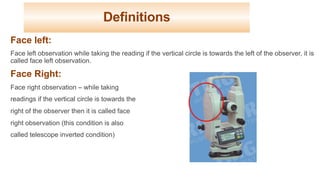
Face left:
Face left observation while taking the reading if the vertical circle is towards the left of the observer, it is
called face left observation.
Face Right:
Face right observation – while taking
readings if the vertical circle is towards the
right of the observer then it is called face
right observation (this condition is also
called telescope inverted condition)
30
Sources of errors
1- Personal errors
2- Instrumental errors
3- Natural of errors
1- Personal errors :
Errors which result from the possibility of the observer the same for every observer the
potential of audio-visual and sensory and non-perfect in these senses cause this type of
errors
31
2- Instrumental errors: The errors resulting from devices used in the monitoring result of
not making devices and measuring instruments up to the degree of perfection.
3-Natural of errors:
The errors that a rise as a result of continuing changes in the factors of
1-wind
2- air temperature
3- pressure.
32

Introduction About Theodolite Instrument Theoretical part

  • 1.
    Plane and AppliedSurveying -2 Theodolite Theoretical part -1 1 Prepared by Asst. Prof. Salar K. Hussein Asst. Lecturer Mr. Kamal Yaseen Technical Engineering College Civil Engineering Department
  • 2.
    Overview v Introduction AboutTheodolite Instrument v Theodolite and its classification v Parts of Theodolite v Theodolite Axis and conditions v Setting up the Theodolite v Levelling & Centring - the Theodolite v Readings in the Theodolite v Theodolite – Instrument Checks v Sources of errors 2
  • 3.
    Introduction About TheodoliteInstrument theodolite is a precise Surveying instrument used for measuring angles both (horizontally and vertically). Theodolite can rotate along their horizontal axis as well as their vertical axis. . Theodolites can also be used to mark out straight and curved lines in the field. Determining the difference in elevation, setting out curves… etc. 3
  • 4.
    The following arethe different purposes for which the theodolite can be used: 1- Measuring horizontal angles. 2- Measuring Vertical angles. 3- Measuring deflection angles. 4- Measuring magnetic bearing. 5- Measuring the horizontal distance between two points. 6- Finding the vertical height of an object. 7- Finding the difference in elevation between various points. 8- Ranging a line. 4
  • 5.
    Parts of aTheodolite 1 - Tripod It should be of a rigid type capable of fixing the position of the instrument with a small lateral movement on its top when required. 2 - Foot screws These are provided for leveling the instruments. 3 - Plate level Provided for checking the level of the instrument. 4 - Horizontal clamp Provided to clamp the movement in horizontal plane. 5 - Vertical clamp For clamping movement in vertical plane. 5
  • 6.
    6 - Telescope Ina telescope vertical hair is used for horizontal angle measurement while horizontal hair is used for vertical angle measurement. Focusing arrangement for the object glass is usually provided in the body of the telescope. Collimator is provided to bring the object in the field of view. 7 - Vertical axis It is the axis around which the telescope rotates in horizontal plane. 8 - Horizontal axis It is the axis around which telescope rotates in vertical plane. 9 - Angle reading arrangement In screen display you can note angle measurements taken with Theodolite 6
  • 7.
    10 - Opticalplummet It is provided for centering the instrument over a ground station. 7 Optical plummet
  • 8.
  • 9.
    Theodolite Axis 1- V-Vaxis (Vertical axis or Rotation axis). 2- L-L axis (Plate Bubble axis). 3- Z-Z axis (Line of Sight axis). 4- H-H axis (Transit axis). 5- P.V.C. (Plan of Vertical Circle). 6- P.H.C. (Plan of Horizontal Circle). 9
  • 10.
    Components of theodolite Trivet vItis a circular plate having a central, threaded hole for fixing the theodolite on the tripod vTribrach It is a triangular plate carrying three foot screws at its ends. 10 Trivet Tribrach
  • 11.
    Components of theodolite Screws: Atheodolite instrument has number of screws as its component parts. These are classified into different types depending on their functions. Levelling Screws (Crosshairs by Theodolite) Clamp Screws Tangent Screws 11
  • 12.
    Components of theodolite LevelingScrews: These are present in the leveling head of a theodolite in between trivet and tribrach. These screws are used for leveling the instrument; to make plate level axis horizontal. 12 Levelling screws
  • 13.
  • 14.
  • 15.
    Hold Theodolite byits handle Attach to tripod head Do not leave the handle until the theodolite is attached to the tripod
  • 16.
    Temporary Adjustment Temporary Adjustment Ateach station point, before taking any observation, it is required to carry out some operations in sequence. The set of operations those are required to be done on an instrument in order to make it ready for taking observation is known as temporary adjustment. Temporary adjustment of a Vernier theodolite consists of following operations: Ø Setting out, Ø Centring, Ø Levelling Ø Focussing. 16
  • 17.
    Temporary Adjustment Setting out 1-Beforeremoving the theodolite from its box, it should be guaranteed that • The tripod head is approximately level • The tripod legs are firmly fixed in the ground 17
  • 18.
    Temporary Adjustment Centring: The operationinvolved in placing the vertical axis of the instrument exactly over the station mark is known as centring. 1-The approximate centring of the instrument is done by moving the tripod legs radially. 18
  • 19.
    Temporary Adjustment 2. NextPlace the instrument on the tripod head. Supporting it with one hand, the centering screw on the bottom of the unit to make sure it is secured to the tripod. 19
  • 20.
    Temporary Adjustment 3-Looking throughthe optical plummet eyepiece, turn the optical plummet eyepiece to focus on the reticle. Turn the optical plummet focussing ring to focus on the survey point 20
  • 21.
    Temporary Adjustment Levelling Levelling ofan instrument is done to make the vertical axis of the instrument truly vertical. Generally, there are three levelling screws and two plate levels are present in a theodolite instrument. Step 1: Bring one of the level tube parallel to any two of the foot screws, by rotating the upper part of the instrument. Step 2: The bubble is brought to the centre of the level tube by rotating both the foot screws either inward or outward. The bubble moves in the same direction as the left thumb. 21
  • 22.
    Temporary Adjustment Step 3:The bubble of the other level tube is then brought to the centre of the level tube by rotating the third foot screw either inward or outward. [In step 1 itself, the other plate level will be parallel to the line joining the third foot screw and the centre of the line joining the previous two foot screws.] Step 4: Repeat Step 2 and step 3 in the same quadrant till both the bubble remain central. 22
  • 23.
    Temporary Adjustment Step 5:By rotating the upper part of the instrument through 180°, the level tube is brought parallel to first two foot screws in reverse order. The bubble will remain in the centre if the instrument is in permanent adjustment. Otherwise, repeat the whole process starting from step1 to step5. 23
  • 24.
  • 25.
  • 26.
  • 27.
    Temporary Adjustment Focusing To obtainthe clear reading, the image formed by the objective lens should fall in the plane of diaphragm and the focus of eye-piece should also be at the plane of diaphragm. Thus, focusing operation involves two steps: ØFocusing of the eye-piece lens. ØFocusing of the objective lens. 27
  • 28.
    2 - PermanentAdjustments These are to be tested after a long interval or at the beginning of an important project. The field party is only expected to carry out the test and adjustment, if required will be done by the trained for this purpose in a workshop. Permanent Adjustments for a theodolite . First adjustment: - to make the axis of the plate levels perpendicular to the vertical axis Second adjustment: - to make the line collimation agree with the optical axis of the telescope Adjustment of Horizontal Hair:- Adjustment of Vertical Hair:- 28
  • 29.
    Permanent Adjustments Third adjustment:- Tomake the horizontal axis perpendicular to the vertical axis Forth adjustment:- To make the bubble – tube axis of the telescope parallel to the line of collimation , to test this adjustment , the two – peg test 29
  • 30.
    Definitions Face left: Face leftobservation while taking the reading if the vertical circle is towards the left of the observer, it is called face left observation. Face Right: Face right observation – while taking readings if the vertical circle is towards the right of the observer then it is called face right observation (this condition is also called telescope inverted condition) 30
  • 31.
    Sources of errors 1-Personal errors 2- Instrumental errors 3- Natural of errors 1- Personal errors : Errors which result from the possibility of the observer the same for every observer the potential of audio-visual and sensory and non-perfect in these senses cause this type of errors 31
  • 32.
    2- Instrumental errors:The errors resulting from devices used in the monitoring result of not making devices and measuring instruments up to the degree of perfection. 3-Natural of errors: The errors that a rise as a result of continuing changes in the factors of 1-wind 2- air temperature 3- pressure. 32