http://DSign4.education
Introduction
February 2018
Analytics in Action
Introduction
©2016 L. SCHLENKER
Agenda
Introduction
Administrative Details
The Fundamentals
Case Methodology
Course Portal ;
http://DSign4.education
©2017 Business Analytics Institute
Introduction
The objective of this course is to
build the students’ knowledge of the
practice of Business Analytics in a
variety of industrial settings
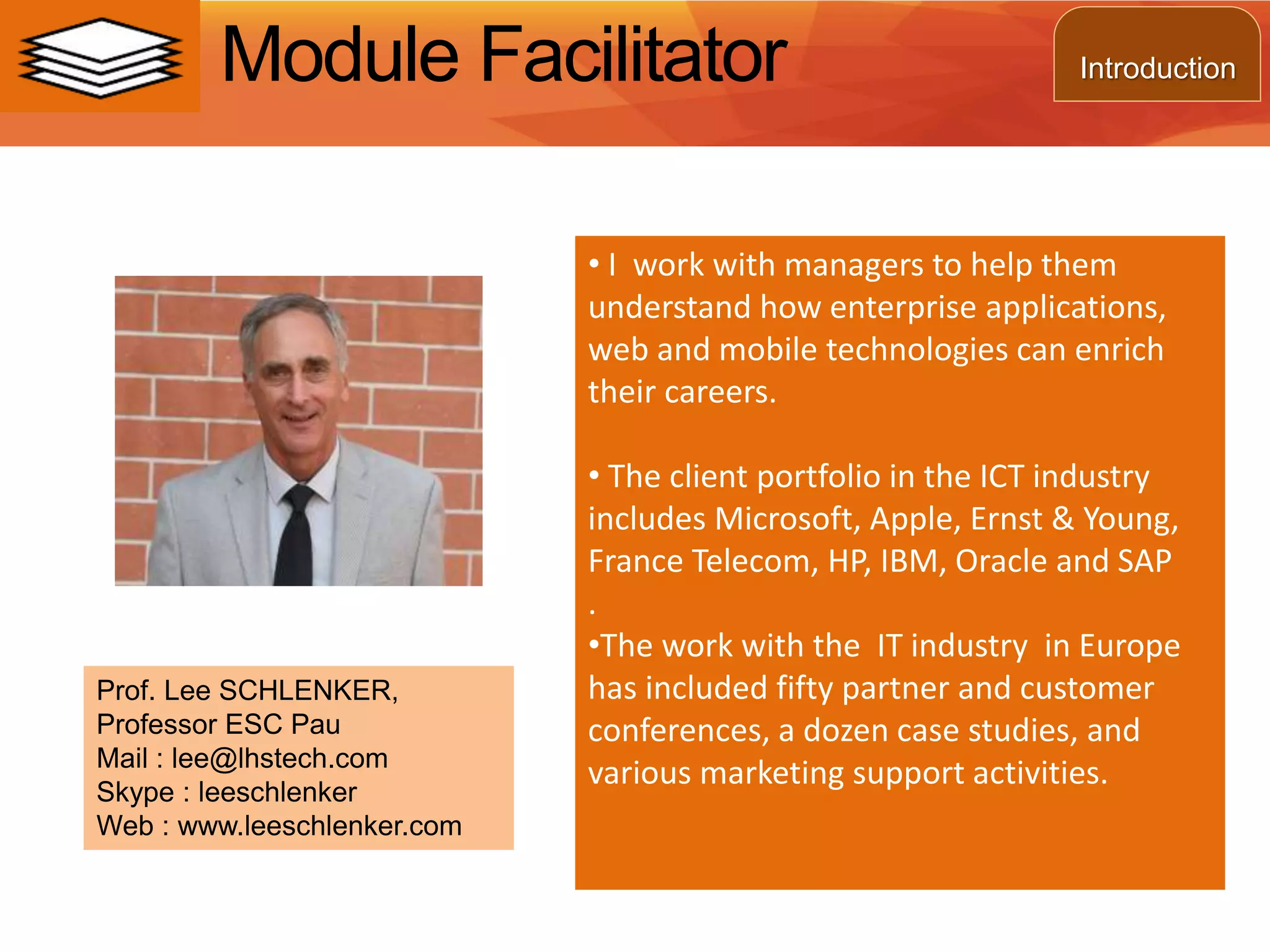
Module Facilitator
• I work with managers to help them
understand how enterprise applications,
web and mobile technologies can enrich
their careers.
• The client portfolio in the ICT industry
includes Microsoft, Apple, Ernst & Young,
France Telecom, HP, IBM, Oracle and SAP
.
•The work with the IT industry in Europe
has included fifty partner and customer
conferences, a dozen case studies, and
various marketing support activities.
Prof. Lee SCHLENKER,
Professor ESC Pau
Mail : lee@lhstech.com
Skype : leeschlenker
Web : www.leeschlenker.com
Introduction
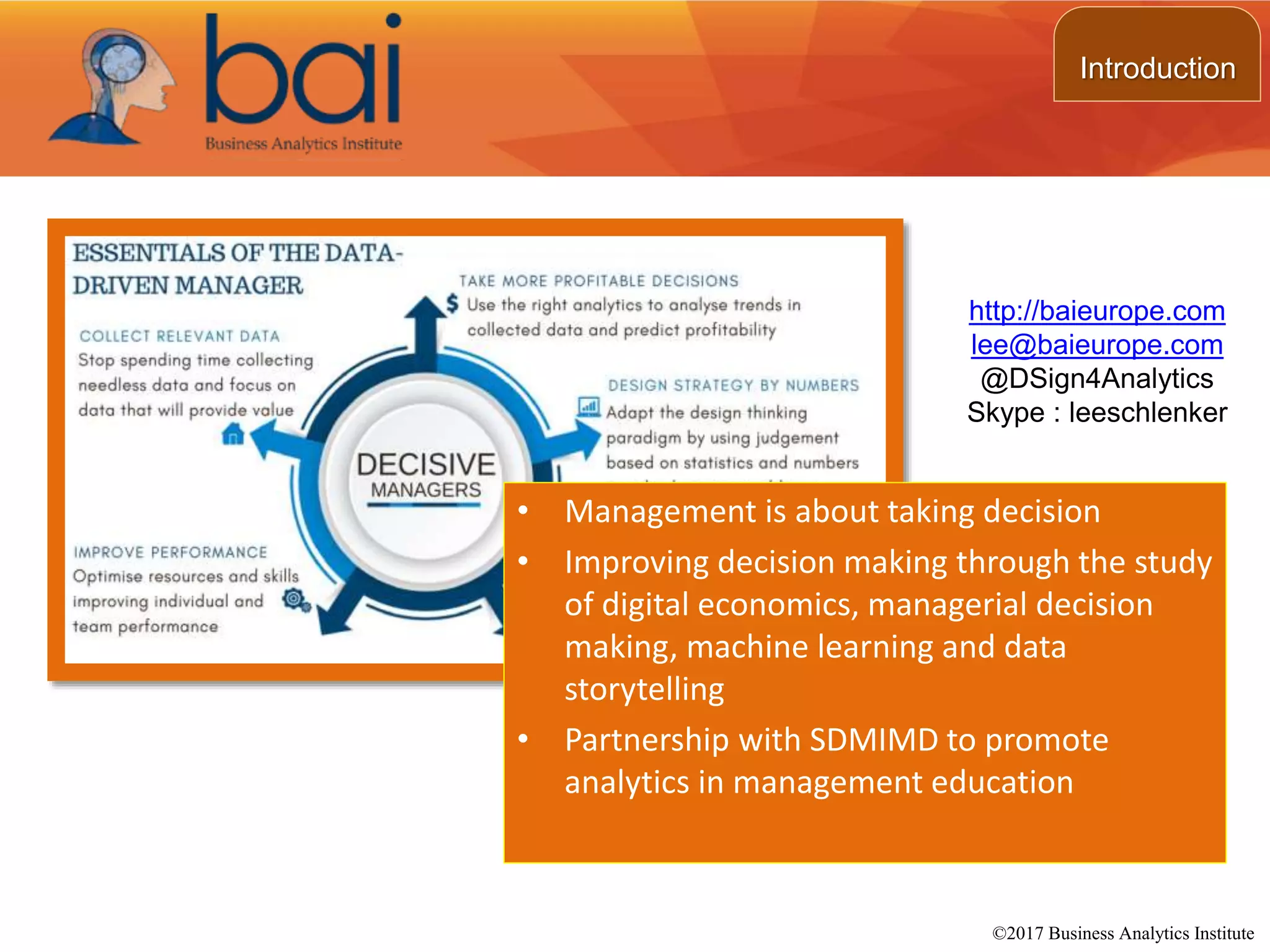
• Management is about taking decision
• Improving decision making through the study
of digital economics, managerial decision
making, machine learning and data
storytelling
• Partnership with SDMIMD to promote
analytics in management education
http://baieurope.com
lee@baieurope.com
@DSign4Analytics
Skype : leeschlenker
©2017 Business Analytics Institute
Introduction
This a place where managers and
students of management can discuss
and debate best practises in the digital
economy, new developments in data
science and decision making. Ask
questions and get practicable
answers, and learn how to use data in
decision making.
Analytics for Management
https://www.linkedin.com/
groups/13536539
Introduction
• How does the author define the “Fourth
Industrial Revolution”?*
• The concept of looking “outside-in”
suggests that we must understand the
shifting business context affects our
work, our careers and our business. Give
at least one example.
• What are digital natives and how do they
look at business differently?
• How are values changing in a digitally
intermediated world?
A Fourth Industrial Revolution ?
Introduction
Schwab, K. (2017), The Fourth Industrial
Revolution
8©2016 LHST sarl
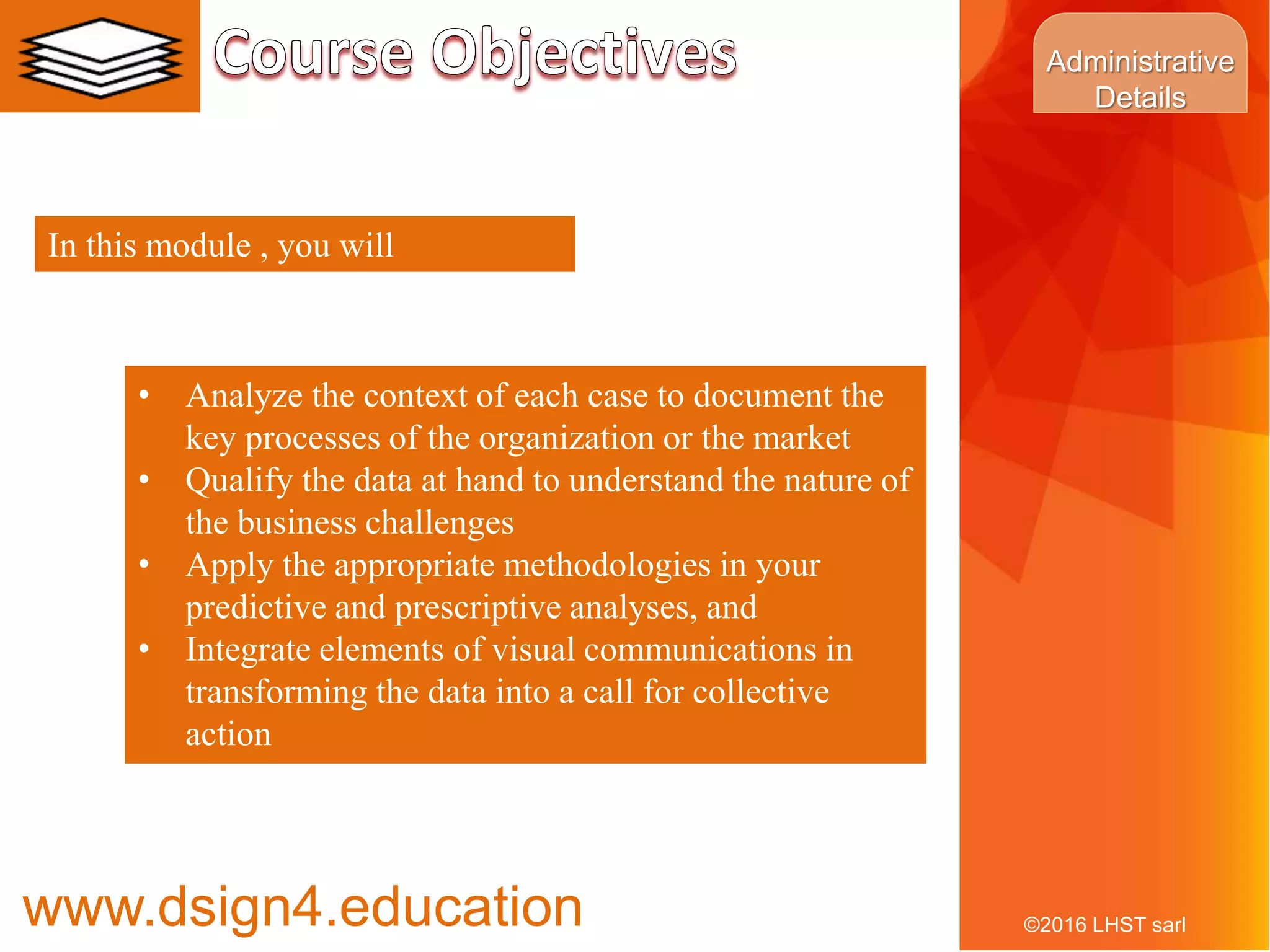
• Analyze the context of each case to document the
key processes of the organization or the market
• Qualify the data at hand to understand the nature of
the business challenges
• Apply the appropriate methodologies in your
predictive and prescriptive analyses, and
• Integrate elements of visual communications in
transforming the data into a call for collective
action
In this module , you will
www.dsign4.education
Administrative
Details
9
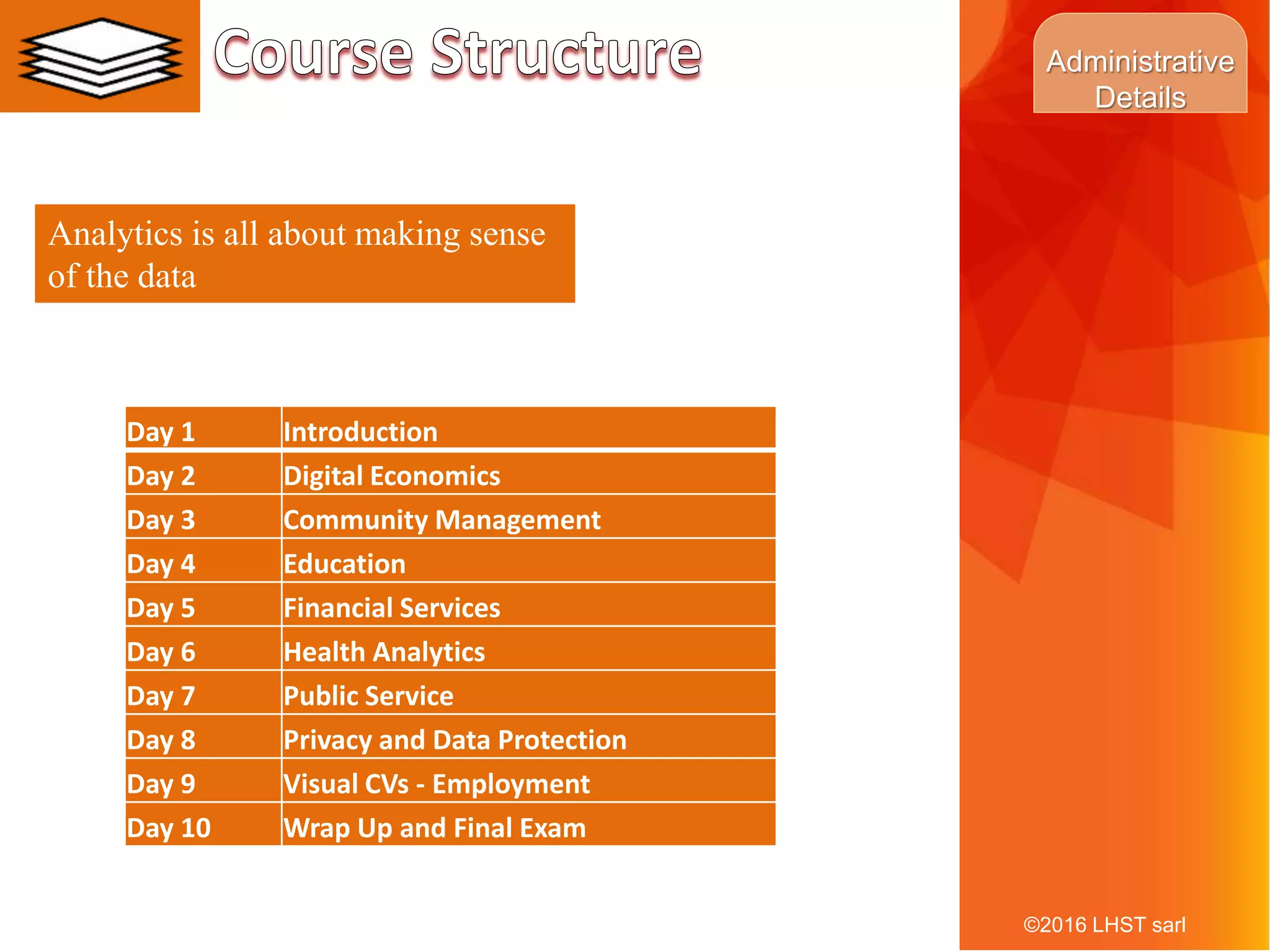
Analytics is all about making sense
of the data
©2016 LHST sarl
Day 1 Introduction
Day 2 Digital Economics
Day 3 Community Management
Day 4 Education
Day 5 Financial Services
Day 6 Health Analytics
Day 7 Public Service
Day 8 Privacy and Data Protection
Day 9 Visual CVs - Employment
Day 10 Wrap Up and Final Exam
Administrative
Details
Grading Scale
Participation: 50% of your grade will be based upon your participation and
engagement in class.
Final exam: 50% of your grade will be based upon your results on the final
multiple choice exam.
• What is the organization’s business model?
• Why does the organization focus on data?
• Which data science techniques does the organization favor
?
• What is the link between data science and decision
making?
• How is the Data Science team organized?
• How does the organization use Data Science to propel
growth?
Administrative
Details
Decision
Trees
 Supervised
 Categorical
It’s sunny, hot,
normaly humid, and
windy – should I play
tennis?
• Management is all about taking better
decisions
• What do better decisions mean (faster,
more impressive, more precise) ?
• Is it observable – how is something more
precise answer to a problem?
• The challenge is deciding what we want to
measure
Lewis Mumford, Technics and Civilization
Decision
Making
©2016 L. SCHLENKER
Analytics is the use of data, methods, analysis and
technology to help managers make better decisions.
1-13
Fundamentals
psychological models
data
mining
cognitive science
decision theory
information theory
databases
Business
Analytics
neuroscience
statistics
evolutionary
models
control theory
Data science is the study of the generalizable
extraction of knowledge from data
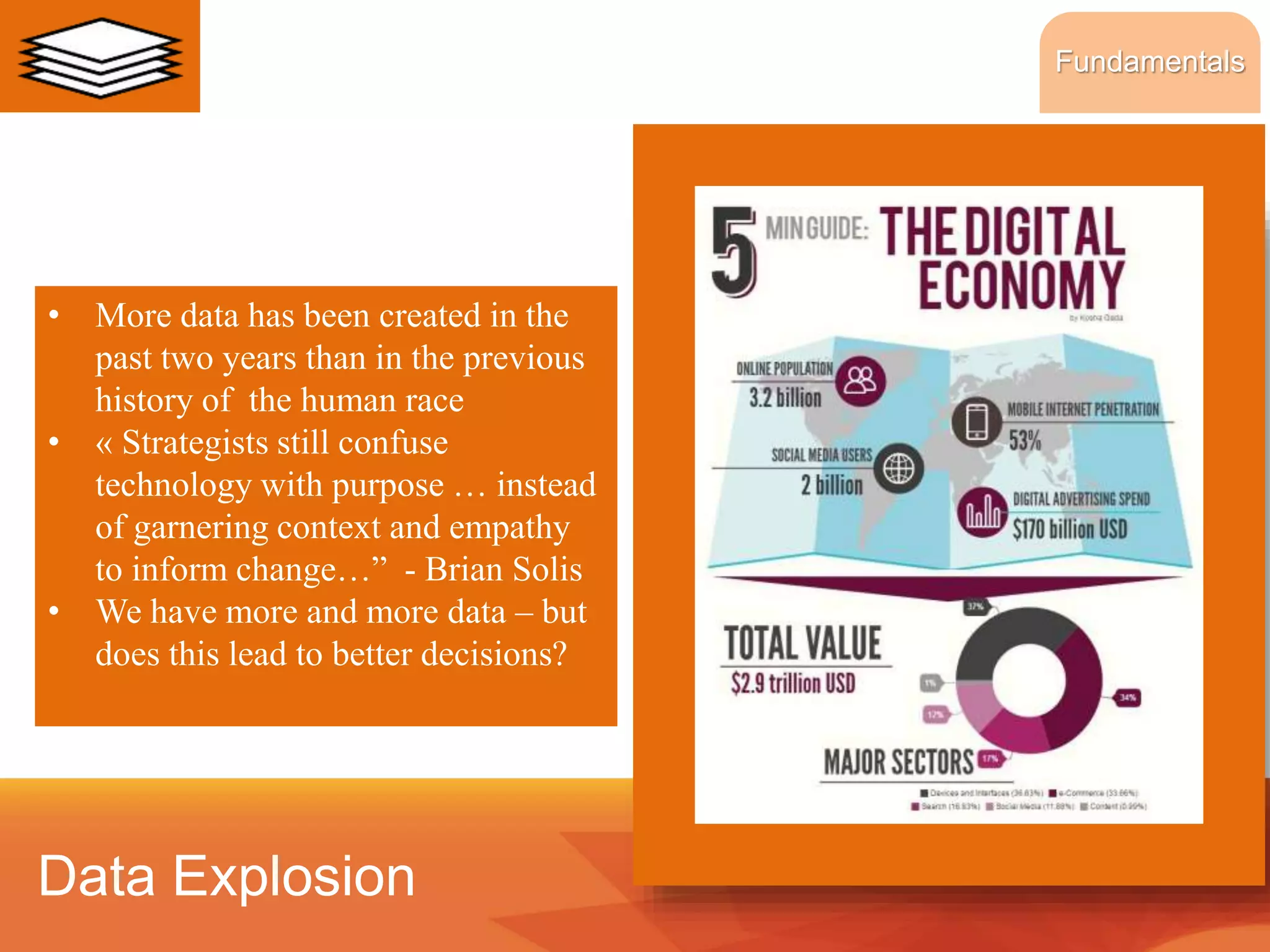
• More data has been created in the
past two years than in the previous
history of the human race
• « Strategists still confuse
technology with purpose … instead
of garnering context and empathy
to inform change…” - Brian Solis
• We have more and more data – but
does this lead to better decisions?
Data Explosion
Fundamentals
• Scan the context
• Qualify the data at hand
• Choose the right method
• Transform data into action
The Business Analytics Institute
https://baieurope.com
Fundamentals
Analytics
• Logic and Statistics
• Programming and Database
• Trade knowledge
• Data Storytelling
davidpritchard.org
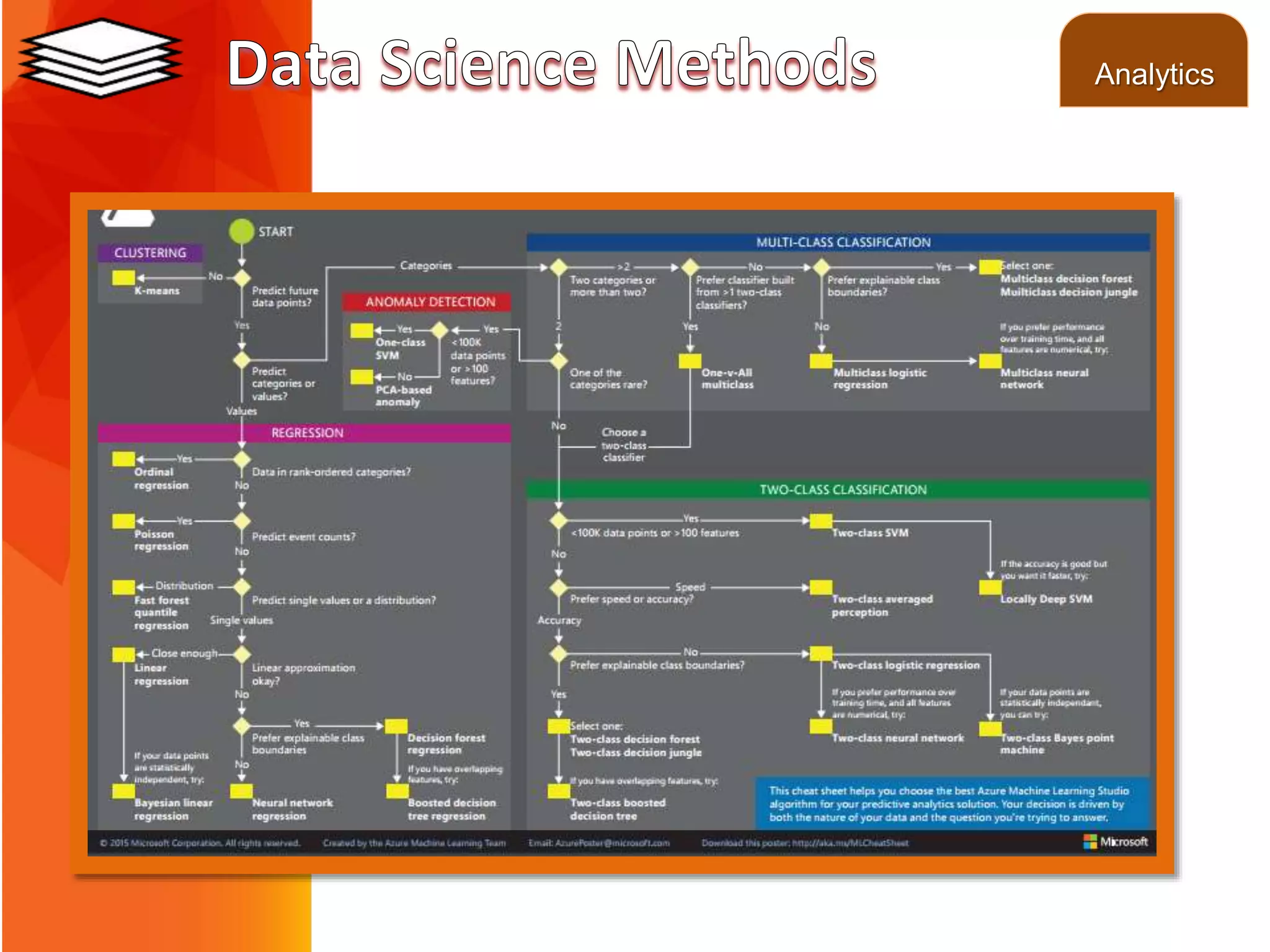
Analytics
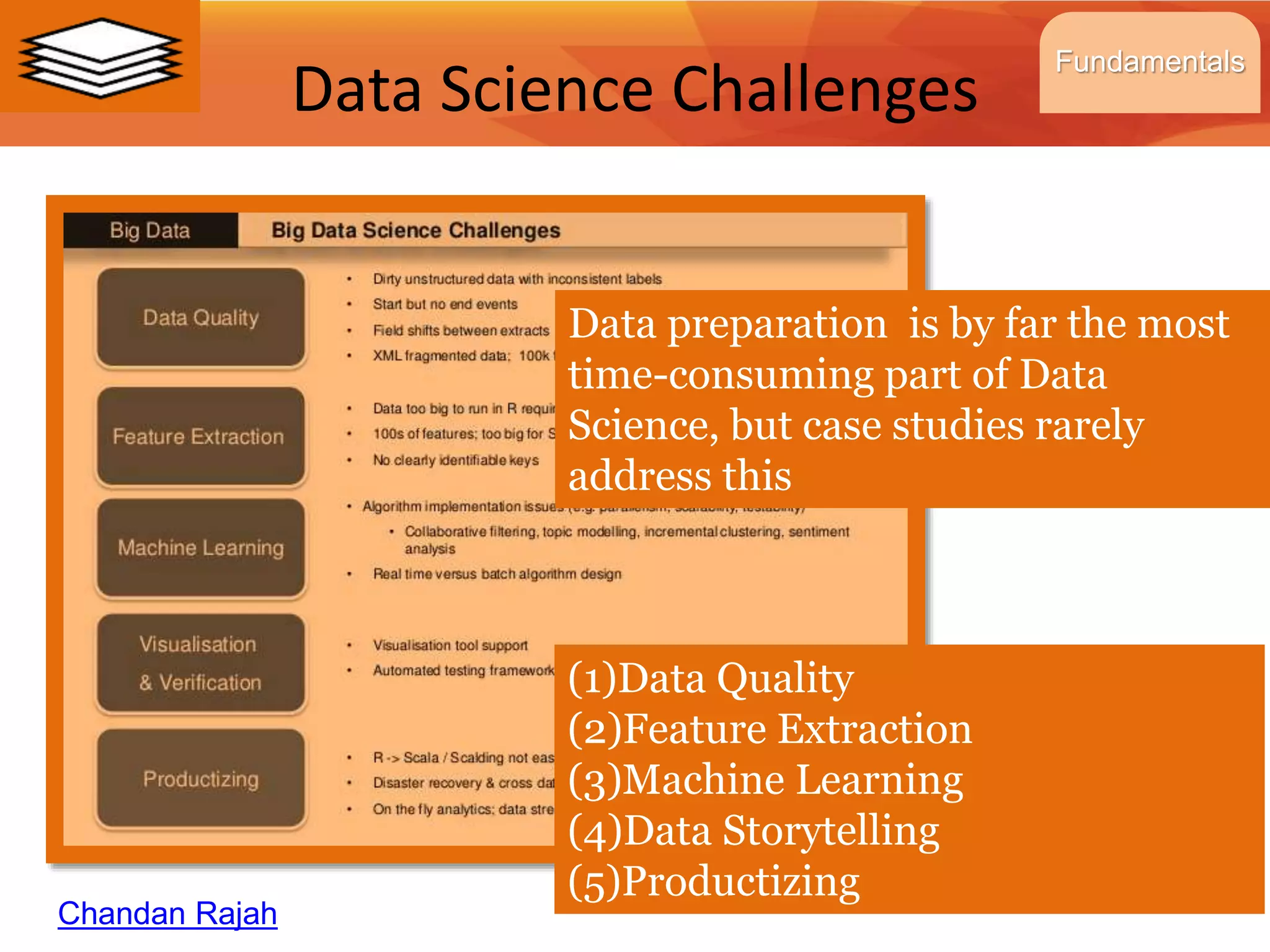
Data Science Challenges
Data preparation is by far the most
time-consuming part of Data
Science, but case studies rarely
address this
Fundamentals
(1)Data Quality
(2)Feature Extraction
(3)Machine Learning
(4)Data Storytelling
(5)Productizing
Chandan Rajah
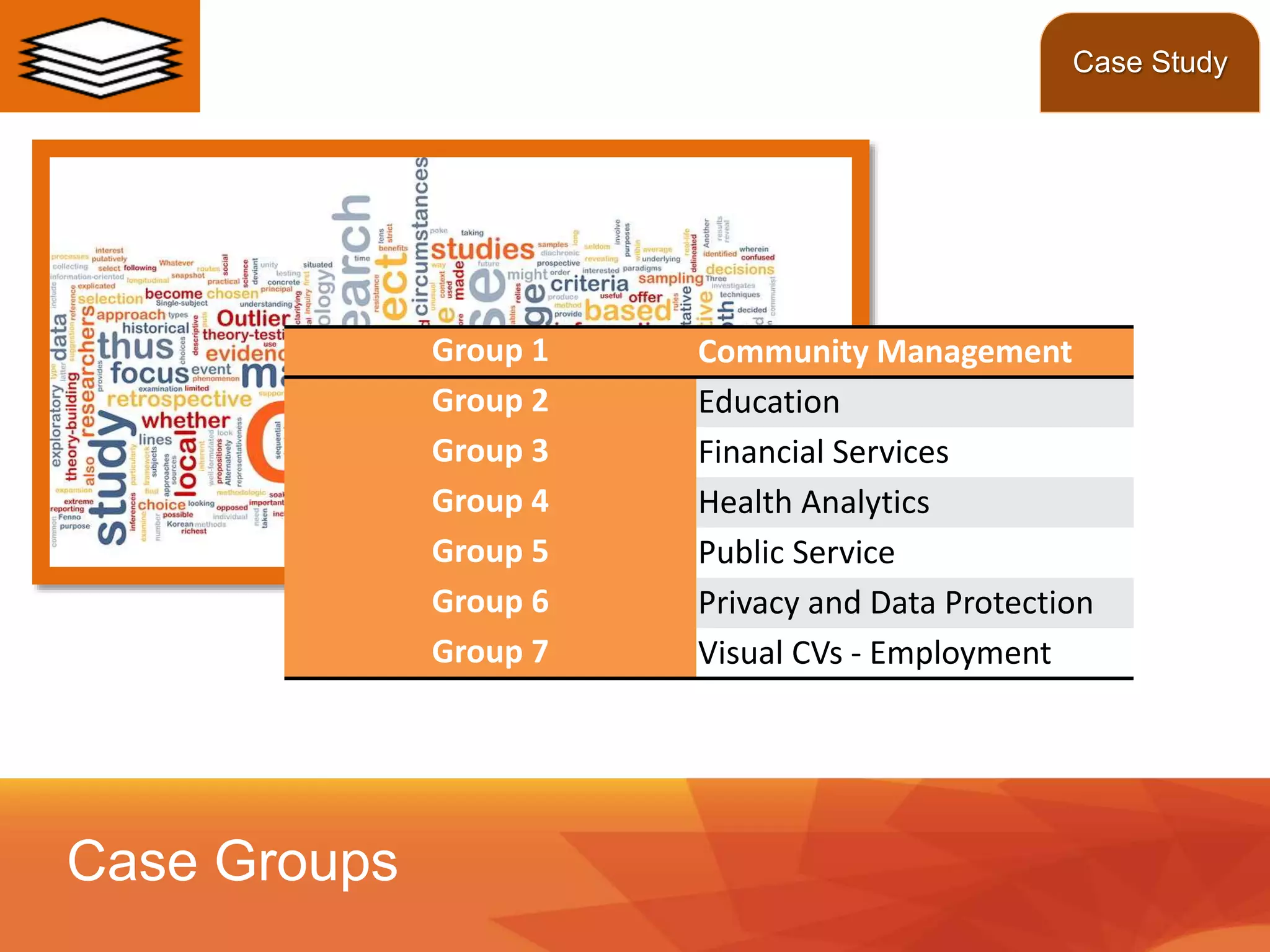
Case Groups
Case Study
Group 1 Community Management
Group 2 Education
Group 3 Financial Services
Group 4 Health Analytics
Group 5 Public Service
Group 6 Privacy and Data Protection
Group 7 Visual CVs - Employment
• What is the organization’s business
model?
• Why does the organization focus on
data?
• How is the Data Science team
organized?
• Which data science techniques does
the organization favor ?
• What is the link between data science
and decision making?
• How does the organization use Data
Science to propel growth
Case Methodology
Case Study
• Carr, N. The World Wide Cage
• Anderson L. and Wladawsky-Berger, L. The 4 Things
It Takes to Succeed in the Digital Economy
• Pine, B. and Gilmore, J. (1999). The Experience
Economy. St. Paul, Minn.: HighBridge Co.
• Schlenker L., (2017), Digital Economics
• Schwab, K. (2017), The Fourth Industrial Revolution
Bibliography
Next Steps

Introduction

  • 1.
  • 2.
  • 3.
    Course Portal ; http://DSign4.education ©2017Business Analytics Institute Introduction The objective of this course is to build the students’ knowledge of the practice of Business Analytics in a variety of industrial settings
  • 4.
    Module Facilitator • Iwork with managers to help them understand how enterprise applications, web and mobile technologies can enrich their careers. • The client portfolio in the ICT industry includes Microsoft, Apple, Ernst & Young, France Telecom, HP, IBM, Oracle and SAP . •The work with the IT industry in Europe has included fifty partner and customer conferences, a dozen case studies, and various marketing support activities. Prof. Lee SCHLENKER, Professor ESC Pau Mail : lee@lhstech.com Skype : leeschlenker Web : www.leeschlenker.com Introduction
  • 5.
    • Management isabout taking decision • Improving decision making through the study of digital economics, managerial decision making, machine learning and data storytelling • Partnership with SDMIMD to promote analytics in management education http://baieurope.com lee@baieurope.com @DSign4Analytics Skype : leeschlenker ©2017 Business Analytics Institute Introduction
  • 6.
    This a placewhere managers and students of management can discuss and debate best practises in the digital economy, new developments in data science and decision making. Ask questions and get practicable answers, and learn how to use data in decision making. Analytics for Management https://www.linkedin.com/ groups/13536539 Introduction
  • 7.
    • How doesthe author define the “Fourth Industrial Revolution”?* • The concept of looking “outside-in” suggests that we must understand the shifting business context affects our work, our careers and our business. Give at least one example. • What are digital natives and how do they look at business differently? • How are values changing in a digitally intermediated world? A Fourth Industrial Revolution ? Introduction Schwab, K. (2017), The Fourth Industrial Revolution
  • 8.
    8©2016 LHST sarl •Analyze the context of each case to document the key processes of the organization or the market • Qualify the data at hand to understand the nature of the business challenges • Apply the appropriate methodologies in your predictive and prescriptive analyses, and • Integrate elements of visual communications in transforming the data into a call for collective action In this module , you will www.dsign4.education Administrative Details
  • 9.
    9 Analytics is allabout making sense of the data ©2016 LHST sarl Day 1 Introduction Day 2 Digital Economics Day 3 Community Management Day 4 Education Day 5 Financial Services Day 6 Health Analytics Day 7 Public Service Day 8 Privacy and Data Protection Day 9 Visual CVs - Employment Day 10 Wrap Up and Final Exam Administrative Details
  • 10.
    Grading Scale Participation: 50%of your grade will be based upon your participation and engagement in class. Final exam: 50% of your grade will be based upon your results on the final multiple choice exam. • What is the organization’s business model? • Why does the organization focus on data? • Which data science techniques does the organization favor ? • What is the link between data science and decision making? • How is the Data Science team organized? • How does the organization use Data Science to propel growth? Administrative Details
  • 11.
    Decision Trees  Supervised  Categorical It’ssunny, hot, normaly humid, and windy – should I play tennis?
  • 12.
    • Management isall about taking better decisions • What do better decisions mean (faster, more impressive, more precise) ? • Is it observable – how is something more precise answer to a problem? • The challenge is deciding what we want to measure Lewis Mumford, Technics and Civilization Decision Making ©2016 L. SCHLENKER
  • 13.
    Analytics is theuse of data, methods, analysis and technology to help managers make better decisions. 1-13 Fundamentals psychological models data mining cognitive science decision theory information theory databases Business Analytics neuroscience statistics evolutionary models control theory Data science is the study of the generalizable extraction of knowledge from data
  • 14.
    • More datahas been created in the past two years than in the previous history of the human race • « Strategists still confuse technology with purpose … instead of garnering context and empathy to inform change…” - Brian Solis • We have more and more data – but does this lead to better decisions? Data Explosion Fundamentals
  • 15.
    • Scan thecontext • Qualify the data at hand • Choose the right method • Transform data into action The Business Analytics Institute https://baieurope.com Fundamentals
  • 16.
    Analytics • Logic andStatistics • Programming and Database • Trade knowledge • Data Storytelling davidpritchard.org
  • 17.
  • 18.
    Data Science Challenges Datapreparation is by far the most time-consuming part of Data Science, but case studies rarely address this Fundamentals (1)Data Quality (2)Feature Extraction (3)Machine Learning (4)Data Storytelling (5)Productizing Chandan Rajah
  • 19.
    Case Groups Case Study Group1 Community Management Group 2 Education Group 3 Financial Services Group 4 Health Analytics Group 5 Public Service Group 6 Privacy and Data Protection Group 7 Visual CVs - Employment
  • 20.
    • What isthe organization’s business model? • Why does the organization focus on data? • How is the Data Science team organized? • Which data science techniques does the organization favor ? • What is the link between data science and decision making? • How does the organization use Data Science to propel growth Case Methodology Case Study
  • 21.
    • Carr, N.The World Wide Cage • Anderson L. and Wladawsky-Berger, L. The 4 Things It Takes to Succeed in the Digital Economy • Pine, B. and Gilmore, J. (1999). The Experience Economy. St. Paul, Minn.: HighBridge Co. • Schlenker L., (2017), Digital Economics • Schwab, K. (2017), The Fourth Industrial Revolution Bibliography Next Steps