Data Analytics
The Role of Data Analytics in
Digital Business and Business
Process Management
© Copyright 2019. BPMInstitute.org. All rights reserved
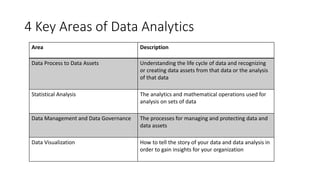
4 Key Areas of Data Analytics
Area Description
Data Process to Data Assets Understanding the life cycle of data and recognizing
or creating data assets from that data or the analysis
of that data
Statistical Analysis The analytics and mathematical operations used for
analysis on sets of data
Data Management and Data Governance The processes for managing and protecting data and
data assets
Data Visualization How to tell the story of your data and data analysis in
order to gain insights for your organization
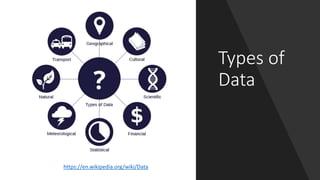
Types of
Data
https://en.wikipedia.org/wiki/Data
Data Analytics?
From Wikipedia
• Data analysis is a process of inspecting,
cleansing, transforming, and modeling
data with the goal of discovering useful
information, informing conclusions,
and supporting decision-making…. In
today's business, data analysis is
playing a role in making decisions more
scientific and helping the business
achieve effective operation.
Data Analytics in
Digital Business
• Combined with Social, Mobile, and Cloud
technologies, analytics is creating a
competitive advantage in digital business
(SMAC)
• Artificial intelligence applications
• Voice recognition
• Ecommerce
• News feeds
• Advertising customization
• Banking applications
• Big data applications
Types of Data Analytics
Descriptive: describing what happened
Diagnostic: explaining why something
happened
Predictive: anticipating the future
Prescriptive: attempting to change the future
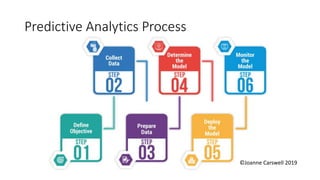
Predictive Analytics Process
©Joanne Carswell 2019
Goals for Data
Management
• Quality
• Accessibility
• Availability
• Reliability
• Performance
• Maintainability
• Timeliness
• Gain insights into business
• Better business decisions
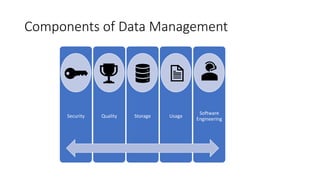
Components of Data Management
Security Quality Storage Usage
Software
Engineering
Goals for Data
Governance
• Increase compliance
• Improve security
• Maximize use of data as an asset
• Increase consistency between
data assets
• Create structure for use of data
• Create accountability for data
quality
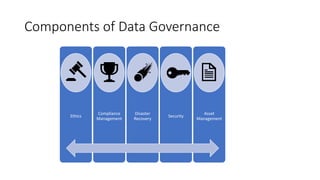
Components of Data Governance
Ethics
Compliance
Management
Disaster
Recovery
Security
Asset
Management
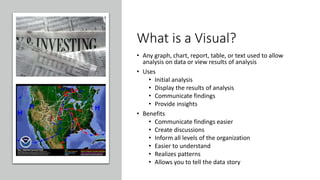
What is a Visual?
• Any graph, chart, report, table, or text used to allow
analysis on data or view results of analysis
• Uses
• Initial analysis
• Display the results of analysis
• Communicate findings
• Provide insights
• Benefits
• Communicate findings easier
• Create discussions
• Inform all levels of the organization
• Easier to understand
• Realizes patterns
• Allows you to tell the data story
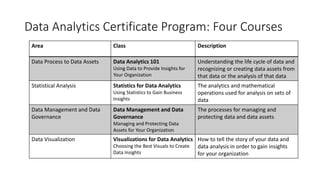
Data Analytics Certificate Program: Four Courses
Area Class Description
Data Process to Data Assets Data Analytics 101
Using Data to Provide Insights for
Your Organization
Understanding the life cycle of data and
recognizing or creating data assets from
that data or the analysis of that data
Statistical Analysis Statistics for Data Analytics
Using Statistics to Gain Business
Insights
The analytics and mathematical
operations used for analysis on sets of
data
Data Management and Data
Governance
Data Management and Data
Governance
Managing and Protecting Data
Assets for Your Organization
The processes for managing and
protecting data and data assets
Data Visualization Visualizations for Data Analytics
Choosing the Best Visuals to Create
Data Insights
How to tell the story of your data and
data analysis in order to gain insights
for your organization
More About Digital Customer Experience
Data Analytics is a program available from
BPMInstitute.org and part of a digital business
certificate program.
To learn more, please visit:
www.bpminstitute.org/learning-paths
Schedule a complimentary consultation:
www.bpminstitute.org/schedule-appointment
© Copyright 2019. BPMInstitute.org. All rights reserved
Data Analytics
Connecting Data Analytics to
Digital Business and Business
Process Management
© Copyright 2019. BPMInstitute.org. All rights reserved

Data Analytics Role in Digital Business & Business Process Management

  • 1.
    Data Analytics The Roleof Data Analytics in Digital Business and Business Process Management © Copyright 2019. BPMInstitute.org. All rights reserved
  • 2.
    4 Key Areasof Data Analytics Area Description Data Process to Data Assets Understanding the life cycle of data and recognizing or creating data assets from that data or the analysis of that data Statistical Analysis The analytics and mathematical operations used for analysis on sets of data Data Management and Data Governance The processes for managing and protecting data and data assets Data Visualization How to tell the story of your data and data analysis in order to gain insights for your organization
  • 3.
  • 4.
    Data Analytics? From Wikipedia •Data analysis is a process of inspecting, cleansing, transforming, and modeling data with the goal of discovering useful information, informing conclusions, and supporting decision-making…. In today's business, data analysis is playing a role in making decisions more scientific and helping the business achieve effective operation.
  • 5.
    Data Analytics in DigitalBusiness • Combined with Social, Mobile, and Cloud technologies, analytics is creating a competitive advantage in digital business (SMAC) • Artificial intelligence applications • Voice recognition • Ecommerce • News feeds • Advertising customization • Banking applications • Big data applications
  • 6.
    Types of DataAnalytics Descriptive: describing what happened Diagnostic: explaining why something happened Predictive: anticipating the future Prescriptive: attempting to change the future
  • 7.
  • 8.
    Goals for Data Management •Quality • Accessibility • Availability • Reliability • Performance • Maintainability • Timeliness • Gain insights into business • Better business decisions
  • 9.
    Components of DataManagement Security Quality Storage Usage Software Engineering
  • 10.
    Goals for Data Governance •Increase compliance • Improve security • Maximize use of data as an asset • Increase consistency between data assets • Create structure for use of data • Create accountability for data quality
  • 11.
    Components of DataGovernance Ethics Compliance Management Disaster Recovery Security Asset Management
  • 12.
    What is aVisual? • Any graph, chart, report, table, or text used to allow analysis on data or view results of analysis • Uses • Initial analysis • Display the results of analysis • Communicate findings • Provide insights • Benefits • Communicate findings easier • Create discussions • Inform all levels of the organization • Easier to understand • Realizes patterns • Allows you to tell the data story
  • 13.
    Data Analytics CertificateProgram: Four Courses Area Class Description Data Process to Data Assets Data Analytics 101 Using Data to Provide Insights for Your Organization Understanding the life cycle of data and recognizing or creating data assets from that data or the analysis of that data Statistical Analysis Statistics for Data Analytics Using Statistics to Gain Business Insights The analytics and mathematical operations used for analysis on sets of data Data Management and Data Governance Data Management and Data Governance Managing and Protecting Data Assets for Your Organization The processes for managing and protecting data and data assets Data Visualization Visualizations for Data Analytics Choosing the Best Visuals to Create Data Insights How to tell the story of your data and data analysis in order to gain insights for your organization
  • 14.
    More About DigitalCustomer Experience Data Analytics is a program available from BPMInstitute.org and part of a digital business certificate program. To learn more, please visit: www.bpminstitute.org/learning-paths Schedule a complimentary consultation: www.bpminstitute.org/schedule-appointment © Copyright 2019. BPMInstitute.org. All rights reserved
  • 15.
    Data Analytics Connecting DataAnalytics to Digital Business and Business Process Management © Copyright 2019. BPMInstitute.org. All rights reserved

Editor's Notes

  • #4 Discuss with class: What data fields are collected for each of these types? Write on flipchart some examples of each.
  • #8 Many of the statistical models are too complex for this class; we will start out with very basic ones that will allow you to get a foundation in the subject If time permits, spend some time on these steps; if not, discuss only modeling steps Define objective: What do you want to predict? Collect data: Find the right data for your insights needed Prepare data: What changes need to occur to the data Determine the model: Decide on the model and apply it Deploy of model: Put the model into production Monitor the model: Verifying any changes over time