SIMPLIFYING
ANALYTICS
Demystifying Analytics:Why and How?
• Instead of identifying the important data and how to
utilize it to improve business, some companies get
stuck in using the most complex of analytics to get
the perfect insights.
• Then discovering real business opportunities and
achieving desired outcomes can be elusive.
• To overcome this, companies should pursue a simpler
path to uncovering the insight in their data and
making insight-driven decisions that add value.
Accelerate Data
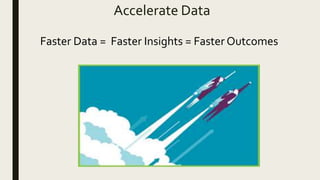
Faster Data = Faster Insights = Faster Outcomes
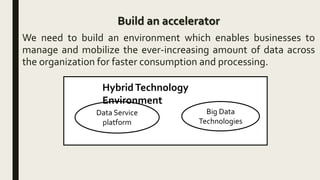
Build an accelerator
We need to build an environment which enables businesses to
manage and mobilize the ever-increasing amount of data across
the organization for faster consumption and processing.
Data Service
platform
Big Data
Technologies
HybridTechnology
Environment
Delegate and Automate
One doesn’t have to do all the work of analyzing data from
scratch. Today there are high end analytics tools available
to do the same.They can derive better insights quickly.
Let’s look at some of the tools that help us in this process.
Business Intelligence and Data
Visualization
• Business Intelligence is about enabling companies to take
informed decisions based on data and analytics, to help
them improve and optimize their decision-making and
organizational performance.
• It makes the data an asset to the company by having
important data in the right place and at the right time so
that each decision maker can use it to reach the desired
outcome.
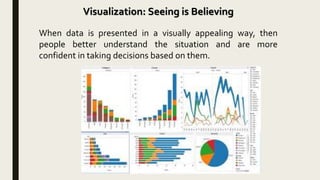
Visualization: Seeing is Believing
When data is presented in a visually appealing way, then
people better understand the situation and are more
confident in taking decisions based on them.
Data discovery
• Data discovery techniques are used to uncover hidden
patterns in the data which might not be evident at the
first glance.
• This is done in order to derive deeper insights from
the data which create more opportunities that add
business value.
Analytics Applications
• Applications can simplify advanced analytics as they
put the power of analytics easily and elegantly into
the hands of the business user to make data-driven
business decisions.
• They can also be industry-specific, flexible, and
tailored to meet the needs of the individual users
across organizations
Machine Learning and Cognitive
Computing
• Machine learning is changing the world for the better. It is a
way through which we teach computers to analyze data and
take decisions based on them.
• Given today’s near infinite computational power and
advanced learning algorithms nearly everything can be
automated.
• We need to take the help of such machine learning models in
order to take better data driven decisions.
The Path to an Insight
Whatever kinds of analytics tools and technology we
use, we have to primarily realize that the path to
deriving each insight is unique. In this context, a
company has to ask itself:
• Is it open to emerging technologies
• Is it experienced enough to handle analytics
Hypothesis based approach
Problem: From a known area of expertise
Solution: Known and Implementable
When the scenario is as above, the company could pilot
and test the known solution initially on a smaller group and
later expand it to its entire customer base.
Discovery based approach
Problem: From a known area of expertise
Solution: Unknown
For the above case, the company could take a discovery-
based approach to look for patterns in the data to find
interesting correlations that may be predictive.
Bringing it all together!!
• Do not dive into analytics, first identify what data is
important and how to use it to improve business.
• There’s no need to do all the work that can be done by
sophisticated analysis tools. Delegate the analysis.
• Visualize the data, it helps you understand better and
take insightful decisions.
• Use data discovery techniques to discover hidden
patterns in the data that create more opportunities
and add business value.
• Use machine learning models to aid in analysis and
decision making.
• Realize that the path to each insight is unique and
customize you approach based on the problem at
hand.
THANKYOU!!

Simplifying analytics

  • 1.
  • 2.
    Demystifying Analytics:Why andHow? • Instead of identifying the important data and how to utilize it to improve business, some companies get stuck in using the most complex of analytics to get the perfect insights. • Then discovering real business opportunities and achieving desired outcomes can be elusive. • To overcome this, companies should pursue a simpler path to uncovering the insight in their data and making insight-driven decisions that add value.
  • 3.
    Accelerate Data Faster Data= Faster Insights = Faster Outcomes
  • 4.
    Build an accelerator Weneed to build an environment which enables businesses to manage and mobilize the ever-increasing amount of data across the organization for faster consumption and processing. Data Service platform Big Data Technologies HybridTechnology Environment
  • 5.
    Delegate and Automate Onedoesn’t have to do all the work of analyzing data from scratch. Today there are high end analytics tools available to do the same.They can derive better insights quickly. Let’s look at some of the tools that help us in this process.
  • 6.
    Business Intelligence andData Visualization • Business Intelligence is about enabling companies to take informed decisions based on data and analytics, to help them improve and optimize their decision-making and organizational performance. • It makes the data an asset to the company by having important data in the right place and at the right time so that each decision maker can use it to reach the desired outcome.
  • 7.
    Visualization: Seeing isBelieving When data is presented in a visually appealing way, then people better understand the situation and are more confident in taking decisions based on them.
  • 8.
    Data discovery • Datadiscovery techniques are used to uncover hidden patterns in the data which might not be evident at the first glance. • This is done in order to derive deeper insights from the data which create more opportunities that add business value.
  • 9.
    Analytics Applications • Applicationscan simplify advanced analytics as they put the power of analytics easily and elegantly into the hands of the business user to make data-driven business decisions. • They can also be industry-specific, flexible, and tailored to meet the needs of the individual users across organizations
  • 10.
    Machine Learning andCognitive Computing • Machine learning is changing the world for the better. It is a way through which we teach computers to analyze data and take decisions based on them. • Given today’s near infinite computational power and advanced learning algorithms nearly everything can be automated. • We need to take the help of such machine learning models in order to take better data driven decisions.
  • 11.
    The Path toan Insight Whatever kinds of analytics tools and technology we use, we have to primarily realize that the path to deriving each insight is unique. In this context, a company has to ask itself: • Is it open to emerging technologies • Is it experienced enough to handle analytics
  • 12.
    Hypothesis based approach Problem:From a known area of expertise Solution: Known and Implementable When the scenario is as above, the company could pilot and test the known solution initially on a smaller group and later expand it to its entire customer base.
  • 13.
    Discovery based approach Problem:From a known area of expertise Solution: Unknown For the above case, the company could take a discovery- based approach to look for patterns in the data to find interesting correlations that may be predictive.
  • 14.
    Bringing it alltogether!! • Do not dive into analytics, first identify what data is important and how to use it to improve business. • There’s no need to do all the work that can be done by sophisticated analysis tools. Delegate the analysis. • Visualize the data, it helps you understand better and take insightful decisions.
  • 15.
    • Use datadiscovery techniques to discover hidden patterns in the data that create more opportunities and add business value. • Use machine learning models to aid in analysis and decision making. • Realize that the path to each insight is unique and customize you approach based on the problem at hand.
  • 16.