DEVELOPMENT OF A
DATA STRATEGY
Turning Chaos into Order: Can It Be Done?
INTRODUCTION
Martha Horler, Data & Compliance Manager at
Futureworks
A private HE provider based in Manchester with courses
in Games, Music Production, and Film. Approx. 470
students, <50 staff, 3 Schools, 9 programmes currently
recruiting
Responsible for: data returns, systems development, TEF,
statistics, enrolment, timetable production, student and
curriculum records management, data protection
QUESTION
How many of you work in a data/planning/returns team?
What other areas are represented here today?
WHAT IS A STRATEGY AND
HOW IT FITS
Strategy: A plan of action designed to achieve a long-
term or overall aim.
“Strategy is a fancy word for coming up with a long-term
plan and putting it into action.” Ellie Pidot
“A strategy is necessary because the future is
unpredictable.” Robert Waterman
“Sound strategy starts with having the right goal.” Michael
Porter
WHAT IS A STRATEGY AND
HOW IT FITS
Mission: why we exist
Values: what we believe in and how we will behave
Vision: what we want to be
Strategy: what is our game plan
Plan: How we will implement and monitor
“A vision without a strategy remains an illusion.” Lee
Bolman
WHY HAVE A DATA STRATEGY
Issues will arise in any organisation around:
-Data quality
-Metadata management
-Access and data sharing
-Ownership
-Provenance
-Maintainability and Usability
-Security and Privacy
A data strategy can help you respond consistently to these
issues
PURPOSE OF THE DATA
TEAM
“The essence of strategy is choosing what not to do.”
Michael Porter
First task: deciding what the team will do … and what it
won’t do
ACTIVITY
List 3 things your team will do with data
Then list 3 things your team will not do
Which list was easier to create?
Which list might be more useful to those outside your team?
WHAT TO DO & NOT DO
What we will do:
Build up robust data sources that can be used to produce
reliable returns, analysis and meet operational
requirements
Produce analysis tools that tutors can use to understand
the health of their programmes and status of their
students
Develop processes that automate the flow of data around
the organisation and reduce the manual entry of data
from other teams to allow them to focus on delivering
value to stakeholders
WHAT TO DO & NOT DO
What we will not do:
Set thresholds on determining student success, whether
that is grade boundaries, attendance monitoring or
classification methods
Determine how data should be used to support students,
this is best done by tutors and student-facing staff
Set data retention policies, as this needs to be
determined by operational requirements, and approved
by the Board of Governors
GATHERING INFORMATION
What data do you collect and store?
How is this data currently used?
How could it be used?
What external data requirements do you have?
What changes to the sector will impact on your data
processes?
What data policies do you already have? Are they up to
date and used often? If not, why not?
Who is owns the data? Who is responsible for its
maintenance
What IT/data capability do you have in the organisation? 1/2
USEFUL TOOLS
SWOT analysis
PEST/PESTLE analysis
The Five Forces
Four Corners
Critical Success Factors
Scenario Planning
Value Chain analysis
QUESTIONS FOR SENIOR
MANAGEMENT
What questions would you ask if access to data wasn’t an
issue?
What don’t we know about our students that would be
useful?
What don’t we know about our staff what would be
useful?
How do you want the organisation to change over the
next 5 years?
TYPE OF DATA STRATEGY
How are your other strategies and policies produced?
What approval process does it need to go through?
How often do you want to refresh the strategy?
Do you use agile techniques in your institution?
Who can help you create it?
What other departments need to input into it?
ACTIVITY
What other teams will you need to consult with on your data strategy?
How quickly can you get institutional approval for the strategy? Will
this impact how often you refresh it?
Discuss
DATA STRATEGY
DEVELOPMENT
At Futureworks I needed approval from the Management
Committee, and then the Board of Governors.
Initial approval can be gained within a month, final
approval takes longer.
Changes can’t be made any more often than twice a year
Not an agile approach, but suitable for the size of
institution and the resource available for changes to be
implemented.
DATA STRATEGY OBJECTIVE
What is the objective of your data strategy?
Should be a simple statement that sums up how you want
the team to act in the medium to long-term.
For us:
“To build up the data capability of the organisation so
that relevant and timely use can be made of internal and
external data sources, to support decision making, and
ensure the sustainability of the organisation.”
DATA STRATEGY
DEVELOPMENT
Link with the organisational mission
How does your data capture and use support this?
Are you doing anything that doesn’t support the mission?
Pick out sections from the mission that you believe can
be supported by the data strategy
What benefits does your data bring to the organisation?
What benefits could it bring?
LINKING TO INSTITUTIONAL
MISSION
Two examples:
“Academic staff will be given the skills, tools, and
capacity to deliver a personalised learning experience for
all our students
 This will be supported by the use of dashboards and analysis to
allow tutors to see how their programmes and students are
performing. ”
“We will regularly review administration processes,
business systems and our technological infrastructure –
new systems and infrastructure will be required to meet
our data needs
 This strategy will guide how this should be developed and how data
will be stored to ensure it meets our future needs. ”
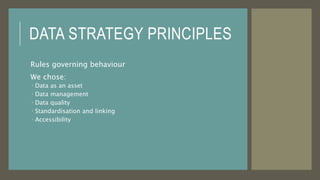
DATA STRATEGY PRINCIPLES
Rules governing behaviour
We chose:
 Data as an asset
 Data management
 Data quality
 Standardisation and linking
 Accessibility
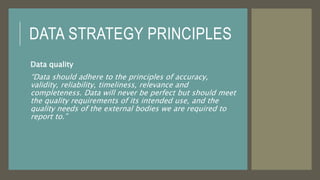
DATA STRATEGY PRINCIPLES
Data quality
“Data should adhere to the principles of accuracy,
validity, reliability, timeliness, relevance and
completeness. Data will never be perfect but should meet
the quality requirements of its intended use, and the
quality needs of the external bodies we are required to
report to.”
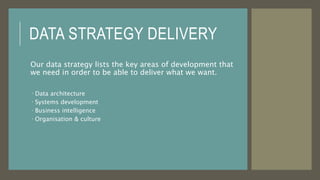
DATA STRATEGY DELIVERY
Our data strategy lists the key areas of development that
we need in order to be able to deliver what we want.
 Data architecture
 Systems development
 Business intelligence
 Organisation & culture
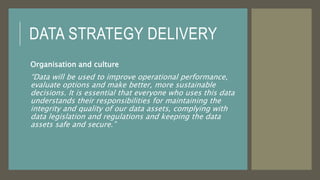
DATA STRATEGY DELIVERY
Organisation and culture
“Data will be used to improve operational performance,
evaluate options and make better, more sustainable
decisions. It is essential that everyone who uses this data
understands their responsibilities for maintaining the
integrity and quality of our data assets, complying with
data legislation and regulations and keeping the data
assets safe and secure.”
DATA STRATEGY LENGTH
How long does your data strategy need to be?
- Who is going to read it?
- How do you want it to be used?
- How well are data concepts known in the organisation?
- If it’s too long, will people disengage from what you are
saying?
Long enough to understand, short enough to remember
ACTIVITY
How long do policies in your organisation tend to be?
How many of them do people remember?
How much training is required to get people doing things as you want
them to?
How long would you make your data strategy?
DATA STRATEGY LENGTH
Our data strategy is currently:
3 pages + 1 header page
LESSONS LEARNT
Not everyone will think it is a worthwhile task – you may
need to spend time explaining the benefits
You will never ‘finish’ your data strategy, it should be an
ever evolving document, not something you write and
then archive
Make it accessible to everyone, and reference it any way
you can
Keep it short enough that people will remember it

Developing a Data Strategy

  • 1.
    DEVELOPMENT OF A DATASTRATEGY Turning Chaos into Order: Can It Be Done?
  • 2.
    INTRODUCTION Martha Horler, Data& Compliance Manager at Futureworks A private HE provider based in Manchester with courses in Games, Music Production, and Film. Approx. 470 students, <50 staff, 3 Schools, 9 programmes currently recruiting Responsible for: data returns, systems development, TEF, statistics, enrolment, timetable production, student and curriculum records management, data protection
  • 3.
    QUESTION How many ofyou work in a data/planning/returns team? What other areas are represented here today?
  • 4.
    WHAT IS ASTRATEGY AND HOW IT FITS Strategy: A plan of action designed to achieve a long- term or overall aim. “Strategy is a fancy word for coming up with a long-term plan and putting it into action.” Ellie Pidot “A strategy is necessary because the future is unpredictable.” Robert Waterman “Sound strategy starts with having the right goal.” Michael Porter
  • 5.
    WHAT IS ASTRATEGY AND HOW IT FITS Mission: why we exist Values: what we believe in and how we will behave Vision: what we want to be Strategy: what is our game plan Plan: How we will implement and monitor “A vision without a strategy remains an illusion.” Lee Bolman
  • 6.
    WHY HAVE ADATA STRATEGY Issues will arise in any organisation around: -Data quality -Metadata management -Access and data sharing -Ownership -Provenance -Maintainability and Usability -Security and Privacy A data strategy can help you respond consistently to these issues
  • 7.
    PURPOSE OF THEDATA TEAM “The essence of strategy is choosing what not to do.” Michael Porter First task: deciding what the team will do … and what it won’t do
  • 8.
    ACTIVITY List 3 thingsyour team will do with data Then list 3 things your team will not do Which list was easier to create? Which list might be more useful to those outside your team?
  • 9.
    WHAT TO DO& NOT DO What we will do: Build up robust data sources that can be used to produce reliable returns, analysis and meet operational requirements Produce analysis tools that tutors can use to understand the health of their programmes and status of their students Develop processes that automate the flow of data around the organisation and reduce the manual entry of data from other teams to allow them to focus on delivering value to stakeholders
  • 10.
    WHAT TO DO& NOT DO What we will not do: Set thresholds on determining student success, whether that is grade boundaries, attendance monitoring or classification methods Determine how data should be used to support students, this is best done by tutors and student-facing staff Set data retention policies, as this needs to be determined by operational requirements, and approved by the Board of Governors
  • 11.
    GATHERING INFORMATION What datado you collect and store? How is this data currently used? How could it be used? What external data requirements do you have? What changes to the sector will impact on your data processes? What data policies do you already have? Are they up to date and used often? If not, why not? Who is owns the data? Who is responsible for its maintenance What IT/data capability do you have in the organisation? 1/2
  • 12.
    USEFUL TOOLS SWOT analysis PEST/PESTLEanalysis The Five Forces Four Corners Critical Success Factors Scenario Planning Value Chain analysis
  • 13.
    QUESTIONS FOR SENIOR MANAGEMENT Whatquestions would you ask if access to data wasn’t an issue? What don’t we know about our students that would be useful? What don’t we know about our staff what would be useful? How do you want the organisation to change over the next 5 years?
  • 14.
    TYPE OF DATASTRATEGY How are your other strategies and policies produced? What approval process does it need to go through? How often do you want to refresh the strategy? Do you use agile techniques in your institution? Who can help you create it? What other departments need to input into it?
  • 15.
    ACTIVITY What other teamswill you need to consult with on your data strategy? How quickly can you get institutional approval for the strategy? Will this impact how often you refresh it? Discuss
  • 16.
    DATA STRATEGY DEVELOPMENT At FutureworksI needed approval from the Management Committee, and then the Board of Governors. Initial approval can be gained within a month, final approval takes longer. Changes can’t be made any more often than twice a year Not an agile approach, but suitable for the size of institution and the resource available for changes to be implemented.
  • 17.
    DATA STRATEGY OBJECTIVE Whatis the objective of your data strategy? Should be a simple statement that sums up how you want the team to act in the medium to long-term. For us: “To build up the data capability of the organisation so that relevant and timely use can be made of internal and external data sources, to support decision making, and ensure the sustainability of the organisation.”
  • 18.
    DATA STRATEGY DEVELOPMENT Link withthe organisational mission How does your data capture and use support this? Are you doing anything that doesn’t support the mission? Pick out sections from the mission that you believe can be supported by the data strategy What benefits does your data bring to the organisation? What benefits could it bring?
  • 19.
    LINKING TO INSTITUTIONAL MISSION Twoexamples: “Academic staff will be given the skills, tools, and capacity to deliver a personalised learning experience for all our students  This will be supported by the use of dashboards and analysis to allow tutors to see how their programmes and students are performing. ” “We will regularly review administration processes, business systems and our technological infrastructure – new systems and infrastructure will be required to meet our data needs  This strategy will guide how this should be developed and how data will be stored to ensure it meets our future needs. ”
  • 20.
    DATA STRATEGY PRINCIPLES Rulesgoverning behaviour We chose:  Data as an asset  Data management  Data quality  Standardisation and linking  Accessibility
  • 21.
    DATA STRATEGY PRINCIPLES Dataquality “Data should adhere to the principles of accuracy, validity, reliability, timeliness, relevance and completeness. Data will never be perfect but should meet the quality requirements of its intended use, and the quality needs of the external bodies we are required to report to.”
  • 22.
    DATA STRATEGY DELIVERY Ourdata strategy lists the key areas of development that we need in order to be able to deliver what we want.  Data architecture  Systems development  Business intelligence  Organisation & culture
  • 23.
    DATA STRATEGY DELIVERY Organisationand culture “Data will be used to improve operational performance, evaluate options and make better, more sustainable decisions. It is essential that everyone who uses this data understands their responsibilities for maintaining the integrity and quality of our data assets, complying with data legislation and regulations and keeping the data assets safe and secure.”
  • 24.
    DATA STRATEGY LENGTH Howlong does your data strategy need to be? - Who is going to read it? - How do you want it to be used? - How well are data concepts known in the organisation? - If it’s too long, will people disengage from what you are saying? Long enough to understand, short enough to remember
  • 25.
    ACTIVITY How long dopolicies in your organisation tend to be? How many of them do people remember? How much training is required to get people doing things as you want them to? How long would you make your data strategy?
  • 26.
    DATA STRATEGY LENGTH Ourdata strategy is currently: 3 pages + 1 header page
  • 27.
    LESSONS LEARNT Not everyonewill think it is a worthwhile task – you may need to spend time explaining the benefits You will never ‘finish’ your data strategy, it should be an ever evolving document, not something you write and then archive Make it accessible to everyone, and reference it any way you can Keep it short enough that people will remember it