©2013 LHST sarl
Introduction
Managerial Perspectives
The Amaté platform
E-Stratégies
Nov 4th 2015
- Preliminary Draft -
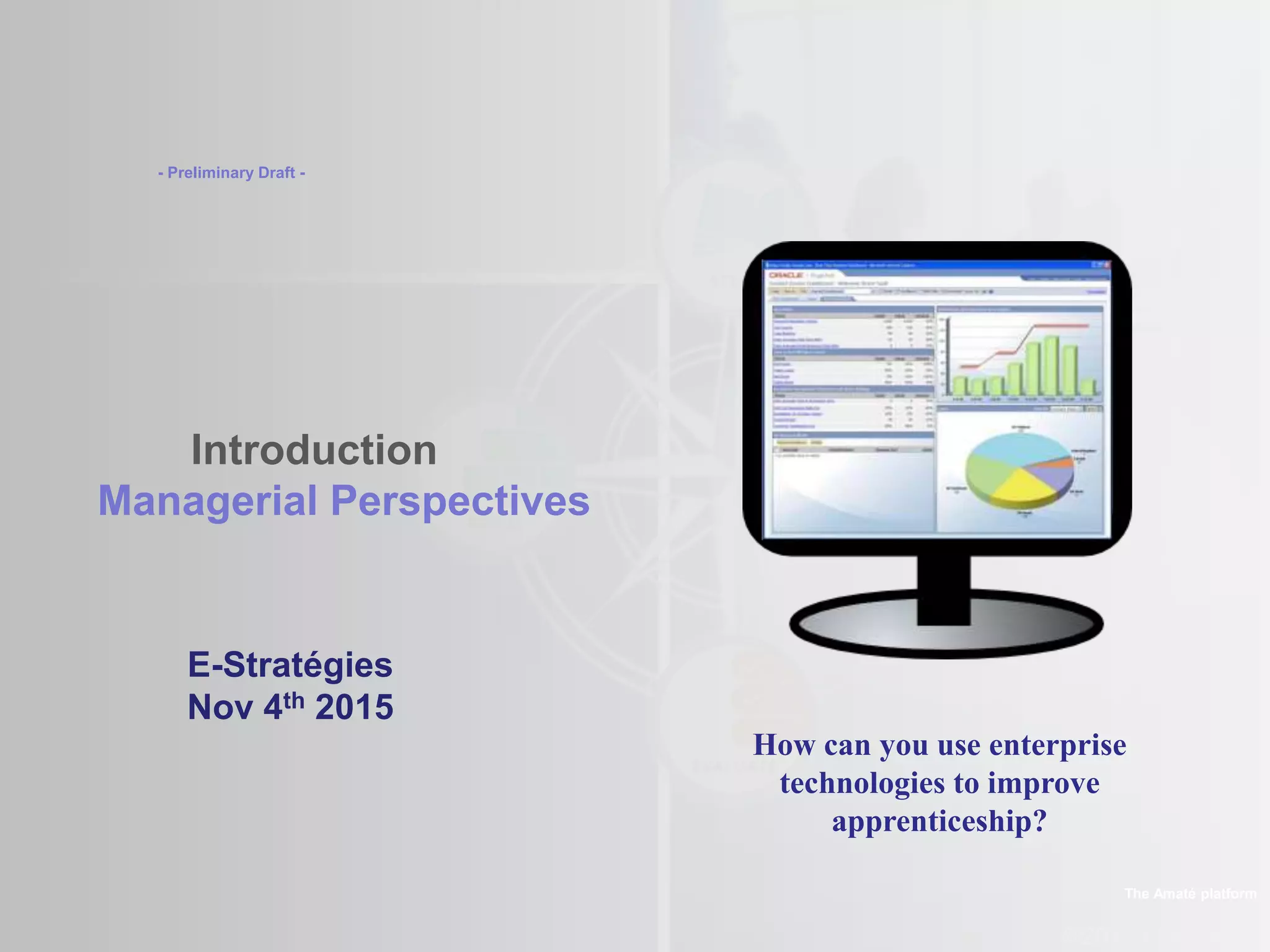
How can you use enterprise
technologies to improve
apprenticeship?
©2013 LHST sarl
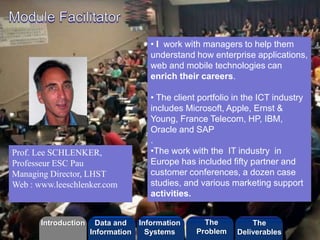
• I work with managers to help them
understand how enterprise applications,
web and mobile technologies can
enrich their careers.
• The client portfolio in the ICT industry
includes Microsoft, Apple, Ernst &
Young, France Telecom, HP, IBM,
Oracle and SAP
.
•The work with the IT industry in
Europe has included fifty partner and
customer conferences, a dozen case
studies, and various marketing support
activities.
Prof. Lee SCHLENKER,
Professeur ESC Pau
Managing Director, LHST
Web : www.leeschlenker.com
Introduction Information
Systems
The
Problem
Data and
Information
The
Deliverables
©2013 LHST sarl
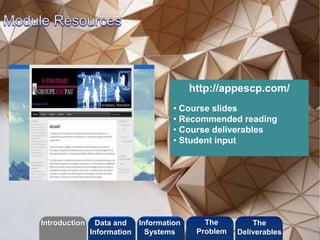
http://appescp.com/
• Course slides
• Recommended reading
• Course deliverables
• Student input
Introduction Information
Systems
The
Problem
Data and
Information
The
Deliverables
©2013 LHST sarl
•In this module, we will explore
the relationship between
business and innovation, and
analyze some of the current
applications on industry,
commerce and training.
•The aim of the present module
is to arm students with a
coherent set of concepts,
methods and metrics to identify,
nurture and evaluate business
innovation.
•. The course is structured
around four specific axes:
The context
Methods and technologies
Case studies
Evaluation Metrics
i. Introduction
ii. Process centric systems
iii. Social networks
iv. Search
v. Web services
vi. The Cloud
vii. Mobile technologies
viii. The Quantified Self
ix. Digital Transformation
Introduction Information
Systems
The
Problem
Data and
Information
The
Deliverables
©2013 LHST sarl
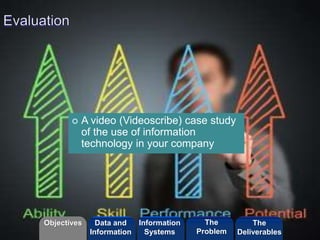
 A video (Videoscribe) case study
of the use of information
technology in your company
Objectives Information
Systems
The
Problem
Data and
Information
The
Deliverables
©2013 LHST sarl
What Morgan called « the management of meaning »
©2010 LHST sarl
• What does enterprise IT mean?
• What are you trying to improve?
• What do you need to learn?
• What does better mean?
• How do you measure success?
Focus Improve Knowledge Leverage Measure
Introduction Information
Systems
The
Problem
Data and
Information
The
Deliverables
©2013 LHST sarl©2010 LHST sarl
• Economic transformation: The transformation from a manufacturing-
based economy to a services-based economy now underway throughout
the developed world will accelerate.
• One World of Business. Political and economic dynamics are forging a
single global market, a global workforce, global customers, partners, and
suppliers.
• Always On, Always Connected. The challenges of the “always on, always
connected” world will be converting information into insights; managing time
and staying focused on high priority tasks
• The Transparent Organization. The systems that make organizations
more agile also make them more accountable.
• NetGen Meets Baby Boom. Workers who will be delivering the innovations
and productivity growth of tomorrow, this technology not only won’t come as
a surprise, it will be a positive expectation.
• Competing for Talent in a Shrinking Workforce: Because demographics
show an aging, shrinking workforce in most of the developed world over the
next 50 years, maximizing the productivity of the workers that are available
is critical.
Introduction Information
Systems
The
Problem
Data and
Information
The
Deliverables
©2013 LHST sarl
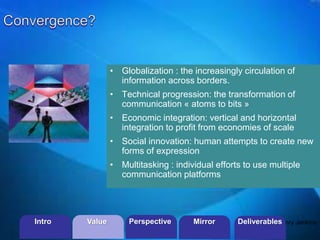
• Globalization : the increasingly circulation of
information across borders.
• Technical progression: the transformation of
communication « atoms to bits »
• Economic integration: vertical and horizontal
integration to profit from economies of scale
• Social innovation: human attempts to create new
forms of expression
• Multitasking : individual efforts to use multiple
communication platforms
Henry JenkinsIntro Perspective MirrorValue Deliverables
©2013 LHST sarl
• The assumption of order
• The assumption of rational
choice
• The assumption of intentional
capacity
• The assumption of identity
©2010 LHST sarl
Introduction Information
Systems
The
Problem
Data and
Information
The
Deliverables
©2013 LHST sarl
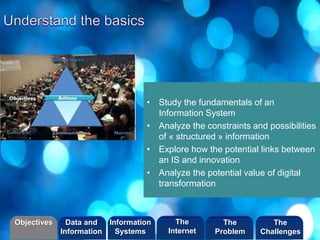
• Study the fundamentals of an
Information System
• Analyze the constraints and possibilities
of « structured » information
• Explore how the potential links between
an IS and innovation
• Analyze the potential value of digital
transformation
Objectives Information
Systems
The
Internet
Data and
Information
The
Problem
The
Challenges
©2013 LHST sarl
What is the link between data and action?
• Understanding the implications between
« structured » and « unstructured data »
• Analyzing the difference between the data and
reality
• Understanding how the data fits together
• Exploring the difference between data and
action
Introduction Information
Systems
The
Problem
Data and
Information
The
Deliverables
©2013 LHST sarl
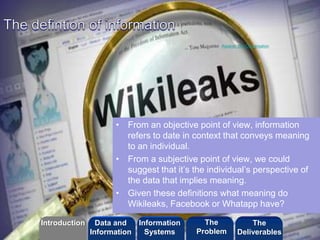
• From an objective point of view, information
refers to date in context that conveys meaning
to an individual.
• From a subjective point of view, we could
suggest that it’s the individual’s perspective of
the data that implies meaning.
• Given these definitions what meaning do
Wikileaks, Facebook or Whatapp have?
Assane, The Conversation
Introduction Information
Systems
The
Problem
Data and
Information
The
Deliverables
©2013 LHST sarl
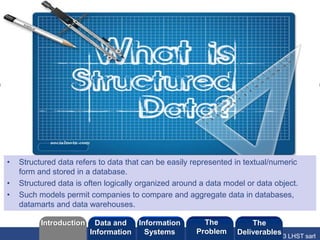
• Structured data refers to data that can be easily represented in textual/numeric
form and stored in a database.
• Structured data is often logically organized around a data model or data object.
• Such models permit companies to compare and aggregate data in databases,
datamarts and data warehouses.
Introduction Information
Systems
The
Problem
Data and
Information
The
Deliverables
©2013 LHST sarl
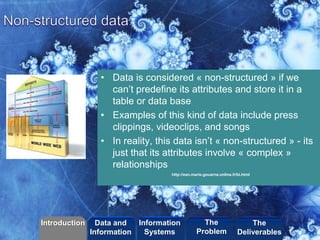
• Data is considered « non-structured » if we
can’t predefine its attributes and store it in a
table or data base
• Examples of this kind of data include press
clippings, videoclips, and songs
• In reality, this data isn’t « non-structured » - its
just that its attributes involve « complex »
relationships
http://ean.marie.gouarne.online.fr/bi.html
Introduction Information
Systems
The
Problem
Data and
Information
The
Deliverables
©2013 LHST sarl
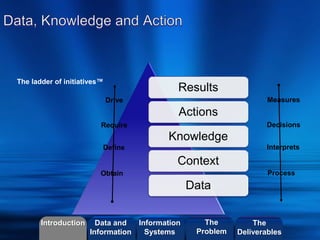
Results
Actions
Knowledge
Context
Data
Process
Interprets
Decisions
Measures
Obtain
Define
Require
Drive
The ladder of initiatives™
Introduction Information
Systems
The
Problem
Data and
Information
The
Deliverables
©2013 LHST sarl
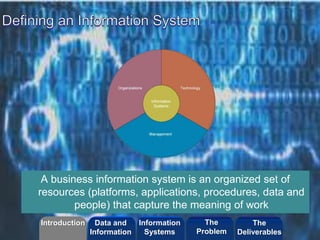
A business information system is an organized set of
resources (platforms, applications, procedures, data and
people) that capture the meaning of work
Introduction Information
Systems
The
Problem
Data and
Information
The
Deliverables
©2013 LHST sarl
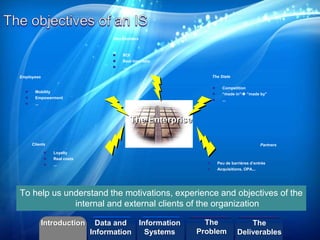
To help us understand the motivations, experience and objectives of the
internal and external clients of the organization
 ROI
 Real time data
 ...
Stockholders
 Competition
 “made in” “made by”
 ...
The State
 Peu de barrières d’entrée
 Acquisitions, OPA...
Partners
 Loyalty
 Real costs
 ...
Clients
The Enterprise
 Mobility
 Empowerment
 ...
Employees
Introduction Information
Systems
The
Problem
Data and
Information
The
Deliverables
©2013 LHST sarl
Introduction Information
Systems
The
Problem
Data and
Information
The
Deliverables
©2013 LHST sarl
©2013 L. SCHLENKER
Introduction Information
Systems
The
Problem
Data and
Information
The
Deliverables
©2013 LHST sarl
Introduction Information
Systems
The
Problem
Data and
Information
The
Deliverables
©2013 LHST sarl
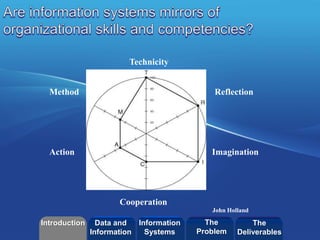
Technicity
Reflection
Imagination
Cooperation
Method
Action
John Holland
Introduction Information
Systems
The
Problem
Data and
Information
The
Deliverables
©2013 LHST sarl
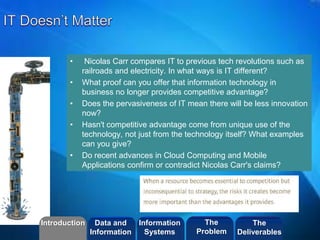
• Nicolas Carr compares IT to previous tech revolutions such as
railroads and electricity. In what ways is IT different?
• What proof can you offer that information technology in
business no longer provides competitive advantage?
• Does the pervasiveness of IT mean there will be less innovation
now?
• Hasn't competitive advantage come from unique use of the
technology, not just from the technology itself? What examples
can you give?
• Do recent advances in Cloud Computing and Mobile
Applications confirm or contradict Nicolas Carr's claims?
Introduction Information
Systems
The
Problem
Data and
Information
The
Deliverables
©2013 LHST sarl
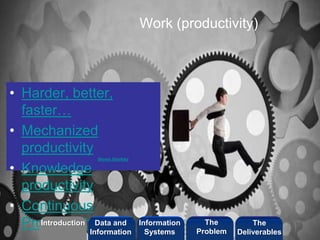
Work (productivity)
• Harder, better,
faster…
• Mechanized
productivity
• Knowledge
productivity
• Continuous
Productivity
Steven Sinofsky
Introduction Information
Systems
The
Problem
Data and
Information
The
Deliverables
©2013 LHST sarl
• Ordered domain: Known
causes and effects.
• Ordered domain: Knowable
causes and effects.
• Un-ordered domain: Complex
relationships.
Introduction Information
Systems
The
Problem
Data and
Information
The
Deliverables
©2013 LHST sarl
Digital Transformation
1. Everyone Will Have the Web
2. The Browser Will Be the Operating System
3. Business Will Live in the Cloud
4. Everything Will Be Social
5. Software Will Eat the World
Marc Andreessen
Introduction Information
Systems
The
Problem
Data and
Information
The
Deliverables
©2013 LHST sarl
Introduction Information
Systems
The
Problem
Data and
Information
The
Deliverables
http://appescp.com/ Example
©2013 LHST sarl
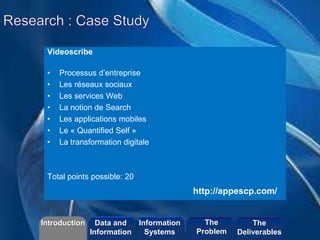
Videoscribe
• Processus d’entreprise
• Les réseaux sociaux
• Les services Web
• La notion de Search
• Les applications mobiles
• Le « Quantified Self »
• La transformation digitale
Total points possible: 20
Introduction Information
Systems
The
Problem
Data and
Information
The
Deliverables
http://appescp.com/

Introduction 2014

  • 1.
    ©2013 LHST sarl Introduction ManagerialPerspectives The Amaté platform E-Stratégies Nov 4th 2015 - Preliminary Draft - How can you use enterprise technologies to improve apprenticeship?
  • 2.
    ©2013 LHST sarl •I work with managers to help them understand how enterprise applications, web and mobile technologies can enrich their careers. • The client portfolio in the ICT industry includes Microsoft, Apple, Ernst & Young, France Telecom, HP, IBM, Oracle and SAP . •The work with the IT industry in Europe has included fifty partner and customer conferences, a dozen case studies, and various marketing support activities. Prof. Lee SCHLENKER, Professeur ESC Pau Managing Director, LHST Web : www.leeschlenker.com Introduction Information Systems The Problem Data and Information The Deliverables
  • 3.
    ©2013 LHST sarl http://appescp.com/ •Course slides • Recommended reading • Course deliverables • Student input Introduction Information Systems The Problem Data and Information The Deliverables
  • 4.
    ©2013 LHST sarl •Inthis module, we will explore the relationship between business and innovation, and analyze some of the current applications on industry, commerce and training. •The aim of the present module is to arm students with a coherent set of concepts, methods and metrics to identify, nurture and evaluate business innovation. •. The course is structured around four specific axes: The context Methods and technologies Case studies Evaluation Metrics i. Introduction ii. Process centric systems iii. Social networks iv. Search v. Web services vi. The Cloud vii. Mobile technologies viii. The Quantified Self ix. Digital Transformation Introduction Information Systems The Problem Data and Information The Deliverables
  • 5.
    ©2013 LHST sarl A video (Videoscribe) case study of the use of information technology in your company Objectives Information Systems The Problem Data and Information The Deliverables
  • 6.
    ©2013 LHST sarl WhatMorgan called « the management of meaning » ©2010 LHST sarl • What does enterprise IT mean? • What are you trying to improve? • What do you need to learn? • What does better mean? • How do you measure success? Focus Improve Knowledge Leverage Measure Introduction Information Systems The Problem Data and Information The Deliverables
  • 7.
    ©2013 LHST sarl©2010LHST sarl • Economic transformation: The transformation from a manufacturing- based economy to a services-based economy now underway throughout the developed world will accelerate. • One World of Business. Political and economic dynamics are forging a single global market, a global workforce, global customers, partners, and suppliers. • Always On, Always Connected. The challenges of the “always on, always connected” world will be converting information into insights; managing time and staying focused on high priority tasks • The Transparent Organization. The systems that make organizations more agile also make them more accountable. • NetGen Meets Baby Boom. Workers who will be delivering the innovations and productivity growth of tomorrow, this technology not only won’t come as a surprise, it will be a positive expectation. • Competing for Talent in a Shrinking Workforce: Because demographics show an aging, shrinking workforce in most of the developed world over the next 50 years, maximizing the productivity of the workers that are available is critical. Introduction Information Systems The Problem Data and Information The Deliverables
  • 8.
    ©2013 LHST sarl •Globalization : the increasingly circulation of information across borders. • Technical progression: the transformation of communication « atoms to bits » • Economic integration: vertical and horizontal integration to profit from economies of scale • Social innovation: human attempts to create new forms of expression • Multitasking : individual efforts to use multiple communication platforms Henry JenkinsIntro Perspective MirrorValue Deliverables
  • 9.
    ©2013 LHST sarl •The assumption of order • The assumption of rational choice • The assumption of intentional capacity • The assumption of identity ©2010 LHST sarl Introduction Information Systems The Problem Data and Information The Deliverables
  • 10.
    ©2013 LHST sarl •Study the fundamentals of an Information System • Analyze the constraints and possibilities of « structured » information • Explore how the potential links between an IS and innovation • Analyze the potential value of digital transformation Objectives Information Systems The Internet Data and Information The Problem The Challenges
  • 11.
    ©2013 LHST sarl Whatis the link between data and action? • Understanding the implications between « structured » and « unstructured data » • Analyzing the difference between the data and reality • Understanding how the data fits together • Exploring the difference between data and action Introduction Information Systems The Problem Data and Information The Deliverables
  • 12.
    ©2013 LHST sarl •From an objective point of view, information refers to date in context that conveys meaning to an individual. • From a subjective point of view, we could suggest that it’s the individual’s perspective of the data that implies meaning. • Given these definitions what meaning do Wikileaks, Facebook or Whatapp have? Assane, The Conversation Introduction Information Systems The Problem Data and Information The Deliverables
  • 13.
    ©2013 LHST sarl •Structured data refers to data that can be easily represented in textual/numeric form and stored in a database. • Structured data is often logically organized around a data model or data object. • Such models permit companies to compare and aggregate data in databases, datamarts and data warehouses. Introduction Information Systems The Problem Data and Information The Deliverables
  • 14.
    ©2013 LHST sarl •Data is considered « non-structured » if we can’t predefine its attributes and store it in a table or data base • Examples of this kind of data include press clippings, videoclips, and songs • In reality, this data isn’t « non-structured » - its just that its attributes involve « complex » relationships http://ean.marie.gouarne.online.fr/bi.html Introduction Information Systems The Problem Data and Information The Deliverables
  • 15.
    ©2013 LHST sarl Results Actions Knowledge Context Data Process Interprets Decisions Measures Obtain Define Require Drive Theladder of initiatives™ Introduction Information Systems The Problem Data and Information The Deliverables
  • 16.
    ©2013 LHST sarl Abusiness information system is an organized set of resources (platforms, applications, procedures, data and people) that capture the meaning of work Introduction Information Systems The Problem Data and Information The Deliverables
  • 17.
    ©2013 LHST sarl Tohelp us understand the motivations, experience and objectives of the internal and external clients of the organization  ROI  Real time data  ... Stockholders  Competition  “made in” “made by”  ... The State  Peu de barrières d’entrée  Acquisitions, OPA... Partners  Loyalty  Real costs  ... Clients The Enterprise  Mobility  Empowerment  ... Employees Introduction Information Systems The Problem Data and Information The Deliverables
  • 18.
    ©2013 LHST sarl IntroductionInformation Systems The Problem Data and Information The Deliverables
  • 19.
    ©2013 LHST sarl ©2013L. SCHLENKER Introduction Information Systems The Problem Data and Information The Deliverables
  • 20.
    ©2013 LHST sarl IntroductionInformation Systems The Problem Data and Information The Deliverables
  • 21.
    ©2013 LHST sarl Technicity Reflection Imagination Cooperation Method Action JohnHolland Introduction Information Systems The Problem Data and Information The Deliverables
  • 22.
    ©2013 LHST sarl •Nicolas Carr compares IT to previous tech revolutions such as railroads and electricity. In what ways is IT different? • What proof can you offer that information technology in business no longer provides competitive advantage? • Does the pervasiveness of IT mean there will be less innovation now? • Hasn't competitive advantage come from unique use of the technology, not just from the technology itself? What examples can you give? • Do recent advances in Cloud Computing and Mobile Applications confirm or contradict Nicolas Carr's claims? Introduction Information Systems The Problem Data and Information The Deliverables
  • 23.
    ©2013 LHST sarl Work(productivity) • Harder, better, faster… • Mechanized productivity • Knowledge productivity • Continuous Productivity Steven Sinofsky Introduction Information Systems The Problem Data and Information The Deliverables
  • 24.
    ©2013 LHST sarl •Ordered domain: Known causes and effects. • Ordered domain: Knowable causes and effects. • Un-ordered domain: Complex relationships. Introduction Information Systems The Problem Data and Information The Deliverables
  • 25.
    ©2013 LHST sarl DigitalTransformation 1. Everyone Will Have the Web 2. The Browser Will Be the Operating System 3. Business Will Live in the Cloud 4. Everything Will Be Social 5. Software Will Eat the World Marc Andreessen Introduction Information Systems The Problem Data and Information The Deliverables
  • 26.
    ©2013 LHST sarl IntroductionInformation Systems The Problem Data and Information The Deliverables http://appescp.com/ Example
  • 27.
    ©2013 LHST sarl Videoscribe •Processus d’entreprise • Les réseaux sociaux • Les services Web • La notion de Search • Les applications mobiles • Le « Quantified Self » • La transformation digitale Total points possible: 20 Introduction Information Systems The Problem Data and Information The Deliverables http://appescp.com/