
©2013 LHST sarl 
- Preliminary Draft - 
Introduction 
Managerial Perspectives 
The Amaté platform 
E-Stratégies 
Oct. 17th 2014 
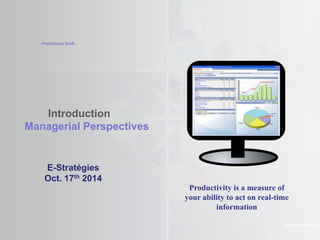
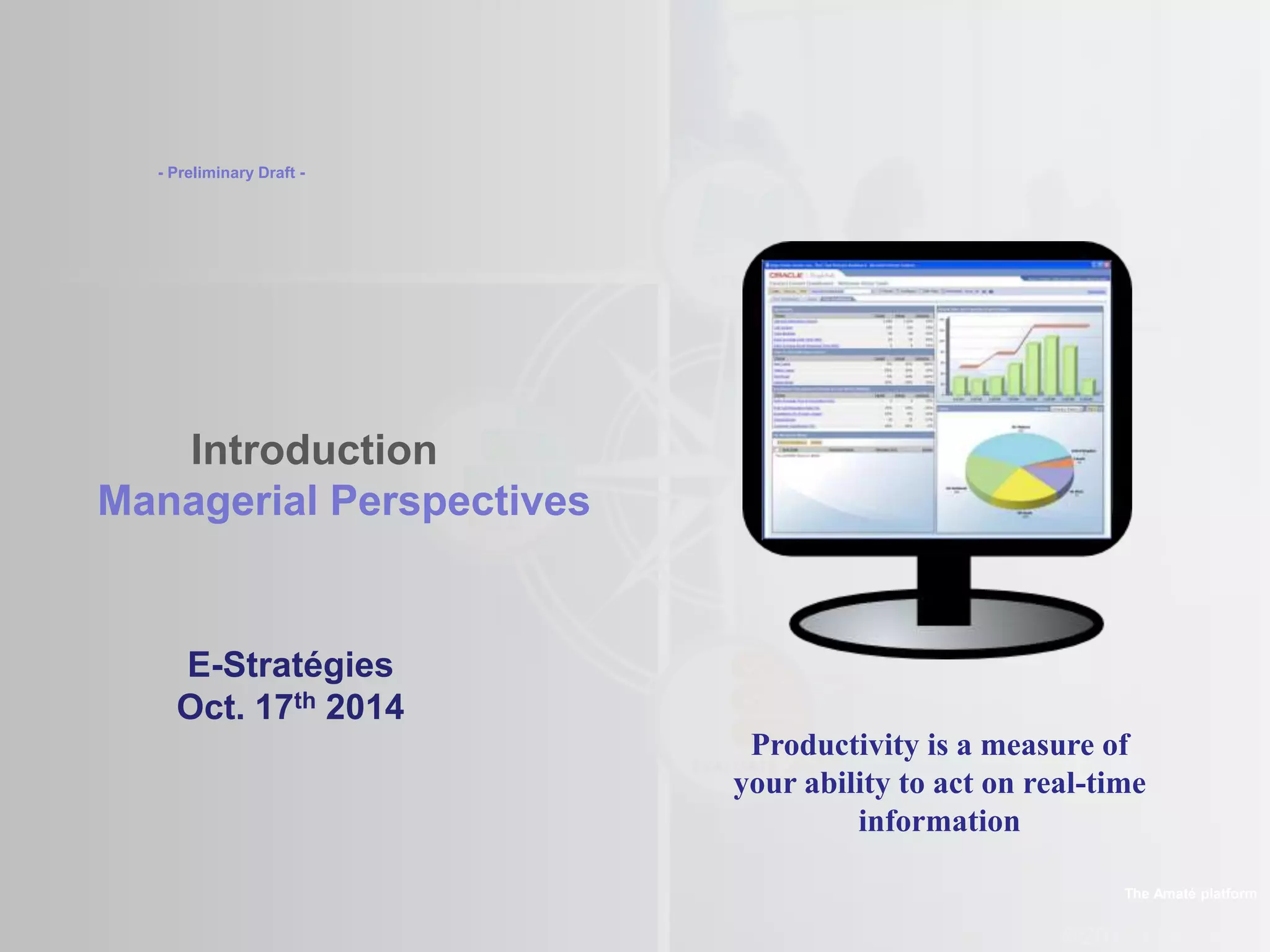
Productivity is a measure of 
your ability to act on real-time 
information
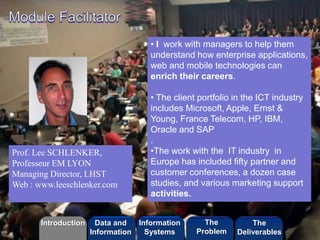
• I work with managers to help them 
understand how enterprise applications, 
web and mobile technologies can 
enrich their careers. 
• The client portfolio in the ICT industry 
includes Microsoft, Apple, Ernst & 
Young, France Telecom, HP, IBM, 
Oracle and SAP 
. 
•The work with the IT industry in 
Europe has included fifty partner and 
customer conferences, a dozen case 
studies, and various marketing support 
activities. 
©2013 LHST sarl 
Prof. Lee SCHLENKER, 
Professeur EM LYON 
Managing Director, LHST 
Web : www.leeschlenker.com 
Introduction Information 
Systems 
The 
Problem 
Data and 
Information 
The 
Deliverables
http://e-thinking.org 
• Course slides 
• Recommended reading 
• Course deliverables 
• Student input 
schlenker@em-lyon.com 
©2013 LHST sarl 
Introduction Information 
Systems 
The 
Problem 
Data and 
Information 
The 
Deliverables
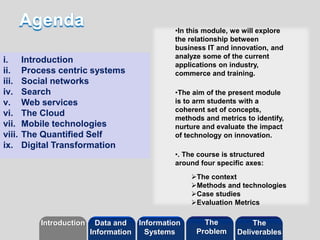
•In this module, we will explore 
the relationship between 
business IT and innovation, and 
analyze some of the current 
applications on industry, 
commerce and training. 
•The aim of the present module 
is to arm students with a 
coherent set of concepts, 
methods and metrics to identify, 
nurture and evaluate the impact 
of technology on innovation. 
©2013 LHST sarl 
•. The course is structured 
around four specific axes: 
The context 
Methods and technologies 
Case studies 
Evaluation Metrics 
i. Introduction 
ii. Process centric systems 
iii. Social networks 
iv. Search 
v. Web services 
vi. The Cloud 
vii. Mobile technologies 
viii. The Quantified Self 
ix. Digital Transformation 
Introduction Information 
Systems 
The 
Problem 
Data and 
Information 
The 
Deliverables
©2013 LHST sarl 
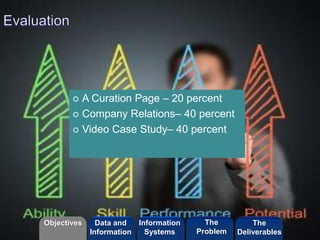
 A Curation Page – 20 percent 
 Company Relations– 40 percent 
 Video Case Study– 40 percent 
Objectives Information 
Systems 
The 
Problem 
Data and 
Information 
The 
Deliverables
©2013 LHST sarl 
Is Google Making Us Stupid? 
“EVERYONE has been talking about an article in 
The Atlantic magazine called "Is Google Making 
Us Stupid?" Some subset of that group has 
actually read the 4,175-word article, by Nicholas 
Carr. 
To save you some time, I was going to give you a 
100-word abridged version. 
But there are just too many distractions to read 
that much. So here is the 140-character Twitter 
version … 
Google makes deep thinking impossible. Media 
changes. Our brains' wiring changes too. 
Computers think for us, flattening our 
intelligence.” 
AMON DARLIN 
1. What does Nicolas Carr suggest when implying that 
technology structures both the content and the process of 
thought? 
3. How can Maryanne Wolf argue that “deep reading is 
indistinguishable from deep thinking?” 
3. How relevant today is F.W. Taylor’s description of 
perfect efficiency, “In the past the man has been first, in 
the future the system must be first.” Why shouldn’t we 
privilege “efficiency” and “immediacy” in learning about 
business? 
4. What proof do we have of Eric Schmidt’s claim that 
Google is a company founded “around the science of 
measurement?” 
5. What implications does Lewis Mumford (Technics 
and Civilization) find in how clocks “disassociate time 
from human events and helped create the belief in an 
independent world of mathematically measurable 
sequences?” 
6. Are talented manger’s Richard Foreman’s ‘pancake 
people’—spread wide and thin to connect with that vast 
network of readily accessible information?” 
Introduction Information 
Systems 
The 
Problem 
Data and 
Information 
The 
Deliverables
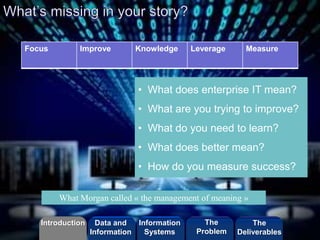
Focus Improve Knowledge Leverage Measure 
• What does enterprise IT mean? 
• What are you trying to improve? 
• What do you need to learn? 
• What does better mean? 
• How do you measure success? 
©2013 LHST sarl 
What Morgan called « the management of meaning » 
©2010 LHST sarl 
Introduction Information 
Systems 
The 
Problem 
Data and 
Information 
The 
Deliverables
©2013 LHST sarl 
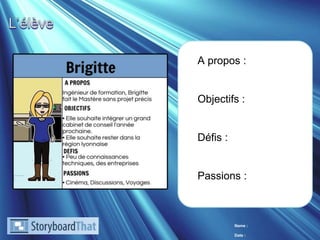
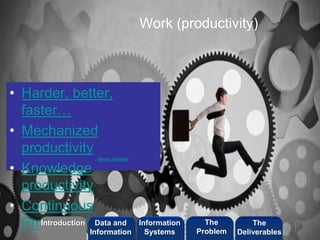
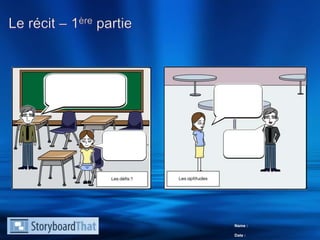
A propos : 
Objectifs : 
Défis : 
Passions : 
Name : 
Date :
©2013 LHST sarl 
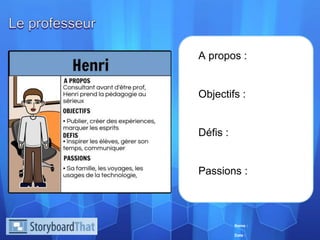
A propos : 
Objectifs : 
Défis : 
Passions : 
Name : 
Date :
• Economic transformation: The transformation from a manufacturing-based 
economy to a services-based economy now underway throughout 
©2010 LHST sarl ©2013 LHST sarl 
the developed world will accelerate. 
• One World of Business. Political and economic dynamics are forging a 
single global market, a global workforce, global customers, partners, and 
suppliers. 
• Always On, Always Connected. The challenges of the “always on, always 
connected” world will be converting information into insights; managing time 
and staying focused on high priority tasks 
• The Transparent Organization. The systems that make organizations 
more agile also make them more accountable. 
• NetGen Meets Baby Boom. Workers who will be delivering the innovations 
and productivity growth of tomorrow, this technology not only won’t come as 
a surprise, it will be a positive expectation. 
• Competing for Talent in a Shrinking Workforce: Because demographics 
show an aging, shrinking workforce in most of the developed world over the 
next 50 years, maximizing the productivity of the workers that are available 
is critical. 
Introduction Information 
Systems 
The 
Problem 
Data and 
Information 
The 
Deliverables
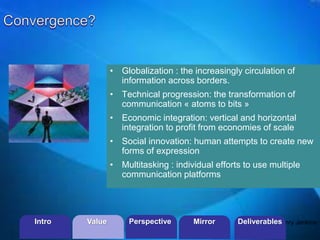
• Globalization : the increasingly circulation of 
©2013 LHST sarl 
information across borders. 
• Technical progression: the transformation of 
communication « atoms to bits » 
• Economic integration: vertical and horizontal 
integration to profit from economies of scale 
• Social innovation: human attempts to create new 
forms of expression 
• Multitasking : individual efforts to use multiple 
communication platforms 
Intro Value Perspective Mirror DeliverableHsenry Jenkins
• The assumption of order 
• The assumption of rational 
©2013 LHST sarl 
choice 
• The assumption of intentional 
capacity 
• The assumption of identity 
©2010 LHST sarl 
Introduction Information 
Systems 
The 
Problem 
Data and 
Information 
The 
Deliverables
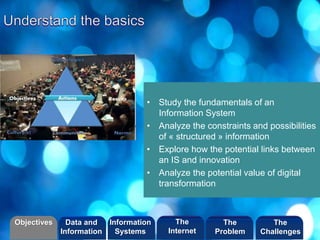
• Study the fundamentals of an 
©2013 LHST sarl 
Information System 
• Analyze the constraints and possibilities 
of « structured » information 
• Explore how the potential links between 
an IS and innovation 
• Analyze the potential value of digital 
transformation 
Objectives Information 
Systems 
The 
Internet 
Data and 
Information 
The 
Problem 
The 
Challenges
What is the link between data and action? 
• Understanding the implications between 
« structured » and « unstructured data » 
• Analyzing the difference between the data and 
©2013 LHST sarl 
reality 
• Understanding how the data fits together 
• Exploring the difference between data and 
action 
Introduction Information 
Systems 
The 
Problem 
Data and 
Information 
The 
Deliverables
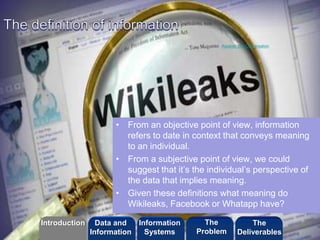
Assane, The Conversation 
• From an objective point of view, information 
refers to date in context that conveys meaning 
to an individual. 
• From a subjective point of view, we could 
suggest that it’s the individual’s perspective of 
the data that implies meaning. 
• Given these definitions what meaning do 
Wikileaks, Facebook or Whatapp have? 
©2013 LHST sarl 
Introduction Information 
Systems 
The 
Problem 
Data and 
Information 
The 
Deliverables
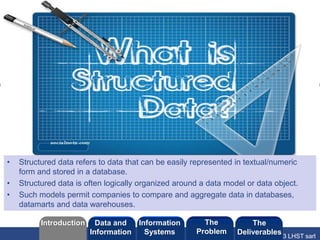
• Structured data refers to data that can be easily represented in textual/numeric 
©2013 LHST sarl 
form and stored in a database. 
• Structured data is often logically organized around a data model or data object. 
• Such models permit companies to compare and aggregate data in databases, 
datamarts and data warehouses. 
Introduction Information 
Systems 
The 
Problem 
Data and 
Information 
The 
Deliverables
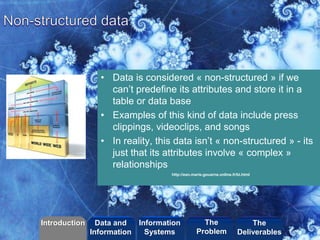
• Data is considered « non-structured » if we 
can’t predefine its attributes and store it in a 
table or data base 
• Examples of this kind of data include press 
©2013 LHST sarl 
clippings, videoclips, and songs 
• In reality, this data isn’t « non-structured » - its 
just that its attributes involve « complex » 
relationships 
http://ean.marie.gouarne.online.fr/bi.html 
Introduction Information 
Systems 
The 
Problem 
Data and 
Information 
The 
Deliverables
©2013 LHST sarl 
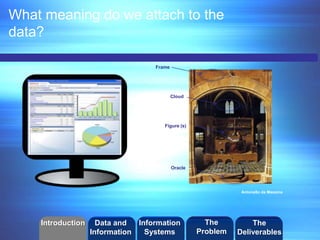
What meaning do we attach to the 
data? 
Frame 
Cloud 
Figure (s) 
Oracle 
Antonello da Messina 
Introduction Information 
Systems 
The 
Problem 
Data and 
Information 
The 
Deliverables
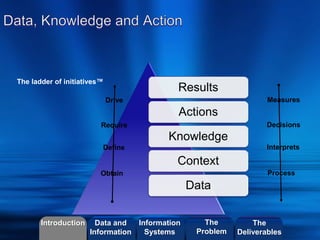
Measures 
Decisions 
Interprets 
©2013 LHST sarl 
Results 
Actions 
Knowledge 
Context 
Data 
Process 
Drive 
The ladder of initiatives™ 
Require 
Define 
Obtain 
Introduction Information 
Systems 
The 
Problem 
Data and 
Information 
The 
Deliverables
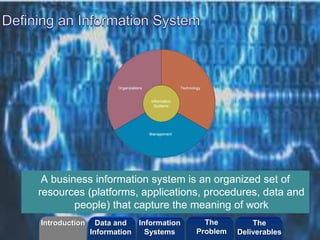
A business information system is an organized set of 
resources (platforms, applications, procedures, data and 
people) that capture the meaning of work 
©2013 LHST sarl 
Introduction Information 
Systems 
The 
Problem 
Data and 
Information 
The 
Deliverables
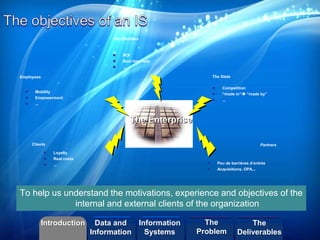
Stockholders 
 ROI 
 Real time data 
 ... 
The State 
 Competition 
 “made in” “made by” 
 ... 
 Peu de barrières d’entrée 
 Acquisitions, OPA... 
Employees 
Clients 
To help us understand the motivations, experience and objectives of the 
©2013 LHST sarl 
internal and external clients of the organization 
Partners 
 Loyalty 
 Real costs 
 ... 
The Enterprise 
 Mobility 
 Empowerment 
 ... 
Introduction Information 
Systems 
The 
Problem 
Data and 
Information 
The 
Deliverables
©2013 LHST sarl 
Introduction Information 
Systems 
The 
Problem 
Data and 
Information 
The 
Deliverables
©2013 L. SCHLENKER 
©2013 LHST sarl 
Introduction Information 
Systems 
The 
Problem 
Data and 
Information 
The 
Deliverables
©2013 LHST sarl 
Introduction Information 
Systems 
The 
Problem 
Data and 
Information 
The 
Deliverables
©2013 LHST sarl 
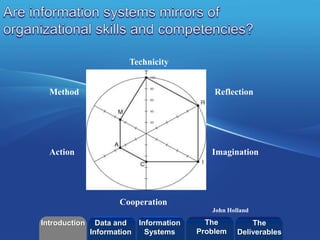
Technicity 
Reflection 
Imagination 
Cooperation 
Method 
Action 
John Holland 
Introduction Information 
Systems 
The 
Problem 
Data and 
Information 
The 
Deliverables
©2013 LHST sarl 
Is Google Making Us Stupid? 
“EVERYONE has been talking about an article in 
The Atlantic magazine called "Is Google Making 
Us Stupid?" Some subset of that group has 
actually read the 4,175-word article, by Nicholas 
Carr. 
To save you some time, I was going to give you a 
100-word abridged version. 
But there are just too many distractions to read 
that much. So here is the 140-character Twitter 
version … 
Google makes deep thinking impossible. Media 
changes. Our brains' wiring changes too. 
Computers think for us, flattening our 
intelligence.” 
AMON DARLIN 
1. What does Nicolas Carr suggest when implying that 
technology structures both the content and the process of 
thought? 
3. How can Maryanne Wolf argue that “deep reading is 
indistinguishable from deep thinking?” 
3. How relevant today is F.W. Taylor’s description of 
perfect efficiency, “In the past the man has been first, in 
the future the system must be first.” Why shouldn’t we 
privilege “efficiency” and “immediacy” in learning about 
business? 
4. What proof do we have of Eric Schmidt’s claim that 
Google is a company founded “around the science of 
measurement?” 
5. What implications does Lewis Mumford (Technics 
and Civilization) find in how clocks “disassociate time 
from human events and helped create the belief in an 
independent world of mathematically measurable 
sequences?” 
6. Are talented manger’s Richard Foreman’s ‘pancake 
people’—spread wide and thin to connect with that vast 
network of readily accessible information?” 
Introduction Information 
Systems 
The 
Problem 
Data and 
Information 
The 
Deliverables
©2013 LHST sarl 
Digital Transformation 
1. Everyone Will Have the Web 
2. The Browser Will Be the Operating System 
3. Business Will Live in the Cloud 
4. Everything Will Be Social 
5. Software Will Eat the World 
Marc Andreessen 
Introduction Information 
Systems 
The 
Problem 
Data and 
Information 
The 
Deliverables
©2013 LHST sarl 
Work (productivity) 
• Harder, better, 
faster… 
• Mechanized 
productivity 
• Knowledge 
productivity 
• Continuous 
Productivity 
Steven Sinofsky 
Introduction Information 
Systems 
The 
Problem 
Data and 
Information 
The 
Deliverables
©2013 LHST sarl 
• Ordered domain: Known 
causes and effects. 
• Ordered domain: Knowable 
causes and effects. 
• Un-ordered domain: Complex 
relationships. 
Introduction Information 
Systems 
The 
Problem 
Data and 
Information 
The 
Deliverables
©2013 LHST sarl 
Name : 
Date :
©2013 LHST sarl 
Name : 
Date :
http://e-thinking.org 
©2013 LHST sarl 
Grading Scale 
The marks in this module will be based upon contributions in three areas : 
• Curation: 20 possible points based on the quality of each individual 
student’s on-line and in-class participation 
• Company Relations: 40 possible points based on the quality of your 
input. 
• Video Case Study: 40 possible points 
• Total points possible: 100 
Introduction Information 
Systems 
The 
Problem 
Data and 
Information 
The 
Deliverables
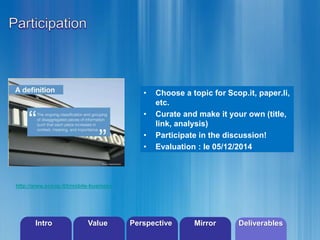
• Choose a topic for Scop.it, paper.li, 
©2013 LHST sarl 
etc. 
• Curate and make it your own (title, 
link, analysis) 
• Participate in the discussion! 
• Evaluation : le 05/12/2014 
http://www.scoop.it/t/mobile-business 
Intro Value Perspective Mirror Deliverables
©2013 LHST sarl 
Chargé des relations MDSI-entreprise 
• Créer et tenir à jour une fiche analytique du groupe 
traçant ses activités, ses objectifs, son implantation en 
France et sa politique d’emploi 
• Créer et tenir à jour une liste des contacts clés de 
l’entreprise, ainsi que le réseau des anciens de l’école 
• Solliciter un entretien avec la DRH du groupe afin de 
présenter le Mastère et de proposer votre rôle 
d’intermédiation 
• Promouvoir et gérer les relations de « parrains » avec 
les mastériens du groupe 
Evaluation : le 23/01/2015 
Intro Value Perspective Mirror Deliverables
©2013 LHST sarl 
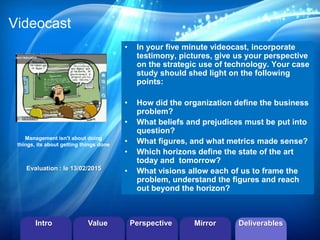
Videocast 
• In your five minute videocast, incorporate 
testimony, pictures, give us your perspective 
on the strategic use of technology. Your case 
study should shed light on the following 
points: 
• How did the organization define the business 
problem? 
• What beliefs and prejudices must be put into 
question? 
• What figures, and what metrics made sense? 
• Which horizons define the state of the art 
today and tomorrow? 
• What visions allow each of us to frame the 
problem, understand the figures and reach 
out beyond the horizon? 
Management isn’t about doing 
things, its about getting things done 
Evaluation : le 13/02/2015 
Intro Value Perspective Mirror Deliverables

Misceb intro2014

  • 1.
    ©2013 LHST sarl - Preliminary Draft - Introduction Managerial Perspectives The Amaté platform E-Stratégies Oct. 17th 2014 Productivity is a measure of your ability to act on real-time information
  • 2.
    • I workwith managers to help them understand how enterprise applications, web and mobile technologies can enrich their careers. • The client portfolio in the ICT industry includes Microsoft, Apple, Ernst & Young, France Telecom, HP, IBM, Oracle and SAP . •The work with the IT industry in Europe has included fifty partner and customer conferences, a dozen case studies, and various marketing support activities. ©2013 LHST sarl Prof. Lee SCHLENKER, Professeur EM LYON Managing Director, LHST Web : www.leeschlenker.com Introduction Information Systems The Problem Data and Information The Deliverables
  • 3.
    http://e-thinking.org • Courseslides • Recommended reading • Course deliverables • Student input schlenker@em-lyon.com ©2013 LHST sarl Introduction Information Systems The Problem Data and Information The Deliverables
  • 4.
    •In this module,we will explore the relationship between business IT and innovation, and analyze some of the current applications on industry, commerce and training. •The aim of the present module is to arm students with a coherent set of concepts, methods and metrics to identify, nurture and evaluate the impact of technology on innovation. ©2013 LHST sarl •. The course is structured around four specific axes: The context Methods and technologies Case studies Evaluation Metrics i. Introduction ii. Process centric systems iii. Social networks iv. Search v. Web services vi. The Cloud vii. Mobile technologies viii. The Quantified Self ix. Digital Transformation Introduction Information Systems The Problem Data and Information The Deliverables
  • 5.
    ©2013 LHST sarl  A Curation Page – 20 percent  Company Relations– 40 percent  Video Case Study– 40 percent Objectives Information Systems The Problem Data and Information The Deliverables
  • 6.
    ©2013 LHST sarl Is Google Making Us Stupid? “EVERYONE has been talking about an article in The Atlantic magazine called "Is Google Making Us Stupid?" Some subset of that group has actually read the 4,175-word article, by Nicholas Carr. To save you some time, I was going to give you a 100-word abridged version. But there are just too many distractions to read that much. So here is the 140-character Twitter version … Google makes deep thinking impossible. Media changes. Our brains' wiring changes too. Computers think for us, flattening our intelligence.” AMON DARLIN 1. What does Nicolas Carr suggest when implying that technology structures both the content and the process of thought? 3. How can Maryanne Wolf argue that “deep reading is indistinguishable from deep thinking?” 3. How relevant today is F.W. Taylor’s description of perfect efficiency, “In the past the man has been first, in the future the system must be first.” Why shouldn’t we privilege “efficiency” and “immediacy” in learning about business? 4. What proof do we have of Eric Schmidt’s claim that Google is a company founded “around the science of measurement?” 5. What implications does Lewis Mumford (Technics and Civilization) find in how clocks “disassociate time from human events and helped create the belief in an independent world of mathematically measurable sequences?” 6. Are talented manger’s Richard Foreman’s ‘pancake people’—spread wide and thin to connect with that vast network of readily accessible information?” Introduction Information Systems The Problem Data and Information The Deliverables
  • 7.
    Focus Improve KnowledgeLeverage Measure • What does enterprise IT mean? • What are you trying to improve? • What do you need to learn? • What does better mean? • How do you measure success? ©2013 LHST sarl What Morgan called « the management of meaning » ©2010 LHST sarl Introduction Information Systems The Problem Data and Information The Deliverables
  • 8.
    ©2013 LHST sarl A propos : Objectifs : Défis : Passions : Name : Date :
  • 9.
    ©2013 LHST sarl A propos : Objectifs : Défis : Passions : Name : Date :
  • 10.
    • Economic transformation:The transformation from a manufacturing-based economy to a services-based economy now underway throughout ©2010 LHST sarl ©2013 LHST sarl the developed world will accelerate. • One World of Business. Political and economic dynamics are forging a single global market, a global workforce, global customers, partners, and suppliers. • Always On, Always Connected. The challenges of the “always on, always connected” world will be converting information into insights; managing time and staying focused on high priority tasks • The Transparent Organization. The systems that make organizations more agile also make them more accountable. • NetGen Meets Baby Boom. Workers who will be delivering the innovations and productivity growth of tomorrow, this technology not only won’t come as a surprise, it will be a positive expectation. • Competing for Talent in a Shrinking Workforce: Because demographics show an aging, shrinking workforce in most of the developed world over the next 50 years, maximizing the productivity of the workers that are available is critical. Introduction Information Systems The Problem Data and Information The Deliverables
  • 11.
    • Globalization :the increasingly circulation of ©2013 LHST sarl information across borders. • Technical progression: the transformation of communication « atoms to bits » • Economic integration: vertical and horizontal integration to profit from economies of scale • Social innovation: human attempts to create new forms of expression • Multitasking : individual efforts to use multiple communication platforms Intro Value Perspective Mirror DeliverableHsenry Jenkins
  • 12.
    • The assumptionof order • The assumption of rational ©2013 LHST sarl choice • The assumption of intentional capacity • The assumption of identity ©2010 LHST sarl Introduction Information Systems The Problem Data and Information The Deliverables
  • 13.
    • Study thefundamentals of an ©2013 LHST sarl Information System • Analyze the constraints and possibilities of « structured » information • Explore how the potential links between an IS and innovation • Analyze the potential value of digital transformation Objectives Information Systems The Internet Data and Information The Problem The Challenges
  • 14.
    What is thelink between data and action? • Understanding the implications between « structured » and « unstructured data » • Analyzing the difference between the data and ©2013 LHST sarl reality • Understanding how the data fits together • Exploring the difference between data and action Introduction Information Systems The Problem Data and Information The Deliverables
  • 15.
    Assane, The Conversation • From an objective point of view, information refers to date in context that conveys meaning to an individual. • From a subjective point of view, we could suggest that it’s the individual’s perspective of the data that implies meaning. • Given these definitions what meaning do Wikileaks, Facebook or Whatapp have? ©2013 LHST sarl Introduction Information Systems The Problem Data and Information The Deliverables
  • 16.
    • Structured datarefers to data that can be easily represented in textual/numeric ©2013 LHST sarl form and stored in a database. • Structured data is often logically organized around a data model or data object. • Such models permit companies to compare and aggregate data in databases, datamarts and data warehouses. Introduction Information Systems The Problem Data and Information The Deliverables
  • 17.
    • Data isconsidered « non-structured » if we can’t predefine its attributes and store it in a table or data base • Examples of this kind of data include press ©2013 LHST sarl clippings, videoclips, and songs • In reality, this data isn’t « non-structured » - its just that its attributes involve « complex » relationships http://ean.marie.gouarne.online.fr/bi.html Introduction Information Systems The Problem Data and Information The Deliverables
  • 18.
    ©2013 LHST sarl What meaning do we attach to the data? Frame Cloud Figure (s) Oracle Antonello da Messina Introduction Information Systems The Problem Data and Information The Deliverables
  • 19.
    Measures Decisions Interprets ©2013 LHST sarl Results Actions Knowledge Context Data Process Drive The ladder of initiatives™ Require Define Obtain Introduction Information Systems The Problem Data and Information The Deliverables
  • 20.
    A business informationsystem is an organized set of resources (platforms, applications, procedures, data and people) that capture the meaning of work ©2013 LHST sarl Introduction Information Systems The Problem Data and Information The Deliverables
  • 21.
    Stockholders  ROI  Real time data  ... The State  Competition  “made in” “made by”  ...  Peu de barrières d’entrée  Acquisitions, OPA... Employees Clients To help us understand the motivations, experience and objectives of the ©2013 LHST sarl internal and external clients of the organization Partners  Loyalty  Real costs  ... The Enterprise  Mobility  Empowerment  ... Introduction Information Systems The Problem Data and Information The Deliverables
  • 22.
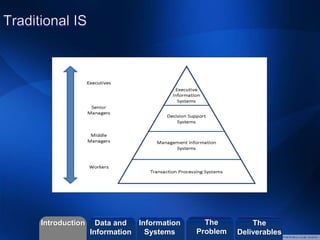
    ©2013 LHST sarl Introduction Information Systems The Problem Data and Information The Deliverables
  • 23.
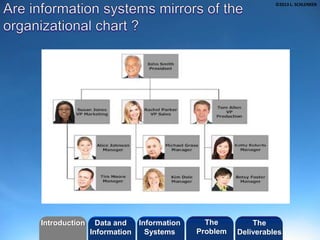
    ©2013 L. SCHLENKER ©2013 LHST sarl Introduction Information Systems The Problem Data and Information The Deliverables
  • 24.
    ©2013 LHST sarl Introduction Information Systems The Problem Data and Information The Deliverables
  • 25.
    ©2013 LHST sarl Technicity Reflection Imagination Cooperation Method Action John Holland Introduction Information Systems The Problem Data and Information The Deliverables
  • 26.
    ©2013 LHST sarl Is Google Making Us Stupid? “EVERYONE has been talking about an article in The Atlantic magazine called "Is Google Making Us Stupid?" Some subset of that group has actually read the 4,175-word article, by Nicholas Carr. To save you some time, I was going to give you a 100-word abridged version. But there are just too many distractions to read that much. So here is the 140-character Twitter version … Google makes deep thinking impossible. Media changes. Our brains' wiring changes too. Computers think for us, flattening our intelligence.” AMON DARLIN 1. What does Nicolas Carr suggest when implying that technology structures both the content and the process of thought? 3. How can Maryanne Wolf argue that “deep reading is indistinguishable from deep thinking?” 3. How relevant today is F.W. Taylor’s description of perfect efficiency, “In the past the man has been first, in the future the system must be first.” Why shouldn’t we privilege “efficiency” and “immediacy” in learning about business? 4. What proof do we have of Eric Schmidt’s claim that Google is a company founded “around the science of measurement?” 5. What implications does Lewis Mumford (Technics and Civilization) find in how clocks “disassociate time from human events and helped create the belief in an independent world of mathematically measurable sequences?” 6. Are talented manger’s Richard Foreman’s ‘pancake people’—spread wide and thin to connect with that vast network of readily accessible information?” Introduction Information Systems The Problem Data and Information The Deliverables
  • 27.
    ©2013 LHST sarl Digital Transformation 1. Everyone Will Have the Web 2. The Browser Will Be the Operating System 3. Business Will Live in the Cloud 4. Everything Will Be Social 5. Software Will Eat the World Marc Andreessen Introduction Information Systems The Problem Data and Information The Deliverables
  • 28.
    ©2013 LHST sarl Work (productivity) • Harder, better, faster… • Mechanized productivity • Knowledge productivity • Continuous Productivity Steven Sinofsky Introduction Information Systems The Problem Data and Information The Deliverables
  • 29.
    ©2013 LHST sarl • Ordered domain: Known causes and effects. • Ordered domain: Knowable causes and effects. • Un-ordered domain: Complex relationships. Introduction Information Systems The Problem Data and Information The Deliverables
  • 30.
    ©2013 LHST sarl Name : Date :
  • 31.
    ©2013 LHST sarl Name : Date :
  • 32.
    http://e-thinking.org ©2013 LHSTsarl Grading Scale The marks in this module will be based upon contributions in three areas : • Curation: 20 possible points based on the quality of each individual student’s on-line and in-class participation • Company Relations: 40 possible points based on the quality of your input. • Video Case Study: 40 possible points • Total points possible: 100 Introduction Information Systems The Problem Data and Information The Deliverables
  • 33.
    • Choose atopic for Scop.it, paper.li, ©2013 LHST sarl etc. • Curate and make it your own (title, link, analysis) • Participate in the discussion! • Evaluation : le 05/12/2014 http://www.scoop.it/t/mobile-business Intro Value Perspective Mirror Deliverables
  • 34.
    ©2013 LHST sarl Chargé des relations MDSI-entreprise • Créer et tenir à jour une fiche analytique du groupe traçant ses activités, ses objectifs, son implantation en France et sa politique d’emploi • Créer et tenir à jour une liste des contacts clés de l’entreprise, ainsi que le réseau des anciens de l’école • Solliciter un entretien avec la DRH du groupe afin de présenter le Mastère et de proposer votre rôle d’intermédiation • Promouvoir et gérer les relations de « parrains » avec les mastériens du groupe Evaluation : le 23/01/2015 Intro Value Perspective Mirror Deliverables
  • 35.
    ©2013 LHST sarl Videocast • In your five minute videocast, incorporate testimony, pictures, give us your perspective on the strategic use of technology. Your case study should shed light on the following points: • How did the organization define the business problem? • What beliefs and prejudices must be put into question? • What figures, and what metrics made sense? • Which horizons define the state of the art today and tomorrow? • What visions allow each of us to frame the problem, understand the figures and reach out beyond the horizon? Management isn’t about doing things, its about getting things done Evaluation : le 13/02/2015 Intro Value Perspective Mirror Deliverables

Editor's Notes

  • #36 http://tinyurl.com/MUSEStudentRegistration