Digital
Transformation
Lessons for Practitioners
Alan W. Brown
Professor of Entrepreneurship and Innovation
Executive Director, Centre for Digital Economy (CoDE)
University of Surrey, UK
alan.w.brown@surrey.ac.uk
www.SurreyCoDE.org
Digital Strategist, NotBinary
www.NotBinary.co.uk
1
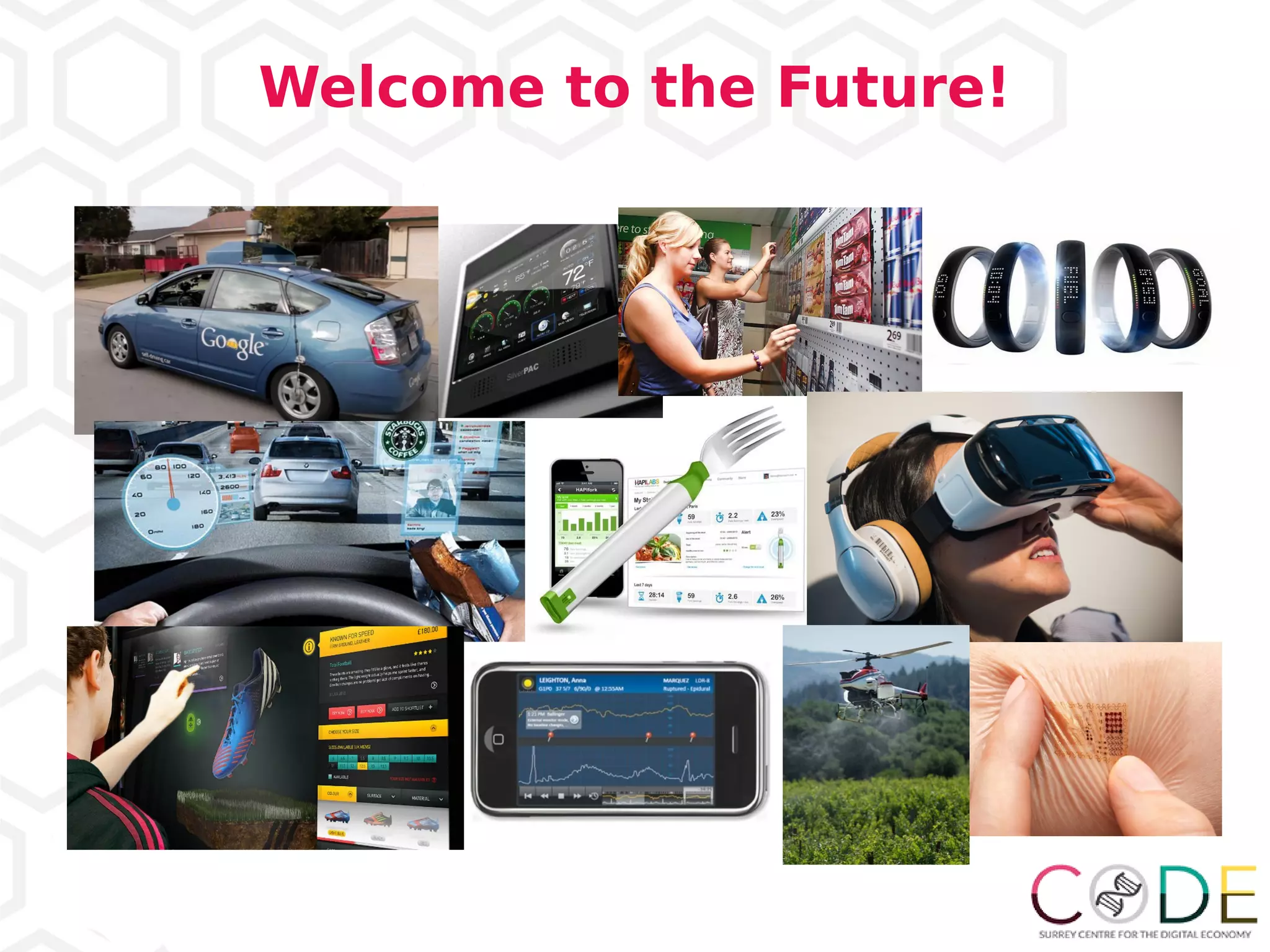
Welcome to the Future!
Digital Transformation:
Moving Beyond
Technology
• Digital as a technology upgrade
(internal focus)
• Digital as new channels to market
(external focus)
Digital Transformation:
Moving Beyond
Technology
• Digital as a technology upgrade
(internal focus)
• Digital as new channels to market
(external focus)
• Digital as new business model opportunities
(business model innovation)
• Digital as an enabler for social
transformation
(power redistribution)
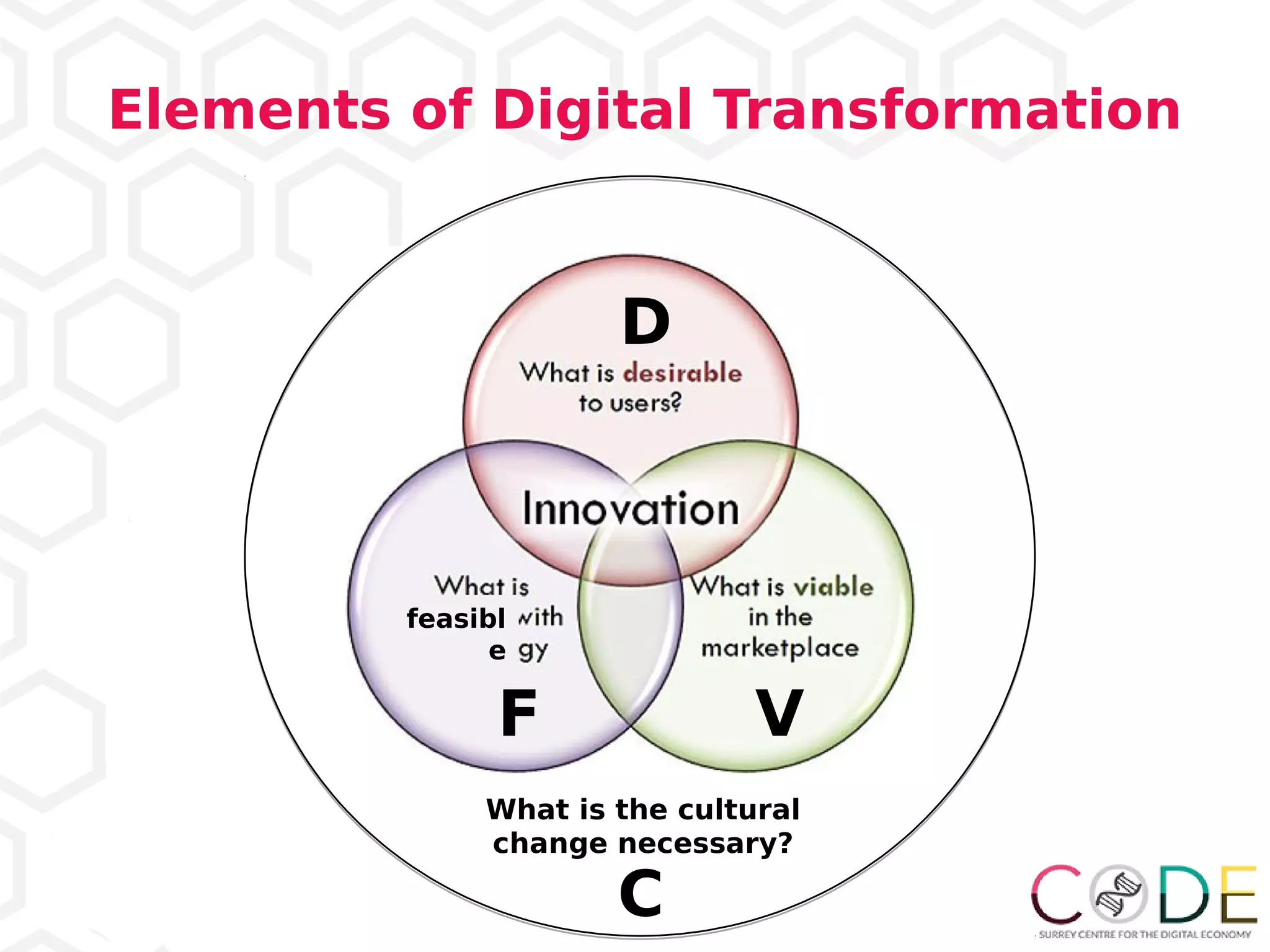
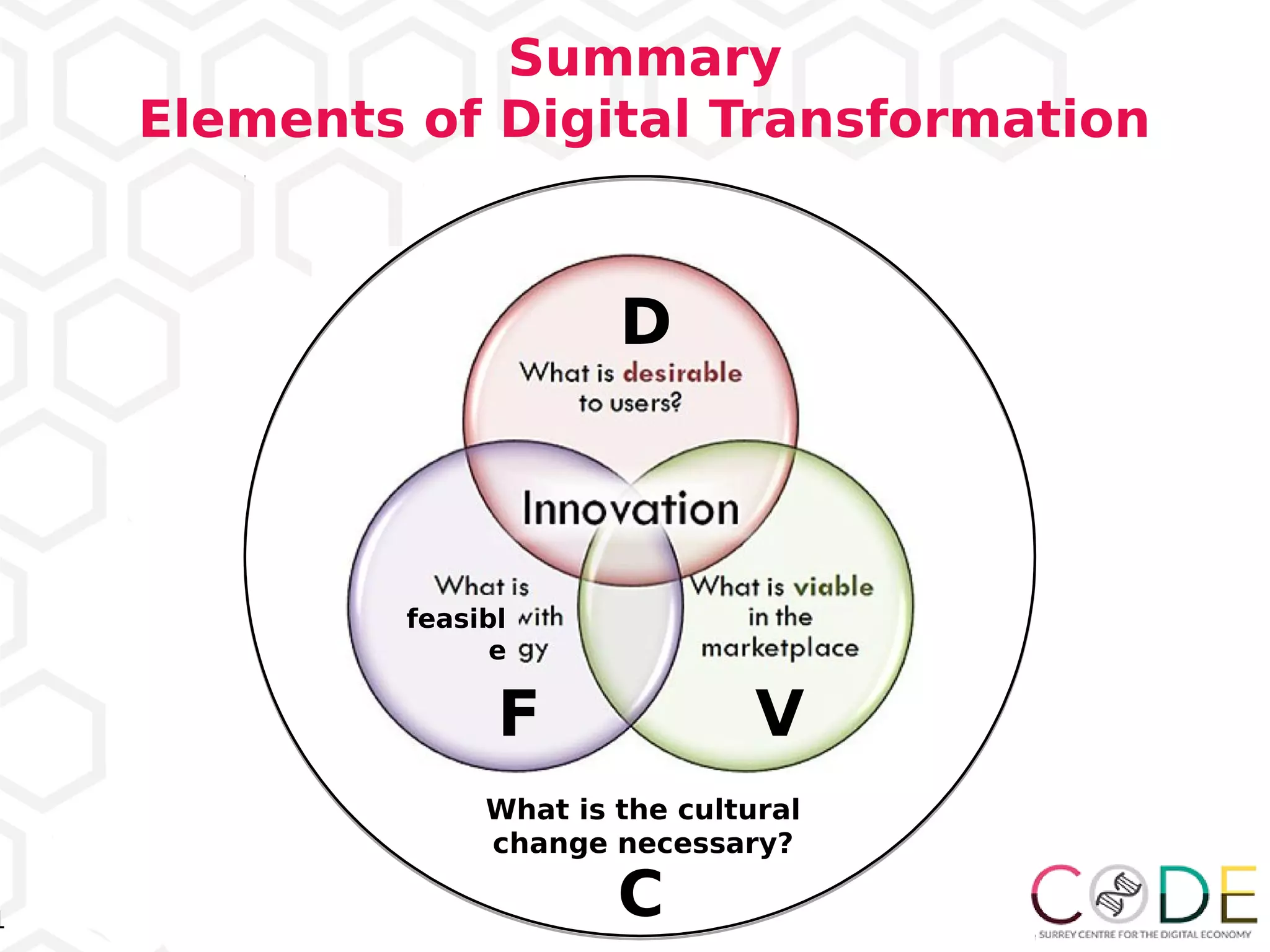
Elements of Digital Transformation
D
F V
feasibl
e
C
What is the cultural
change necessary?
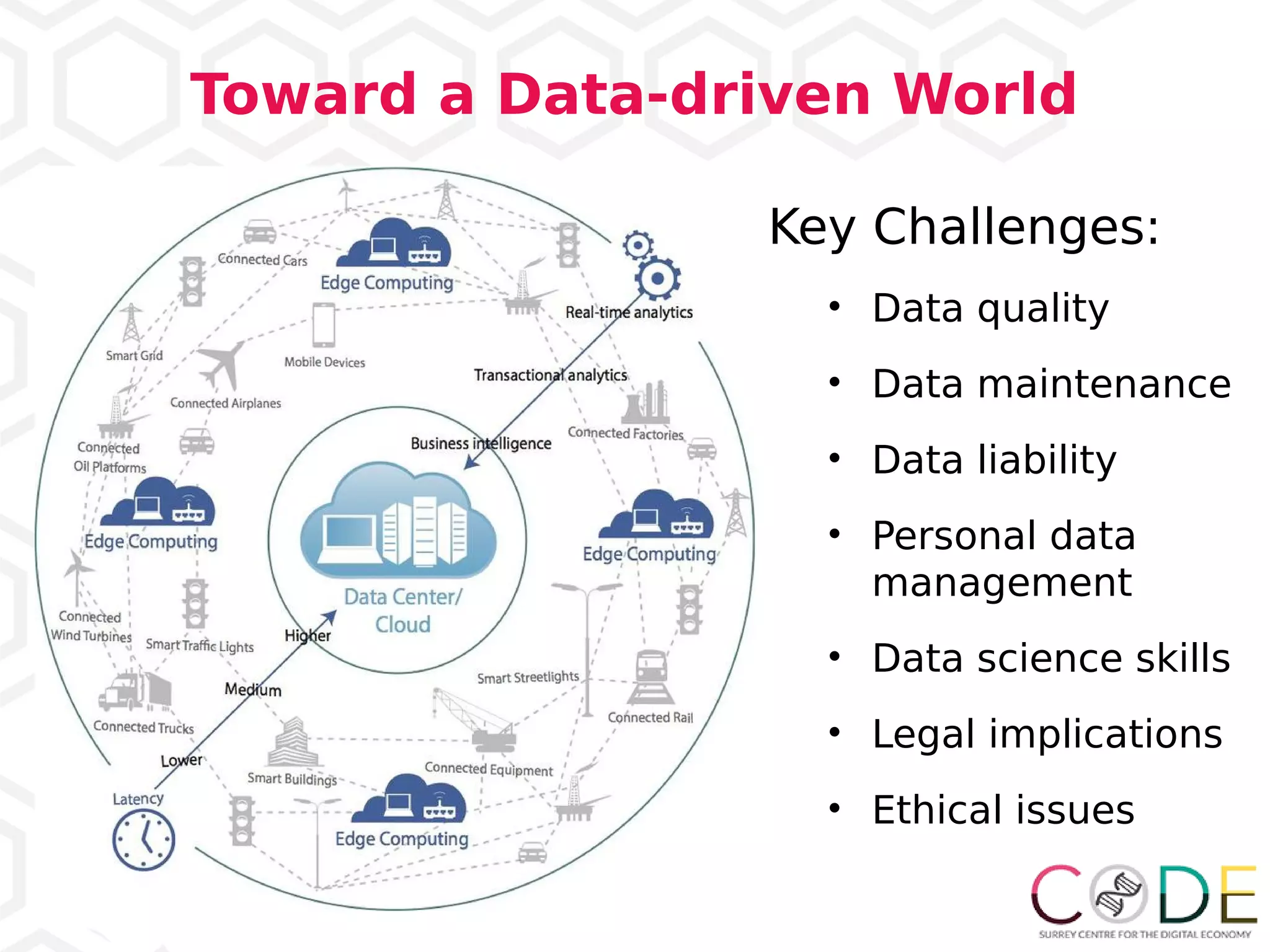
Toward a Data-driven World
• Data quality
• Data maintenance
• Data liability
• Personal data
management
• Data science skills
• Legal implications
• Ethical issues
Key Challenges:
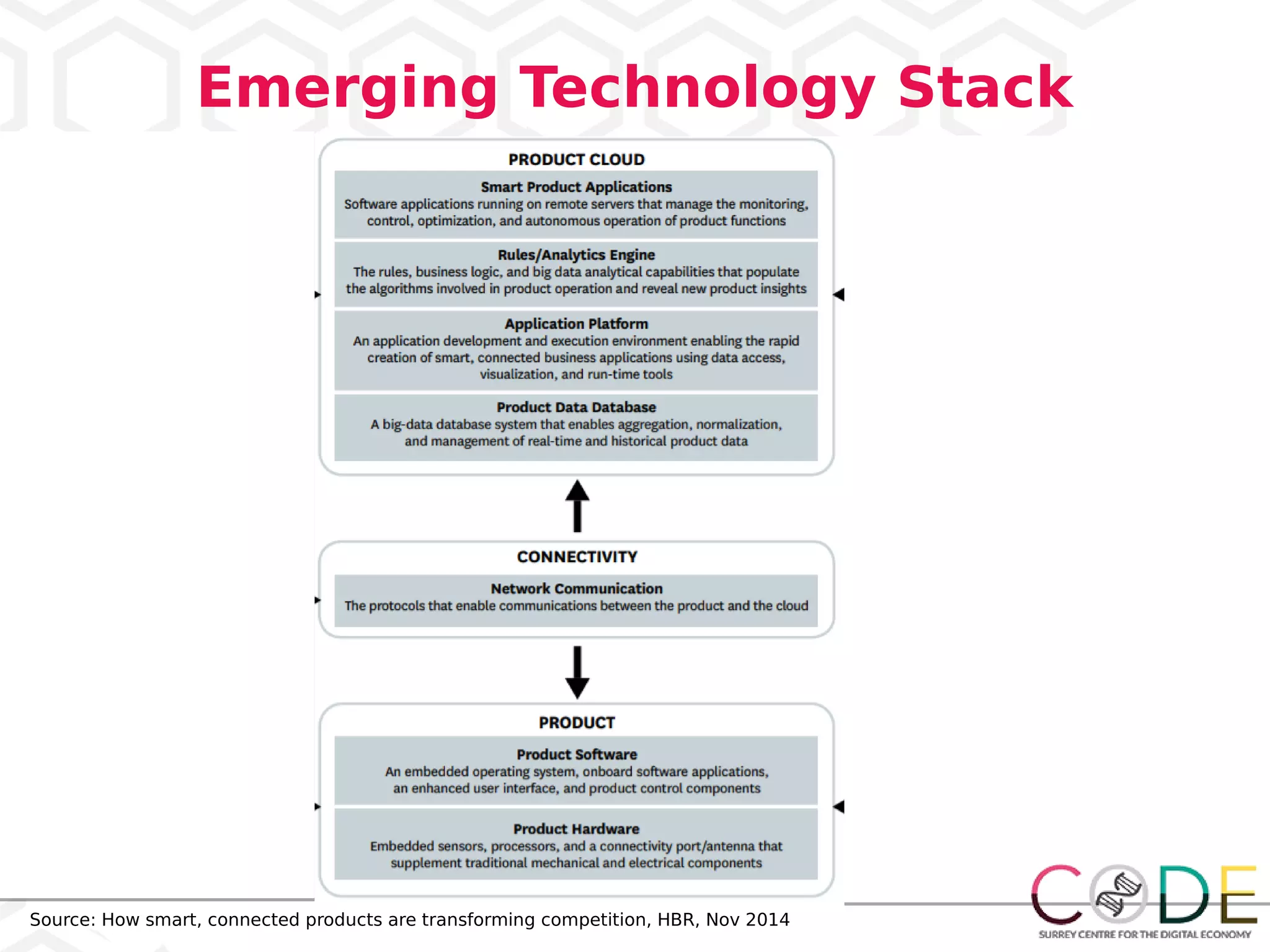
Emerging Technology Stack
Source: How smart, connected products are transforming competition, HBR, Nov 2014
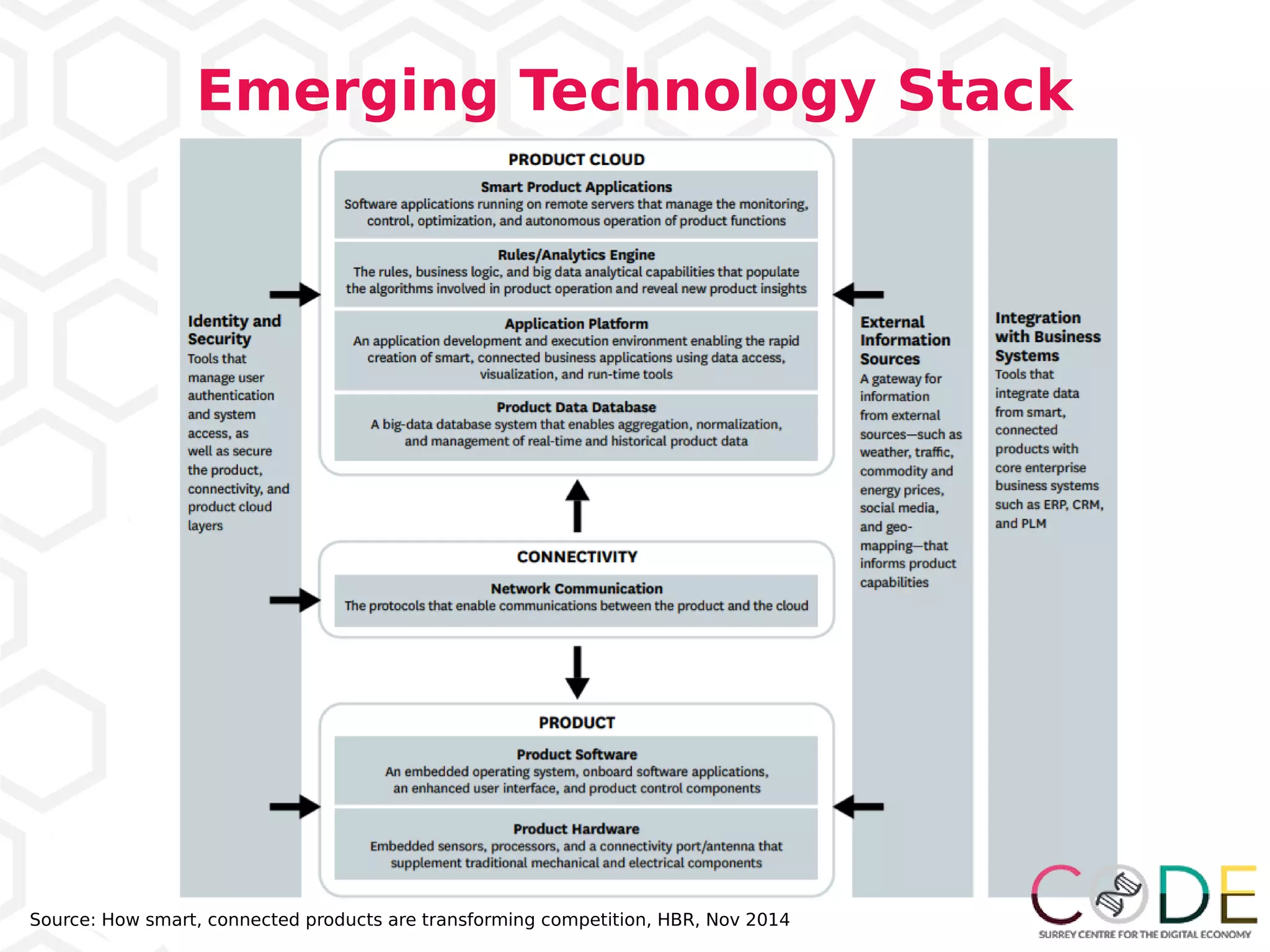
Emerging Technology Stack
Source: How smart, connected products are transforming competition, HBR, Nov 2014
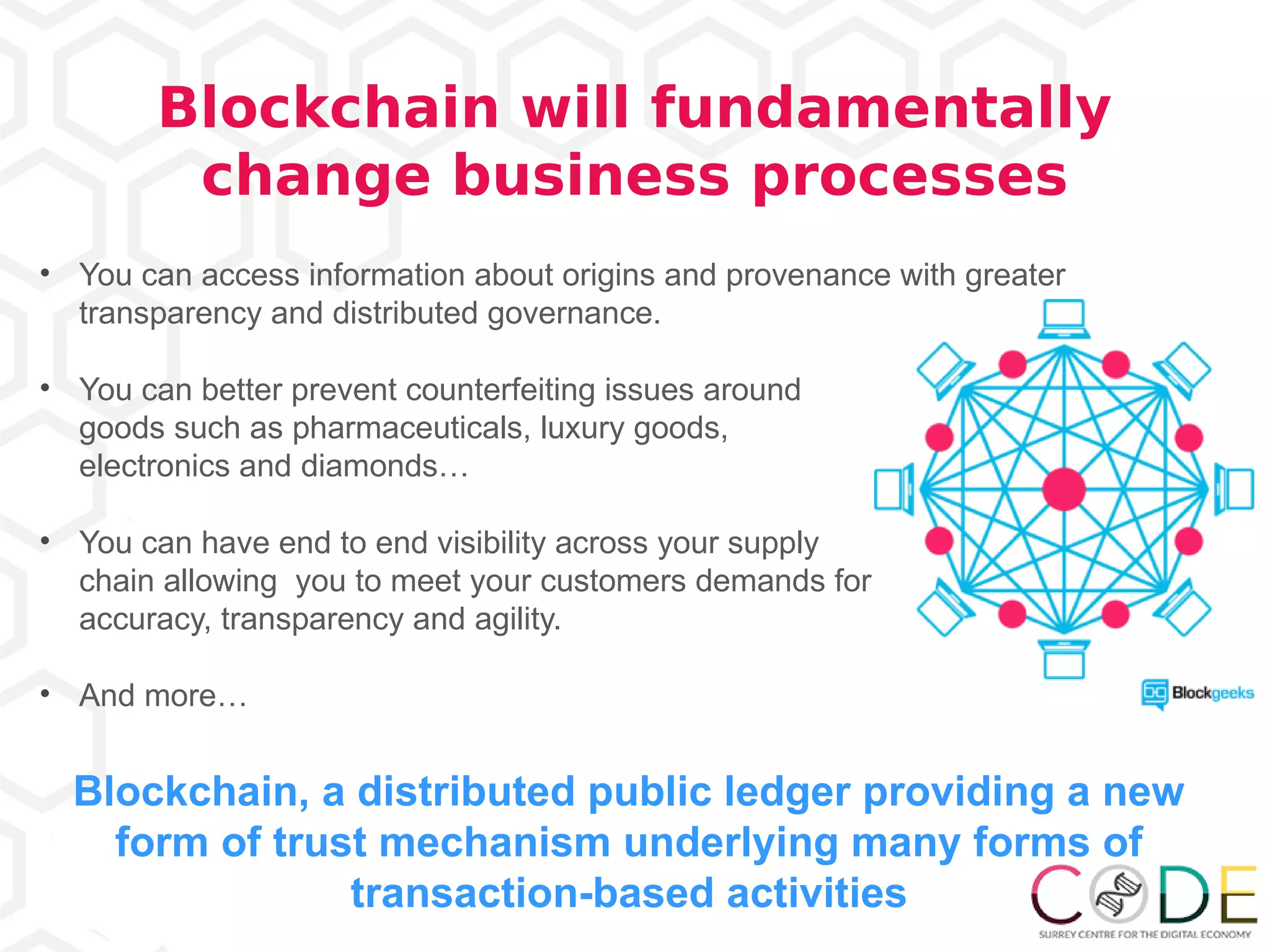
• You can access information about origins and provenance with greater
transparency and distributed governance.
• You can better prevent counterfeiting issues around
goods such as pharmaceuticals, luxury goods,
electronics and diamonds…
• You can have end to end visibility across your supply
chain allowing you to meet your customers demands for
accuracy, transparency and agility.
• And more…
Blockchain, a distributed public ledger providing a new
form of trust mechanism underlying many forms of
transaction-based activities
Blockchain will fundamentally
change business processes
0
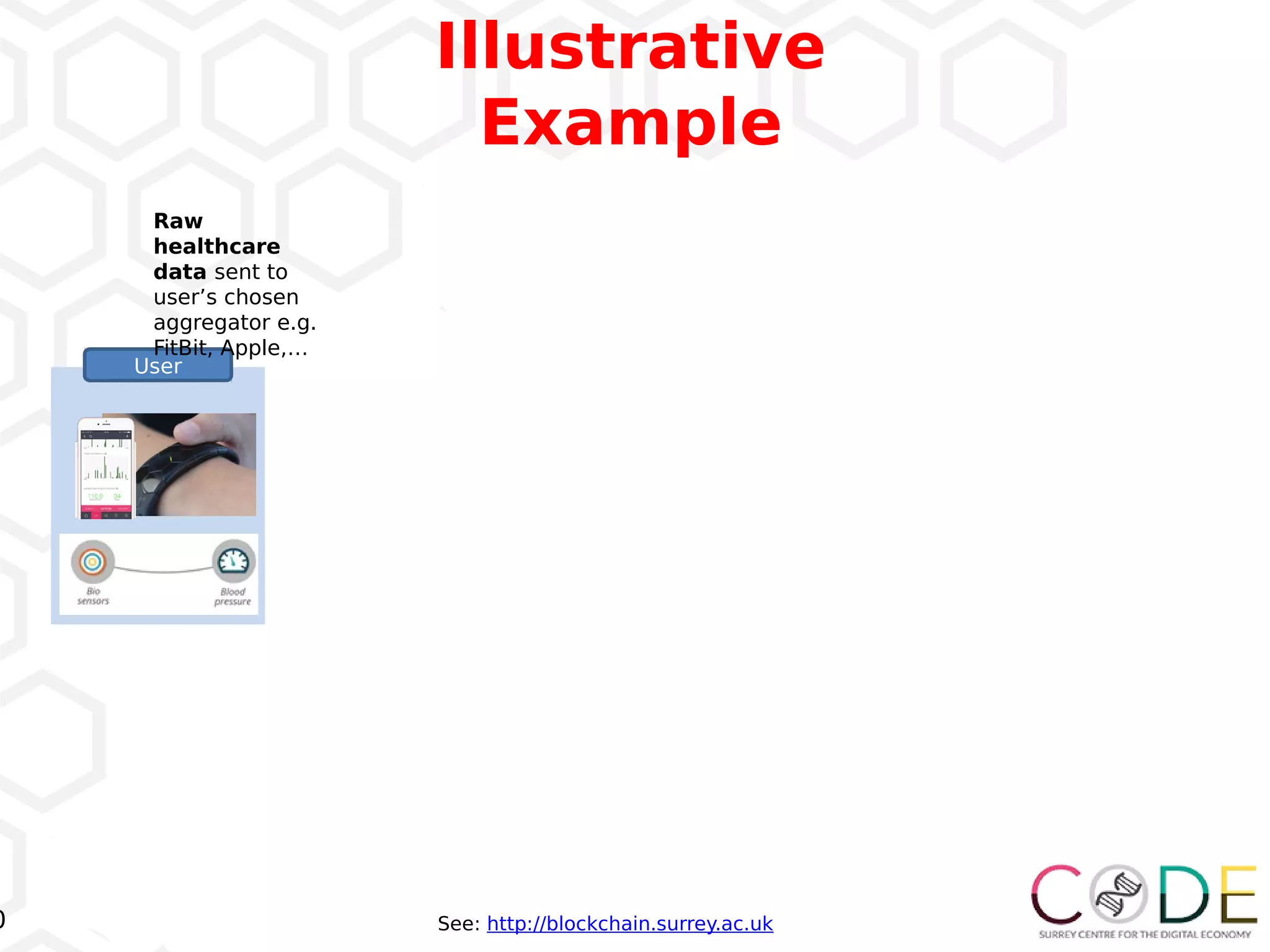
User
Raw
healthcare
data sent to
user’s chosen
aggregator e.g.
FitBit, Apple,…
Illustrative
Example
See: http://blockchain.surrey.ac.uk
1
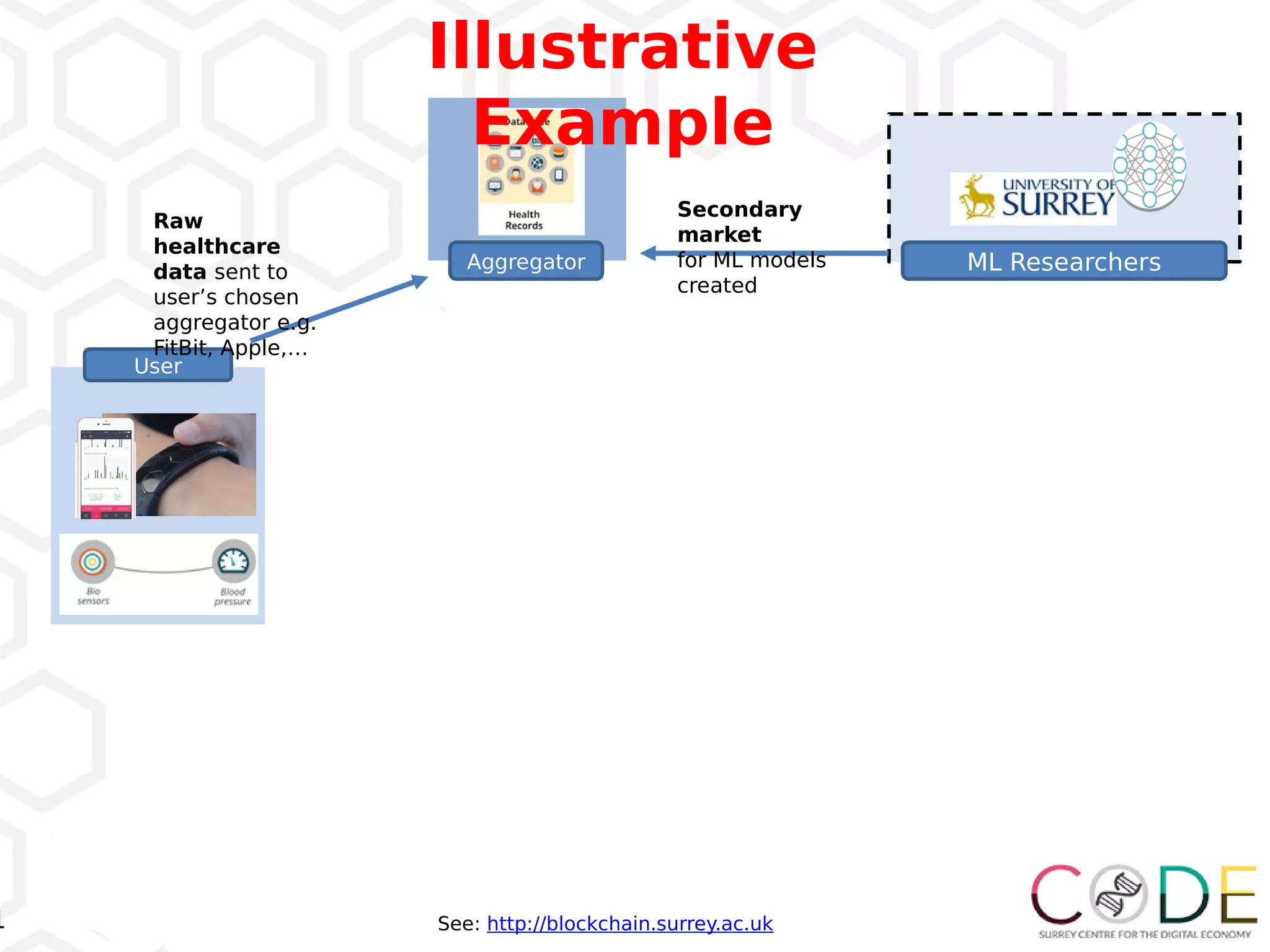
User
Aggregator ML Researchers
Raw
healthcare
data sent to
user’s chosen
aggregator e.g.
FitBit, Apple,…
Secondary
market
for ML models
created
Illustrative
Example
See: http://blockchain.surrey.ac.uk
2
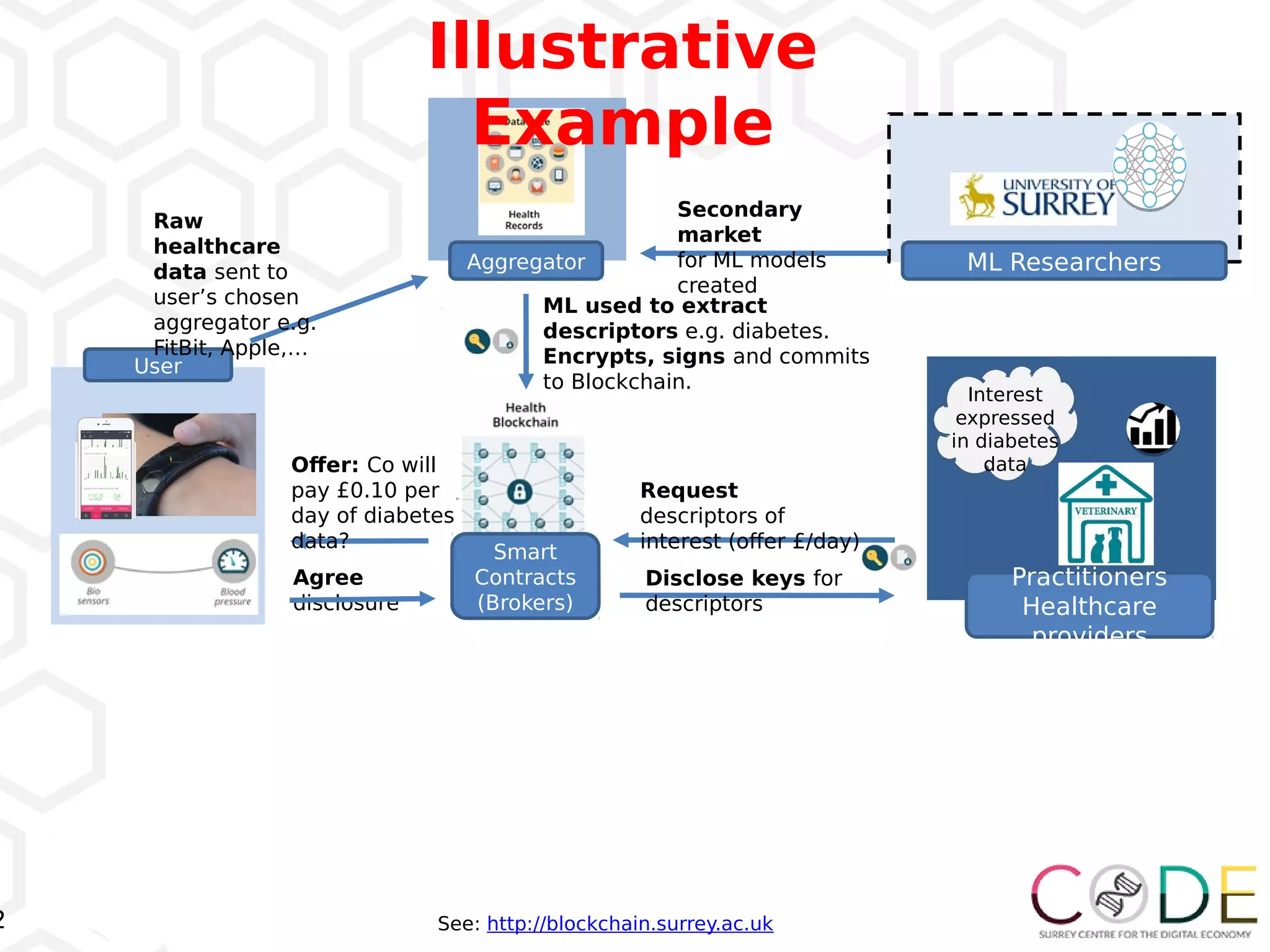
User
Aggregator ML Researchers
Smart
Contracts
(Brokers)
Practitioners
Healthcare
providers
Interest
expressed
in diabetes
data
Raw
healthcare
data sent to
user’s chosen
aggregator e.g.
FitBit, Apple,…
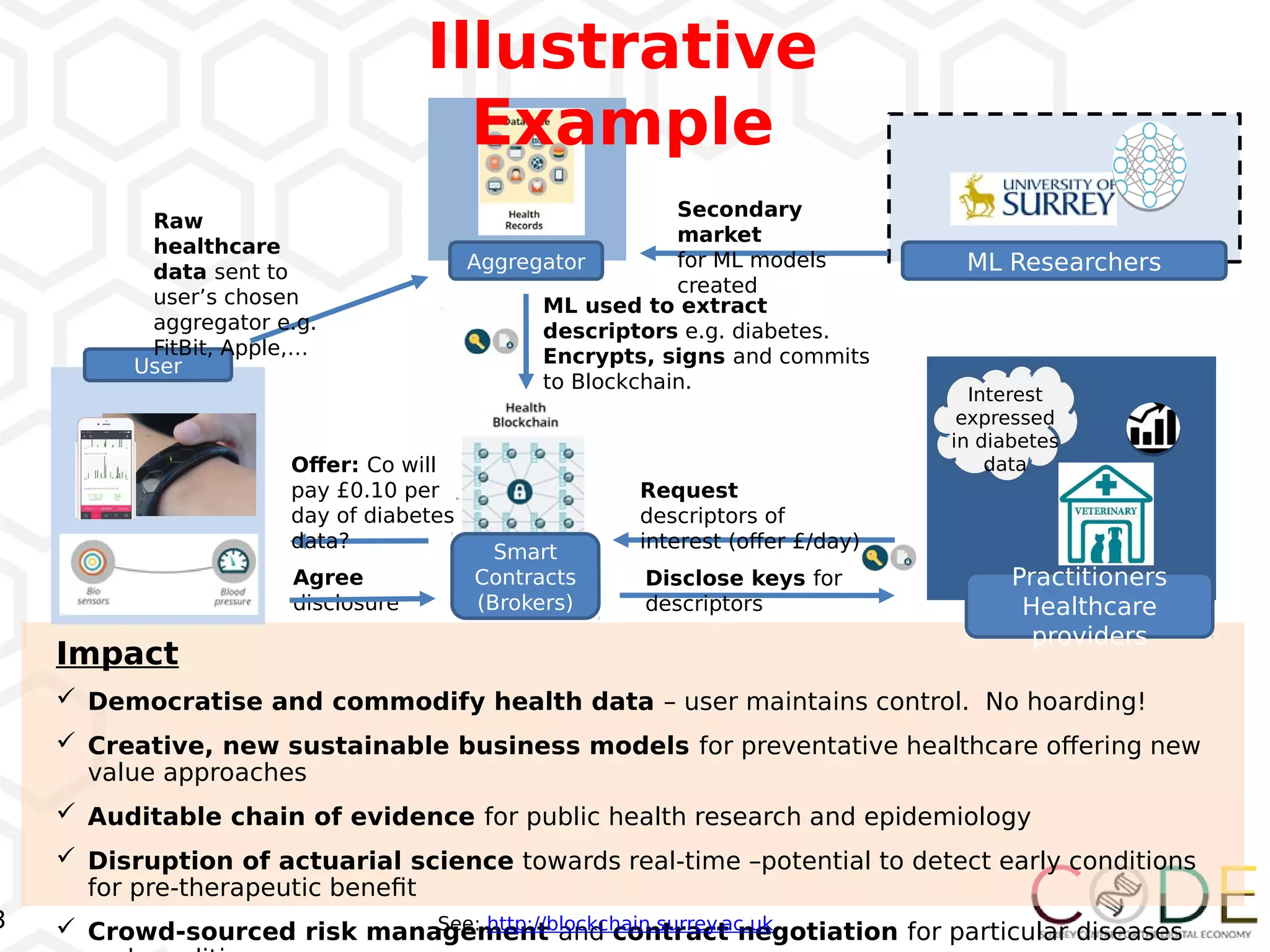
ML used to extract
descriptors e.g. diabetes.
Encrypts, signs and commits
to Blockchain.
Secondary
market
for ML models
created
Request
descriptors of
interest (ofer £/day)
Offer: Co will
pay £0.10 per
day of diabetes
data?
Agree
disclosure
Disclose keys for
descriptors
Illustrative
Example
See: http://blockchain.surrey.ac.uk
3
Impact
 Democratise and commodify health data – user maintains control. No hoarding!
 Creative, new sustainable business models for preventative healthcare ofering new
value approaches
 Auditable chain of evidence for public health research and epidemiology
 Disruption of actuarial science towards real-time –potential to detect early conditions
for pre-therapeutic beneft
 Crowd-sourced risk management and contract negotiation for particular diseases
User
Aggregator ML Researchers
Smart
Contracts
(Brokers)
Practitioners
Healthcare
providers
Interest
expressed
in diabetes
data
Raw
healthcare
data sent to
user’s chosen
aggregator e.g.
FitBit, Apple,…
ML used to extract
descriptors e.g. diabetes.
Encrypts, signs and commits
to Blockchain.
Secondary
market
for ML models
created
Request
descriptors of
interest (ofer £/day)
Offer: Co will
pay £0.10 per
day of diabetes
data?
Agree
disclosure
Disclose keys for
descriptors
Illustrative
Example
See: http://blockchain.surrey.ac.uk
4
Data-Driven Transformation
Examples
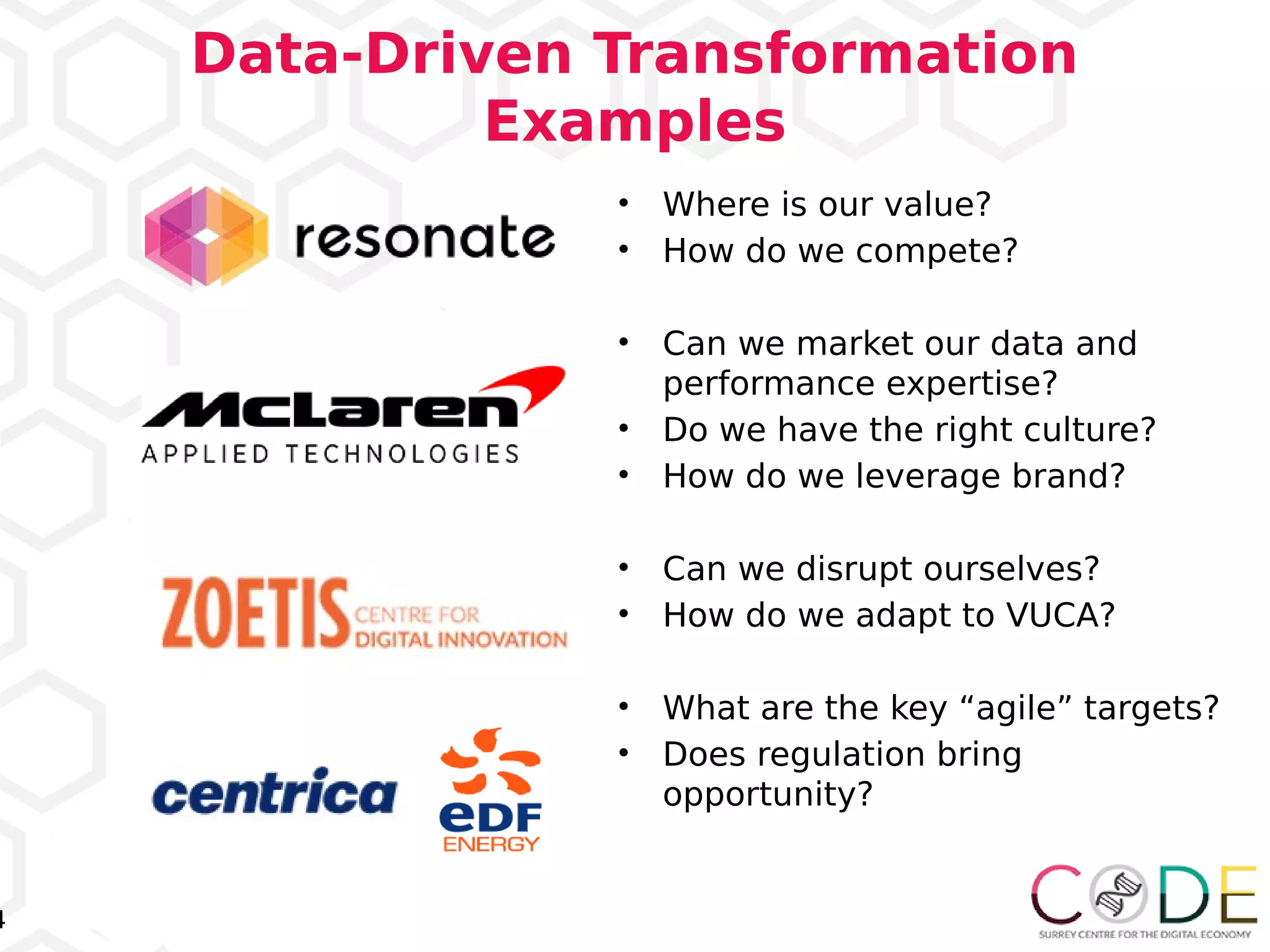
• Where is our value?
• How do we compete?
• Can we market our data and
performance expertise?
• Do we have the right culture?
• How do we leverage brand?
• Can we disrupt ourselves?
• How do we adapt to VUCA?
• What are the key “agile” targets?
• Does regulation bring
opportunity?
5
Data-Driven Innovation
4 Key Lessons
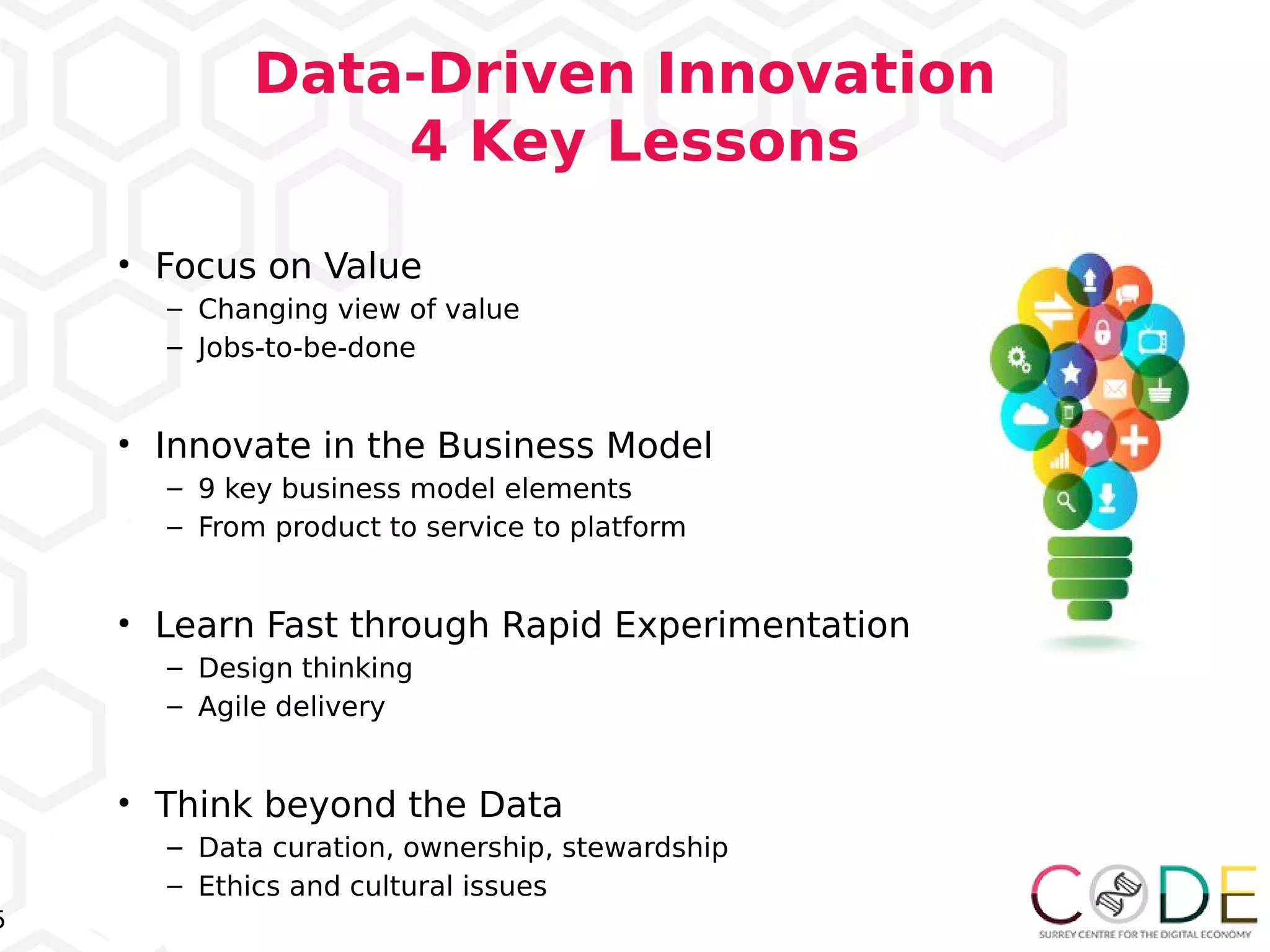
• Focus on Value
– Changing view of value
– Jobs-to-be-done
• Innovate in the Business Model
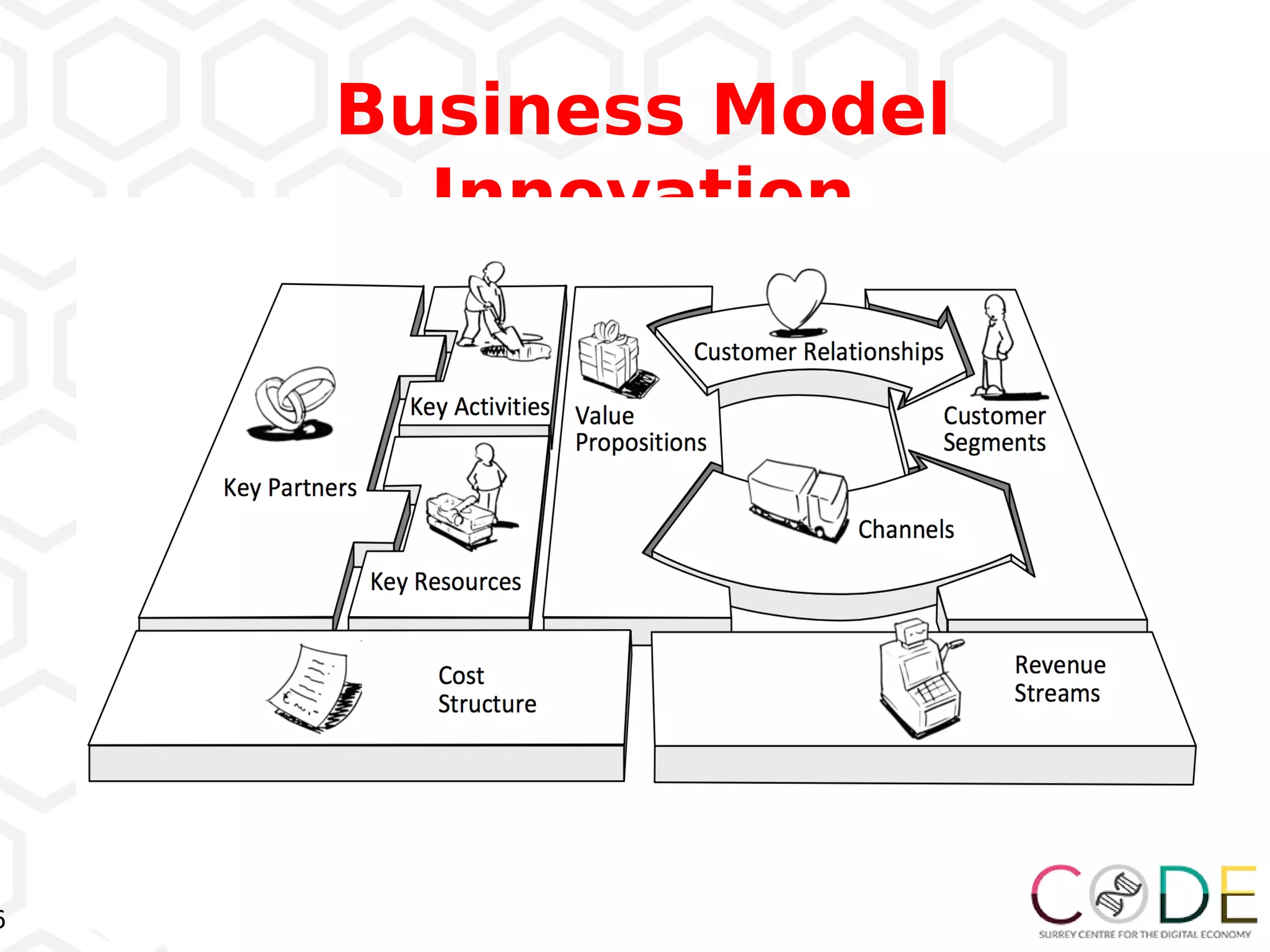
– 9 key business model elements
– From product to service to platform
• Learn Fast through Rapid Experimentation
– Design thinking
– Agile delivery
• Think beyond the Data
– Data curation, ownership, stewardship
– Ethics and cultural issues
6
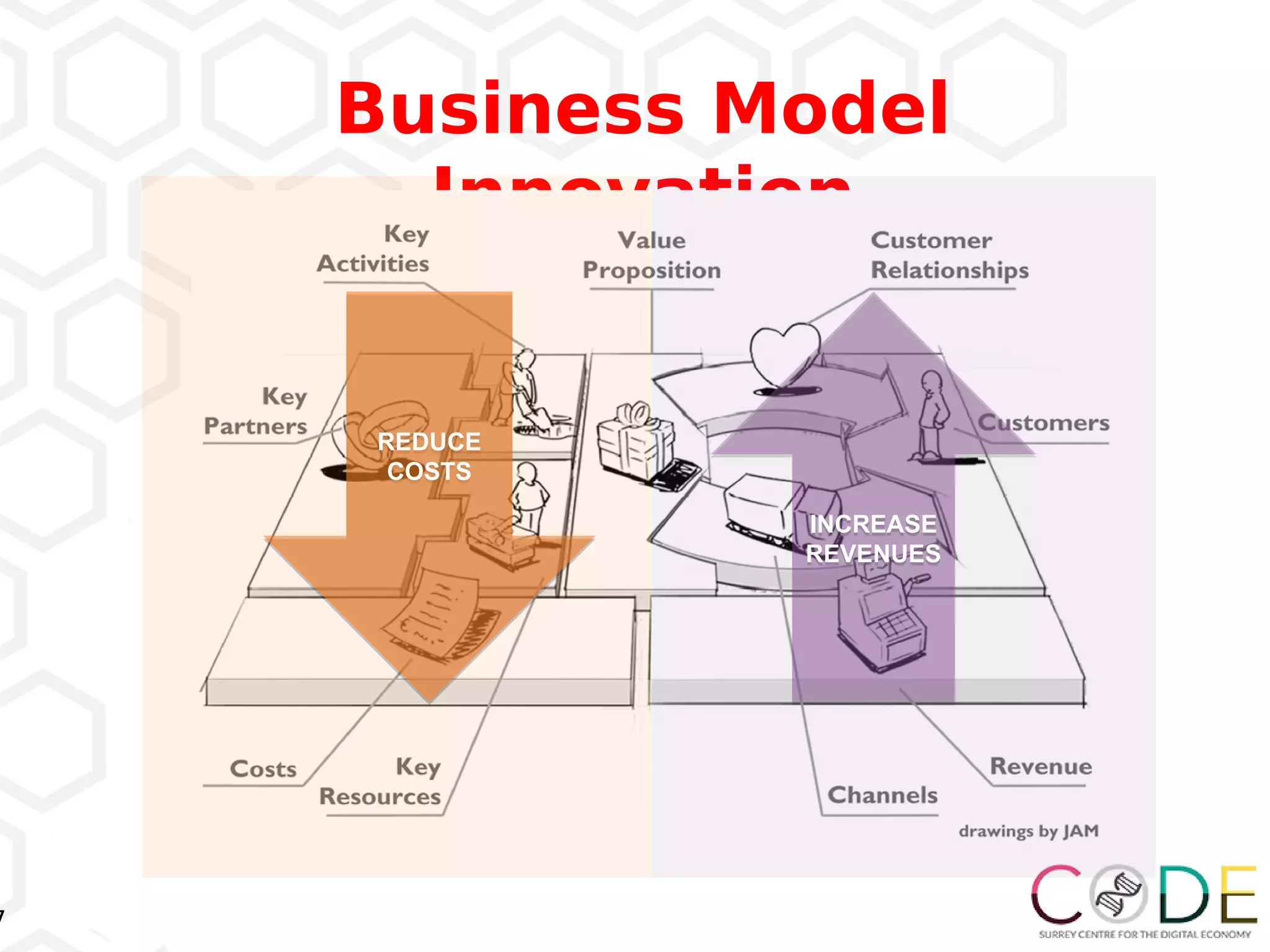
Business Model
Innovation
7
Business Model
Innovation
REDUCE
COSTS
REDUCE
COSTS
INCREASE
REVENUES
INCREASE
REVENUES
8
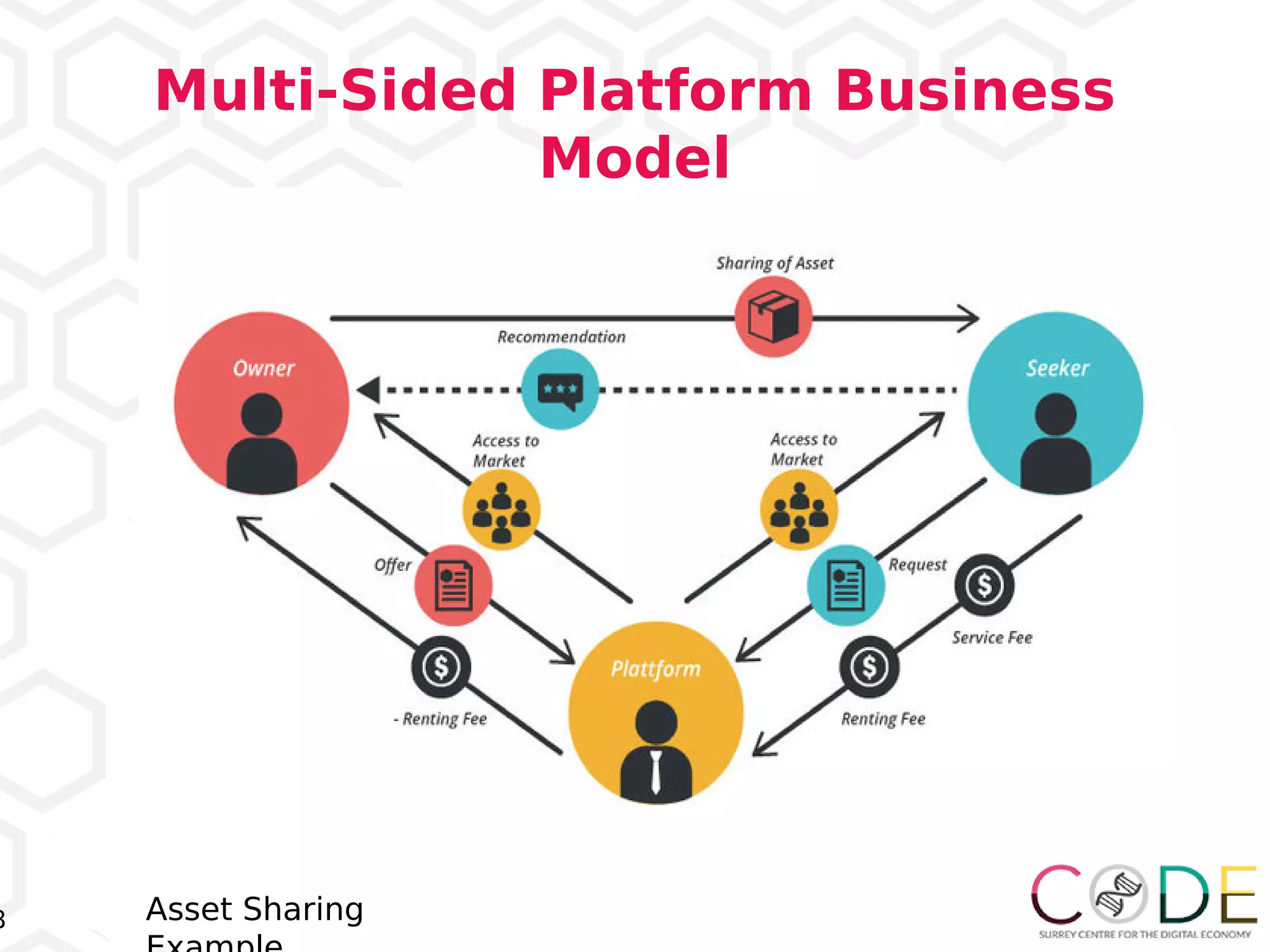
Multi-Sided Platform Business
Model
Asset Sharing
9
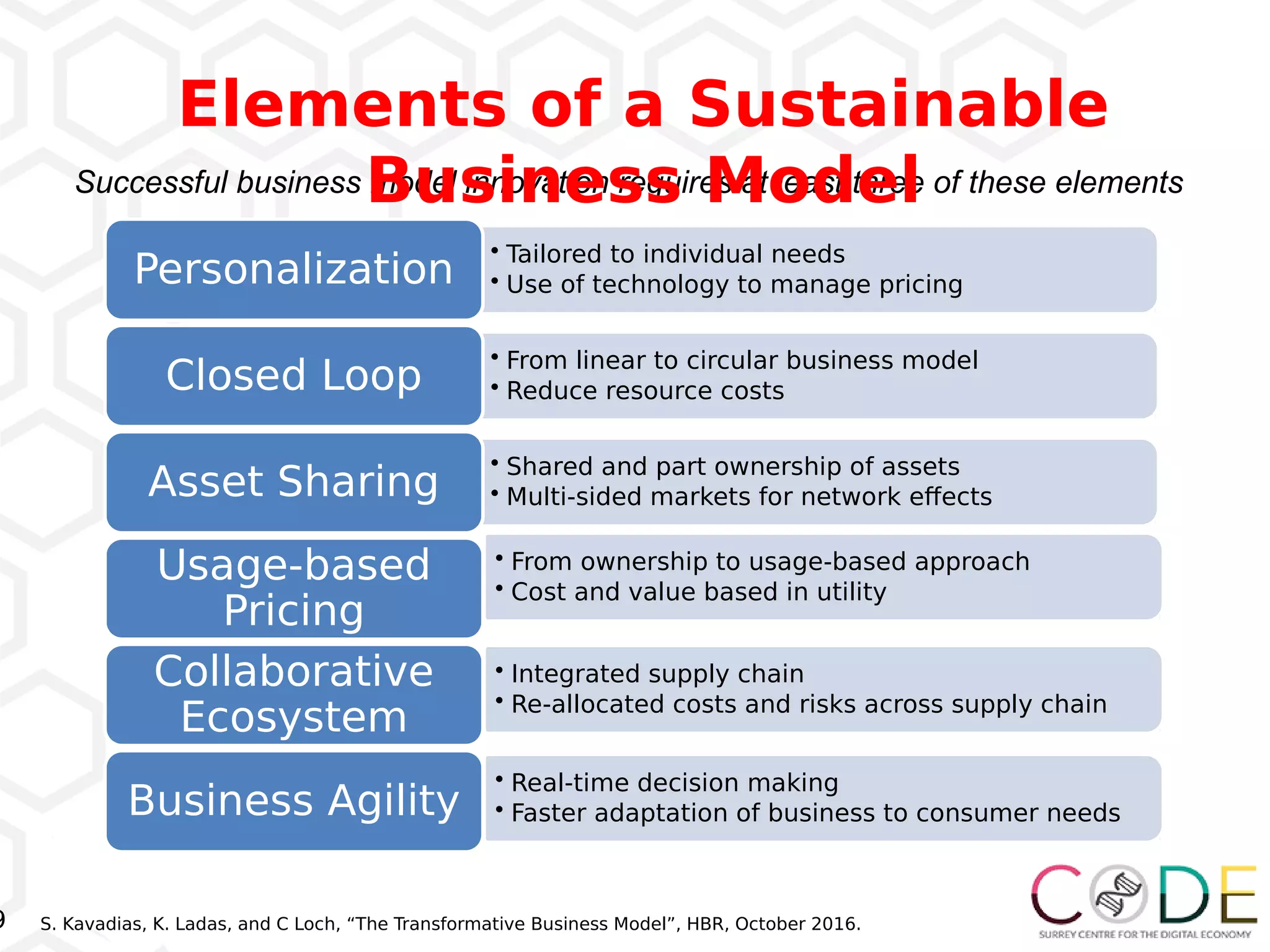
Successful business model innovation requires at least three of these elements
• Tailored to individual needs
• Use of technology to manage pricingPersonalization
• From linear to circular business model
• Reduce resource costsClosed Loop
• Shared and part ownership of assets
• Multi-sided markets for network efectsAsset Sharing
Usage-based
Pricing
Collaborative
Ecosystem
Business Agility
• From ownership to usage-based approach
• Cost and value based in utility
• Integrated supply chain
• Re-allocated costs and risks across supply chain
• Real-time decision making
• Faster adaptation of business to consumer needs
S. Kavadias, K. Ladas, and C Loch, “The Transformative Business Model”, HBR, October 2016.
Elements of a Sustainable
Business Model
0
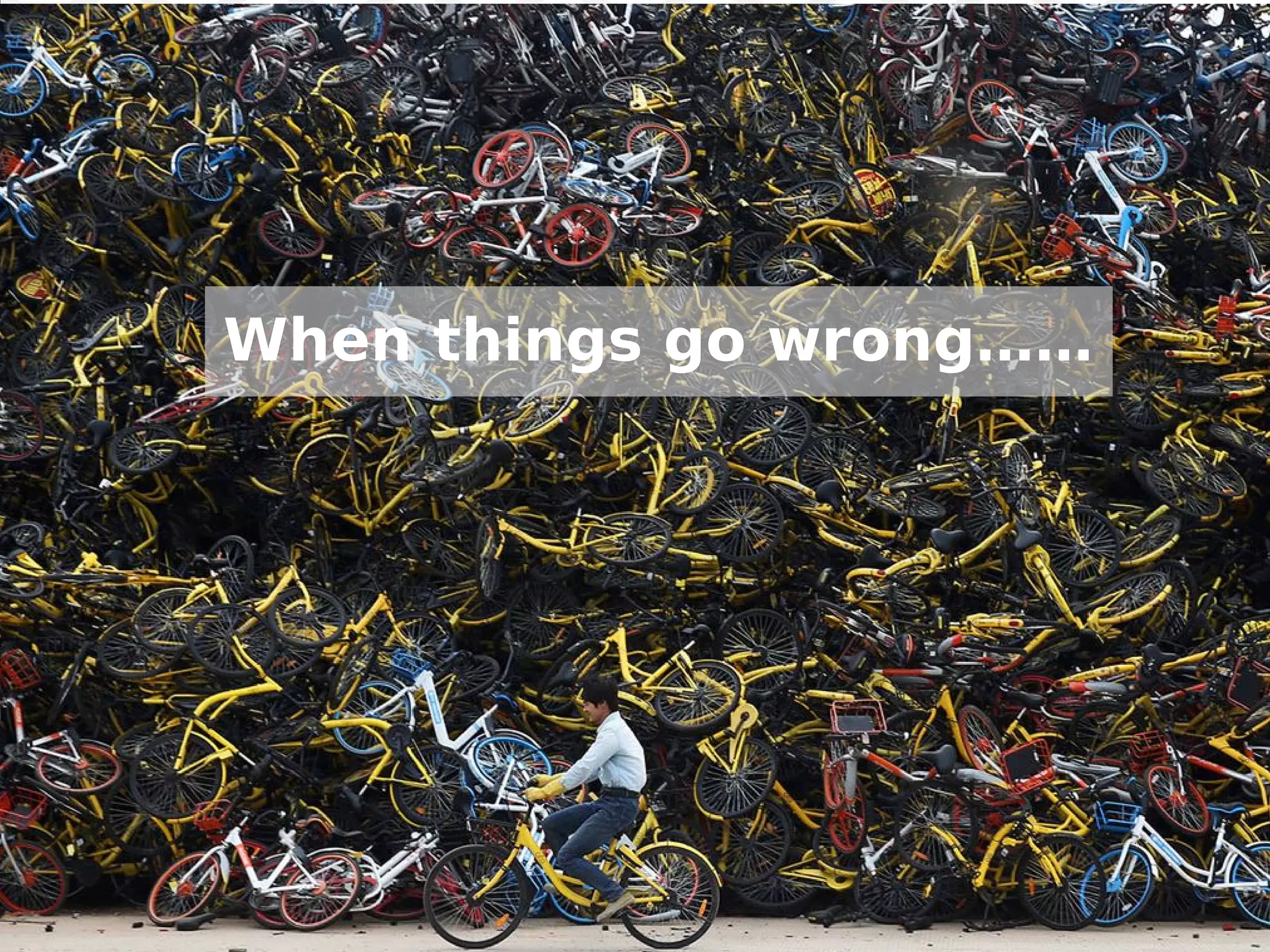
When things go wrong……
1
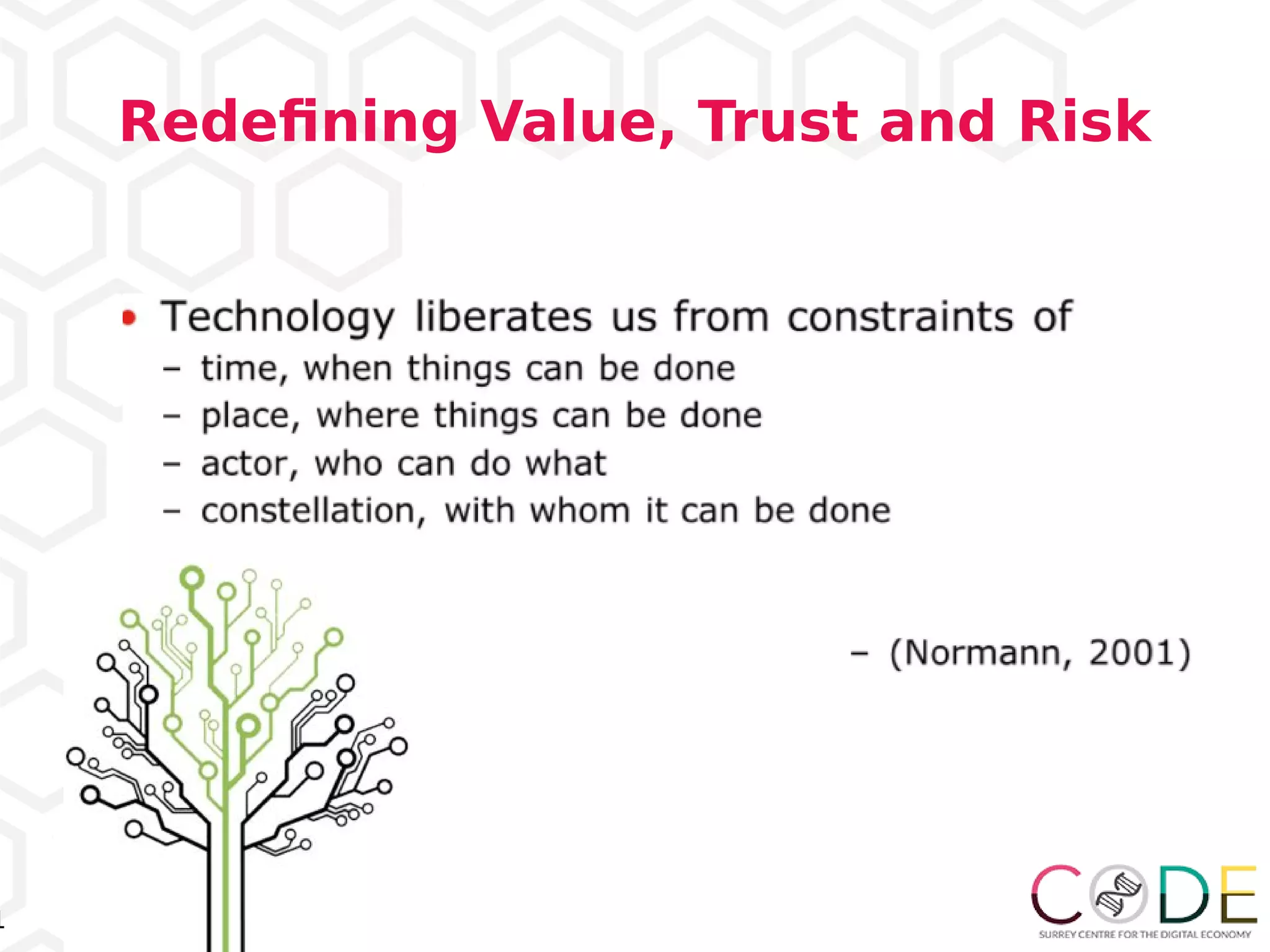
Redefning Value, Trust and Risk
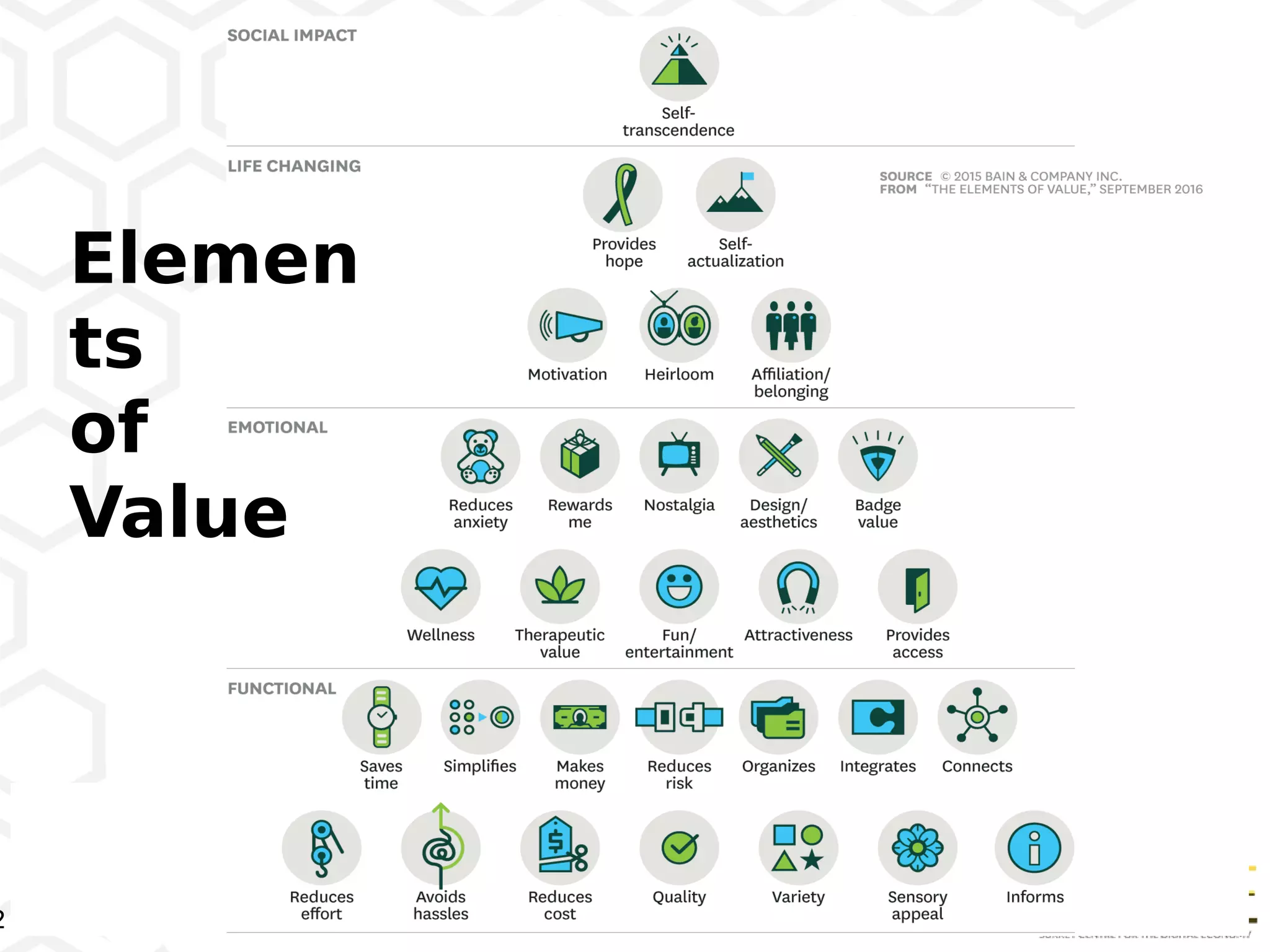
2
Elemen
ts
of
Value
3
Key Elements of Digital Strategy
• Opening up
• Co-creation with clients and stakeholders
• Transparency of activities and processes
• New ideas, solution, suppliers
• Joining up
• Across silos internally and externally
• Public-Private mix
• Outcome-led KPIs
• Smartening up
• Upskilling
• Efcient Processes
• Automation through new technology
4
5
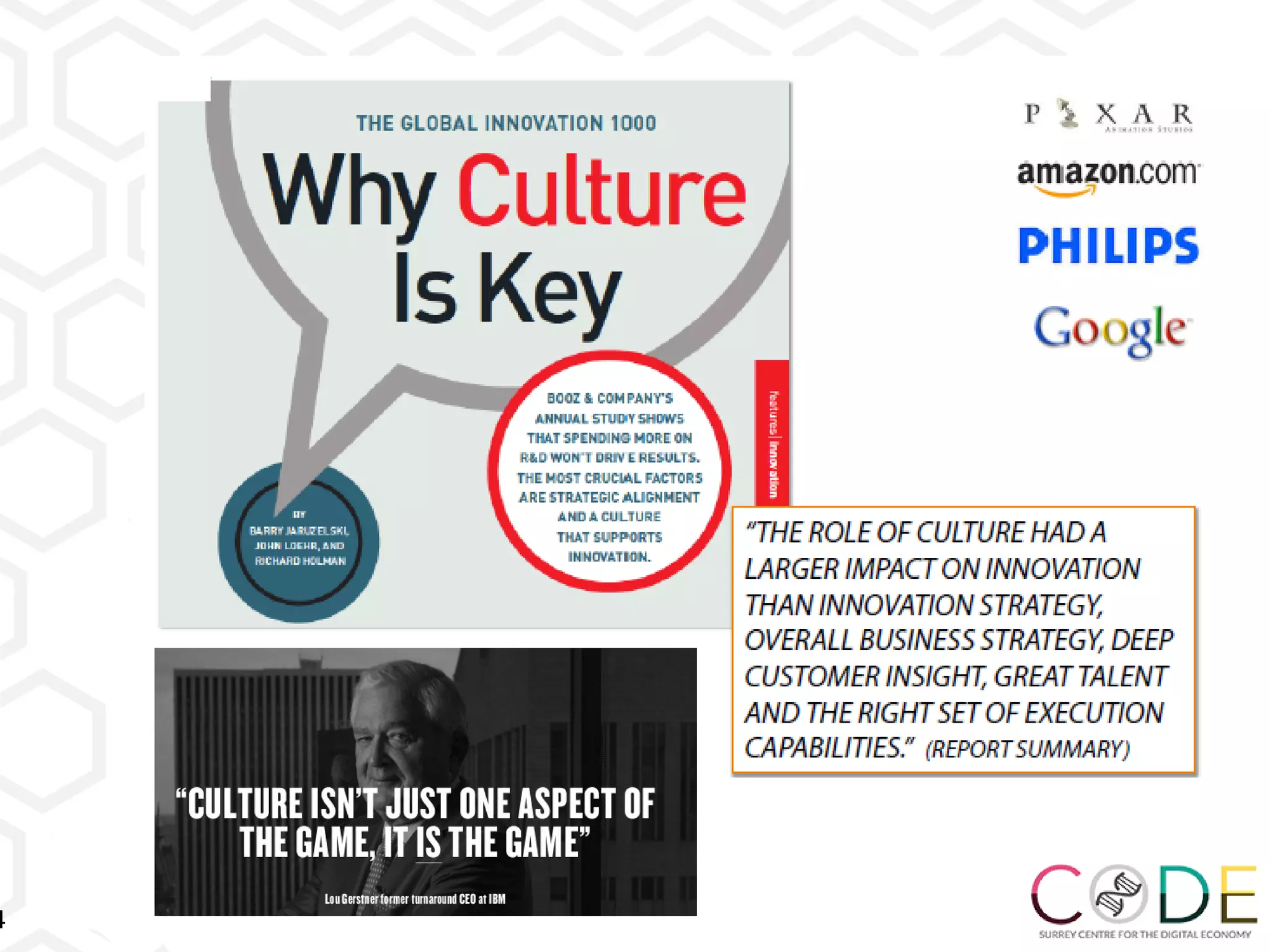
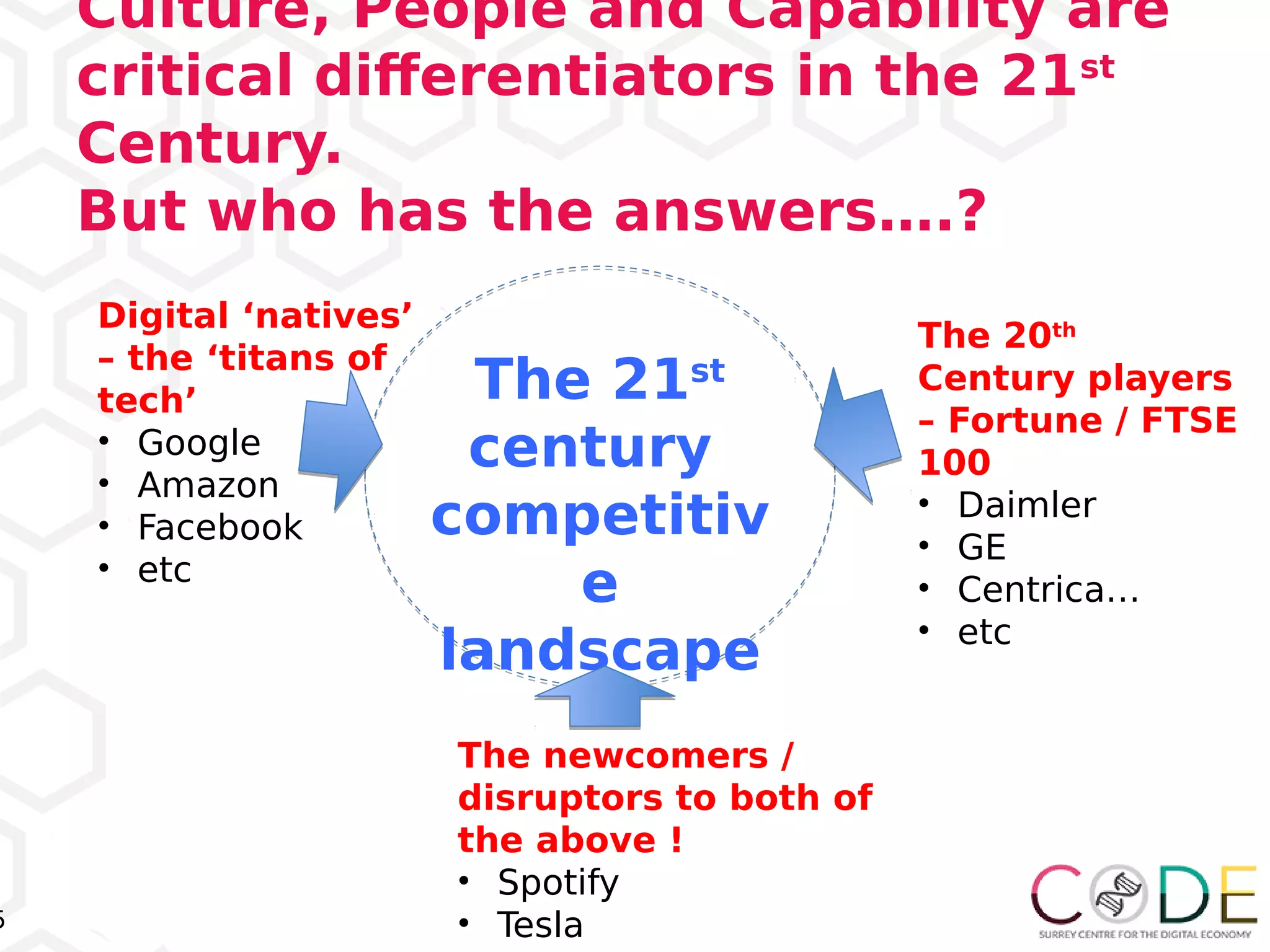
Culture, People and Capability are
critical differentiators in the 21st
Century.
But who has the answers….?
The 21st
century
competitiv
e
landscape
The newcomers /
disruptors to both of
the above !
• Spotify
• Tesla
The 20th
Century players
– Fortune / FTSE
100
• Daimler
• GE
• Centrica…
• etc
Digital ‘natives’
– the ‘titans of
tech’
• Google
• Amazon
• Facebook
• etc
6
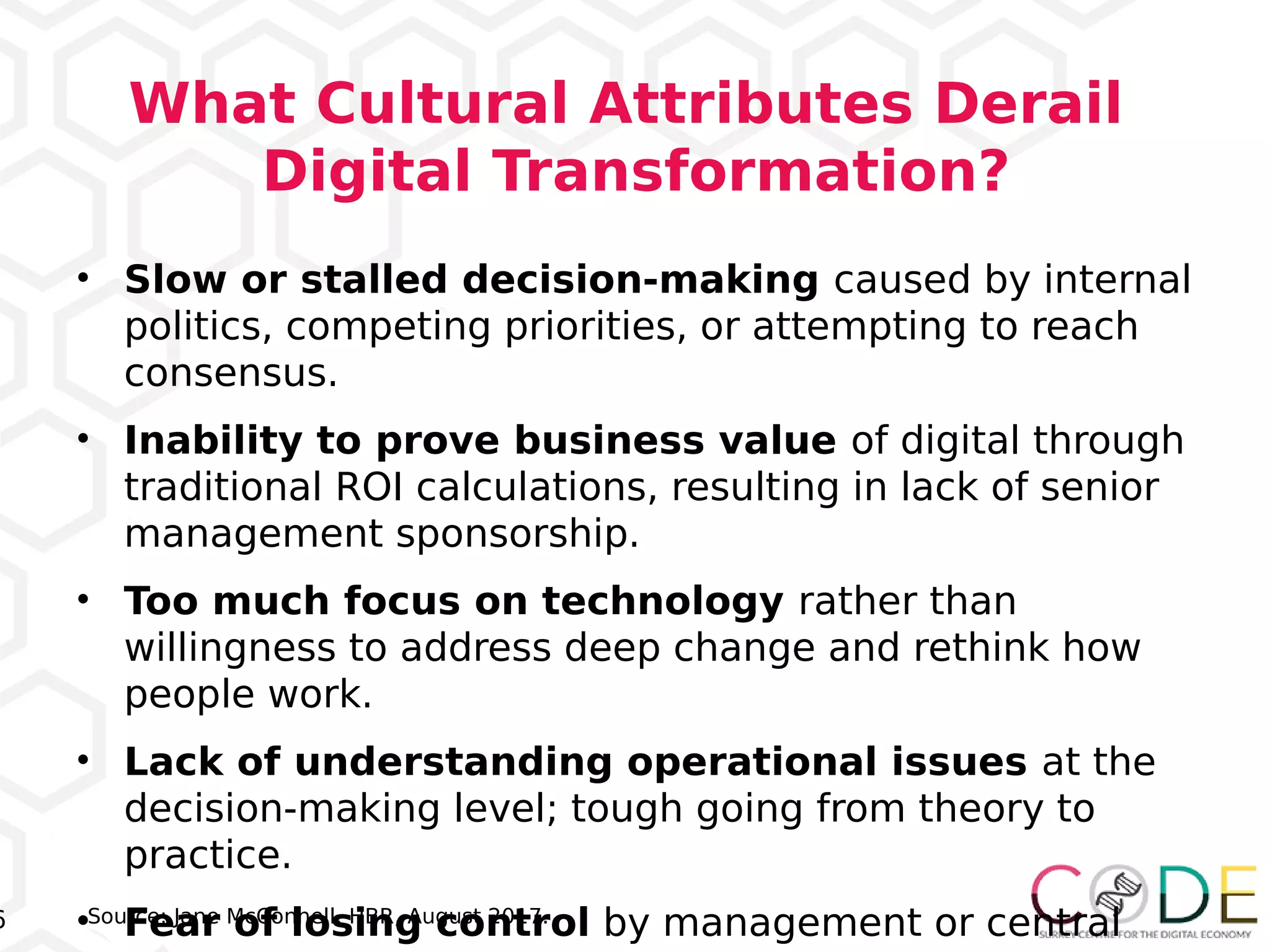
• Slow or stalled decision-making caused by internal
politics, competing priorities, or attempting to reach
consensus.
• Inability to prove business value of digital through
traditional ROI calculations, resulting in lack of senior
management sponsorship.
• Too much focus on technology rather than
willingness to address deep change and rethink how
people work.
• Lack of understanding operational issues at the
decision-making level; tough going from theory to
practice.
• Fear of losing control by management or centralSource: Jane McConnell, HBR, August 2017.
What Cultural Attributes Derail
Digital Transformation?
7
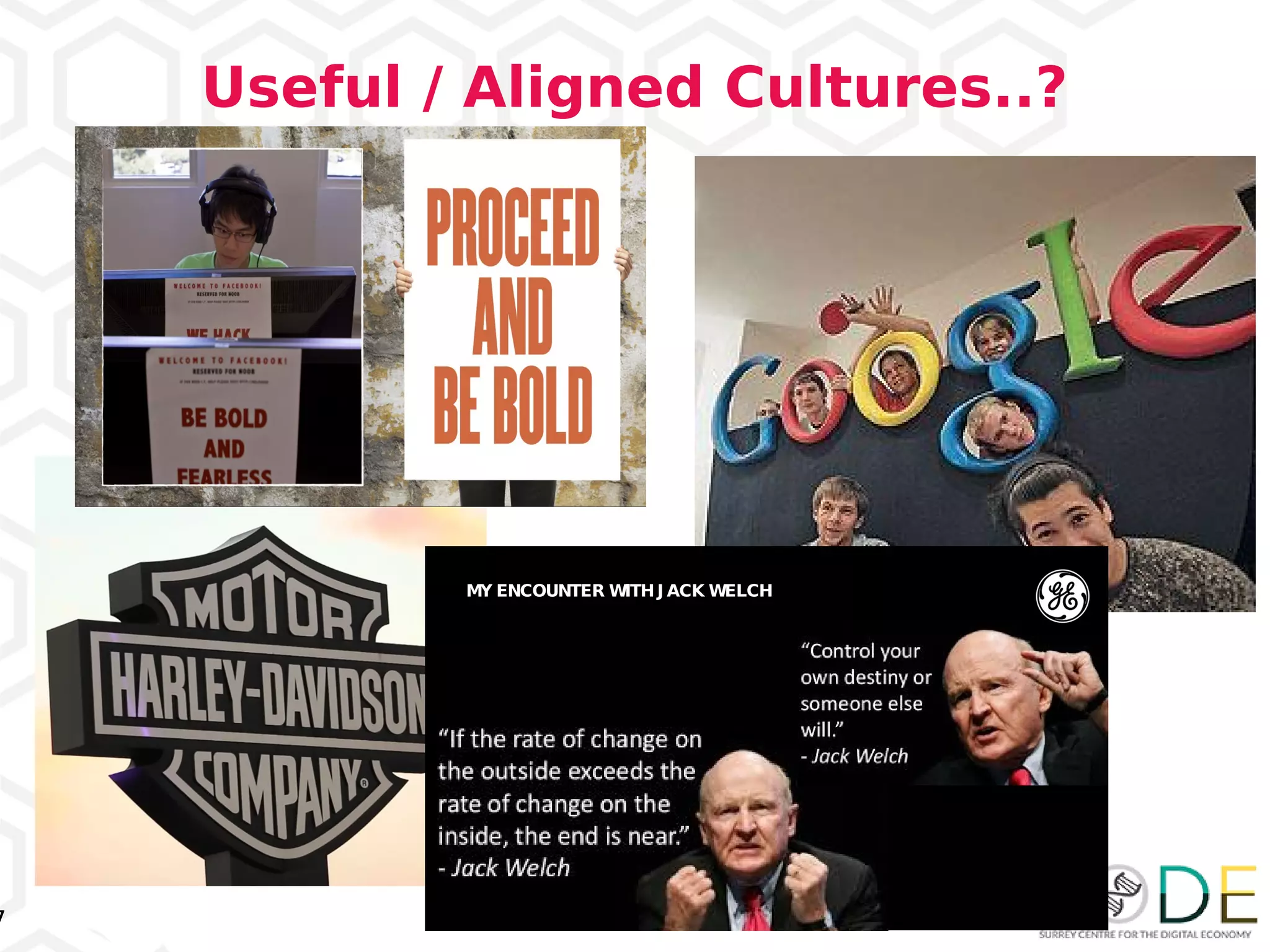
Useful / Aligned Cultures..?
• Facebook
GOLD STANDARD/ PAGE 9 /
MY ENCOUNTER WITH J ACK WELCH
8
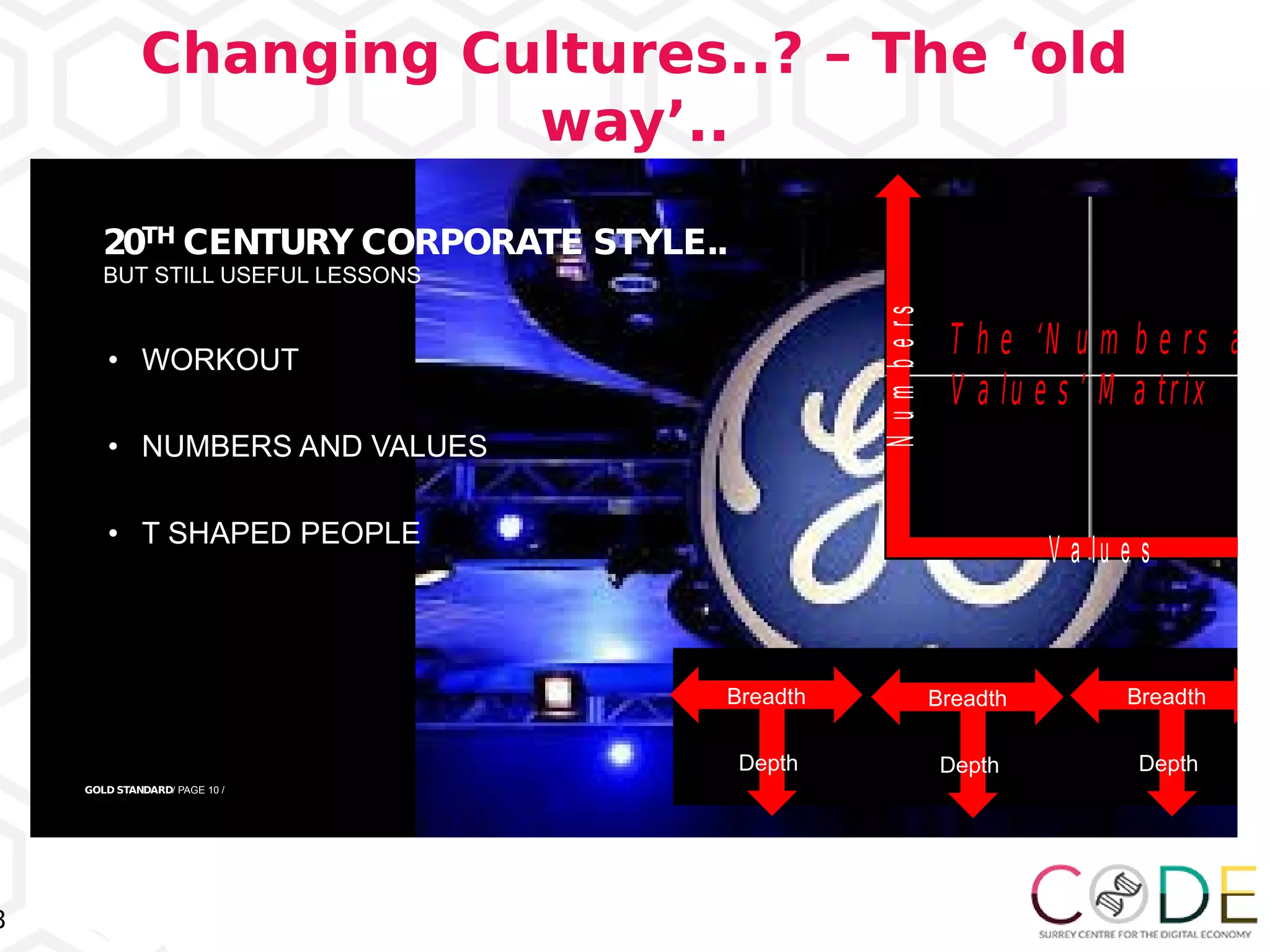
Changing Cultures..? – The ‘old
way’..
GOLD STANDARD/ PAGE 10 /
• WORKOUT
• NUMBERS AND VALUES
• T SHAPED PEOPLE
BUT STILL USEFUL LESSONS
20TH CENTURY CORPORATE STYLE..
V a lu e s
Numbers
T h e ‘N u m b e rs a n
V a lu e s ’ M a trix
Breadth
Depth
Breadth
Depth
Breadth
Depth
9
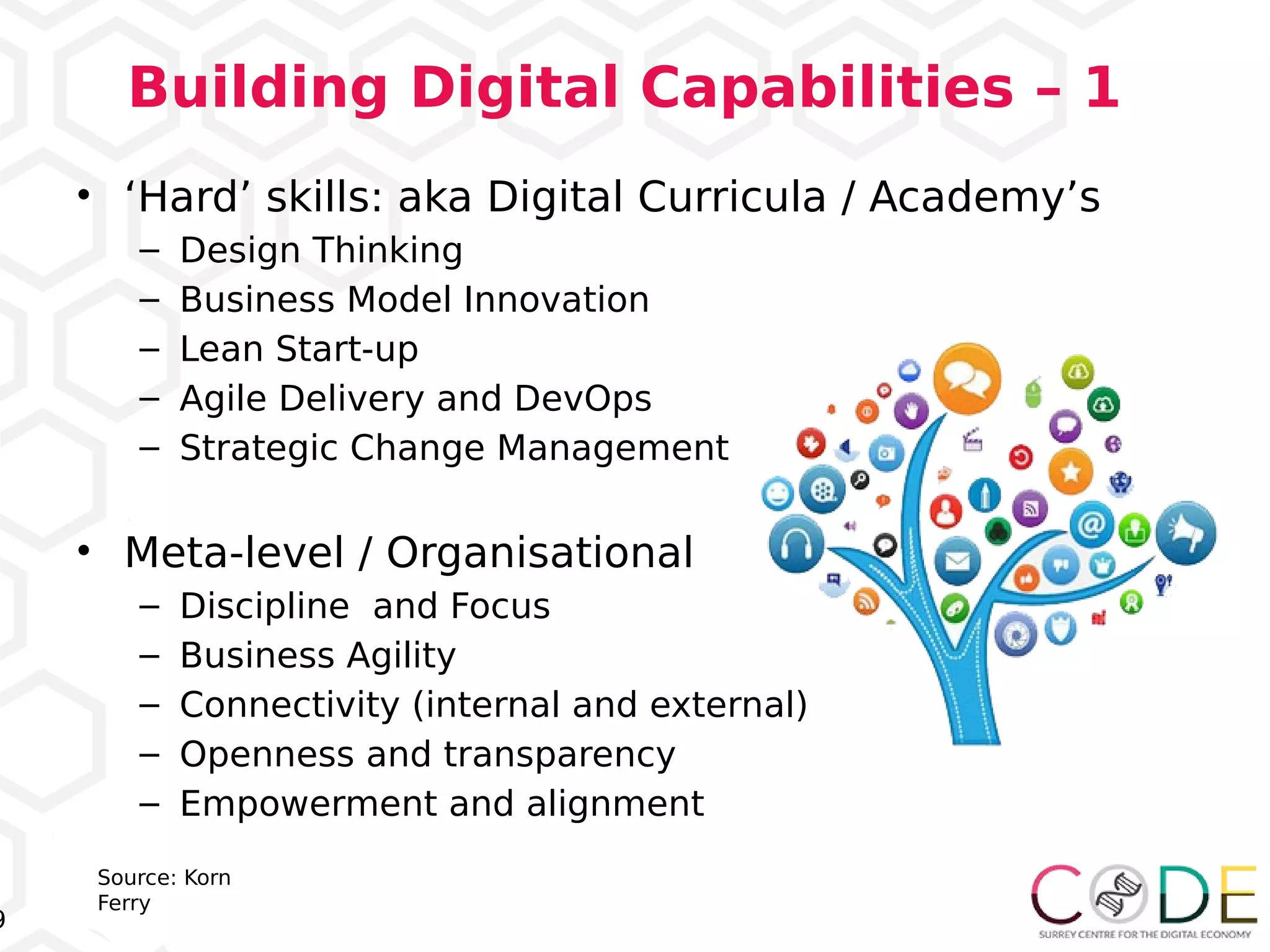
Building Digital Capabilities – 1
• ‘Hard’ skills: aka Digital Curricula / Academy’s
– Design Thinking
– Business Model Innovation
– Lean Start-up
– Agile Delivery and DevOps
– Strategic Change Management
• Meta-level / Organisational
– Discipline and Focus
– Business Agility
– Connectivity (internal and external)
– Openness and transparency
– Empowerment and alignment
Source: Korn
Ferry
0
Building Digital Capabilities – 2
• Soft Skills: Exec Leadership needs to:
– Develop and retain 21st
Century talent
– Manage change well
– Drive execution
– Nurture cross team and company collaboration
– Empowerment and decision making
• Soft Skills: Team Leads need to:
– Listen, communicate, feedback, coach
– Remove roadblocks, not micro-management
– Have real interest in team members’ success and
wellbeing
– Be productive and results orientated
– Help their people with career development
1
Summary
Elements of Digital Transformation
D
F V
feasibl
e
C
What is the cultural
change necessary?

Alan Brown - Digital Transformation Lessons for Practitioners

  • 1.
    Digital Transformation Lessons for Practitioners AlanW. Brown Professor of Entrepreneurship and Innovation Executive Director, Centre for Digital Economy (CoDE) University of Surrey, UK alan.w.brown@surrey.ac.uk www.SurreyCoDE.org Digital Strategist, NotBinary www.NotBinary.co.uk 1
  • 2.
  • 3.
    Digital Transformation: Moving Beyond Technology •Digital as a technology upgrade (internal focus) • Digital as new channels to market (external focus)
  • 4.
    Digital Transformation: Moving Beyond Technology •Digital as a technology upgrade (internal focus) • Digital as new channels to market (external focus) • Digital as new business model opportunities (business model innovation) • Digital as an enabler for social transformation (power redistribution)
  • 5.
    Elements of DigitalTransformation D F V feasibl e C What is the cultural change necessary?
  • 6.
    Toward a Data-drivenWorld • Data quality • Data maintenance • Data liability • Personal data management • Data science skills • Legal implications • Ethical issues Key Challenges:
  • 7.
    Emerging Technology Stack Source:How smart, connected products are transforming competition, HBR, Nov 2014
  • 8.
    Emerging Technology Stack Source:How smart, connected products are transforming competition, HBR, Nov 2014
  • 9.
    • You canaccess information about origins and provenance with greater transparency and distributed governance. • You can better prevent counterfeiting issues around goods such as pharmaceuticals, luxury goods, electronics and diamonds… • You can have end to end visibility across your supply chain allowing you to meet your customers demands for accuracy, transparency and agility. • And more… Blockchain, a distributed public ledger providing a new form of trust mechanism underlying many forms of transaction-based activities Blockchain will fundamentally change business processes
  • 10.
    0 User Raw healthcare data sent to user’schosen aggregator e.g. FitBit, Apple,… Illustrative Example See: http://blockchain.surrey.ac.uk
  • 11.
    1 User Aggregator ML Researchers Raw healthcare datasent to user’s chosen aggregator e.g. FitBit, Apple,… Secondary market for ML models created Illustrative Example See: http://blockchain.surrey.ac.uk
  • 12.
    2 User Aggregator ML Researchers Smart Contracts (Brokers) Practitioners Healthcare providers Interest expressed indiabetes data Raw healthcare data sent to user’s chosen aggregator e.g. FitBit, Apple,… ML used to extract descriptors e.g. diabetes. Encrypts, signs and commits to Blockchain. Secondary market for ML models created Request descriptors of interest (ofer £/day) Offer: Co will pay £0.10 per day of diabetes data? Agree disclosure Disclose keys for descriptors Illustrative Example See: http://blockchain.surrey.ac.uk
  • 13.
    3 Impact  Democratise andcommodify health data – user maintains control. No hoarding!  Creative, new sustainable business models for preventative healthcare ofering new value approaches  Auditable chain of evidence for public health research and epidemiology  Disruption of actuarial science towards real-time –potential to detect early conditions for pre-therapeutic beneft  Crowd-sourced risk management and contract negotiation for particular diseases User Aggregator ML Researchers Smart Contracts (Brokers) Practitioners Healthcare providers Interest expressed in diabetes data Raw healthcare data sent to user’s chosen aggregator e.g. FitBit, Apple,… ML used to extract descriptors e.g. diabetes. Encrypts, signs and commits to Blockchain. Secondary market for ML models created Request descriptors of interest (ofer £/day) Offer: Co will pay £0.10 per day of diabetes data? Agree disclosure Disclose keys for descriptors Illustrative Example See: http://blockchain.surrey.ac.uk
  • 14.
    4 Data-Driven Transformation Examples • Whereis our value? • How do we compete? • Can we market our data and performance expertise? • Do we have the right culture? • How do we leverage brand? • Can we disrupt ourselves? • How do we adapt to VUCA? • What are the key “agile” targets? • Does regulation bring opportunity?
  • 15.
    5 Data-Driven Innovation 4 KeyLessons • Focus on Value – Changing view of value – Jobs-to-be-done • Innovate in the Business Model – 9 key business model elements – From product to service to platform • Learn Fast through Rapid Experimentation – Design thinking – Agile delivery • Think beyond the Data – Data curation, ownership, stewardship – Ethics and cultural issues
  • 16.
  • 17.
  • 18.
  • 19.
    9 Successful business modelinnovation requires at least three of these elements • Tailored to individual needs • Use of technology to manage pricingPersonalization • From linear to circular business model • Reduce resource costsClosed Loop • Shared and part ownership of assets • Multi-sided markets for network efectsAsset Sharing Usage-based Pricing Collaborative Ecosystem Business Agility • From ownership to usage-based approach • Cost and value based in utility • Integrated supply chain • Re-allocated costs and risks across supply chain • Real-time decision making • Faster adaptation of business to consumer needs S. Kavadias, K. Ladas, and C Loch, “The Transformative Business Model”, HBR, October 2016. Elements of a Sustainable Business Model
  • 20.
    0 When things gowrong……
  • 21.
  • 22.
  • 23.
    3 Key Elements ofDigital Strategy • Opening up • Co-creation with clients and stakeholders • Transparency of activities and processes • New ideas, solution, suppliers • Joining up • Across silos internally and externally • Public-Private mix • Outcome-led KPIs • Smartening up • Upskilling • Efcient Processes • Automation through new technology
  • 24.
  • 25.
    5 Culture, People andCapability are critical differentiators in the 21st Century. But who has the answers….? The 21st century competitiv e landscape The newcomers / disruptors to both of the above ! • Spotify • Tesla The 20th Century players – Fortune / FTSE 100 • Daimler • GE • Centrica… • etc Digital ‘natives’ – the ‘titans of tech’ • Google • Amazon • Facebook • etc
  • 26.
    6 • Slow orstalled decision-making caused by internal politics, competing priorities, or attempting to reach consensus. • Inability to prove business value of digital through traditional ROI calculations, resulting in lack of senior management sponsorship. • Too much focus on technology rather than willingness to address deep change and rethink how people work. • Lack of understanding operational issues at the decision-making level; tough going from theory to practice. • Fear of losing control by management or centralSource: Jane McConnell, HBR, August 2017. What Cultural Attributes Derail Digital Transformation?
  • 27.
    7 Useful / AlignedCultures..? • Facebook GOLD STANDARD/ PAGE 9 / MY ENCOUNTER WITH J ACK WELCH
  • 28.
    8 Changing Cultures..? –The ‘old way’.. GOLD STANDARD/ PAGE 10 / • WORKOUT • NUMBERS AND VALUES • T SHAPED PEOPLE BUT STILL USEFUL LESSONS 20TH CENTURY CORPORATE STYLE.. V a lu e s Numbers T h e ‘N u m b e rs a n V a lu e s ’ M a trix Breadth Depth Breadth Depth Breadth Depth
  • 29.
    9 Building Digital Capabilities– 1 • ‘Hard’ skills: aka Digital Curricula / Academy’s – Design Thinking – Business Model Innovation – Lean Start-up – Agile Delivery and DevOps – Strategic Change Management • Meta-level / Organisational – Discipline and Focus – Business Agility – Connectivity (internal and external) – Openness and transparency – Empowerment and alignment Source: Korn Ferry
  • 30.
    0 Building Digital Capabilities– 2 • Soft Skills: Exec Leadership needs to: – Develop and retain 21st Century talent – Manage change well – Drive execution – Nurture cross team and company collaboration – Empowerment and decision making • Soft Skills: Team Leads need to: – Listen, communicate, feedback, coach – Remove roadblocks, not micro-management – Have real interest in team members’ success and wellbeing – Be productive and results orientated – Help their people with career development
  • 31.
    1 Summary Elements of DigitalTransformation D F V feasibl e C What is the cultural change necessary?