PwC CAS Presentation
Fraud Management
Prashant De
Mark Jones
CAMAR 2016, Fall Session
www.pwc.com
PwC
Agenda
1) Insurance Fraud in the news
2) Introduction to Enterprise Fraud Management
a. How companies manage fraud today + Challenges within the industry
b. Analytical Approaches, Solutions and Thoughts on the Future
1. Better technology in Claims and SIU
2. Outsourcing SIUs
3. New (next generation) approaches
3) Model Demo
2
PwC
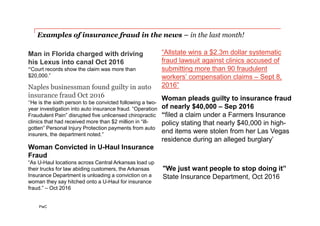
Examples of insurance fraud in the news – in the last month!
Man in Florida charged with driving
his Lexus into canal Oct 2016
“Court records show the claim was more than
$20,000.”
Woman Convicted in U-Haul Insurance
Fraud
“As U-Haul locations across Central Arkansas load up
their trucks for law abiding customers, the Arkansas
Insurance Department is unloading a conviction on a
woman they say hitched onto a U-Haul for insurance
fraud.” – Oct 2016
Naples businessman found guilty in auto
insurance fraud Oct 2016
“He is the sixth person to be convicted following a two-
year investigation into auto insurance fraud. “Operation
Fraudulent Pain” disrupted five unlicensed chiropractic
clinics that had received more than $2 million in “ill-
gotten” Personal Injury Protection payments from auto
insurers, the department noted.”
"We just want people to stop doing it”
State Insurance Department, Oct 2016
Woman pleads guilty to insurance fraud
of nearly $40,000 – Sep 2016
“filed a claim under a Farmers Insurance
policy stating that nearly $40,000 in high-
end items were stolen from her Las Vegas
residence during an alleged burglary’
“Allstate wins a $2.3m dollar systematic
fraud lawsuit against clinics accused of
submitting more than 90 fraudulent
workers’ compensation claims – Sept 8,
2016”
PwC
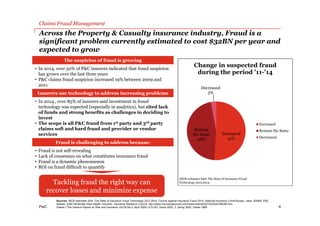
Across the Property & Casualty insurance industry, Fraud is a
significant problem currently estimated to cost $32BN per year and
expected to grow
Increased
51%
Remain
the Same
46%
Decreased
3%
Change in suspected fraud
during the period ’11-’14
Increased
Remain the Same
Decreased
The suspicion of fraud is growing
• In 2014, over 50% of P&C insurers indicated that fraud suspicion
has grown over the last three years
• P&C claims fraud suspicion increased 19% between 2009 and
2011
Insurers use technology to address increasing problems
• In 2014 , over 85% of insurers said investment in fraud
technology was expected (especially in analytics), but cited lack
of funds and strong benefits as challenges in deciding to
invest
• The scope is all P&C fraud from 1st party and 3rd party
claims soft and hard fraud and provider or vendor
services
Fraud is challenging to address because:
• Fraud is not self-revealing
• Lack of consensus on what constitutes insurance fraud
• Fraud is a dynamic phenomenon
• ROI on fraud difficult to quantify
Sources: NICB estimates SAS :The State of Insurance Fraud Technology 2012,2014, Council Against Insurance Fraud 2014, National Insurance Crime Bureau, news. $30BN P&C
release, 2/28/12Estimate (Non-Health Insurers), Insurance Research Council, http://www.insurancejournal.com/news/national/2015/02/04/356392.htm
Viaene (“The Geneva Papers on Risk and Insurance Vol.29 No.2 (April 2004) 313-333, Dione 2002, 2, Derrig 2002, Clarke 1989
Tackling fraud the right way can
recover losses and minimize expense
NICB estimates SAS :The State of Insurance Fraud
Technology 2012,2014
Claims Fraud Management
4
PwC
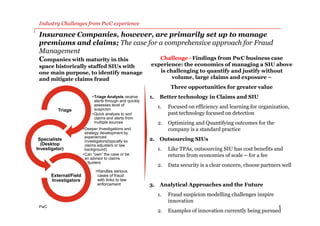
Insurance Companies, however, are primarily set up to manage
premiums and claims; The case for a comprehensive approach for Fraud
Management
Companies with maturity in this
space historically staffed SIUs with
one main purpose, to identify manage
and mitigate claims fraud
5
Challenge - Findings from PwC business case
experience: the economics of managing a SIU above
is challenging to quantify and justify without
volume, large claims and exposure –
Three opportunities for greater value
1. Better technology in Claims and SIU
1. Focused on efficiency and learning for organization,
past technology focused on detection
2. Optimizing and Quantifying outcomes for the
company is a standard practice
2. Outsourcing SIUs
1. Like TPAs, outsourcing SIU has cost benefits and
returns from economies of scale – for a fee
2. Data security is a clear concern, choose partners well
3. Analytical Approaches and the Future
1. Fraud suspicion modelling challenges inspire
innovation
2. Examples of innovation currently being pursued
Industry Challenges from PwC experience
•Triage Analysts receive
alerts through and quickly
assesses level of
suspicion
•Quick analysis to sort
claims and alerts from
multiple sources
Triage
•Deeper Investigations and
strategy development by
experienced
investigators(typically ex
claims adjusters or law
background)
•Can “own” the case or be
an advisor to claims
adjusters
Specialists
(Desktop
Investigator)
•Handles serious
cases of fraud
with links to law
enforcement
External/Field
Investigators
PwC
1a Humans and machines learn from each other
Important decisions from identification, economic to moral decisions is a
reflection of (collective) human decisions
6
Better technology in Claims and SIU : It’s not all about automation!
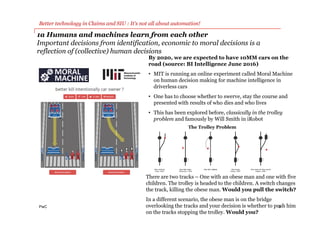
By 2020, we are expected to have 10MM cars on the
road (source: BI Intelligence June 2016)
• MIT is running an online experiment called Moral Machine
on human decision making for machine intelligence in
driverless cars
• One has to choose whether to swerve, stay the course and
presented with results of who dies and who lives
• This has been explored before, classically in the trolley
problem and famously by Will Smith in iRobot
The Trolley Problem
There are two tracks – One with an obese man and one with five
children. The trolley is headed to the children. A switch changes
the track, killing the obese man. Would you pull the switch?
In a different scenario, the obese man is on the bridge
overlooking the tracks and your decision is whether to push him
on the tracks stopping the trolley. Would you?
PwC
1b Decisions in Claims and SIU improved by balancing Human and
Machine Intelligence and optimizing outcomes - Typical technology
solutions on the market can already use or be augmented to use a learning
approach
7
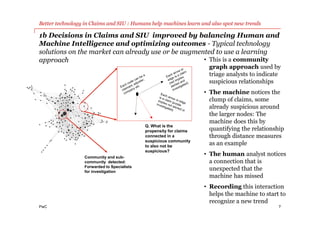
Community and sub-
community detected:
Forwarded to Specialists
for investigation
Q. What is the
propensity for claims
connected in a
suspicious community
to also not be
suspicious?
• This is a community
graph approach used by
triage analysts to indicate
suspicious relationships
• The machine notices the
clump of claims, some
already suspicious around
the larger nodes: The
machine does this by
quantifying the relationship
through distance measures
as an example
• The human analyst notices
a connection that is
unexpected that the
machine has missed
• Recording this interaction
helps the machine to start to
recognize a new trend
Better technology in Claims and SIU : Humans help machines learn and also spot new trends
PwC
First Notice of
Loss
Immediate
Investigation for
Suspicion
Direct to
Investigator
Adjuster-
Investigator
Regular Claims
Process
Adjuster
Reviews for
Suspicion
Referred to SIU
(Triage)
Technology
Reviews for
Suspicion
Referred to SIU
(Triage)
Accepted
Case Open
Desktop
Investigators
Pursue with
Adjusters
Pursue with
Negotiation
Pursue with
Field
Investigation
Do Not Pursue
Case Closed
Case Re-Opened
Case Closed
without
Recovery /
Indemnity
Reduction /
Indemnity
Reduction
Case Closed
with Recovery /
Indemnity
Reduction
Rejected (False
Positive)
Meritorious
Claim for Fast
Processing
Case Re-
Referred
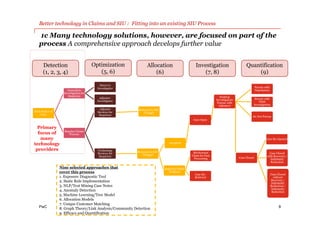
1c Many technology solutions, however, are focused on part of the
process A comprehensive approach develops further value
8
Better technology in Claims and SIU : Fitting into an existing SIU Process
Detection
(1, 2, 3, 4)
Optimization
(5, 6)
Investigation
(7, 8)
Quantification
(9)
Allocation
(6)
Nine selected approaches that
cover this process
1. Exposure Diagnostic Tool
2. Static Rule Implementation
3. NLP/Text Mining Case Notes
4. Anomaly Detection
5. Machine Learning/Tree Model
6. Allocation Models
7. Unique Customer Matching
8. Graph Theory/Link Analysis/Community Detection
9. Efficacy and Quantification
Primary
focus of
many
technology
providers
PwC
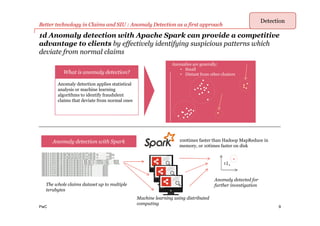
1d Anomaly detection with Apache Spark can provide a competitive
advantage to clients by effectively identifying suspicious patterns which
deviate from normal claims
......
.
Anomaly detected for
further investigation
Machine learning using distributed
computing
The whole claims dataset up to multiple
terabytes
100times faster than Hadoop MapReduce in
memory, or 10times faster on disk
Anomaly detection with Spark
Anomalies are generally:
• Small
• Distant from other clustersWhat is anomaly detection?
Anomaly detection applies statistical
analysis or machine learning
algorithms to identify fraudulent
claims that deviate from normal ones
Better technology in Claims and SIU : Anomaly Detection as a first approach
9
Detection
PwC
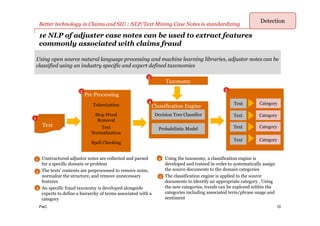
• Unstructured adjustor notes are collected and parsed
for a specific domain or problem
• The texts’ contents are preprocessed to remove noise,
normalize the structure, and remove unnecessary
features
• An specific fraud taxonomy is developed alongside
experts to define a hierarchy of terms associated with a
category
• Using the taxonomy, a classification engine is
developed and trained in order to systematically assign
the source documents to the domain categories
• The classification engine is applied to the source
documents to identify an appropriate category . Using
the new categories, trends can be explored within the
categories including associated term/phrase usage and
sentiment
1e NLP of adjuster case notes can be used to extract features
commonly associated with claims fraud
TaxonomyTaxonomy
Text
Pre ProcessingPre Processing
Tokenization
Stop Word
Removal
Spell Checking
Text
Normalization
Classification EngineClassification Engine
Probabilistic Model
Decision Tree Classifier
Text Category
Text Category
Text Category
Text Category
1
2
4
5
3
Using open source natural language processing and machine learning libraries, adjustor notes can be
classified using an industry specific and expert defined taxonomies
1
2
3
4
5
Better technology in Claims and SIU : NLP/Text Mining Case Notes is standardizing
10
Detection
PwC
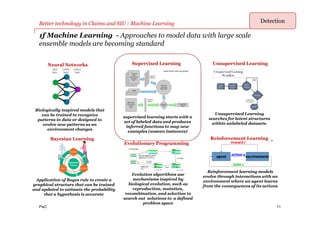
1f Machine Learning - Approaches to model data with large scale
ensemble models are becoming standard
Supervised LearningNeural Networks
Bayesian Learning
Unsupervised Learning
Reinforcement Learning
Unsupervised Learning
searches for latent structures
within unlabeled datasets.
supervised learning starts with a
set of labeled data and produces
inferred functions to map new
examples (unseen instances)
Reinforcement learning models
evolve through interactions with an
environment where an agent learns
from the consequences of its actions
Biologically inspired models that
can be trained to recognize
patterns in data or designed to
evolve new patterns as an
environment changes
Application of Bayes rule to create a
graphical structure that can be trained
and updated to estimate the probability
that a hypothesis is accurate
Evolutionary Programming
Evolution algorithms use
mechanisms inspired by
biological evolution, such as
reproduction, mutation,
recombination, and selection to
search out solutions to a defined
problem space
Better technology in Claims and SIU : Machine Learning
11
Detection
PwC
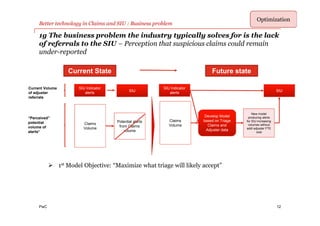
1g The business problem the industry typically solves for is the lack
of referrals to the SIU – Perception that suspicious claims could remain
under-reported
12
Optimization
SIU Indicator
alerts
Potential alerts
from Claims
volume
Current Volume
of adjuster
referrals
“Perceived”
potential
volume of
alerts*
Current State
SIU
Future state
SIU Indicator
alerts
Claims
Volume
Develop Model
based on Triage
Claims and
Adjuster data
SIU
New model
producing alerts
for SIU increasing
volumes without
addl adjuster FTE
cost
Claims
Volume
 1st Model Objective: “Maximize what triage will likely accept”
Better technology in Claims and SIU : Business problem
PwC
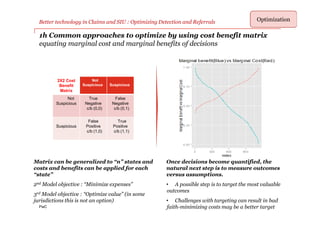
Better technology in Claims and SIU : Optimizing Detection and Referrals Optimization
2X2 Cost
Benefit
Matrix
Not
Suspicious Suspicious
Not
Suspicious
True
Negative
c/b (0,0)
False
Negative
c/b (0,1)
Suspicious
False
Positive
c/b (1,0)
True
Positive
c/b (1,1)
1h Common approaches to optimize by using cost benefit matrix
equating marginal cost and marginal benefits of decisions
Matrix can be generalized to “n” states and
costs and benefits can be applied for each
“state”
2nd Model objective : “Minimize expenses”
3rd Model objective : “Optimize value” (in some
jurisdictions this is not an option)
Once decisions become quantified, the
natural next step is to measure outcomes
versus assumptions.
• A possible step is to target the most valuable
outcomes
• Challenges with targeting can result in bad
faith-minimizing costs may be a better target
PwC
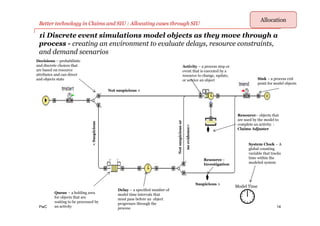
1i Discrete event simulations model objects as they move through a
process - creating an environment to evaluate delays, resource constraints,
and demand scenarios
14
Model Time
Decisions – probabilistic
and discrete choices that
are based on resource
attributes and can direct
and objects state
Queue – a holding area
for objects that are
waiting to be processed by
an activity
System Clock – A
global counting
variable that tracks
time within the
modeled system
Sink – a process exit
point for model objects
Delay – a specified number of
model time intervals that
must pass before an object
progresses through the
process
Activity – a process step or
event that is executed by a
resource to change, update,
or service an object
Better technology in Claims and SIU : Allocating cases through SIU
Allocation
Not suspicious >
<Suspicious
Resource– objects that
are used by the model to
complete an activity. :
Claims Adjuster
Notsuspiciousor
noevidence>
Resource -
Investigation
Suspicious >
PwC
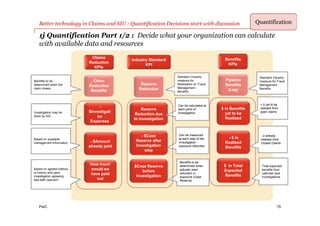
1j Quantification Part 1/2 : Decide what your organization can calculate
with available data and resources
15
Quantification
Claim
Reduction
Benefits
- $Amount
already paid
How much
would we
have paid
out
Claims
Reduction
KPIs
Benefits to be
determined when the
claim closes
Based on agreed metrics
or history and upon
investigation agreeing
bad faith claimant
-
$Investigati
on
Expenses
Reserve
Reduction
Pipeline
Benefits
(Lag)
Based on available
management information
Investigation may be
done by SIU
$Case Reserve
before
Investigation
- $Case
Reserve after
Investigation
step
Reserve
Reduction due
to investigation
$ in Total
Expected
Benefits
- $ in
Realized
Benefits
$ in Benefits
yet to be
Realized
Standard Industry
measure for
Realization of Fraud
Management
Benefits
Can be calculated at
each point of
investigation
Can be measured
at each step of the
investigation -
exposure reduction
Benefits to be
determined when
adjuster sees
reduction in
exposure (Case
Reserve)
Industry Standard
KPI
Benefits
KPIs
Standard Industry
measure for Fraud
Management
Benefits
= $ yet to be
realized from
open claims
- $ already
realized from
Closed Claims
Total expected
benefits from
calendar year
investigations
Better technology in Claims and SIU : Quantification Decisions start with discussion
PwC 16
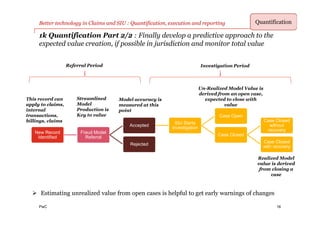
1k Quantification Part 2/2 : Finally develop a predictive approach to the
expected value creation, if possible in jurisdiction and monitor total value
QuantificationBetter technology in Claims and SIU : Quantification, execution and reporting
New Record
Identified
Fraud Model
Referral
Accepted
SIU Starts
Investigation
Case Open
Case Closed
Case Closed
without
recovery
Case Closed
with recovery
Rejected
This record can
apply to claims,
internal
transactions,
billings, claims
Model accuracy is
measured at this
point
Streamlined
Model
Production is
Key to value
Realized Model
value is derived
from closing a
case
Investigation PeriodReferral Period
Un-Realized Model Value is
derived from an open case,
expected to close with
value
 Estimating unrealized value from open cases is helpful to get early warnings of changes
PwC
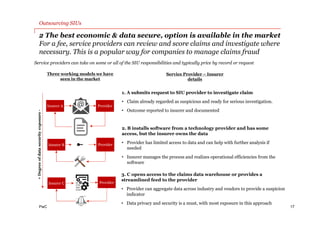
2 The best economic & data secure, option is available in the market
For a fee, service providers can review and score claims and investigate where
necessary. This is a popular way for companies to manage claims fraud
Service providers can take on some or all of the SIU responsibilities and typically price by record or request
17
Insurer A
Provider
Insurer C
+Degreeofdatasecurityexposure-
Three working models we have
seen in the market
1. A submits request to SIU provider to investigate claim
• Claim already regarded as suspicious and ready for serious investigation.
• Outcome reported to insurer and documented
2. B installs software from a technology provider and has some
access, but the insurer owns the data
• Provider has limited access to data and can help with further analysis if
needed
• Insurer manages the process and realizes operational efficiencies from the
software
Service Provider – Insurer
details
Provider
Insurer B
Provider
3. C opens access to the claims data warehouse or provides a
streamlined feed to the provider
• Provider can aggregate data across industry and vendors to provide a suspicion
indicator
• Data privacy and security is a must, with most exposure in this approach
Outsourcing SIUs
PwC
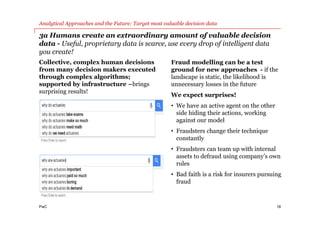
3a Humans create an extraordinary amount of valuable decision
data - Useful, proprietary data is scarce, use every drop of intelligent data
you create!
18
Analytical Approaches and the Future: Target most valuable decision data
Collective, complex human decisions
from many decision makers executed
through complex algorithms;
supported by infrastructure –brings
surprising results!
Fraud modelling can be a test
ground for new approaches - if the
landscape is static, the likelihood is
unnecessary losses in the future
We expect surprises!
• We have an active agent on the other
side hiding their actions, working
against our model
• Fraudsters change their technique
constantly
• Fraudsters can team up with internal
assets to defraud using company’s own
rules
• Bad faith is a risk for insurers pursuing
fraud
PwC
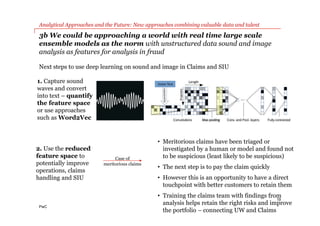
3b We could be approaching a world with real time large scale
ensemble models as the norm with unstructured data sound and image
analysis as features for analysis in fraud
Next steps to use deep learning on sound and image in Claims and SIU
19
Analytical Approaches and the Future: New approaches combining valuable data and talent
1. Capture sound
waves and convert
into text – quantify
the feature space
or use approaches
such as Word2Vec
2. Use the reduced
feature space to
potentially improve
operations, claims
handling and SIU
Case of
meritorious claims
• Meritorious claims have been triaged or
investigated by a human or model and found not
to be suspicious (least likely to be suspicious)
• The next step is to pay the claim quickly
• However this is an opportunity to have a direct
touchpoint with better customers to retain them
• Training the claims team with findings from
analysis helps retain the right risks and improve
the portfolio – connecting UW and Claims
PwC
Questions
20

Fraud Management_CAS_Presentation_Oct2016

  • 1.
    PwC CAS Presentation FraudManagement Prashant De Mark Jones CAMAR 2016, Fall Session www.pwc.com
  • 2.
    PwC Agenda 1) Insurance Fraudin the news 2) Introduction to Enterprise Fraud Management a. How companies manage fraud today + Challenges within the industry b. Analytical Approaches, Solutions and Thoughts on the Future 1. Better technology in Claims and SIU 2. Outsourcing SIUs 3. New (next generation) approaches 3) Model Demo 2
  • 3.
    PwC Examples of insurancefraud in the news – in the last month! Man in Florida charged with driving his Lexus into canal Oct 2016 “Court records show the claim was more than $20,000.” Woman Convicted in U-Haul Insurance Fraud “As U-Haul locations across Central Arkansas load up their trucks for law abiding customers, the Arkansas Insurance Department is unloading a conviction on a woman they say hitched onto a U-Haul for insurance fraud.” – Oct 2016 Naples businessman found guilty in auto insurance fraud Oct 2016 “He is the sixth person to be convicted following a two- year investigation into auto insurance fraud. “Operation Fraudulent Pain” disrupted five unlicensed chiropractic clinics that had received more than $2 million in “ill- gotten” Personal Injury Protection payments from auto insurers, the department noted.” "We just want people to stop doing it” State Insurance Department, Oct 2016 Woman pleads guilty to insurance fraud of nearly $40,000 – Sep 2016 “filed a claim under a Farmers Insurance policy stating that nearly $40,000 in high- end items were stolen from her Las Vegas residence during an alleged burglary’ “Allstate wins a $2.3m dollar systematic fraud lawsuit against clinics accused of submitting more than 90 fraudulent workers’ compensation claims – Sept 8, 2016”
  • 4.
    PwC Across the Property& Casualty insurance industry, Fraud is a significant problem currently estimated to cost $32BN per year and expected to grow Increased 51% Remain the Same 46% Decreased 3% Change in suspected fraud during the period ’11-’14 Increased Remain the Same Decreased The suspicion of fraud is growing • In 2014, over 50% of P&C insurers indicated that fraud suspicion has grown over the last three years • P&C claims fraud suspicion increased 19% between 2009 and 2011 Insurers use technology to address increasing problems • In 2014 , over 85% of insurers said investment in fraud technology was expected (especially in analytics), but cited lack of funds and strong benefits as challenges in deciding to invest • The scope is all P&C fraud from 1st party and 3rd party claims soft and hard fraud and provider or vendor services Fraud is challenging to address because: • Fraud is not self-revealing • Lack of consensus on what constitutes insurance fraud • Fraud is a dynamic phenomenon • ROI on fraud difficult to quantify Sources: NICB estimates SAS :The State of Insurance Fraud Technology 2012,2014, Council Against Insurance Fraud 2014, National Insurance Crime Bureau, news. $30BN P&C release, 2/28/12Estimate (Non-Health Insurers), Insurance Research Council, http://www.insurancejournal.com/news/national/2015/02/04/356392.htm Viaene (“The Geneva Papers on Risk and Insurance Vol.29 No.2 (April 2004) 313-333, Dione 2002, 2, Derrig 2002, Clarke 1989 Tackling fraud the right way can recover losses and minimize expense NICB estimates SAS :The State of Insurance Fraud Technology 2012,2014 Claims Fraud Management 4
  • 5.
    PwC Insurance Companies, however,are primarily set up to manage premiums and claims; The case for a comprehensive approach for Fraud Management Companies with maturity in this space historically staffed SIUs with one main purpose, to identify manage and mitigate claims fraud 5 Challenge - Findings from PwC business case experience: the economics of managing a SIU above is challenging to quantify and justify without volume, large claims and exposure – Three opportunities for greater value 1. Better technology in Claims and SIU 1. Focused on efficiency and learning for organization, past technology focused on detection 2. Optimizing and Quantifying outcomes for the company is a standard practice 2. Outsourcing SIUs 1. Like TPAs, outsourcing SIU has cost benefits and returns from economies of scale – for a fee 2. Data security is a clear concern, choose partners well 3. Analytical Approaches and the Future 1. Fraud suspicion modelling challenges inspire innovation 2. Examples of innovation currently being pursued Industry Challenges from PwC experience •Triage Analysts receive alerts through and quickly assesses level of suspicion •Quick analysis to sort claims and alerts from multiple sources Triage •Deeper Investigations and strategy development by experienced investigators(typically ex claims adjusters or law background) •Can “own” the case or be an advisor to claims adjusters Specialists (Desktop Investigator) •Handles serious cases of fraud with links to law enforcement External/Field Investigators
  • 6.
    PwC 1a Humans andmachines learn from each other Important decisions from identification, economic to moral decisions is a reflection of (collective) human decisions 6 Better technology in Claims and SIU : It’s not all about automation! By 2020, we are expected to have 10MM cars on the road (source: BI Intelligence June 2016) • MIT is running an online experiment called Moral Machine on human decision making for machine intelligence in driverless cars • One has to choose whether to swerve, stay the course and presented with results of who dies and who lives • This has been explored before, classically in the trolley problem and famously by Will Smith in iRobot The Trolley Problem There are two tracks – One with an obese man and one with five children. The trolley is headed to the children. A switch changes the track, killing the obese man. Would you pull the switch? In a different scenario, the obese man is on the bridge overlooking the tracks and your decision is whether to push him on the tracks stopping the trolley. Would you?
  • 7.
    PwC 1b Decisions inClaims and SIU improved by balancing Human and Machine Intelligence and optimizing outcomes - Typical technology solutions on the market can already use or be augmented to use a learning approach 7 Community and sub- community detected: Forwarded to Specialists for investigation Q. What is the propensity for claims connected in a suspicious community to also not be suspicious? • This is a community graph approach used by triage analysts to indicate suspicious relationships • The machine notices the clump of claims, some already suspicious around the larger nodes: The machine does this by quantifying the relationship through distance measures as an example • The human analyst notices a connection that is unexpected that the machine has missed • Recording this interaction helps the machine to start to recognize a new trend Better technology in Claims and SIU : Humans help machines learn and also spot new trends
  • 8.
    PwC First Notice of Loss Immediate Investigationfor Suspicion Direct to Investigator Adjuster- Investigator Regular Claims Process Adjuster Reviews for Suspicion Referred to SIU (Triage) Technology Reviews for Suspicion Referred to SIU (Triage) Accepted Case Open Desktop Investigators Pursue with Adjusters Pursue with Negotiation Pursue with Field Investigation Do Not Pursue Case Closed Case Re-Opened Case Closed without Recovery / Indemnity Reduction / Indemnity Reduction Case Closed with Recovery / Indemnity Reduction Rejected (False Positive) Meritorious Claim for Fast Processing Case Re- Referred 1c Many technology solutions, however, are focused on part of the process A comprehensive approach develops further value 8 Better technology in Claims and SIU : Fitting into an existing SIU Process Detection (1, 2, 3, 4) Optimization (5, 6) Investigation (7, 8) Quantification (9) Allocation (6) Nine selected approaches that cover this process 1. Exposure Diagnostic Tool 2. Static Rule Implementation 3. NLP/Text Mining Case Notes 4. Anomaly Detection 5. Machine Learning/Tree Model 6. Allocation Models 7. Unique Customer Matching 8. Graph Theory/Link Analysis/Community Detection 9. Efficacy and Quantification Primary focus of many technology providers
  • 9.
    PwC 1d Anomaly detectionwith Apache Spark can provide a competitive advantage to clients by effectively identifying suspicious patterns which deviate from normal claims ...... . Anomaly detected for further investigation Machine learning using distributed computing The whole claims dataset up to multiple terabytes 100times faster than Hadoop MapReduce in memory, or 10times faster on disk Anomaly detection with Spark Anomalies are generally: • Small • Distant from other clustersWhat is anomaly detection? Anomaly detection applies statistical analysis or machine learning algorithms to identify fraudulent claims that deviate from normal ones Better technology in Claims and SIU : Anomaly Detection as a first approach 9 Detection
  • 10.
    PwC • Unstructured adjustornotes are collected and parsed for a specific domain or problem • The texts’ contents are preprocessed to remove noise, normalize the structure, and remove unnecessary features • An specific fraud taxonomy is developed alongside experts to define a hierarchy of terms associated with a category • Using the taxonomy, a classification engine is developed and trained in order to systematically assign the source documents to the domain categories • The classification engine is applied to the source documents to identify an appropriate category . Using the new categories, trends can be explored within the categories including associated term/phrase usage and sentiment 1e NLP of adjuster case notes can be used to extract features commonly associated with claims fraud TaxonomyTaxonomy Text Pre ProcessingPre Processing Tokenization Stop Word Removal Spell Checking Text Normalization Classification EngineClassification Engine Probabilistic Model Decision Tree Classifier Text Category Text Category Text Category Text Category 1 2 4 5 3 Using open source natural language processing and machine learning libraries, adjustor notes can be classified using an industry specific and expert defined taxonomies 1 2 3 4 5 Better technology in Claims and SIU : NLP/Text Mining Case Notes is standardizing 10 Detection
  • 11.
    PwC 1f Machine Learning- Approaches to model data with large scale ensemble models are becoming standard Supervised LearningNeural Networks Bayesian Learning Unsupervised Learning Reinforcement Learning Unsupervised Learning searches for latent structures within unlabeled datasets. supervised learning starts with a set of labeled data and produces inferred functions to map new examples (unseen instances) Reinforcement learning models evolve through interactions with an environment where an agent learns from the consequences of its actions Biologically inspired models that can be trained to recognize patterns in data or designed to evolve new patterns as an environment changes Application of Bayes rule to create a graphical structure that can be trained and updated to estimate the probability that a hypothesis is accurate Evolutionary Programming Evolution algorithms use mechanisms inspired by biological evolution, such as reproduction, mutation, recombination, and selection to search out solutions to a defined problem space Better technology in Claims and SIU : Machine Learning 11 Detection
  • 12.
    PwC 1g The businessproblem the industry typically solves for is the lack of referrals to the SIU – Perception that suspicious claims could remain under-reported 12 Optimization SIU Indicator alerts Potential alerts from Claims volume Current Volume of adjuster referrals “Perceived” potential volume of alerts* Current State SIU Future state SIU Indicator alerts Claims Volume Develop Model based on Triage Claims and Adjuster data SIU New model producing alerts for SIU increasing volumes without addl adjuster FTE cost Claims Volume  1st Model Objective: “Maximize what triage will likely accept” Better technology in Claims and SIU : Business problem
  • 13.
    PwC Better technology inClaims and SIU : Optimizing Detection and Referrals Optimization 2X2 Cost Benefit Matrix Not Suspicious Suspicious Not Suspicious True Negative c/b (0,0) False Negative c/b (0,1) Suspicious False Positive c/b (1,0) True Positive c/b (1,1) 1h Common approaches to optimize by using cost benefit matrix equating marginal cost and marginal benefits of decisions Matrix can be generalized to “n” states and costs and benefits can be applied for each “state” 2nd Model objective : “Minimize expenses” 3rd Model objective : “Optimize value” (in some jurisdictions this is not an option) Once decisions become quantified, the natural next step is to measure outcomes versus assumptions. • A possible step is to target the most valuable outcomes • Challenges with targeting can result in bad faith-minimizing costs may be a better target
  • 14.
    PwC 1i Discrete eventsimulations model objects as they move through a process - creating an environment to evaluate delays, resource constraints, and demand scenarios 14 Model Time Decisions – probabilistic and discrete choices that are based on resource attributes and can direct and objects state Queue – a holding area for objects that are waiting to be processed by an activity System Clock – A global counting variable that tracks time within the modeled system Sink – a process exit point for model objects Delay – a specified number of model time intervals that must pass before an object progresses through the process Activity – a process step or event that is executed by a resource to change, update, or service an object Better technology in Claims and SIU : Allocating cases through SIU Allocation Not suspicious > <Suspicious Resource– objects that are used by the model to complete an activity. : Claims Adjuster Notsuspiciousor noevidence> Resource - Investigation Suspicious >
  • 15.
    PwC 1j Quantification Part1/2 : Decide what your organization can calculate with available data and resources 15 Quantification Claim Reduction Benefits - $Amount already paid How much would we have paid out Claims Reduction KPIs Benefits to be determined when the claim closes Based on agreed metrics or history and upon investigation agreeing bad faith claimant - $Investigati on Expenses Reserve Reduction Pipeline Benefits (Lag) Based on available management information Investigation may be done by SIU $Case Reserve before Investigation - $Case Reserve after Investigation step Reserve Reduction due to investigation $ in Total Expected Benefits - $ in Realized Benefits $ in Benefits yet to be Realized Standard Industry measure for Realization of Fraud Management Benefits Can be calculated at each point of investigation Can be measured at each step of the investigation - exposure reduction Benefits to be determined when adjuster sees reduction in exposure (Case Reserve) Industry Standard KPI Benefits KPIs Standard Industry measure for Fraud Management Benefits = $ yet to be realized from open claims - $ already realized from Closed Claims Total expected benefits from calendar year investigations Better technology in Claims and SIU : Quantification Decisions start with discussion
  • 16.
    PwC 16 1k QuantificationPart 2/2 : Finally develop a predictive approach to the expected value creation, if possible in jurisdiction and monitor total value QuantificationBetter technology in Claims and SIU : Quantification, execution and reporting New Record Identified Fraud Model Referral Accepted SIU Starts Investigation Case Open Case Closed Case Closed without recovery Case Closed with recovery Rejected This record can apply to claims, internal transactions, billings, claims Model accuracy is measured at this point Streamlined Model Production is Key to value Realized Model value is derived from closing a case Investigation PeriodReferral Period Un-Realized Model Value is derived from an open case, expected to close with value  Estimating unrealized value from open cases is helpful to get early warnings of changes
  • 17.
    PwC 2 The besteconomic & data secure, option is available in the market For a fee, service providers can review and score claims and investigate where necessary. This is a popular way for companies to manage claims fraud Service providers can take on some or all of the SIU responsibilities and typically price by record or request 17 Insurer A Provider Insurer C +Degreeofdatasecurityexposure- Three working models we have seen in the market 1. A submits request to SIU provider to investigate claim • Claim already regarded as suspicious and ready for serious investigation. • Outcome reported to insurer and documented 2. B installs software from a technology provider and has some access, but the insurer owns the data • Provider has limited access to data and can help with further analysis if needed • Insurer manages the process and realizes operational efficiencies from the software Service Provider – Insurer details Provider Insurer B Provider 3. C opens access to the claims data warehouse or provides a streamlined feed to the provider • Provider can aggregate data across industry and vendors to provide a suspicion indicator • Data privacy and security is a must, with most exposure in this approach Outsourcing SIUs
  • 18.
    PwC 3a Humans createan extraordinary amount of valuable decision data - Useful, proprietary data is scarce, use every drop of intelligent data you create! 18 Analytical Approaches and the Future: Target most valuable decision data Collective, complex human decisions from many decision makers executed through complex algorithms; supported by infrastructure –brings surprising results! Fraud modelling can be a test ground for new approaches - if the landscape is static, the likelihood is unnecessary losses in the future We expect surprises! • We have an active agent on the other side hiding their actions, working against our model • Fraudsters change their technique constantly • Fraudsters can team up with internal assets to defraud using company’s own rules • Bad faith is a risk for insurers pursuing fraud
  • 19.
    PwC 3b We couldbe approaching a world with real time large scale ensemble models as the norm with unstructured data sound and image analysis as features for analysis in fraud Next steps to use deep learning on sound and image in Claims and SIU 19 Analytical Approaches and the Future: New approaches combining valuable data and talent 1. Capture sound waves and convert into text – quantify the feature space or use approaches such as Word2Vec 2. Use the reduced feature space to potentially improve operations, claims handling and SIU Case of meritorious claims • Meritorious claims have been triaged or investigated by a human or model and found not to be suspicious (least likely to be suspicious) • The next step is to pay the claim quickly • However this is an opportunity to have a direct touchpoint with better customers to retain them • Training the claims team with findings from analysis helps retain the right risks and improve the portfolio – connecting UW and Claims
  • 20.