
JYOTHISH.O.S 
201224 
S4 MCA 
1 @techinfo Creationz
PERFORMANCE STUDIES ON THE 
VARIOUS ROUTING PROTOCOLS IN 
AD-HOC NETWORKS 
@techinfo Creationz 
2
INTRODUCTION 
In the last couple of years ,the use of Wireless 
networks has become more and more popular. 
There exists 3 types mobile wireless networks: 
 Infrastructure n/w 
 Ad-hoc n/w 
 Hybrid n/w 
@techinfo Creationz 
3
Infrastructure n/w consists of wireless mobile 
nodes and one or more bridges,which connect 
wireless n/w to wired n/w.These bridges are 
called base staions. 
Ad-hoc n/w consist no base stations,no fixed 
routers and no centralized administration.All 
node move randomly and are connecting 
dynamically each other. 
Hybrid n/w combines both aspect described 
before.It makes use of any available base stations 
while also support infrastructure less 
communication. 
@techinfo Creationz 
4
Evolution of MANET 
A MobileAdHoc Network is a collection of 
wireless mobile nodes forming temporary n/w 
without any fixed infrastructure where all nodes 
are free to move and configure themselves.In 
MANET ,each node acts both as a router and a 
host even the topology of n/w may also change 
rapidly. 
@techinfo Creationz 
5
ROUTING PROTOCOLS 
Routing is a process of finding a path from a 
source to destination on the n/w. 
The Routing protocols fall into 2 general 
categories: 
 Proactive Routing protocols 
 Reactive routing Protocols 
@techinfo Creationz 
6
Proactive Routing Protocols 
 Table driven Routing Protocols 
 The protocols are table driven and will actively 
determine the layout of the n/w. 
 The protocols include WRP, FSR,ZRP 
@techinfo Creationz 
7
Reactive Routing Protocol 
 On Demand routing protocol 
 Popular routing category 
 It is new routing philosophy and relatively large 
network topologies. 
 The design follows the idea only sending 
routing packets when communication is 
requested. 
 Protocols include DSR,AODV,TORA 
@techinfo Creationz 
8
 DSR(DYNAMIC SOURCE ROUTING) 
 On- Demand routing protocol 
 Every mobile node in the n/w needs to main a 
route cache where it catches source routes that it 
has learned. 
 When Host want sent a packet ,it first checks for 
a source route to destination. If it found sender 
use this route.Otherwise the source initiates 
route discovery process. 
 Route Discovery and route maintains are the 
major parts of routing protocol. 
@techinfo Creationz 
9
 AODV(Ad hoc on Demand distance vector) 
 It creates the routers on a demand basis,as 
opposed to maintain a complete list of routes 
for each destination. 
 AODV consist of 
The sending node will initiate a path 
discovery process.A route request message 
(RREQ) is broadcasted to all neighbours.The 
forwording process is continued until 
destination is found or intermediate node 
knows destination.And also ensure maintance 
Routes. 
@techinfo Creationz 
10
Advantages of AODV 
 Unicast and Multicast packet transmission 
 It also respond very quickly to the 
topological changes. 
@techinfo Creationz 
11
TORA(Temporally orderd routing protocols) 
 Multipath routing 
 The protocol can simultaneously support both on 
demand routing and proactive routing per destination 
basis. 
 It is an adaptive routing protocol for multi hop 
networks. 
WRP(Wireless routing protocol) 
 Distance vector routing protocol designed for ad-hoc 
n/w. 
 WRP modifies and enhances distance vector routing . 
@techinfo Creationz 
12
PERFORMANCE METRICS 
• Routing overhead 
how many packets for route discovery 
and route maintained need to sent . 
• Throughput 
the total number of bits forwarded to higher 
layers per second. 
• Media access delay 
the time takes to access media for starting the 
packet transmission. 
• Packet delivery ratio 
Ratio b/w incoming and received data 
packets. 
@techinfo Creationz 
13
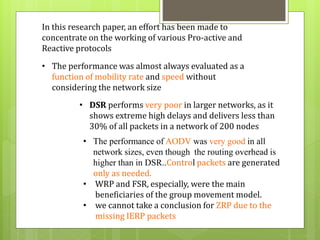
In this research paper, an effort has been made to 
concentrate on the working of various Pro-active and 
Reactive protocols 
• The performance was almost always evaluated as a 
function of mobility rate and speed without 
considering the network size 
• DSR performs very poor in larger networks, as it 
shows extreme high delays and delivers less than 
30% of all packets in a network of 200 nodes 
• The performance of AODV was very good in all 
network sizes, even though the routing overhead is 
higher than in DSR..Control packets are generated 
only as needed. 
• WRP and FSR, especially, were the main 
beneficiaries of the group movement model. 
• we cannot take a conclusion for ZRP due to the 
missing IERP packets
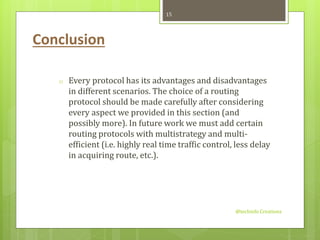
Conclusion 
o Every protocol has its advantages and disadvantages 
in different scenarios. The choice of a routing 
protocol should be made carefully after considering 
every aspect we provided in this section (and 
possibly more). In future work we must add certain 
routing protocols with multistrategy and multi-efficient 
(i.e. highly real time traffic control, less delay 
in acquiring route, etc.). 
@techinfo Creationz 
15
 References 
 [1] Ashwani Kush ; Phalguni Gupta ; Ram Kumar ; 
:Performance Comparison of Wireless Routing Protocols, 
Journal of the CSI, Vol.35 No.2, April-June 2005 
 [2] AnneAaron; JieWeng; :Performance Comparison of 
Ad-hoc Routing Protocols for Networks with Node Energy 
Constraints , availableathttp://ivms.stanford.edu 
 [3] Charles Perkins; Elizabeth Royer; Samir Das; Mahesh 
Marina;: Performance of two on-demand Routing 
Protocols for Ad-hocNetworks, IEEE Personal 
Communications, February 2001, pp. 16-28. 
 [4] Perkins, C.; Royer, E.B.; Das, .S; :Ad hoc On-Demand 
Distance Vector (AODV) Routing - Internet Draft”, RFC 
3561, IETFNetworkWorking Group, July 2003. 
@techinfo Creationz 
16
@techinfo Creationz 
17

PERFORMANCE STUDIES ON THE VARIOUS ROUTING PROTOCOLS IN AD-HOC NETWORKS

  • 1.
    JYOTHISH.O.S 201224 S4MCA 1 @techinfo Creationz
  • 2.
    PERFORMANCE STUDIES ONTHE VARIOUS ROUTING PROTOCOLS IN AD-HOC NETWORKS @techinfo Creationz 2
  • 3.
    INTRODUCTION In thelast couple of years ,the use of Wireless networks has become more and more popular. There exists 3 types mobile wireless networks:  Infrastructure n/w  Ad-hoc n/w  Hybrid n/w @techinfo Creationz 3
  • 4.
    Infrastructure n/w consistsof wireless mobile nodes and one or more bridges,which connect wireless n/w to wired n/w.These bridges are called base staions. Ad-hoc n/w consist no base stations,no fixed routers and no centralized administration.All node move randomly and are connecting dynamically each other. Hybrid n/w combines both aspect described before.It makes use of any available base stations while also support infrastructure less communication. @techinfo Creationz 4
  • 5.
    Evolution of MANET A MobileAdHoc Network is a collection of wireless mobile nodes forming temporary n/w without any fixed infrastructure where all nodes are free to move and configure themselves.In MANET ,each node acts both as a router and a host even the topology of n/w may also change rapidly. @techinfo Creationz 5
  • 6.
    ROUTING PROTOCOLS Routingis a process of finding a path from a source to destination on the n/w. The Routing protocols fall into 2 general categories:  Proactive Routing protocols  Reactive routing Protocols @techinfo Creationz 6
  • 7.
    Proactive Routing Protocols  Table driven Routing Protocols  The protocols are table driven and will actively determine the layout of the n/w.  The protocols include WRP, FSR,ZRP @techinfo Creationz 7
  • 8.
    Reactive Routing Protocol  On Demand routing protocol  Popular routing category  It is new routing philosophy and relatively large network topologies.  The design follows the idea only sending routing packets when communication is requested.  Protocols include DSR,AODV,TORA @techinfo Creationz 8
  • 9.
     DSR(DYNAMIC SOURCEROUTING)  On- Demand routing protocol  Every mobile node in the n/w needs to main a route cache where it catches source routes that it has learned.  When Host want sent a packet ,it first checks for a source route to destination. If it found sender use this route.Otherwise the source initiates route discovery process.  Route Discovery and route maintains are the major parts of routing protocol. @techinfo Creationz 9
  • 10.
     AODV(Ad hocon Demand distance vector)  It creates the routers on a demand basis,as opposed to maintain a complete list of routes for each destination.  AODV consist of The sending node will initiate a path discovery process.A route request message (RREQ) is broadcasted to all neighbours.The forwording process is continued until destination is found or intermediate node knows destination.And also ensure maintance Routes. @techinfo Creationz 10
  • 11.
    Advantages of AODV  Unicast and Multicast packet transmission  It also respond very quickly to the topological changes. @techinfo Creationz 11
  • 12.
    TORA(Temporally orderd routingprotocols)  Multipath routing  The protocol can simultaneously support both on demand routing and proactive routing per destination basis.  It is an adaptive routing protocol for multi hop networks. WRP(Wireless routing protocol)  Distance vector routing protocol designed for ad-hoc n/w.  WRP modifies and enhances distance vector routing . @techinfo Creationz 12
  • 13.
    PERFORMANCE METRICS •Routing overhead how many packets for route discovery and route maintained need to sent . • Throughput the total number of bits forwarded to higher layers per second. • Media access delay the time takes to access media for starting the packet transmission. • Packet delivery ratio Ratio b/w incoming and received data packets. @techinfo Creationz 13
  • 14.
    In this researchpaper, an effort has been made to concentrate on the working of various Pro-active and Reactive protocols • The performance was almost always evaluated as a function of mobility rate and speed without considering the network size • DSR performs very poor in larger networks, as it shows extreme high delays and delivers less than 30% of all packets in a network of 200 nodes • The performance of AODV was very good in all network sizes, even though the routing overhead is higher than in DSR..Control packets are generated only as needed. • WRP and FSR, especially, were the main beneficiaries of the group movement model. • we cannot take a conclusion for ZRP due to the missing IERP packets
  • 15.
    Conclusion o Everyprotocol has its advantages and disadvantages in different scenarios. The choice of a routing protocol should be made carefully after considering every aspect we provided in this section (and possibly more). In future work we must add certain routing protocols with multistrategy and multi-efficient (i.e. highly real time traffic control, less delay in acquiring route, etc.). @techinfo Creationz 15
  • 16.
     References [1] Ashwani Kush ; Phalguni Gupta ; Ram Kumar ; :Performance Comparison of Wireless Routing Protocols, Journal of the CSI, Vol.35 No.2, April-June 2005  [2] AnneAaron; JieWeng; :Performance Comparison of Ad-hoc Routing Protocols for Networks with Node Energy Constraints , availableathttp://ivms.stanford.edu  [3] Charles Perkins; Elizabeth Royer; Samir Das; Mahesh Marina;: Performance of two on-demand Routing Protocols for Ad-hocNetworks, IEEE Personal Communications, February 2001, pp. 16-28.  [4] Perkins, C.; Royer, E.B.; Das, .S; :Ad hoc On-Demand Distance Vector (AODV) Routing - Internet Draft”, RFC 3561, IETFNetworkWorking Group, July 2003. @techinfo Creationz 16
  • 17.