PRODUCT LINE
An Introduction And Overview Of
The art and science of distributing A/V content
over coaxial infrastructure in premise installations
remains a valuable skill set for the 21st Century!
MATV Design And
Application
Joseph D. Cornwall, CTS-D
PRODUCT LINE
Our Agenda
• What is MATV?
• Bandwidth and the RF
spectrum
• What does the MATV installation
distribute?
• Understanding coaxial cable
• The basic MATV “pipe”
• Head-end building blocks
Amplification, equalization and
notch filters
• Distributing the signal
• Balancing the MATV system
PRODUCT LINE
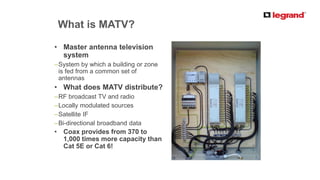
What is MATV?
• Master antenna television
system
–System by which a building or zone
is fed from a common set of
antennas
• What does MATV distribute?
–RF broadcast TV and radio
–Locally modulated sources
–Satellite IF
–Bi-directional broadband data
• Coax provides from 370 to
1,000 times more capacity than
Cat 5E or Cat 6!
PRODUCT LINE
“If it weren't for Philo T. Farnsworth,
inventor of television, we'd still be
eating frozen radio dinners.”
– Johnny Carson
Understanding Spectrum
PRODUCT LINE
Broadcast Spectrum
• OTA broadcasts encompass
“channels” 2 thru 51
• Digital television stations are
placed on high VHF and UHF
channels
─7 to 13 and 14 to 51, except 37
─VHF 2 to 6 are rarely used due to impulse
noise
─VHF channels 7 to 13 broadcast from
174 to 216 MHz
─UHF channels 14 to 36 broadcast from
470 to 608 MHz
─UHF channels 38 to 51 broadcast from
614 to 698 MHz
─FM radio broadcasts from 87 to 108 MHz
PRODUCT LINE
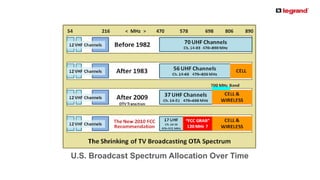
U.S. Broadcast Spectrum Allocation Over Time
PRODUCT LINE
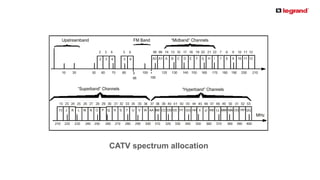
CATV spectrum allocation
PRODUCT LINE
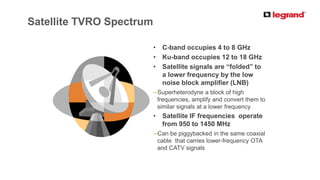
Satellite TVRO Spectrum
• C-band occupies 4 to 8 GHz
• Ku-band occupies 12 to 18 GHz
• Satellite signals are “folded” to
a lower frequency by the low
noise block amplifier (LNB)
─Superheterodyne a block of high
frequencies, amplify and convert them to
similar signals at a lower frequency
• Satellite IF frequencies operate
from 950 to 1450 MHz
─Can be piggybacked in the same coaxial
cable that carries lower-frequency OTA
and CATV signals
PRODUCT LINE
“The cable TV sex channels don't
expand our horizons, don't make us
better people, and don't come in
clearly enough.”
– Bill Maher
About Coaxial Cable
PRODUCT LINE
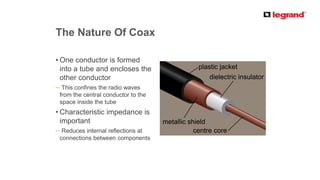
The Nature Of Coax
• One conductor is formed
into a tube and encloses the
other conductor
─ This confines the radio waves
from the central conductor to the
space inside the tube
• Characteristic impedance is
important
─ Reduces internal reflections at
connections between components
PRODUCT LINE
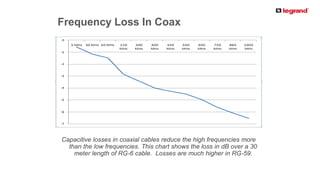
Capacitive losses in coaxial cables reduce the high frequencies more
than the low frequencies. This chart shows the loss in dB over a 30
meter length of RG-6 cable. Losses are much higher in RG-59.
Frequency Loss In Coax
PRODUCT LINE
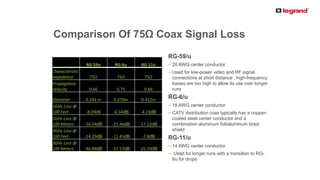
Comparison Of 75Ω Coax Signal Loss
RG-59u RG-6u RG-11u
Characteristic
Impedance 75Ω 75Ω 75Ω
Propagation
Velocity 0.66 0.75 0.66
Diameter 0.242 in 0.270in 0.412in
1GHz Loss @
100 Feet -8.09dB -6.54dB -4.23dB
1GHz Loss @
100 Meters -26.54dB -21.46dB -17.22dB
3GHz Loss @
100 Feet -14.29dB -11.45dB -7.8dB
3GHz Loss @
100 Meters -46.88dB -37.57dB -25.29dB
RG-59/u
─20 AWG center conductor
─Used for low-power video and RF signal
connections at short distance , high-frequency
losses are too high to allow its use over longer
runs
RG-6/u
─18 AWG center conductor
─CATV distribution coax typically has a copper-
coated steel center conductor and a
combination aluminum foil/aluminum braid
shield
RG-11/u
─14 AWG center conductor
─ Used for longer runs with a transition to RG-
6u for drops
PRODUCT LINE
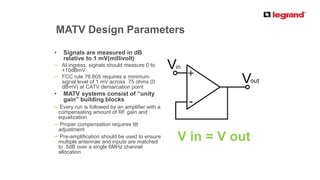
MATV Design Parameters
• Signals are measured in dB
relative to 1 mV(millivolt)
─ At ingress, signals should measure 0 to
+10dBmV
─ FCC rule 76.605 requires a minimum
signal level of 1 mV across 75 ohms (0
dBmV) at CATV demarcation point
• MATV systems consist of “unity
gain” building blocks
─ Every run is followed by an amplifier with a
compensating amount of RF gain and
equalization
─ Proper compensation requires tilt
adjustment
─ Pre-amplification should be used to ensure
multiple antennae and inputs are matched
to .5dB over a single 6MHz channel
allocation
V in = V out
PRODUCT LINE
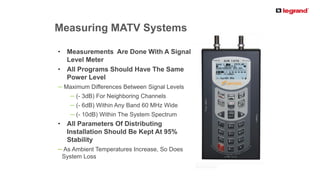
Measuring MATV Systems
• Measurements Are Done With A Signal
Level Meter
• All Programs Should Have The Same
Power Level
─ Maximum Differences Between Signal Levels
─ (- 3dB) For Neighboring Channels
─ (- 6dB) Within Any Band 60 MHz Wide
─ (- 10dB) Within The System Spectrum
• All Parameters Of Distributing
Installation Should Be Kept At 95%
Stability
─ As Ambient Temperatures Increase, So Does
System Loss
PRODUCT LINE
“Everything you can imagine is real.”
― Pablo Picasso
Elements of an MATV System
PRODUCT LINE
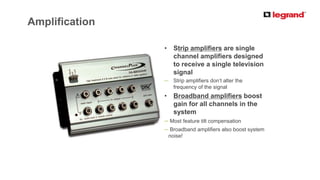
Amplification
• Strip amplifiers are single
channel amplifiers designed
to receive a single television
signal
─ Strip amplifiers don’t alter the
frequency of the signal
• Broadband amplifiers boost
gain for all channels in the
system
─ Most feature tilt compensation
─ Broadband amplifiers also boost system
noise!
PRODUCT LINE
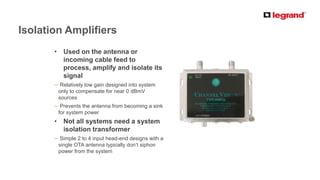
Isolation Amplifiers
• Used on the antenna or
incoming cable feed to
process, amplify and isolate its
signal
─ Relatively low gain designed into system
only to compensate for near 0 dBmV
sources
─ Prevents the antenna from becoming a sink
for system power
• Not all systems need a system
isolation transformer
─ Simple 2 to 4 input head-end designs with a
single OTA antenna typically don’t siphon
power from the system
PRODUCT LINE
Modulators and Notch Filters
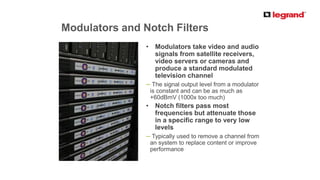
• Modulators take video and audio
signals from satellite receivers,
video servers or cameras and
produce a standard modulated
television channel
─ The signal output level from a modulator
is constant and can be as much as
+60dBmV (1000x too much)
• Notch filters pass most
frequencies but attenuate those
in a specific range to very low
levels
─ Typically used to remove a channel from
an system to replace content or improve
performance
PRODUCT LINE
Splitters and Taps
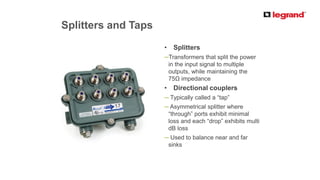
• Splitters
─Transformers that split the power
in the input signal to multiple
outputs, while maintaining the
75Ω impedance
• Directional couplers
─ Typically called a “tap”
─ Asymmetrical splitter where
“through” ports exhibit minimal
loss and each “drop” exhibits multi
dB loss
─ Used to balance near and far
sinks
PRODUCT LINE
Combiners
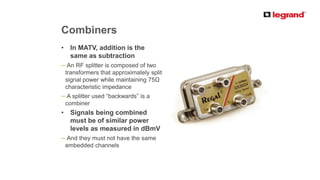
• In MATV, addition is the
same as subtraction
─ An RF splitter is composed of two
transformers that approximately split
signal power while maintaining 75Ω
characteristic impedance
─ A splitter used “backwards” is a
combiner
• Signals being combined
must be of similar power
levels as measured in dBmV
─ And they must not have the same
embedded channels
PRODUCT LINE
“Luck is the residue of design.”
─ Branch Rickey
Designing an MATV System
PRODUCT LINE
Calculate System Gain
• The goal is to end up with the
same power level in each band,
and that power level should match
the incoming broadcast feed
• Two sections of gain must be
considered
─ Locally modulated sources must be gain-
matched to the broadcast feed
─ Ensures constant power level across all
bands
─ The trunk/zone/room delivery devices must
have all insertion losses compensated
PRODUCT LINE
 The project requires the modulation and input of two unique sources housed in the facility
 For this exercise, let’s assume these are the output of a computer and a media server with no HDCP
compliance necessary
 The project demands that we insert the signals from these two devices into a system that is
carrying traditional OTA television content as sourced from a local antenna
 This could be a CATV input instead of an antenna, but more care will be needed to parse and control
the wider bandwidth and plethora of channels found on a typical cable feed
 CMTS and network carriage is not part of the design parameters for this exercise
 The signal will be routed to 4 separate zones in the building
 Each zone will have 8 displays (for a total of 32 displays)
 Assume all displays are grouped equidistant from the head-end and from each other
Example Project Parameters
PRODUCT LINE
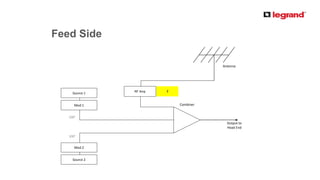
Feed Side
RF Amp
Antenna
Output to
Head End
Source 2
Source 1
Mod 2
Mod 1
100’
100’
Combiner
?
PRODUCT LINE
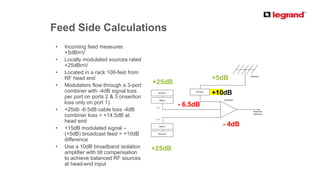
Feed Side Calculations
• Incoming feed measures
+5dBmV
• Locally modulated sources rated
+25dBmV
• Located in a rack 100-feet from
RF head end
• Modulators flow through a 3-port
combiner with -4dB signal loss
per port on ports 2 & 3 (insertion
loss only on port 1).
• +25db -6.5dB cable loss -4dB
combiner loss = +14.5dB at
head end
• +15dB modulated signal –
(+5dB) broadcast feed = +10dB
difference
• Use a 10dB broadband isolation
amplifier with tilt compensation
to achieve balanced RF sources
at head-end input
+5dB
+25dB
+25dB
- 6.5dB
- 4dB
+10dB
PRODUCT LINE
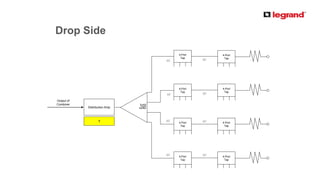
Drop Side
Output of
Combiner
Distribution Amp
4-port
Trunk
Splitter
?
4-Port
Tap
4-Port
Tap
50’
50’
4-Port
Tap
4-Port
Tap
50’
50’
4-Port
Tap
50’4-Port
Tap
50’ 4-Port
Tap
50’4-Port
Tap
50’
PRODUCT LINE
Drop Side Calculations
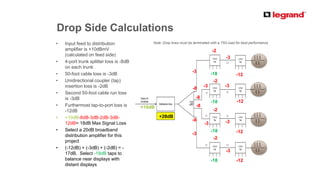
• Input feed to distribution
amplifier is +10dBmV
(calculated on feed side)
• 4-port trunk splitter loss is -8dB
on each trunk
• 50-foot cable loss is -3dB
• Unidirectional coupler (tap)
insertion loss is -2dB
• Second 50-foot cable run loss
is -3dB
• Furthermost tap-to-port loss is
-12dB
• +10dB-8dB-3dB-2dB-3dB-
12dB= 18dB Max Signal Loss
• Select a 20dB broadband
distribution amplifier for this
project
• (-12dB) + (-3dB) + (-2dB) = -
17dB. Select -18dB taps to
balance near displays with
distant displays
+10dB
-8
-8
-8
-8
-3
-3
-3
-3
-3
-3
-3
-3
-2
-2
-2
-2
-12
-12
-12
-12
+20dB
-18
-18
-18
-18
Note: Drop lines must be terminated with a 75Ω load for best performance
PRODUCT LINE
“Knowledge is a process of piling up
facts; wisdom lies in their
simplification.”
− Martin H. Fischer
In Conclusion…
PRODUCT LINE
What We’ve Learned…
• MATV installations offer significant value in distribution
of cable and broadcast video sources across multiple
displays and devices in any project from small to large
scale
• Coaxial cable offers significantly more bandwidth than
unshielded twisted pair making MATV installations A
cost-effective and high performance alternative to
distributing content over a LAN
• The Quality Of An MATV Installation Depends On The
Quality And Condition Of The Coaxial Cable Used In
The Project
• MATV systems are designed for unity gain.
• Success In MATV Installation Is Only Ensured When
You Know The Quality Of The Starting Signal And
Accurately Account For All Insertion Loss, Slope Loss
And Drop Loss Across The Distribution Network
PRODUCT LINE
Questions?

Intro to-matv

  • 1.
    PRODUCT LINE An IntroductionAnd Overview Of The art and science of distributing A/V content over coaxial infrastructure in premise installations remains a valuable skill set for the 21st Century! MATV Design And Application Joseph D. Cornwall, CTS-D
  • 2.
    PRODUCT LINE Our Agenda •What is MATV? • Bandwidth and the RF spectrum • What does the MATV installation distribute? • Understanding coaxial cable • The basic MATV “pipe” • Head-end building blocks Amplification, equalization and notch filters • Distributing the signal • Balancing the MATV system
  • 3.
    PRODUCT LINE What isMATV? • Master antenna television system –System by which a building or zone is fed from a common set of antennas • What does MATV distribute? –RF broadcast TV and radio –Locally modulated sources –Satellite IF –Bi-directional broadband data • Coax provides from 370 to 1,000 times more capacity than Cat 5E or Cat 6!
  • 4.
    PRODUCT LINE “If itweren't for Philo T. Farnsworth, inventor of television, we'd still be eating frozen radio dinners.” – Johnny Carson Understanding Spectrum
  • 5.
    PRODUCT LINE Broadcast Spectrum •OTA broadcasts encompass “channels” 2 thru 51 • Digital television stations are placed on high VHF and UHF channels ─7 to 13 and 14 to 51, except 37 ─VHF 2 to 6 are rarely used due to impulse noise ─VHF channels 7 to 13 broadcast from 174 to 216 MHz ─UHF channels 14 to 36 broadcast from 470 to 608 MHz ─UHF channels 38 to 51 broadcast from 614 to 698 MHz ─FM radio broadcasts from 87 to 108 MHz
  • 6.
    PRODUCT LINE U.S. BroadcastSpectrum Allocation Over Time
  • 7.
  • 8.
    PRODUCT LINE Satellite TVROSpectrum • C-band occupies 4 to 8 GHz • Ku-band occupies 12 to 18 GHz • Satellite signals are “folded” to a lower frequency by the low noise block amplifier (LNB) ─Superheterodyne a block of high frequencies, amplify and convert them to similar signals at a lower frequency • Satellite IF frequencies operate from 950 to 1450 MHz ─Can be piggybacked in the same coaxial cable that carries lower-frequency OTA and CATV signals
  • 9.
    PRODUCT LINE “The cableTV sex channels don't expand our horizons, don't make us better people, and don't come in clearly enough.” – Bill Maher About Coaxial Cable
  • 10.
    PRODUCT LINE The NatureOf Coax • One conductor is formed into a tube and encloses the other conductor ─ This confines the radio waves from the central conductor to the space inside the tube • Characteristic impedance is important ─ Reduces internal reflections at connections between components
  • 11.
    PRODUCT LINE Capacitive lossesin coaxial cables reduce the high frequencies more than the low frequencies. This chart shows the loss in dB over a 30 meter length of RG-6 cable. Losses are much higher in RG-59. Frequency Loss In Coax
  • 12.
    PRODUCT LINE Comparison Of75Ω Coax Signal Loss RG-59u RG-6u RG-11u Characteristic Impedance 75Ω 75Ω 75Ω Propagation Velocity 0.66 0.75 0.66 Diameter 0.242 in 0.270in 0.412in 1GHz Loss @ 100 Feet -8.09dB -6.54dB -4.23dB 1GHz Loss @ 100 Meters -26.54dB -21.46dB -17.22dB 3GHz Loss @ 100 Feet -14.29dB -11.45dB -7.8dB 3GHz Loss @ 100 Meters -46.88dB -37.57dB -25.29dB RG-59/u ─20 AWG center conductor ─Used for low-power video and RF signal connections at short distance , high-frequency losses are too high to allow its use over longer runs RG-6/u ─18 AWG center conductor ─CATV distribution coax typically has a copper- coated steel center conductor and a combination aluminum foil/aluminum braid shield RG-11/u ─14 AWG center conductor ─ Used for longer runs with a transition to RG- 6u for drops
  • 13.
    PRODUCT LINE MATV DesignParameters • Signals are measured in dB relative to 1 mV(millivolt) ─ At ingress, signals should measure 0 to +10dBmV ─ FCC rule 76.605 requires a minimum signal level of 1 mV across 75 ohms (0 dBmV) at CATV demarcation point • MATV systems consist of “unity gain” building blocks ─ Every run is followed by an amplifier with a compensating amount of RF gain and equalization ─ Proper compensation requires tilt adjustment ─ Pre-amplification should be used to ensure multiple antennae and inputs are matched to .5dB over a single 6MHz channel allocation V in = V out
  • 14.
    PRODUCT LINE Measuring MATVSystems • Measurements Are Done With A Signal Level Meter • All Programs Should Have The Same Power Level ─ Maximum Differences Between Signal Levels ─ (- 3dB) For Neighboring Channels ─ (- 6dB) Within Any Band 60 MHz Wide ─ (- 10dB) Within The System Spectrum • All Parameters Of Distributing Installation Should Be Kept At 95% Stability ─ As Ambient Temperatures Increase, So Does System Loss
  • 15.
    PRODUCT LINE “Everything youcan imagine is real.” ― Pablo Picasso Elements of an MATV System
  • 16.
    PRODUCT LINE Amplification • Stripamplifiers are single channel amplifiers designed to receive a single television signal ─ Strip amplifiers don’t alter the frequency of the signal • Broadband amplifiers boost gain for all channels in the system ─ Most feature tilt compensation ─ Broadband amplifiers also boost system noise!
  • 17.
    PRODUCT LINE Isolation Amplifiers •Used on the antenna or incoming cable feed to process, amplify and isolate its signal ─ Relatively low gain designed into system only to compensate for near 0 dBmV sources ─ Prevents the antenna from becoming a sink for system power • Not all systems need a system isolation transformer ─ Simple 2 to 4 input head-end designs with a single OTA antenna typically don’t siphon power from the system
  • 18.
    PRODUCT LINE Modulators andNotch Filters • Modulators take video and audio signals from satellite receivers, video servers or cameras and produce a standard modulated television channel ─ The signal output level from a modulator is constant and can be as much as +60dBmV (1000x too much) • Notch filters pass most frequencies but attenuate those in a specific range to very low levels ─ Typically used to remove a channel from an system to replace content or improve performance
  • 19.
    PRODUCT LINE Splitters andTaps • Splitters ─Transformers that split the power in the input signal to multiple outputs, while maintaining the 75Ω impedance • Directional couplers ─ Typically called a “tap” ─ Asymmetrical splitter where “through” ports exhibit minimal loss and each “drop” exhibits multi dB loss ─ Used to balance near and far sinks
  • 20.
    PRODUCT LINE Combiners • InMATV, addition is the same as subtraction ─ An RF splitter is composed of two transformers that approximately split signal power while maintaining 75Ω characteristic impedance ─ A splitter used “backwards” is a combiner • Signals being combined must be of similar power levels as measured in dBmV ─ And they must not have the same embedded channels
  • 21.
    PRODUCT LINE “Luck isthe residue of design.” ─ Branch Rickey Designing an MATV System
  • 22.
    PRODUCT LINE Calculate SystemGain • The goal is to end up with the same power level in each band, and that power level should match the incoming broadcast feed • Two sections of gain must be considered ─ Locally modulated sources must be gain- matched to the broadcast feed ─ Ensures constant power level across all bands ─ The trunk/zone/room delivery devices must have all insertion losses compensated
  • 23.
    PRODUCT LINE  Theproject requires the modulation and input of two unique sources housed in the facility  For this exercise, let’s assume these are the output of a computer and a media server with no HDCP compliance necessary  The project demands that we insert the signals from these two devices into a system that is carrying traditional OTA television content as sourced from a local antenna  This could be a CATV input instead of an antenna, but more care will be needed to parse and control the wider bandwidth and plethora of channels found on a typical cable feed  CMTS and network carriage is not part of the design parameters for this exercise  The signal will be routed to 4 separate zones in the building  Each zone will have 8 displays (for a total of 32 displays)  Assume all displays are grouped equidistant from the head-end and from each other Example Project Parameters
  • 24.
    PRODUCT LINE Feed Side RFAmp Antenna Output to Head End Source 2 Source 1 Mod 2 Mod 1 100’ 100’ Combiner ?
  • 25.
    PRODUCT LINE Feed SideCalculations • Incoming feed measures +5dBmV • Locally modulated sources rated +25dBmV • Located in a rack 100-feet from RF head end • Modulators flow through a 3-port combiner with -4dB signal loss per port on ports 2 & 3 (insertion loss only on port 1). • +25db -6.5dB cable loss -4dB combiner loss = +14.5dB at head end • +15dB modulated signal – (+5dB) broadcast feed = +10dB difference • Use a 10dB broadband isolation amplifier with tilt compensation to achieve balanced RF sources at head-end input +5dB +25dB +25dB - 6.5dB - 4dB +10dB
  • 26.
    PRODUCT LINE Drop Side Outputof Combiner Distribution Amp 4-port Trunk Splitter ? 4-Port Tap 4-Port Tap 50’ 50’ 4-Port Tap 4-Port Tap 50’ 50’ 4-Port Tap 50’4-Port Tap 50’ 4-Port Tap 50’4-Port Tap 50’
  • 27.
    PRODUCT LINE Drop SideCalculations • Input feed to distribution amplifier is +10dBmV (calculated on feed side) • 4-port trunk splitter loss is -8dB on each trunk • 50-foot cable loss is -3dB • Unidirectional coupler (tap) insertion loss is -2dB • Second 50-foot cable run loss is -3dB • Furthermost tap-to-port loss is -12dB • +10dB-8dB-3dB-2dB-3dB- 12dB= 18dB Max Signal Loss • Select a 20dB broadband distribution amplifier for this project • (-12dB) + (-3dB) + (-2dB) = - 17dB. Select -18dB taps to balance near displays with distant displays +10dB -8 -8 -8 -8 -3 -3 -3 -3 -3 -3 -3 -3 -2 -2 -2 -2 -12 -12 -12 -12 +20dB -18 -18 -18 -18 Note: Drop lines must be terminated with a 75Ω load for best performance
  • 28.
    PRODUCT LINE “Knowledge isa process of piling up facts; wisdom lies in their simplification.” − Martin H. Fischer In Conclusion…
  • 29.
    PRODUCT LINE What We’veLearned… • MATV installations offer significant value in distribution of cable and broadcast video sources across multiple displays and devices in any project from small to large scale • Coaxial cable offers significantly more bandwidth than unshielded twisted pair making MATV installations A cost-effective and high performance alternative to distributing content over a LAN • The Quality Of An MATV Installation Depends On The Quality And Condition Of The Coaxial Cable Used In The Project • MATV systems are designed for unity gain. • Success In MATV Installation Is Only Ensured When You Know The Quality Of The Starting Signal And Accurately Account For All Insertion Loss, Slope Loss And Drop Loss Across The Distribution Network
  • 30.