Programa Para o Futuro  Preparing Youth for Employability Experiences from Brazil Youth Microenterprise Conference Washington, D.C. September 10 and 11, 2007 Eric Rusten – AED & Tania Ogasawara – ADE Brasil
Overview AED and ADE-Brasil Definitions 4 Principles for Youth Employability Sustainability Critical elements for Success Youth unemployment is a  complex  problem, especially for disadvantaged youth & demands multiple complex responses.  Micro-enterprise development is  NOT  a  silver bullet  for  youth employment and/or employability .
ADE-Brasil ADE-Brasil, a Recife-based Brazilian NGO, focuses on enabling  disadvantaged  youth to: develop their capacity; gain confidence and essential skills, abilities & attitudes; transform their lives; and  create productive futures. We achieve  sustainable results  through partnerships with private companies, donors, government agencies, communities, youth, parents, talented individuals and NGOs. Founded in 2005 via a partnership with the Academy for Educational Development (AED) to continue the work started by the USAID/Brasil-funded project –  Program Para o Futuro (PPF).
Being Disadvantaged? Much more than income  poverty Weak education and communication skills Lack practical skills & positive attitude for work Negatively reinforcing networks  Poor understanding of the formal job market Lack of technical and workplace skills Lack or entrepreneurial skills Often weak family support Often live with violence Physical or mental disability Prejudice, social exclusion and isolation  Poor self-esteem and pessimistic view of the future No access to credit
What is Employability? Employability is the capacity to  move self-sufficiently  into and within labour markets, to fulfill potential through  sustainable  employment or self-employment. Employability is  a set of achievements, understanding and personal attributes  that make it more likely to gain employment or become self-employed and have a  successful career .
Transformation for Employability Jobs vs. Employability  Employability is building capacity Requires permanent transformation Some essential skills:   Motivation & enthusiasm;  Teamwork & communication;  Self-Managed continuous learning; Flexibility & initiative; and  Ability to vision a new future.  Technical skills Business development & management skills Employ ability   is about  learning  and depends on developing critical, reflective abilities, with a view toward empowering and enhancing the learner.  Employment or self-employment is a  by-product  of this enabling process .
PPF Facts, Features & Results USAID Funding with Public-Private-Partnerships 50 youth  16-21 years, 25 boys & 25 girls Including  first-offender  youth 2, 4-hour training session per day for 1 year Project-based learning, simulating work place e-Mentoring program 98% of youth graduated 88% of youth achieved employability at graduation 3 years later,  93% of youth employed Youth offered free scholarships to technical school 31% of employed youth promoted within 1st year youth starting their own businesses
4 Principles Create an environment where youth can take the risk to change and learn. (Focus on  Learning  not training!) 2 + 2 = 5 and here, Time Matters “ If you want me to be a professional, treat me so!” The power of Relationships, Networks & Networking
Principle 1 Create an environment where youth can take the risk to change.
Steps for Successful Inclusion Permanent social inclusion & employability requires creating and growing positive,  attitudes, learning and professional networks ADE Brasil  Employability Program Community Learning Program Job Marketplace Professional Network Learning Disadvantaged Youth’s Environment Job Marketplace Com munity Civil Society Professional Networking Sustainable  Positive Future Professional Network Civil Society Community Learning Systems Job Marketplace Youth
Project-Based Learning Learning through collaborative projects in professional environment Professional and attitudinal Skills Interdisciplinary projects Instructor as facilitator and professional supervisor Rich interaction among youth and professional adults Simulates the work place
Social Assistant and Psychologist Bimonthly parent meetings  First offender youth inclusion Gender Collaborative learning e-Mentoring Uniforms, professional environment Meals and transportation Supportive Social Environment
Principle 2 2 + 2 = 5 and here, Time Matters
Integrated Curriculum
Integrating Increases Impact
Principle 3 “ If you want me to be a professional, treat me so!”
Curriculum aligned with the market demands e-Mentoring  Public Presentation Collaborative work among youth & staff Projects integrate skills Result oriented  Students produce real products Expect more & achieve more Creating Employability Capacity
“ 0 km computers” and the  “Ways for Success” When I started PPF, it was surprising! When I entered the IT lab and viewed the structure, I was thrilled, as   all the machines were “0 km” ,  not mentioning they were first quality. When I started the program, I already new some basic IT as a user.  I thought my knowledge was sufficient to compete with other people in the field, but I found myself wrong when I saw the program curriculum. I saw I had a lot to learn. Besides Software and Hardware, I also had subjects to work the humanity side: Criativity, Gender, Portuguese, maths, which provided the general improvement for a  complete professional . ... Another great experience was e-Mentoring that helped us to direct our careers, by exchanging experiences with an experienced professional that helped us  “sculpe the way for our success”.
Principle 4 The power of Relationships, Networks & Networking
Rich professional network to learn networking Start: 50 Mentors - End: 53 Mentors Powerful support for level of youth participation Professional communication & Problem solving Heterogeneous network; positive reinforcing Facilitates transition into a new world “ If they think I’m worth something maybe I am.” e-Mentoring
C M m M m M m M m M m M m M m M m M m M m
Next… The Return on Investment of: time, multiple areas of skills, creating enabling environment,  treating youth professionally
Once Transformed… Weidson PPF End PPF Start Today Tomorrow? Forever Growing…
Youth status in August, 2007 24% Youth with no Technical or University degrees  64% Studying or finished Technical School 28% Studying or finished University Studies 2% Loss to crime 8% Not working – Living with temporary jobs  6% Not working – Mothers of young babies (all have worked on administrative jobs) 84% Working Occupation 50 Youth that started Programa para o Futuro
Youth status in August, 2007 + 63% Salary increase compared to August/2004  (Salaries have an annual ~5% adjustment) 2% 1 Priest 2% 1 Policeman 2% 1 Art Restaurer 4% Services (as Attendant)  19% Administrative, Finance 71% ICT Professional Fields 12% Freelance/Research Assistance at the University 12% Entrepreneurs (Technical Support and/or Internet Café) 24% Paid technical Internship 53% Full time employment Nature of the work relation/commitment
Sustainability
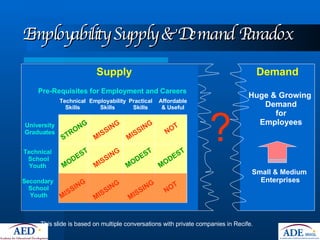
Employability Supply & Demand Paradox Small & Medium  Enterprises ? Huge & Growing  Demand for Employees This slide is based on multiple conversations with private companies in Recife. Demand Pre-Requisites for Employment and Careers Secondary  School Youth Technical School Youth MISSING MISSING MISSING MISSING MODEST MODEST MODEST NOT Supply University Graduates MISSING MISSING NOT STRONG Technical Skills Employability Skills Practical Skills Affordable & Useful
Improved PPF Employability Training e-Mentoring: Career Transition e-Mentoring: Internships 7 mths Tech School w/ Scholarship Technical Schools w/ Fees Internships (w/ Companies) Evaluation 1 2 mths 6 mths 1 mths Evaluation 2 At two Technical Schools (IT and Admin) Low cost post-secondary employability & career program Formal work
School to Career Transition After school program At schools & integrated with academic work 2 nd  or 3 rd  year of secondary school Alternative paths to the world-of-work 2 hrs/day for 6-8 months after school Employability project-based curriculum for practical skills e-Mentoring, job shadowing & public presentations Leading to jobs and post-secondary education Low cost, rapid and intense Builds on State’s education reform effort
Important Issues Quantity  vs. Quality Transforming  youth for careers vs. job training  Stand alone programs vs. With  public schools Measuring success : completion rates; employment; job retention; employability capacity; transition to tertiary education; promotion rates; ROI, etc. Permanent  transformation vs. Temporary change Measuring the  economic and social value  of permanent transformation and employability –  ROI Creating an environment for youth to change Working with youth as people not as statistics
Thank you! For further information: Tania Ogasawara, Executive Director ADE-Brasil [email_address]

Programa Para o Futuro

  • 1.
    Programa Para oFuturo Preparing Youth for Employability Experiences from Brazil Youth Microenterprise Conference Washington, D.C. September 10 and 11, 2007 Eric Rusten – AED & Tania Ogasawara – ADE Brasil
  • 2.
    Overview AED andADE-Brasil Definitions 4 Principles for Youth Employability Sustainability Critical elements for Success Youth unemployment is a complex problem, especially for disadvantaged youth & demands multiple complex responses. Micro-enterprise development is NOT a silver bullet for youth employment and/or employability .
  • 3.
    ADE-Brasil ADE-Brasil, aRecife-based Brazilian NGO, focuses on enabling disadvantaged youth to: develop their capacity; gain confidence and essential skills, abilities & attitudes; transform their lives; and create productive futures. We achieve sustainable results through partnerships with private companies, donors, government agencies, communities, youth, parents, talented individuals and NGOs. Founded in 2005 via a partnership with the Academy for Educational Development (AED) to continue the work started by the USAID/Brasil-funded project – Program Para o Futuro (PPF).
  • 4.
    Being Disadvantaged? Muchmore than income poverty Weak education and communication skills Lack practical skills & positive attitude for work Negatively reinforcing networks Poor understanding of the formal job market Lack of technical and workplace skills Lack or entrepreneurial skills Often weak family support Often live with violence Physical or mental disability Prejudice, social exclusion and isolation Poor self-esteem and pessimistic view of the future No access to credit
  • 5.
    What is Employability?Employability is the capacity to move self-sufficiently into and within labour markets, to fulfill potential through sustainable employment or self-employment. Employability is a set of achievements, understanding and personal attributes that make it more likely to gain employment or become self-employed and have a successful career .
  • 6.
    Transformation for EmployabilityJobs vs. Employability Employability is building capacity Requires permanent transformation Some essential skills: Motivation & enthusiasm; Teamwork & communication; Self-Managed continuous learning; Flexibility & initiative; and Ability to vision a new future. Technical skills Business development & management skills Employ ability is about learning and depends on developing critical, reflective abilities, with a view toward empowering and enhancing the learner. Employment or self-employment is a by-product of this enabling process .
  • 7.
    PPF Facts, Features& Results USAID Funding with Public-Private-Partnerships 50 youth 16-21 years, 25 boys & 25 girls Including first-offender youth 2, 4-hour training session per day for 1 year Project-based learning, simulating work place e-Mentoring program 98% of youth graduated 88% of youth achieved employability at graduation 3 years later, 93% of youth employed Youth offered free scholarships to technical school 31% of employed youth promoted within 1st year youth starting their own businesses
  • 8.
    4 Principles Createan environment where youth can take the risk to change and learn. (Focus on Learning not training!) 2 + 2 = 5 and here, Time Matters “ If you want me to be a professional, treat me so!” The power of Relationships, Networks & Networking
  • 9.
    Principle 1 Createan environment where youth can take the risk to change.
  • 10.
    Steps for SuccessfulInclusion Permanent social inclusion & employability requires creating and growing positive, attitudes, learning and professional networks ADE Brasil Employability Program Community Learning Program Job Marketplace Professional Network Learning Disadvantaged Youth’s Environment Job Marketplace Com munity Civil Society Professional Networking Sustainable Positive Future Professional Network Civil Society Community Learning Systems Job Marketplace Youth
  • 11.
    Project-Based Learning Learningthrough collaborative projects in professional environment Professional and attitudinal Skills Interdisciplinary projects Instructor as facilitator and professional supervisor Rich interaction among youth and professional adults Simulates the work place
  • 12.
    Social Assistant andPsychologist Bimonthly parent meetings First offender youth inclusion Gender Collaborative learning e-Mentoring Uniforms, professional environment Meals and transportation Supportive Social Environment
  • 13.
    Principle 2 2+ 2 = 5 and here, Time Matters
  • 14.
  • 15.
  • 16.
    Principle 3 “If you want me to be a professional, treat me so!”
  • 17.
    Curriculum aligned withthe market demands e-Mentoring Public Presentation Collaborative work among youth & staff Projects integrate skills Result oriented Students produce real products Expect more & achieve more Creating Employability Capacity
  • 18.
    “ 0 kmcomputers” and the “Ways for Success” When I started PPF, it was surprising! When I entered the IT lab and viewed the structure, I was thrilled, as all the machines were “0 km” , not mentioning they were first quality. When I started the program, I already new some basic IT as a user. I thought my knowledge was sufficient to compete with other people in the field, but I found myself wrong when I saw the program curriculum. I saw I had a lot to learn. Besides Software and Hardware, I also had subjects to work the humanity side: Criativity, Gender, Portuguese, maths, which provided the general improvement for a complete professional . ... Another great experience was e-Mentoring that helped us to direct our careers, by exchanging experiences with an experienced professional that helped us “sculpe the way for our success”.
  • 19.
    Principle 4 Thepower of Relationships, Networks & Networking
  • 20.
    Rich professional networkto learn networking Start: 50 Mentors - End: 53 Mentors Powerful support for level of youth participation Professional communication & Problem solving Heterogeneous network; positive reinforcing Facilitates transition into a new world “ If they think I’m worth something maybe I am.” e-Mentoring
  • 21.
    C M mM m M m M m M m M m M m M m M m M m
  • 22.
    Next… The Returnon Investment of: time, multiple areas of skills, creating enabling environment, treating youth professionally
  • 23.
    Once Transformed… WeidsonPPF End PPF Start Today Tomorrow? Forever Growing…
  • 24.
    Youth status inAugust, 2007 24% Youth with no Technical or University degrees 64% Studying or finished Technical School 28% Studying or finished University Studies 2% Loss to crime 8% Not working – Living with temporary jobs 6% Not working – Mothers of young babies (all have worked on administrative jobs) 84% Working Occupation 50 Youth that started Programa para o Futuro
  • 25.
    Youth status inAugust, 2007 + 63% Salary increase compared to August/2004 (Salaries have an annual ~5% adjustment) 2% 1 Priest 2% 1 Policeman 2% 1 Art Restaurer 4% Services (as Attendant) 19% Administrative, Finance 71% ICT Professional Fields 12% Freelance/Research Assistance at the University 12% Entrepreneurs (Technical Support and/or Internet Café) 24% Paid technical Internship 53% Full time employment Nature of the work relation/commitment
  • 26.
  • 27.
    Employability Supply &Demand Paradox Small & Medium Enterprises ? Huge & Growing Demand for Employees This slide is based on multiple conversations with private companies in Recife. Demand Pre-Requisites for Employment and Careers Secondary School Youth Technical School Youth MISSING MISSING MISSING MISSING MODEST MODEST MODEST NOT Supply University Graduates MISSING MISSING NOT STRONG Technical Skills Employability Skills Practical Skills Affordable & Useful
  • 28.
    Improved PPF EmployabilityTraining e-Mentoring: Career Transition e-Mentoring: Internships 7 mths Tech School w/ Scholarship Technical Schools w/ Fees Internships (w/ Companies) Evaluation 1 2 mths 6 mths 1 mths Evaluation 2 At two Technical Schools (IT and Admin) Low cost post-secondary employability & career program Formal work
  • 29.
    School to CareerTransition After school program At schools & integrated with academic work 2 nd or 3 rd year of secondary school Alternative paths to the world-of-work 2 hrs/day for 6-8 months after school Employability project-based curriculum for practical skills e-Mentoring, job shadowing & public presentations Leading to jobs and post-secondary education Low cost, rapid and intense Builds on State’s education reform effort
  • 30.
    Important Issues Quantity vs. Quality Transforming youth for careers vs. job training Stand alone programs vs. With public schools Measuring success : completion rates; employment; job retention; employability capacity; transition to tertiary education; promotion rates; ROI, etc. Permanent transformation vs. Temporary change Measuring the economic and social value of permanent transformation and employability – ROI Creating an environment for youth to change Working with youth as people not as statistics
  • 31.
    Thank you! Forfurther information: Tania Ogasawara, Executive Director ADE-Brasil [email_address]