Introduction to Technical
Writing
ENG 150
What is Technical Writing?
Some Definitions:
• “the terms technical writing, professional writing, business
writing, and occupational writing also refer to writing done in
your career” (Pfeiffer 3).
• Technical writing is writing that helps users solve problems
with technologies and technical subject matter (Jeff Grabill,
Georgia State University).
• [Technical Writer is one who]Writes technical materials, such
as equipment manuals, appendices, or operating and
maintenance instructions. May assist in layout work
(Department of Labor).
What is Technical Writing?
Each of these definitions attempts to fuse the gap in what
technical writing means in terms of what is produced versus
how it is produced.
While some definitions focus on what the final product is such as
manuals, reports, and instructions, other definitions focus on
how those products are written, including the clarity or
conciseness of the writing.
So…what do we know?
• Purpose: It gets stuff done.
• Writer’s knowledge: You generally know more about the
subject than your reader.
• Audience: Very often will be several people with differing
backgrounds.
• Evaluation: It needs to be clear and well organized to help
readers.
• Graphic Elements: It usually includes visuals such as
flowcharts, screenshots, and graphs to help explain complex
information.
So…how do we help our audience?
• The audience or group of readers will often be faced with
problems or issues when the encounter your document. The
textbook lists four obstacles for readers; these are rather
general.
• Readers will encounter different obstacles with different
documents. For example, the textbook does not include the
obstacles readers face when reviewing documents online.
Such obstacles include fatigue from reading onscreen and lack
of technical knowledge.
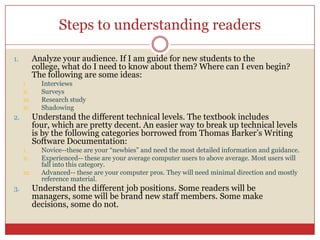
Steps to understanding readers
1. Analyze your audience. If I am guide for new students to the college, what do I
need to know about them? Where can I even begin? The following are some
ideas:
I. Interviews
II. Surveys
III. Research study
IV. Shadowing
2. Understand the different technical levels. The textbook includes four, which are
pretty decent. An easier way to break up technical levels is by the following
categories borrowed from Thomas Barker’s Writing Software Documentation:
I. Novice--these are your “newbies” and need the most detailed information and guidance.
II. Experienced-- these are your average computer users to above average. Most users will fall
into this category.
III. Advanced-- these are your computer pros. They will need minimal direction and mostly
reference material.
3. Understand the different job positions. Some readers will be managers, some
will be brand new staff members. Some make decisions, some do not.
Summary
• Technical writing has many definitions. We will use the
book’s definition of workplace writing that solves a
problem or helps a user with a task.
• Technical writing requires audience and situation analysis.
You have to figure out who will be reading your final
product and in what context.
• Technical writing involves readers of differing technical and
decision making levels.
• Technical writing may require additional research after the
audience analysis to get the job done.

Intro to technical writing

  • 1.
  • 2.
    What is TechnicalWriting? Some Definitions: • “the terms technical writing, professional writing, business writing, and occupational writing also refer to writing done in your career” (Pfeiffer 3). • Technical writing is writing that helps users solve problems with technologies and technical subject matter (Jeff Grabill, Georgia State University). • [Technical Writer is one who]Writes technical materials, such as equipment manuals, appendices, or operating and maintenance instructions. May assist in layout work (Department of Labor).
  • 3.
    What is TechnicalWriting? Each of these definitions attempts to fuse the gap in what technical writing means in terms of what is produced versus how it is produced. While some definitions focus on what the final product is such as manuals, reports, and instructions, other definitions focus on how those products are written, including the clarity or conciseness of the writing.
  • 4.
    So…what do weknow? • Purpose: It gets stuff done. • Writer’s knowledge: You generally know more about the subject than your reader. • Audience: Very often will be several people with differing backgrounds. • Evaluation: It needs to be clear and well organized to help readers. • Graphic Elements: It usually includes visuals such as flowcharts, screenshots, and graphs to help explain complex information.
  • 5.
    So…how do wehelp our audience? • The audience or group of readers will often be faced with problems or issues when the encounter your document. The textbook lists four obstacles for readers; these are rather general. • Readers will encounter different obstacles with different documents. For example, the textbook does not include the obstacles readers face when reviewing documents online. Such obstacles include fatigue from reading onscreen and lack of technical knowledge.
  • 6.
    Steps to understandingreaders 1. Analyze your audience. If I am guide for new students to the college, what do I need to know about them? Where can I even begin? The following are some ideas: I. Interviews II. Surveys III. Research study IV. Shadowing 2. Understand the different technical levels. The textbook includes four, which are pretty decent. An easier way to break up technical levels is by the following categories borrowed from Thomas Barker’s Writing Software Documentation: I. Novice--these are your “newbies” and need the most detailed information and guidance. II. Experienced-- these are your average computer users to above average. Most users will fall into this category. III. Advanced-- these are your computer pros. They will need minimal direction and mostly reference material. 3. Understand the different job positions. Some readers will be managers, some will be brand new staff members. Some make decisions, some do not.
  • 7.
    Summary • Technical writinghas many definitions. We will use the book’s definition of workplace writing that solves a problem or helps a user with a task. • Technical writing requires audience and situation analysis. You have to figure out who will be reading your final product and in what context. • Technical writing involves readers of differing technical and decision making levels. • Technical writing may require additional research after the audience analysis to get the job done.