ENGLISH-III
ASSIGNMENT
TOPIC:
 TECHNICAL WRITING
SKILLS
HJ
Submitted to:
1 | P a g e
“TECHNICAL WRITING SKILL”
Technical writing can be defined as:
“Art of presenting technical informationin such a way that the audience it is
addressedto can understand and use the information”.
The three main stages of the writing processtogether with their corresponding
sub stages are as following:
PRE-WRITING:
It is defined as getting ready to write stage.
 PLANNING
Planningincludes anythingyou do to help yourselfdecide what your central
idea is or what details examples, content or reasonsyou will includeto create
the documents.
In order to do this one shouldconsider:
a. Audience& purpose.(who you’rewriting to and Why?)
b. Tone & Style.( how you transmitthe information!)
c. Gathering of information. (brainstorming& analyzinginformation)
d. Organization of information.
First of all, ask the following questions:
Pre-Writing Writing Post-Writing
2 | P a g e
Who am I writing for? What is the skill level, the average age of the
audience?
How many documentsdo I need to write? , deadline?
WRITING:
“Writing is where you convert your bare-bone tables of notes into series
of drafts, that’s ready for formal review.”
So writing involves:
a. Drafting
b. Revising
c. Editing

“It is the stage in which you develop acomplete first version of a piece of
writing.”
When you start draftingyou should notcare about mistakes.
In draftingediting is ignored totally.
There are 3 ways of putting draft on paper:
1. Handwriting
2. Typewrite
3. Computers

Taking time to Re-Readyour original draft
While revisingreread:
Introduction, topicsentence, details, transitions, sentence variety, closing.
There are three main points to ensureeffectiveness:
1. Audience
DRAFTING
REVISING
3 | P a g e
2. Purpose
3. Subject

“Editing is the process that involves revising the content, grammar &
presentationof a piece of writing.”
Wechange the documentuntilit is right.
In editing wecheck
• Punctuation
• Spelling
• Accuracy of fact
• Format of page.
 EDITINGFOR STYLE
It makesthe writing moreinteresting & appealing.
 EDITINGFOR GRAMMAR
The documentischecked foegrammatical errors
 EDITINGFor Context
Appropriateamountof context is importantto avoid unintended meaningfrom
the text
After edit askyourself
Is it correct?
Is it accurate?
POST-WRITING:
The finalstage of the writingprocess involvesrevisingcontent organization
and checking for grammatical accuracy and crafting the documentinto product
that effectively guidesyou through the topic.
 FINISHING
Editing the documentinto finalform is called finishing.
In this stage you:
1. Learn your common mistakes
2. Point outrepeated errors.
EDITING
4 | P a g e
 PUBLISHING
Publishing is the last stage where writers submit their work to the publisher
 It is also known asfinal draft.
 It is based on users demand.
Sharing can be accomplished in a variety of ways, and with the help of
computers, it can even be printed or published online.
COLLABORATIVE WRITING
Writing that entails the collaborative efforts of a groupof people who
gather together to write documentation, produceimages, providesubtext,
and more in an effort to bring a project tocompletion.”
 It creates a moreenjoyablework environment
 It creates a productthat considersdiverseaudiences
 Co-writingfosters engagement through active learning
AUDIENCE;
The peoplewith whom we are to communicateis called audience
A technical writer shouldknow:
 Who your audienceis
 What their goals are
 Their background, knowledge, experienceetc.
 Their needsand interests
 Any cultureand communication preferences
Knowing your audience determines:
What information you present, how you presentit & how you write about it?
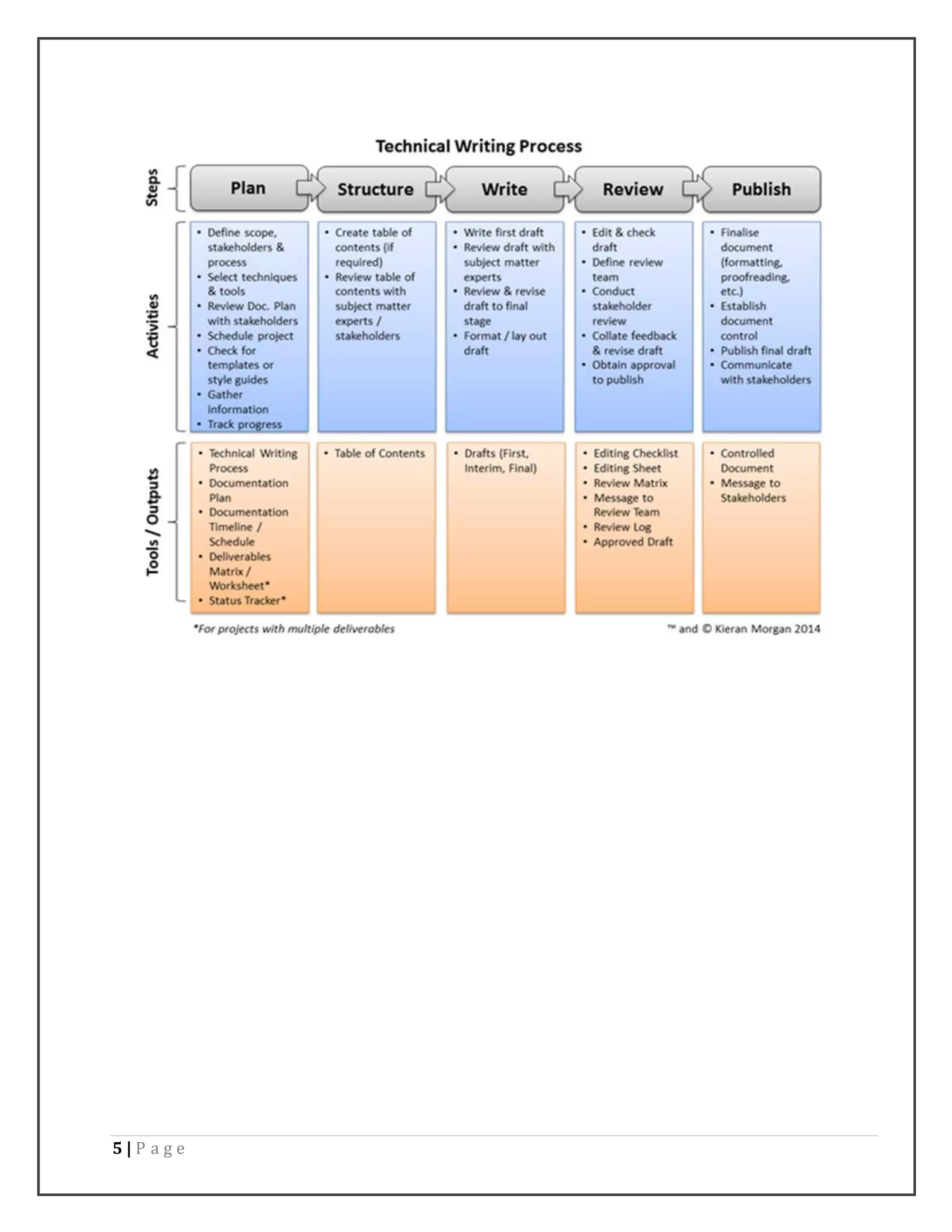
SUMMARY
5 | P a g e

Technical writing

  • 1.
  • 2.
    1 | Pa g e “TECHNICAL WRITING SKILL” Technical writing can be defined as: “Art of presenting technical informationin such a way that the audience it is addressedto can understand and use the information”. The three main stages of the writing processtogether with their corresponding sub stages are as following: PRE-WRITING: It is defined as getting ready to write stage.  PLANNING Planningincludes anythingyou do to help yourselfdecide what your central idea is or what details examples, content or reasonsyou will includeto create the documents. In order to do this one shouldconsider: a. Audience& purpose.(who you’rewriting to and Why?) b. Tone & Style.( how you transmitthe information!) c. Gathering of information. (brainstorming& analyzinginformation) d. Organization of information. First of all, ask the following questions: Pre-Writing Writing Post-Writing
  • 3.
    2 | Pa g e Who am I writing for? What is the skill level, the average age of the audience? How many documentsdo I need to write? , deadline? WRITING: “Writing is where you convert your bare-bone tables of notes into series of drafts, that’s ready for formal review.” So writing involves: a. Drafting b. Revising c. Editing  “It is the stage in which you develop acomplete first version of a piece of writing.” When you start draftingyou should notcare about mistakes. In draftingediting is ignored totally. There are 3 ways of putting draft on paper: 1. Handwriting 2. Typewrite 3. Computers  Taking time to Re-Readyour original draft While revisingreread: Introduction, topicsentence, details, transitions, sentence variety, closing. There are three main points to ensureeffectiveness: 1. Audience DRAFTING REVISING
  • 4.
    3 | Pa g e 2. Purpose 3. Subject  “Editing is the process that involves revising the content, grammar & presentationof a piece of writing.” Wechange the documentuntilit is right. In editing wecheck • Punctuation • Spelling • Accuracy of fact • Format of page.  EDITINGFOR STYLE It makesthe writing moreinteresting & appealing.  EDITINGFOR GRAMMAR The documentischecked foegrammatical errors  EDITINGFor Context Appropriateamountof context is importantto avoid unintended meaningfrom the text After edit askyourself Is it correct? Is it accurate? POST-WRITING: The finalstage of the writingprocess involvesrevisingcontent organization and checking for grammatical accuracy and crafting the documentinto product that effectively guidesyou through the topic.  FINISHING Editing the documentinto finalform is called finishing. In this stage you: 1. Learn your common mistakes 2. Point outrepeated errors. EDITING
  • 5.
    4 | Pa g e  PUBLISHING Publishing is the last stage where writers submit their work to the publisher  It is also known asfinal draft.  It is based on users demand. Sharing can be accomplished in a variety of ways, and with the help of computers, it can even be printed or published online. COLLABORATIVE WRITING Writing that entails the collaborative efforts of a groupof people who gather together to write documentation, produceimages, providesubtext, and more in an effort to bring a project tocompletion.”  It creates a moreenjoyablework environment  It creates a productthat considersdiverseaudiences  Co-writingfosters engagement through active learning AUDIENCE; The peoplewith whom we are to communicateis called audience A technical writer shouldknow:  Who your audienceis  What their goals are  Their background, knowledge, experienceetc.  Their needsand interests  Any cultureand communication preferences Knowing your audience determines: What information you present, how you presentit & how you write about it? SUMMARY
  • 6.
    5 | Pa g e