THE NATURE OF
TECHNICAL WRITING
Members:
Juntoria
Dinopol
Carlon
Ventura
OBJECTIVES:
• Understand THE NATURE, PURPOSE, AND
FUNCTIONS OF TECHNICAL WRITING.
• IDENTIFY AND APPLY THE KEY
CHARACTERISTICS, PRINCIPLES, AND STYLE OF
EFFECTIVE TECHNICAL WRITING.
• FOLLOW A STRUCTURED GUIDE TO PRODUCE
EFFECTIVE TECHNICAL DOCUMENTS THAT
MEET THE NEEDS OF SPECIFIC AUDIENCES AND
SITUATIONS.
The Nature of Technical
Writing
• Technical writing is an audience-centered means of
communication that provides a reader with clear and
easy access to information.
• Technical writing is the art of conveying complex
information in a clear, concise, and accessible manner.
It's a specialized form of writing that focuses on making
complex ideas easy to understand for a specific
audience.
• Technical writers recognize the importance of effective
and efficient communication by providing documents
written in specific formats, using unambiguous
language to provide information.
Characteristics of Technical
Writing
• Technical writing explains a topic in a way that is easy to understand, sticks to the facts,
is correct, and is straight to the point.
• It often uses special ways of writing to explain things, like describing how something
works, how to do something step by step, making things clearer, showing what causes
what, comparing things, giving examples, and explaining meanings.
• It uses words that are specific to a certain field (like medicine or technology). It also
uses charts, tables, and pictures to help explain the information better. Plus, it follows
common report formats that professionals usually use
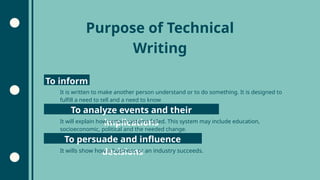
Purpose of Technical
Writing
It is written to make another person understand or to do something. It is designed to
fulfill a need to tell and a need to know
To analyze events and their
implications
To inform
To persuade and influence
decisions
It will explain how certain systems failed. This system may include education,
socioeconomic, political and the needed change.
It wills show how a business or an industry succeeds.
Functions of Technical
writing
Writers have the luxury of time to delve deeply
into their subject matter, conduct thorough
research, and engage in extensive planning
and outlining. They can afford to explore a
more intricate and comprehensive approach to
their writing.
Writers can spread their writing process across
multiple stages, including researching,
outlining, drafting, revising, and editing, with
ample room for reflection and revision. The
focus is on producing a polished, well-
structured, and thoroughly revised piece of
writing.
Functions of Technical
writing
Communication: It effectively communicates
intricate technical information to targeted
audiences in a straightforward and succinct
manner.
Instruction: Technical writing offers clear,
step-by-step guidelines or instructions for
users, as seen in user manuals or tutorials.
Several key Functions:
Documentation: It records processes,
procedures, and policies for future use,
ensuring uniformity and adherence to
standards.
Information sharing: Technical writing shares
knowledge and research findings with relevant
parties, such as in technical reports or white
papers.
Functions of Technical
writing
Problem-solving: It assists users in
troubleshooting problems or addressing
issues by providing thorough explanations
and solutions.
Several key Functions:
Training and education: Technical writing
facilitates learning and professional growth
through resources like online courses,
manuals, and tutorials.
Basic Principles of Good
Technical Writing
Understanding the
Reader
Knowing the Purpose of
Technical Report
• The technical writer should know how to
adapt his writings and terminologies of
the type of the intended audience or
readers.
• Difficult technical terms used must be
carefully defined so that the reader will
easily understand the information being
presented.
• The technical paper must be organized
around a central theme. The reader
should understand the main purpose
after reading the paper.
• The purpose maybe is to describe a thing,
to report on a specific problem or project,
or to analyze and solve a problem
Basic Principles of Good
Technical Writing
Knowing the Subject Matter
Knowing the Purpose of
Technical Report
• If the report is on the result of a technical
experiment, the writer who writes the
report should explain what the problem is
all about, what causes the problem and
how the problem is solved.
• The impersonal style is basic to an
effective technical writer. He represents
facts, figures and statistics skillfully woven
around the subject matter or central
theme and written in an impersonal
manner.
Basic Principles of Good
Technical Writing
Using Correct Format Adopting Ethical Standars
• The format and style of a report attract
the attention of the readers first.
Companies require neatly-typed
communications, reports and project
proposals and feasibility studies.
• A technical writer should undertake
comprehensive research work;
accumulate the required data through
interviews, surveys, referrals and related
publications.
• Must have to present facts and figures as
gathered and required, using only those
that are pertinent to the report.
Style in Technical
writing
Delve deep into the topic by conducting thorough research.
Utilize a variety of reputable sources to gather diverse
perspectives and solid evidence.
Research extensively
Create an outline before you start writing. This helps in
structuring the essay and organizing the gathered information
effectively.
Organize your thoughts
Construct a clear and focused thesis statement that conveys the
main argument or purpose of the essay. It should guide the
entire essay.
Develop a thesis statement
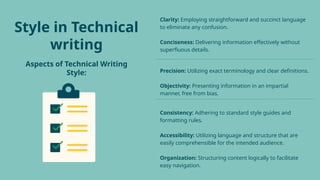
Style in Technical
writing
Clarity: Employing straightforward and succinct language
to eliminate any confusion.
Conciseness: Delivering information effectively without
superfluous details.
Aspects of Technical Writing
Style: Precision: Utilizing exact terminology and clear definitions.
Objectivity: Presenting information in an impartial
manner, free from bias.
Consistency: Adhering to standard style guides and
formatting rules.
Accessibility: Utilizing language and structure that are
easily comprehensible for the intended audience.
Organization: Structuring content logically to facilitate
easy navigation.
GUIDE TO EFFECTIVE
TECHNICAL WRITING
The lesson aimed to equip students with the
fundamental skills and strategies necessary to
produce clear, concise, and accurate technical
documentation for various audiences and purposes.
We explored the core characteristics of good
technical writing, common challenges, and practical
techniques for improvement.
1.Understanding the Audience:
• Identifying the target audience (e.g., experts, novices,
specific roles).
• Considering their existing knowledge, technical
background, and information needs.
• Tailoring the language, level of detail, and complexity
accordingly.
• Anticipating potential questions and addressing
them proactively.
2. Defining the Purpose:
• Clearly understanding the objective of the technical
document (e.g., to instruct, inform, persuade, record).
• Ensuring all content directly supports the intended
purpose.
• Maintaining focus and avoiding unnecessary
information.
3. Clarity and Conciseness:
• Using precise and unambiguous language.
• Avoiding jargon, slang, and overly complex sentence
structures.
• Employing active voice whenever possible for
directness.
• Eliminating redundancy and unnecessary words.
• Structuring information logically for easy
comprehension.
4. Accuracy and Precision:
• Ensuring all technical information, data, and
procedures are factually correct.
• Double-checking details, measurements, and
calculations.
• Using consistent terminology and units of
measurement.
• Citing sources appropriately when referencing
external information.
5. Organization and Structure:
• Employing a logical flow and clear organizational patterns (e.g.,
chronological, hierarchical, problem-solution).
• Using headings, subheadings, bullet points, and numbered
lists to break down information.
• Creating a clear table of contents and index for easy navigation
(for longer documents).
• Providing effective introductions and conclusions that frame
and summarize the content.
6. Visual Aids:
• Recognizing the value of incorporating
relevant visuals (e.g., diagrams, charts,
graphs, screenshots).
• Ensuring visuals are clear, labeled
appropriately, and directly support the text.
• Integrating visuals seamlessly within the
document.
7. Tone and Style:
• Maintaining a professional, objective, and
unbiased tone.
• Avoiding personal opinions or emotional
language.
• Adhering to any specific style guides or
conventions relevant to the field or organization.
8. Usability and Accessibility:
• Designing documents that are easy to
read, understand, and use.
• Considering accessibility guidelines for
users with disabilities (e.g., alternative text
for images, clear font choices).
9. The Technical Writing Process:
• Planning: Defining the audience, purpose, scope, and outline.
• Drafting: Writing the initial content, focusing on conveying
information.
• Reviewing and Editing: Checking for clarity, accuracy, grammar,
spelling, and style.
• Testing (if applicable): Ensuring the document is effective for the
intended users.
• Publishing and Maintaining: Distributing the document and
updating it as needed.
In conclusion, this lesson provided a foundational
understanding of effective technical writing,
emphasizing audience focus, clarity, accuracy, and
structured organization. Mastering these
principles is crucial for clear communication in
technical fields and will be further developed in
future learning.
“My aim is to put down on paper what I
see and what I feel in the best and
simplest way.”
―Ernest Hemingway

TechnicalWritingreportPresentation1.pptx

  • 1.
    THE NATURE OF TECHNICALWRITING Members: Juntoria Dinopol Carlon Ventura
  • 2.
    OBJECTIVES: • Understand THENATURE, PURPOSE, AND FUNCTIONS OF TECHNICAL WRITING. • IDENTIFY AND APPLY THE KEY CHARACTERISTICS, PRINCIPLES, AND STYLE OF EFFECTIVE TECHNICAL WRITING. • FOLLOW A STRUCTURED GUIDE TO PRODUCE EFFECTIVE TECHNICAL DOCUMENTS THAT MEET THE NEEDS OF SPECIFIC AUDIENCES AND SITUATIONS.
  • 4.
    The Nature ofTechnical Writing • Technical writing is an audience-centered means of communication that provides a reader with clear and easy access to information. • Technical writing is the art of conveying complex information in a clear, concise, and accessible manner. It's a specialized form of writing that focuses on making complex ideas easy to understand for a specific audience. • Technical writers recognize the importance of effective and efficient communication by providing documents written in specific formats, using unambiguous language to provide information.
  • 5.
    Characteristics of Technical Writing •Technical writing explains a topic in a way that is easy to understand, sticks to the facts, is correct, and is straight to the point. • It often uses special ways of writing to explain things, like describing how something works, how to do something step by step, making things clearer, showing what causes what, comparing things, giving examples, and explaining meanings. • It uses words that are specific to a certain field (like medicine or technology). It also uses charts, tables, and pictures to help explain the information better. Plus, it follows common report formats that professionals usually use
  • 6.
    Purpose of Technical Writing Itis written to make another person understand or to do something. It is designed to fulfill a need to tell and a need to know To analyze events and their implications To inform To persuade and influence decisions It will explain how certain systems failed. This system may include education, socioeconomic, political and the needed change. It wills show how a business or an industry succeeds.
  • 7.
    Functions of Technical writing Writershave the luxury of time to delve deeply into their subject matter, conduct thorough research, and engage in extensive planning and outlining. They can afford to explore a more intricate and comprehensive approach to their writing. Writers can spread their writing process across multiple stages, including researching, outlining, drafting, revising, and editing, with ample room for reflection and revision. The focus is on producing a polished, well- structured, and thoroughly revised piece of writing.
  • 8.
    Functions of Technical writing Communication:It effectively communicates intricate technical information to targeted audiences in a straightforward and succinct manner. Instruction: Technical writing offers clear, step-by-step guidelines or instructions for users, as seen in user manuals or tutorials. Several key Functions: Documentation: It records processes, procedures, and policies for future use, ensuring uniformity and adherence to standards. Information sharing: Technical writing shares knowledge and research findings with relevant parties, such as in technical reports or white papers.
  • 9.
    Functions of Technical writing Problem-solving:It assists users in troubleshooting problems or addressing issues by providing thorough explanations and solutions. Several key Functions: Training and education: Technical writing facilitates learning and professional growth through resources like online courses, manuals, and tutorials.
  • 10.
    Basic Principles ofGood Technical Writing Understanding the Reader Knowing the Purpose of Technical Report • The technical writer should know how to adapt his writings and terminologies of the type of the intended audience or readers. • Difficult technical terms used must be carefully defined so that the reader will easily understand the information being presented. • The technical paper must be organized around a central theme. The reader should understand the main purpose after reading the paper. • The purpose maybe is to describe a thing, to report on a specific problem or project, or to analyze and solve a problem
  • 11.
    Basic Principles ofGood Technical Writing Knowing the Subject Matter Knowing the Purpose of Technical Report • If the report is on the result of a technical experiment, the writer who writes the report should explain what the problem is all about, what causes the problem and how the problem is solved. • The impersonal style is basic to an effective technical writer. He represents facts, figures and statistics skillfully woven around the subject matter or central theme and written in an impersonal manner.
  • 12.
    Basic Principles ofGood Technical Writing Using Correct Format Adopting Ethical Standars • The format and style of a report attract the attention of the readers first. Companies require neatly-typed communications, reports and project proposals and feasibility studies. • A technical writer should undertake comprehensive research work; accumulate the required data through interviews, surveys, referrals and related publications. • Must have to present facts and figures as gathered and required, using only those that are pertinent to the report.
  • 13.
    Style in Technical writing Delvedeep into the topic by conducting thorough research. Utilize a variety of reputable sources to gather diverse perspectives and solid evidence. Research extensively Create an outline before you start writing. This helps in structuring the essay and organizing the gathered information effectively. Organize your thoughts Construct a clear and focused thesis statement that conveys the main argument or purpose of the essay. It should guide the entire essay. Develop a thesis statement
  • 14.
    Style in Technical writing Clarity:Employing straightforward and succinct language to eliminate any confusion. Conciseness: Delivering information effectively without superfluous details. Aspects of Technical Writing Style: Precision: Utilizing exact terminology and clear definitions. Objectivity: Presenting information in an impartial manner, free from bias. Consistency: Adhering to standard style guides and formatting rules. Accessibility: Utilizing language and structure that are easily comprehensible for the intended audience. Organization: Structuring content logically to facilitate easy navigation.
  • 15.
  • 16.
    The lesson aimedto equip students with the fundamental skills and strategies necessary to produce clear, concise, and accurate technical documentation for various audiences and purposes. We explored the core characteristics of good technical writing, common challenges, and practical techniques for improvement.
  • 17.
    1.Understanding the Audience: •Identifying the target audience (e.g., experts, novices, specific roles). • Considering their existing knowledge, technical background, and information needs. • Tailoring the language, level of detail, and complexity accordingly. • Anticipating potential questions and addressing them proactively.
  • 18.
    2. Defining thePurpose: • Clearly understanding the objective of the technical document (e.g., to instruct, inform, persuade, record). • Ensuring all content directly supports the intended purpose. • Maintaining focus and avoiding unnecessary information.
  • 19.
    3. Clarity andConciseness: • Using precise and unambiguous language. • Avoiding jargon, slang, and overly complex sentence structures. • Employing active voice whenever possible for directness. • Eliminating redundancy and unnecessary words. • Structuring information logically for easy comprehension.
  • 20.
    4. Accuracy andPrecision: • Ensuring all technical information, data, and procedures are factually correct. • Double-checking details, measurements, and calculations. • Using consistent terminology and units of measurement. • Citing sources appropriately when referencing external information.
  • 21.
    5. Organization andStructure: • Employing a logical flow and clear organizational patterns (e.g., chronological, hierarchical, problem-solution). • Using headings, subheadings, bullet points, and numbered lists to break down information. • Creating a clear table of contents and index for easy navigation (for longer documents). • Providing effective introductions and conclusions that frame and summarize the content.
  • 22.
    6. Visual Aids: •Recognizing the value of incorporating relevant visuals (e.g., diagrams, charts, graphs, screenshots). • Ensuring visuals are clear, labeled appropriately, and directly support the text. • Integrating visuals seamlessly within the document.
  • 23.
    7. Tone andStyle: • Maintaining a professional, objective, and unbiased tone. • Avoiding personal opinions or emotional language. • Adhering to any specific style guides or conventions relevant to the field or organization.
  • 24.
    8. Usability andAccessibility: • Designing documents that are easy to read, understand, and use. • Considering accessibility guidelines for users with disabilities (e.g., alternative text for images, clear font choices).
  • 25.
    9. The TechnicalWriting Process: • Planning: Defining the audience, purpose, scope, and outline. • Drafting: Writing the initial content, focusing on conveying information. • Reviewing and Editing: Checking for clarity, accuracy, grammar, spelling, and style. • Testing (if applicable): Ensuring the document is effective for the intended users. • Publishing and Maintaining: Distributing the document and updating it as needed.
  • 26.
    In conclusion, thislesson provided a foundational understanding of effective technical writing, emphasizing audience focus, clarity, accuracy, and structured organization. Mastering these principles is crucial for clear communication in technical fields and will be further developed in future learning.
  • 27.
    “My aim isto put down on paper what I see and what I feel in the best and simplest way.” ―Ernest Hemingway