

durable_rules
Who am I?
Why durable_rules?
durable_rules is the result of my personal research, it does not reflect the positions of my
employer.
Agenda
• History
• Rete
• Performance Challenge
• Benchmark
• Demo
• Futures
• Q & A
History
2400 years ago
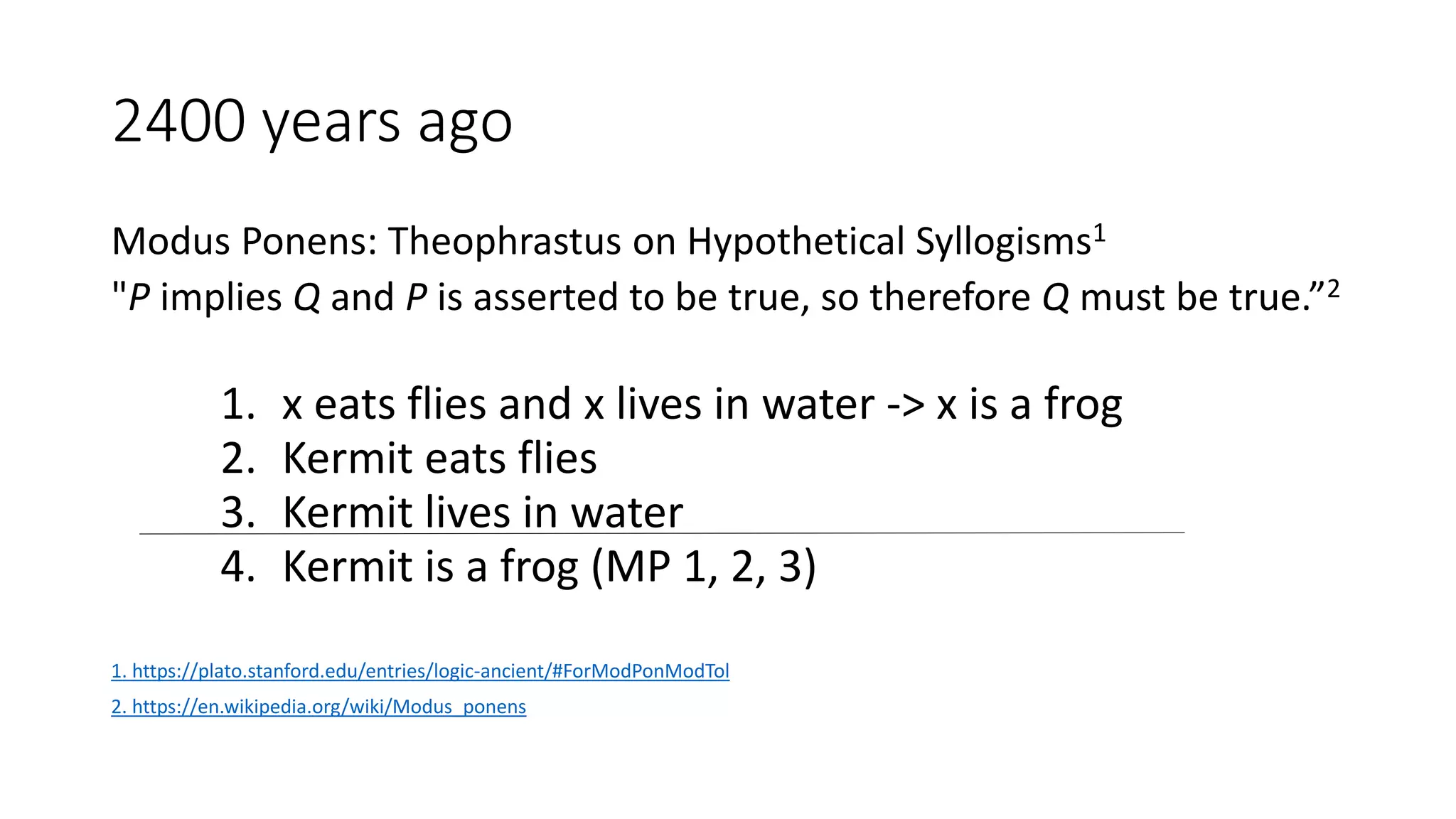
Modus Ponens: Theophrastus on Hypothetical Syllogisms1
"P implies Q and P is asserted to be true, so therefore Q must be true.”2
1. x eats flies and x lives in water -> x is a frog
2. Kermit eats flies
3. Kermit lives in water
4. Kermit is a frog (MP 1, 2, 3)
1. https://plato.stanford.edu/entries/logic-ancient/#ForModPonModTol
2. https://en.wikipedia.org/wiki/Modus_ponens
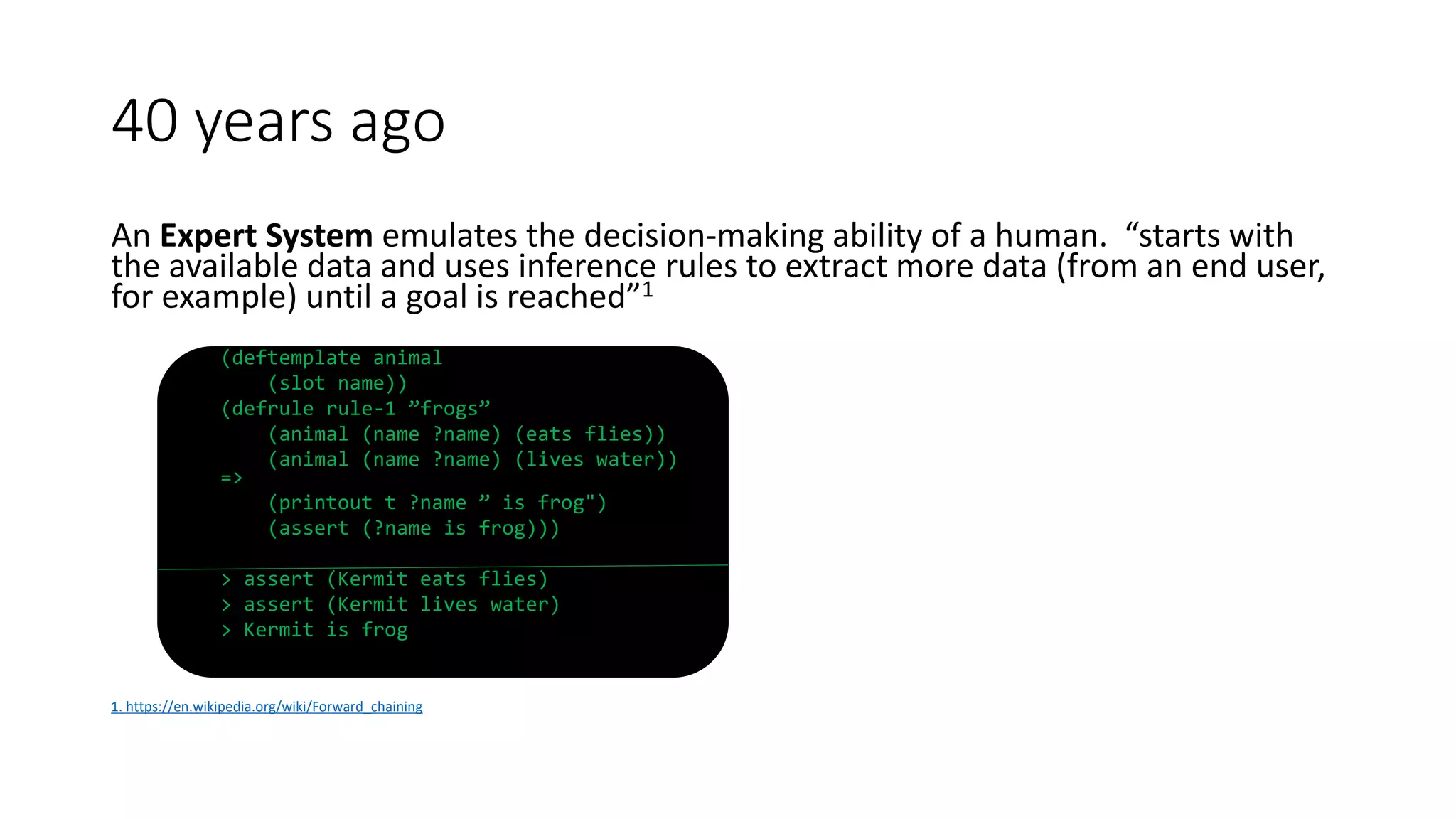
An Expert System emulates the decision-making ability of a human. “starts with
the available data and uses inference rules to extract more data (from an end user,
for example) until a goal is reached”1
(deftemplate animal
(slot name))
(defrule rule-1 ”frogs”
(animal (name ?name) (eats flies))
(animal (name ?name) (lives water))
=>
(printout t ?name ” is frog")
(assert (?name is frog)))
> assert (Kermit eats flies)
> assert (Kermit lives water)
> Kermit is frog
1. https://en.wikipedia.org/wiki/Forward_chaining
40 years ago
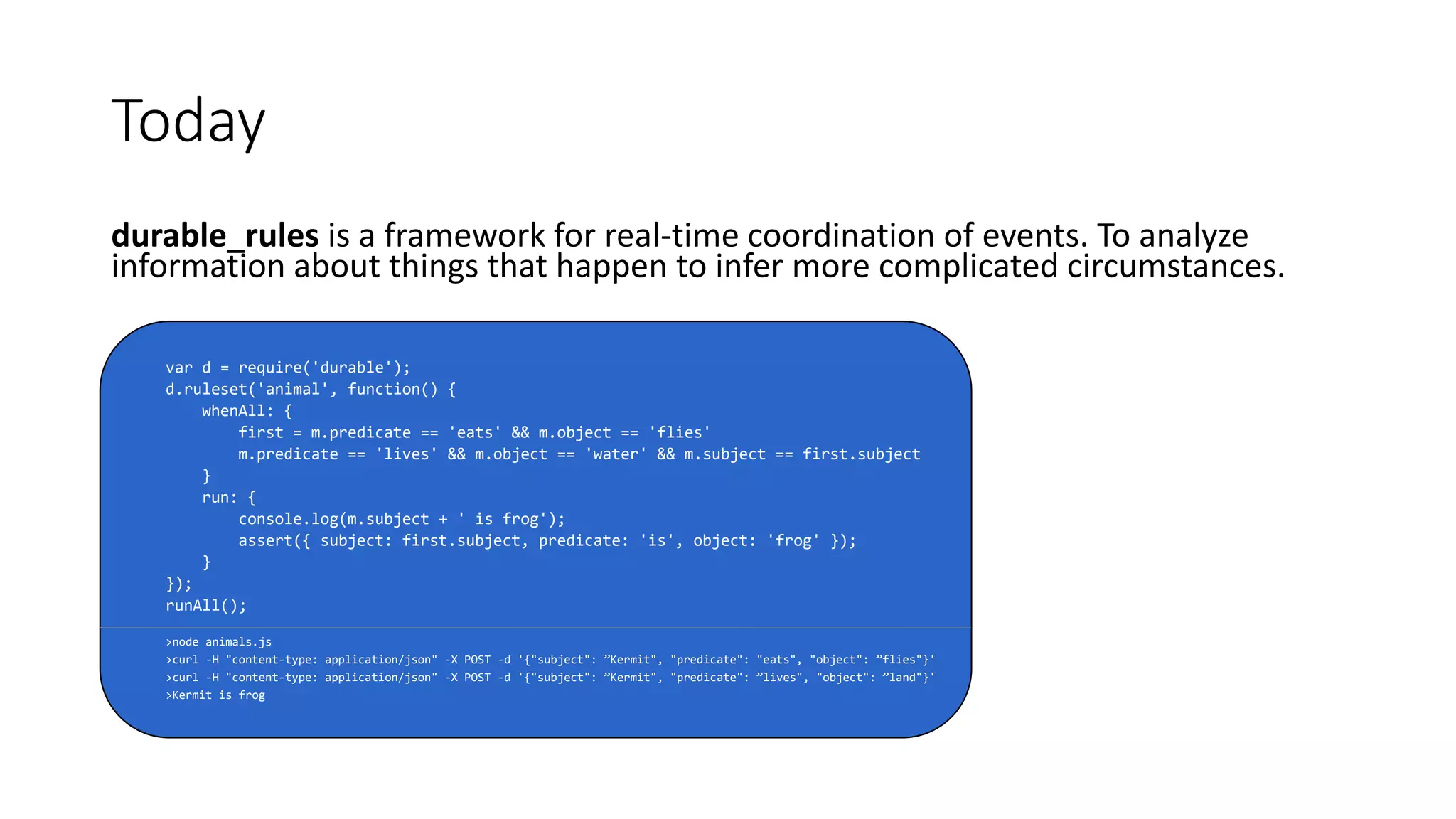
durable_rules is a framework for real-time coordination of events. To analyze
information about things that happen to infer more complicated circumstances.
var d = require('durable');
d.ruleset('animal', function() {
whenAll: {
first = m.predicate == 'eats' && m.object == 'flies'
m.predicate == 'lives' && m.object == 'water' && m.subject == first.subject
}
run: {
console.log(m.subject + ' is frog');
assert({ subject: first.subject, predicate: 'is', object: 'frog' });
}
});
runAll();
>node animals.js
>curl -H "content-type: application/json" -X POST -d '{"subject": ”Kermit", "predicate": "eats", "object": ”flies"}'
>curl -H "content-type: application/json" -X POST -d '{"subject": ”Kermit", "predicate": ”lives", "object": ”land"}'
>Kermit is frog
Today
Rete
: a network especially of blood vessels or nerves : 1
The Rete algorithm was designed by Charles L. Forgy of Carnegie Mellon
University, first published in a working paper in 1974. 2
1. https://www.merriam-webster.com/dictionary/rete
2. https://en.wikipedia.org/wiki/Rete_algorithm
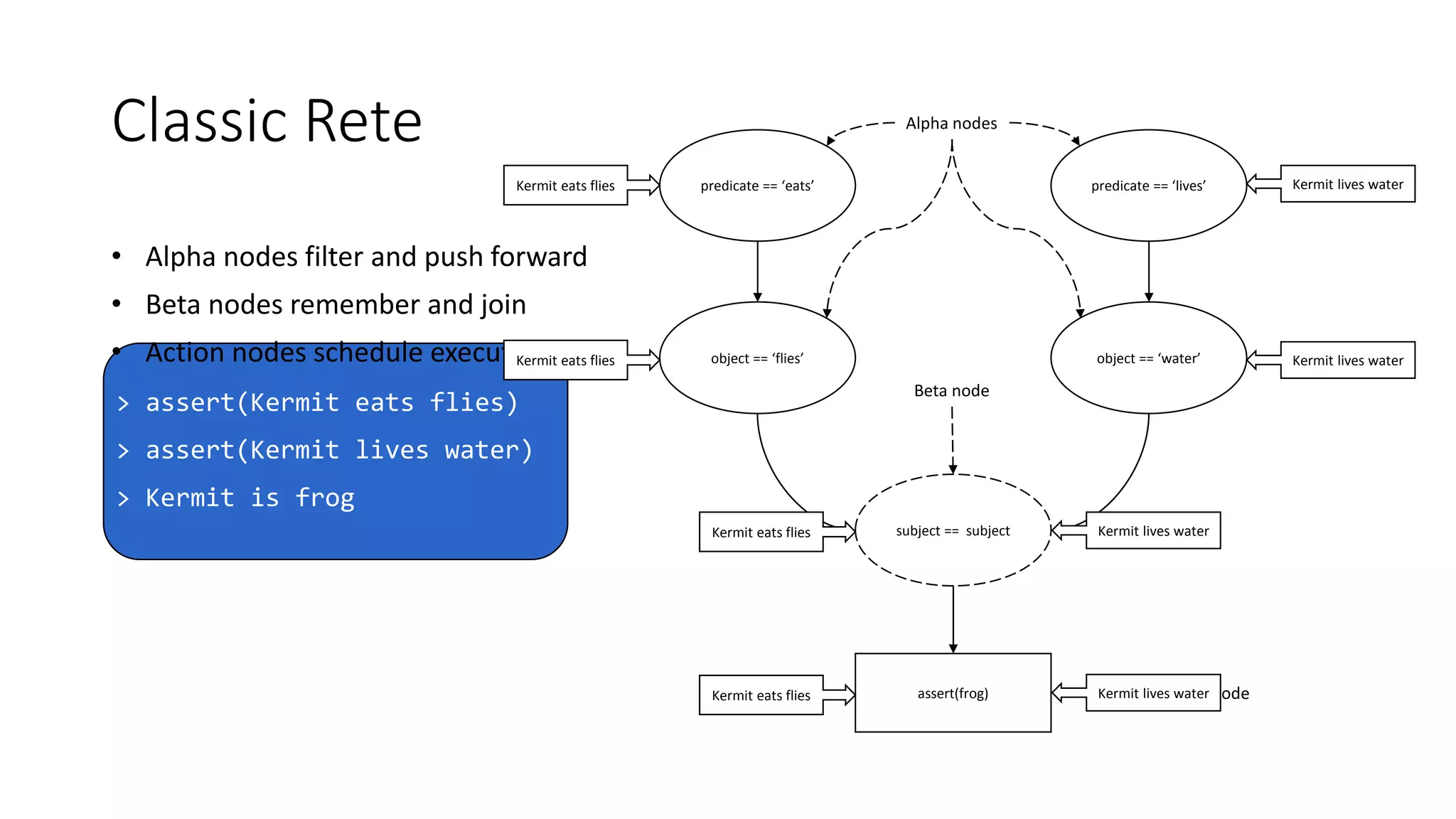
Kermit eats flies
Classic Rete
predicate == ‘eats’
object == ‘flies’
predicate == ‘lives’
object == ‘water’
subject == subject
assert(frog)
Beta node
Action node
Alpha nodes
• Alpha nodes filter and push forward
• Beta nodes remember and join
• Action nodes schedule execution
> assert(Kermit eats flies)
> assert(Kermit lives water)
> Kermit is frog
Kermit eats flies
Kermit eats flies Kermit lives water
Kermit lives water
Kermit lives water
Kermit eats flies Kermit lives water
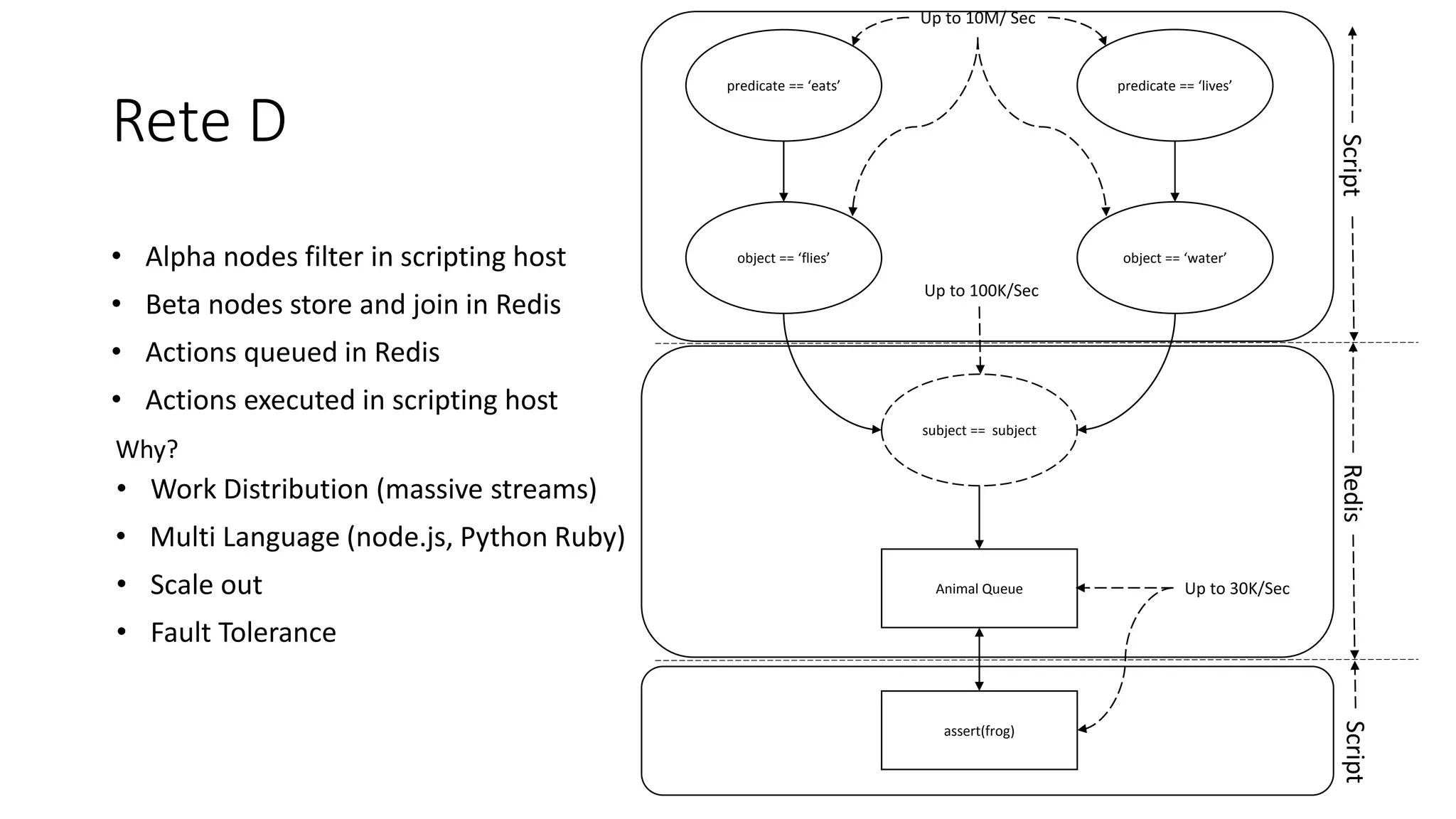
Rete D
predicate == ‘eats’
object == ‘flies’
predicate == ‘lives’
object == ‘water’
subject == subject
Animal Queue
• Alpha nodes filter in scripting host
• Beta nodes store and join in Redis
• Actions queued in Redis
assert(frog)
• Actions executed in scripting host
RedisScriptScript
• Work Distribution (massive streams)
• Scale out
• Fault Tolerance
• Multi Language (node.js, Python Ruby)
Why?
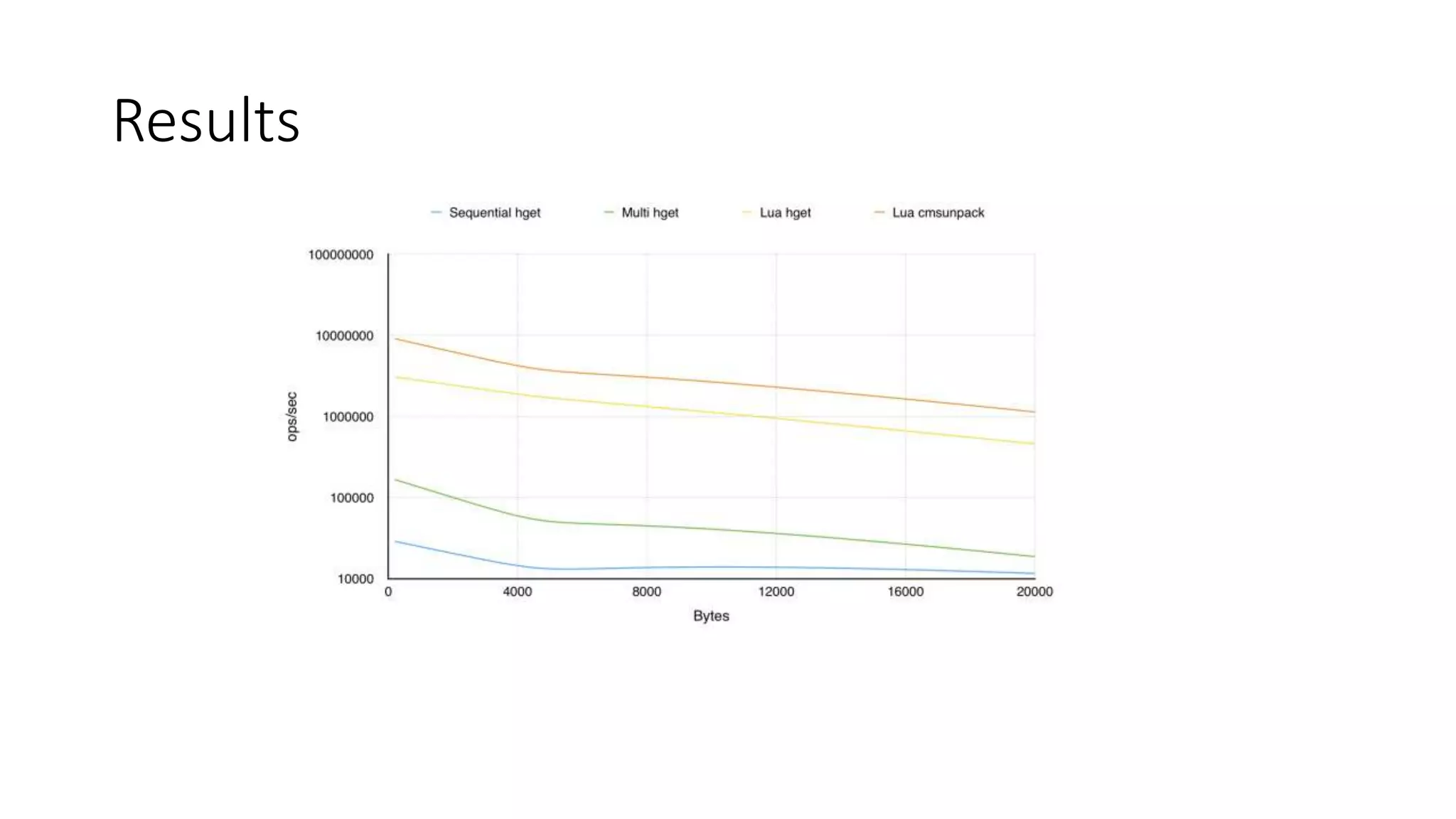
Up to 10M/ Sec
Up to 100K/Sec
Up to 30K/Sec
Performance Challenge
1. We have 100000 objects stored in Redis
2. We have 100 objects in a Node.js client
3. We want to generate object pairs that match: first.subject == second.subject
First solution var redis = require('redis'), client = redis.createClient();
// more details here…
var callback = function (err, res) {
var first = JSON.parse(res);
for (var ii = 0; ii < localObjects.length; ++ii) {
if (first.subject == localObjects[ii].subject) {
results.push({first: first, second: localObjects[ii]});
}
}
if (i != 99999) {
++i;
client.lindex('test', i, callback);
}
}
client.lindex('test', i, callback);
“{‘subject’:1, ’object’:’flies’}”
“{‘subject’:2, ’object’:’flies’}”
“{‘subject’:3, ’object’:’flies’}”
“{‘subject’:4, ’object’:’flies’}”
“{‘subject’:5, ’object’:’flies’}”
“{‘subject’:6, ’object’:’flies’}”
“{‘subject’:7, ’object’:’flies’}”
“{‘subject’:8, ’object’:’flies’}”
“{‘subject’:9, ’object’:’flies’}”
“{‘subject’:2, ’object’:’water’}”
“{‘subject’:3, ’object’:’water’}”
, 100000
“{‘subject’:4, ’object’:’flies’}”
“{‘subject’:5, ’object’:’flies’}”
, 100
“{‘subject’:1, ’object’:’flies’}”
RedisNode.js
Total execution time -> 4067 ms
Second solution
var redis = require('redis'), client = redis.createClient();
// more details here…
var callback = function (err, res) {
var first = JSON.parse(res);
results.push({first: first, second: objects[i]});
if (i != localObjects.length - 1) {
++i;
client.hget('test', localObjects[i].subject, callback);
}
}
client.hget('test', localObjects[i].subject, callback);
“{‘subject’:1, ’object’:’flies’}”
“{‘subject’:2, ’object’:’flies’}”
“{‘subject’:3, ’object’:’flies’}”
“{‘subject’:4, ’object’:’flies’}”
“{‘subject’:5, ’object’:’flies’}”
“{‘subject’:6, ’object’:’flies’}”
“{‘subject’:7, ’object’:’flies’}”
“{‘subject’:8, ’object’:’flies’}”
“{‘subject’:9, ’object’:’flies’}”
“{‘subject’:2, ’object’:’water’}”
“{‘subject’:3, ’object’:’water’}”
, 100000
“{‘subject’:4, ’object’:’flies’}”
“{‘subject’:5, ’object’:’flies’}”
, 100
1
2
3
4
5
6
7
8
9
RedisNode.js
“{‘subject’:3, ’object’:’flies’}”
“{‘subject’:2, ’object’:’flies’}”
Total execution time -> 7 ms
Third solution
var redis = require('redis'), client = redis.createClient();
// more details here…
client.script('load',
'local results = {}n' +
'for i = 1, #ARGV, 1 don' +
' results[i] = redis.call("hget", "test", ARGV[i])n' +
'endn' +
'return resultsn',
function (err, res) {
var hash = res;
var callback = function (err, res) {
for (var ii = 0; ii < localObjects.length; ++ii) {
results.push({first: JSON.parse(res[ii]), second: localObjects[ii]});
}
};
var args = [hash, 0];
for (ii = 0; ii < localObjects.length; ++ii) {
args.push(localObjects[ii].subject);
}
args.push(callback);
client.evalsha.apply(client, args);
}
);
“{‘subject’:1, ’object’:’flies’}”
“{‘subject’:2, ’object’:’flies’}”
“{‘subject’:3, ’object’:’flies’}”
“{‘subject’:4, ’object’:’flies’}”
“{‘subject’:5, ’object’:’flies’}”
“{‘subject’:6, ’object’:’flies’}”
“{‘subject’:7, ’object’:’flies’}”
“{‘subject’:8, ’object’:’flies’}”
“{‘subject’:9, ’object’:’flies’}”
“{‘subject’:2, ’object’:’water’}”
“{‘subject’:3, ’object’:’water’}”
, 100000
“{‘subject’:4, ’object’:’flies’}”
“{‘subject’:5, ’object’:’flies’}”
, 100
1
2
3
4
5
6
7
8
9
RedisNode.js
Total execution time -> 600 micros
“{‘subject’:2, ’object’:’flies’}”
“{‘subject’:3, ’object’:’flies’}”
“{‘subject’:4, ’object’:’flies’}”
“{‘subject’:5, ’object’:’flies’}”
“{‘subject’:2, ’object’:’flies’}”
“{‘subject’:3, ’object’:’flies’}”
“{‘subject’:4, ’object’:’flies’}”
“{‘subject’:5, ’object’:’flies’}”
Results
Benchmark
Miss Manners has decided to throw a party. She wants to seat her
guests such that adjacent people are of opposite sex and share at least
one hobby. The problem has to be solved for 8, 16, 32 and 128 guests.
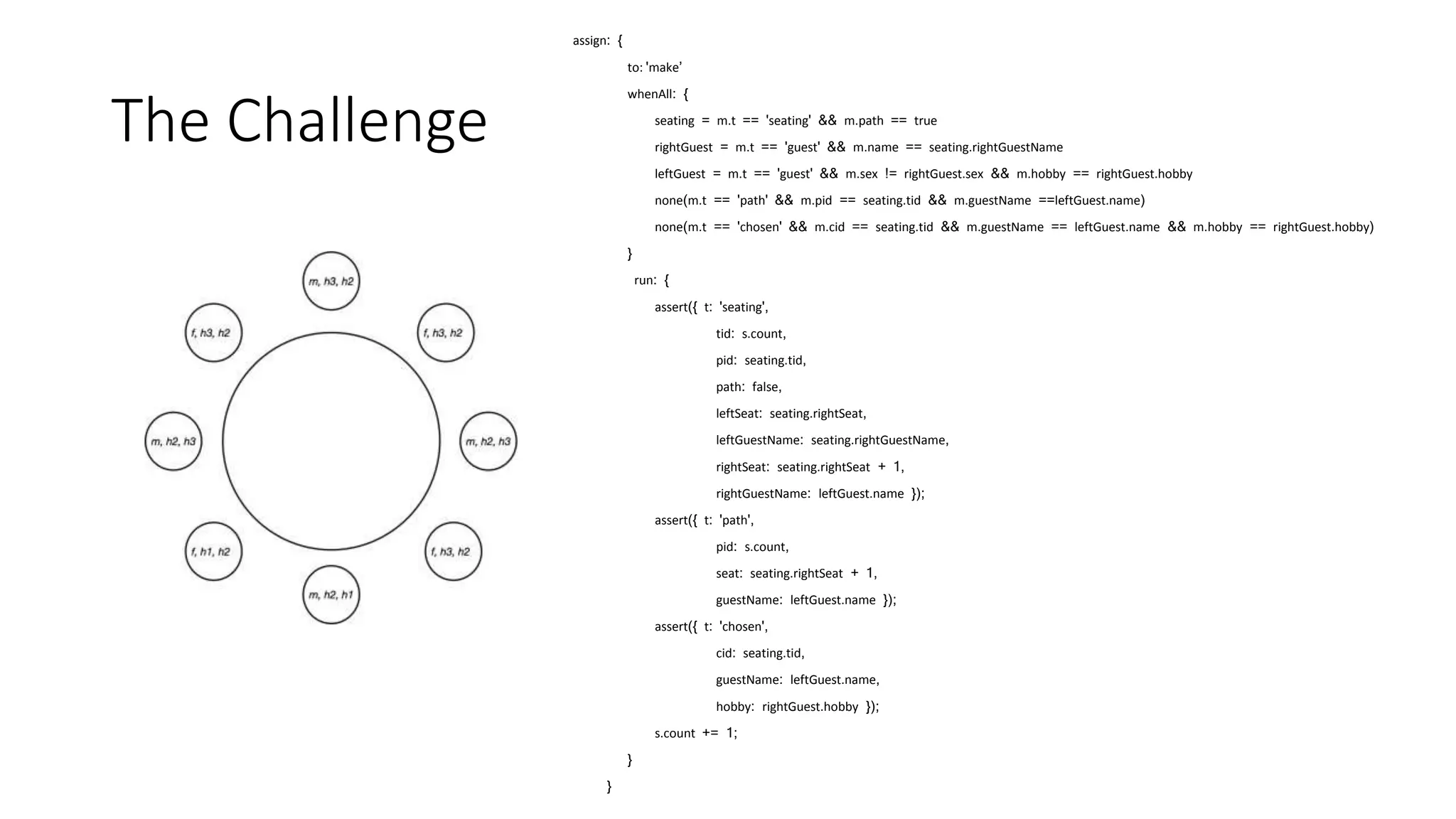
The Challenge
assign: {
to: 'make’
whenAll: {
seating = m.t == 'seating' && m.path == true
rightGuest = m.t == 'guest' && m.name == seating.rightGuestName
leftGuest = m.t == 'guest' && m.sex != rightGuest.sex && m.hobby == rightGuest.hobby
none(m.t == 'path' && m.pid == seating.tid && m.guestName ==leftGuest.name)
none(m.t == 'chosen' && m.cid == seating.tid && m.guestName == leftGuest.name && m.hobby == rightGuest.hobby)
}
run: {
assert({ t: 'seating',
tid: s.count,
pid: seating.tid,
path: false,
leftSeat: seating.rightSeat,
leftGuestName: seating.rightGuestName,
rightSeat: seating.rightSeat + 1,
rightGuestName: leftGuest.name });
assert({ t: 'path',
pid: s.count,
seat: seating.rightSeat + 1,
guestName: leftGuest.name });
assert({ t: 'chosen',
cid: seating.tid,
guestName: leftGuest.name,
hobby: rightGuest.hobby });
s.count += 1;
}
}
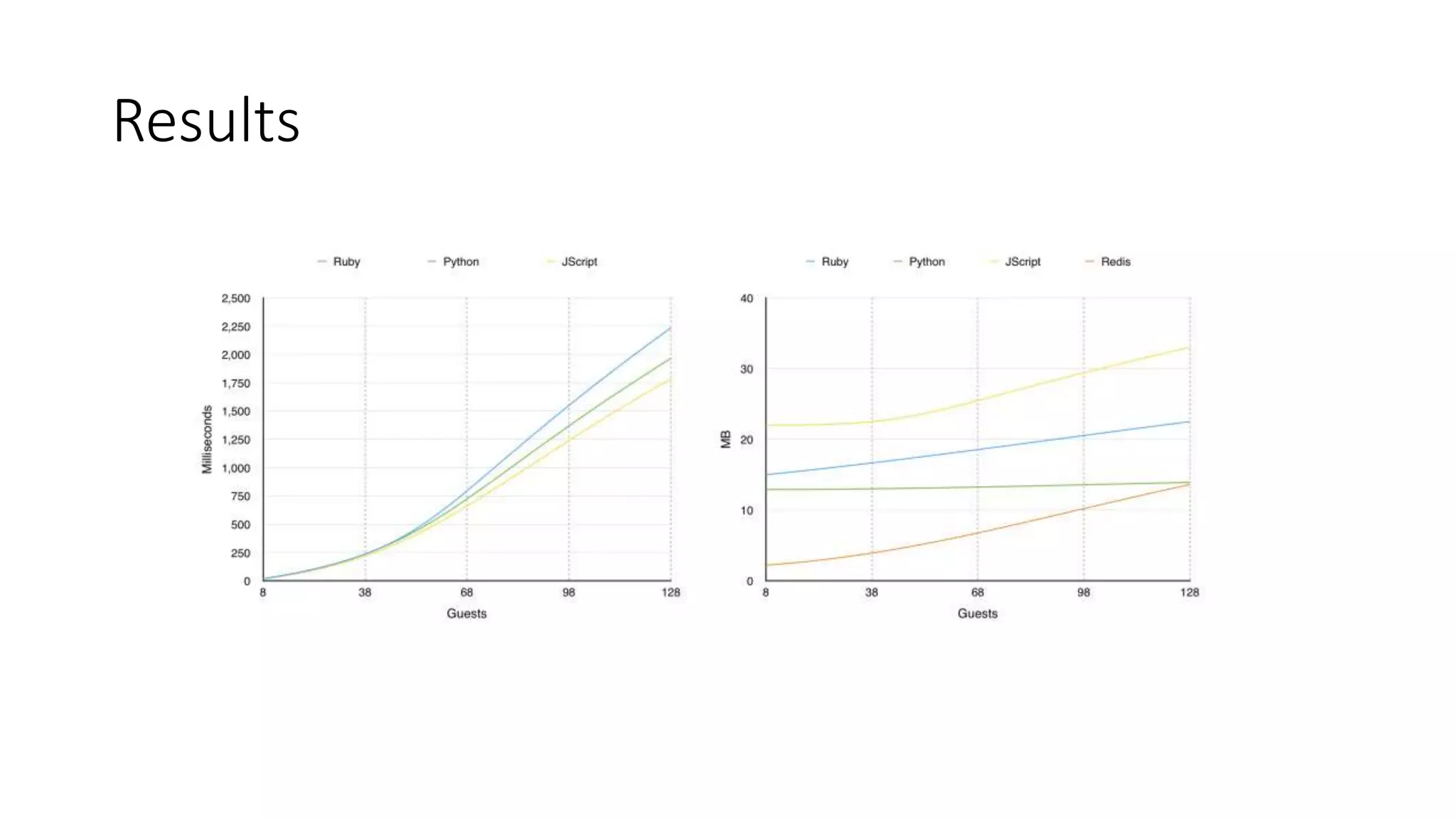
Results
Futures
• Performance
• Richer Queries (array support)
• Facts: Queries (facts, antecedents)
• Events: Bloom Filters
• WebSite
• Service
Q & A
To learn more:
https://github.com/jruizgit/rules
@jruiztwi

RedisConf17- durable_rules

  • 1.
  • 2.
    Who am I? Whydurable_rules? durable_rules is the result of my personal research, it does not reflect the positions of my employer.
  • 3.
    Agenda • History • Rete •Performance Challenge • Benchmark • Demo • Futures • Q & A
  • 4.
  • 5.
    2400 years ago ModusPonens: Theophrastus on Hypothetical Syllogisms1 "P implies Q and P is asserted to be true, so therefore Q must be true.”2 1. x eats flies and x lives in water -> x is a frog 2. Kermit eats flies 3. Kermit lives in water 4. Kermit is a frog (MP 1, 2, 3) 1. https://plato.stanford.edu/entries/logic-ancient/#ForModPonModTol 2. https://en.wikipedia.org/wiki/Modus_ponens
  • 6.
    An Expert Systememulates the decision-making ability of a human. “starts with the available data and uses inference rules to extract more data (from an end user, for example) until a goal is reached”1 (deftemplate animal (slot name)) (defrule rule-1 ”frogs” (animal (name ?name) (eats flies)) (animal (name ?name) (lives water)) => (printout t ?name ” is frog") (assert (?name is frog))) > assert (Kermit eats flies) > assert (Kermit lives water) > Kermit is frog 1. https://en.wikipedia.org/wiki/Forward_chaining 40 years ago
  • 7.
    durable_rules is aframework for real-time coordination of events. To analyze information about things that happen to infer more complicated circumstances. var d = require('durable'); d.ruleset('animal', function() { whenAll: { first = m.predicate == 'eats' && m.object == 'flies' m.predicate == 'lives' && m.object == 'water' && m.subject == first.subject } run: { console.log(m.subject + ' is frog'); assert({ subject: first.subject, predicate: 'is', object: 'frog' }); } }); runAll(); >node animals.js >curl -H "content-type: application/json" -X POST -d '{"subject": ”Kermit", "predicate": "eats", "object": ”flies"}' >curl -H "content-type: application/json" -X POST -d '{"subject": ”Kermit", "predicate": ”lives", "object": ”land"}' >Kermit is frog Today
  • 8.
    Rete : a networkespecially of blood vessels or nerves : 1 The Rete algorithm was designed by Charles L. Forgy of Carnegie Mellon University, first published in a working paper in 1974. 2 1. https://www.merriam-webster.com/dictionary/rete 2. https://en.wikipedia.org/wiki/Rete_algorithm
  • 9.
    Kermit eats flies ClassicRete predicate == ‘eats’ object == ‘flies’ predicate == ‘lives’ object == ‘water’ subject == subject assert(frog) Beta node Action node Alpha nodes • Alpha nodes filter and push forward • Beta nodes remember and join • Action nodes schedule execution > assert(Kermit eats flies) > assert(Kermit lives water) > Kermit is frog Kermit eats flies Kermit eats flies Kermit lives water Kermit lives water Kermit lives water Kermit eats flies Kermit lives water
  • 10.
    Rete D predicate ==‘eats’ object == ‘flies’ predicate == ‘lives’ object == ‘water’ subject == subject Animal Queue • Alpha nodes filter in scripting host • Beta nodes store and join in Redis • Actions queued in Redis assert(frog) • Actions executed in scripting host RedisScriptScript • Work Distribution (massive streams) • Scale out • Fault Tolerance • Multi Language (node.js, Python Ruby) Why? Up to 10M/ Sec Up to 100K/Sec Up to 30K/Sec
  • 11.
    Performance Challenge 1. Wehave 100000 objects stored in Redis 2. We have 100 objects in a Node.js client 3. We want to generate object pairs that match: first.subject == second.subject
  • 12.
    First solution varredis = require('redis'), client = redis.createClient(); // more details here… var callback = function (err, res) { var first = JSON.parse(res); for (var ii = 0; ii < localObjects.length; ++ii) { if (first.subject == localObjects[ii].subject) { results.push({first: first, second: localObjects[ii]}); } } if (i != 99999) { ++i; client.lindex('test', i, callback); } } client.lindex('test', i, callback); “{‘subject’:1, ’object’:’flies’}” “{‘subject’:2, ’object’:’flies’}” “{‘subject’:3, ’object’:’flies’}” “{‘subject’:4, ’object’:’flies’}” “{‘subject’:5, ’object’:’flies’}” “{‘subject’:6, ’object’:’flies’}” “{‘subject’:7, ’object’:’flies’}” “{‘subject’:8, ’object’:’flies’}” “{‘subject’:9, ’object’:’flies’}” “{‘subject’:2, ’object’:’water’}” “{‘subject’:3, ’object’:’water’}” , 100000 “{‘subject’:4, ’object’:’flies’}” “{‘subject’:5, ’object’:’flies’}” , 100 “{‘subject’:1, ’object’:’flies’}” “{‘subject’:1, ’object’:’flies’}” “{‘subject’:1, ’object’:’flies’}” “{‘subject’:1, ’object’:’flies’}” “{‘subject’:1, ’object’:’flies’}” RedisNode.js Total execution time -> 4067 ms
  • 13.
    Second solution var redis= require('redis'), client = redis.createClient(); // more details here… var callback = function (err, res) { var first = JSON.parse(res); results.push({first: first, second: objects[i]}); if (i != localObjects.length - 1) { ++i; client.hget('test', localObjects[i].subject, callback); } } client.hget('test', localObjects[i].subject, callback); “{‘subject’:1, ’object’:’flies’}” “{‘subject’:2, ’object’:’flies’}” “{‘subject’:3, ’object’:’flies’}” “{‘subject’:4, ’object’:’flies’}” “{‘subject’:5, ’object’:’flies’}” “{‘subject’:6, ’object’:’flies’}” “{‘subject’:7, ’object’:’flies’}” “{‘subject’:8, ’object’:’flies’}” “{‘subject’:9, ’object’:’flies’}” “{‘subject’:2, ’object’:’water’}” “{‘subject’:3, ’object’:’water’}” , 100000 “{‘subject’:4, ’object’:’flies’}” “{‘subject’:5, ’object’:’flies’}” , 100 1 2 3 4 5 6 7 8 9 RedisNode.js “{‘subject’:3, ’object’:’flies’}” “{‘subject’:2, ’object’:’flies’}” Total execution time -> 7 ms
  • 14.
    Third solution var redis= require('redis'), client = redis.createClient(); // more details here… client.script('load', 'local results = {}n' + 'for i = 1, #ARGV, 1 don' + ' results[i] = redis.call("hget", "test", ARGV[i])n' + 'endn' + 'return resultsn', function (err, res) { var hash = res; var callback = function (err, res) { for (var ii = 0; ii < localObjects.length; ++ii) { results.push({first: JSON.parse(res[ii]), second: localObjects[ii]}); } }; var args = [hash, 0]; for (ii = 0; ii < localObjects.length; ++ii) { args.push(localObjects[ii].subject); } args.push(callback); client.evalsha.apply(client, args); } ); “{‘subject’:1, ’object’:’flies’}” “{‘subject’:2, ’object’:’flies’}” “{‘subject’:3, ’object’:’flies’}” “{‘subject’:4, ’object’:’flies’}” “{‘subject’:5, ’object’:’flies’}” “{‘subject’:6, ’object’:’flies’}” “{‘subject’:7, ’object’:’flies’}” “{‘subject’:8, ’object’:’flies’}” “{‘subject’:9, ’object’:’flies’}” “{‘subject’:2, ’object’:’water’}” “{‘subject’:3, ’object’:’water’}” , 100000 “{‘subject’:4, ’object’:’flies’}” “{‘subject’:5, ’object’:’flies’}” , 100 1 2 3 4 5 6 7 8 9 RedisNode.js Total execution time -> 600 micros “{‘subject’:2, ’object’:’flies’}” “{‘subject’:3, ’object’:’flies’}” “{‘subject’:4, ’object’:’flies’}” “{‘subject’:5, ’object’:’flies’}” “{‘subject’:2, ’object’:’flies’}” “{‘subject’:3, ’object’:’flies’}” “{‘subject’:4, ’object’:’flies’}” “{‘subject’:5, ’object’:’flies’}”
  • 15.
  • 16.
    Benchmark Miss Manners hasdecided to throw a party. She wants to seat her guests such that adjacent people are of opposite sex and share at least one hobby. The problem has to be solved for 8, 16, 32 and 128 guests.
  • 17.
    The Challenge assign: { to:'make’ whenAll: { seating = m.t == 'seating' && m.path == true rightGuest = m.t == 'guest' && m.name == seating.rightGuestName leftGuest = m.t == 'guest' && m.sex != rightGuest.sex && m.hobby == rightGuest.hobby none(m.t == 'path' && m.pid == seating.tid && m.guestName ==leftGuest.name) none(m.t == 'chosen' && m.cid == seating.tid && m.guestName == leftGuest.name && m.hobby == rightGuest.hobby) } run: { assert({ t: 'seating', tid: s.count, pid: seating.tid, path: false, leftSeat: seating.rightSeat, leftGuestName: seating.rightGuestName, rightSeat: seating.rightSeat + 1, rightGuestName: leftGuest.name }); assert({ t: 'path', pid: s.count, seat: seating.rightSeat + 1, guestName: leftGuest.name }); assert({ t: 'chosen', cid: seating.tid, guestName: leftGuest.name, hobby: rightGuest.hobby }); s.count += 1; } }
  • 18.
  • 19.
    Futures • Performance • RicherQueries (array support) • Facts: Queries (facts, antecedents) • Events: Bloom Filters • WebSite • Service
  • 20.
    Q & A Tolearn more: https://github.com/jruizgit/rules @jruiztwi