What is Art?
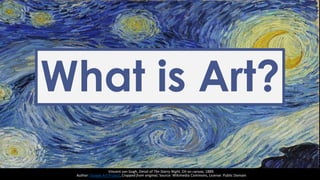
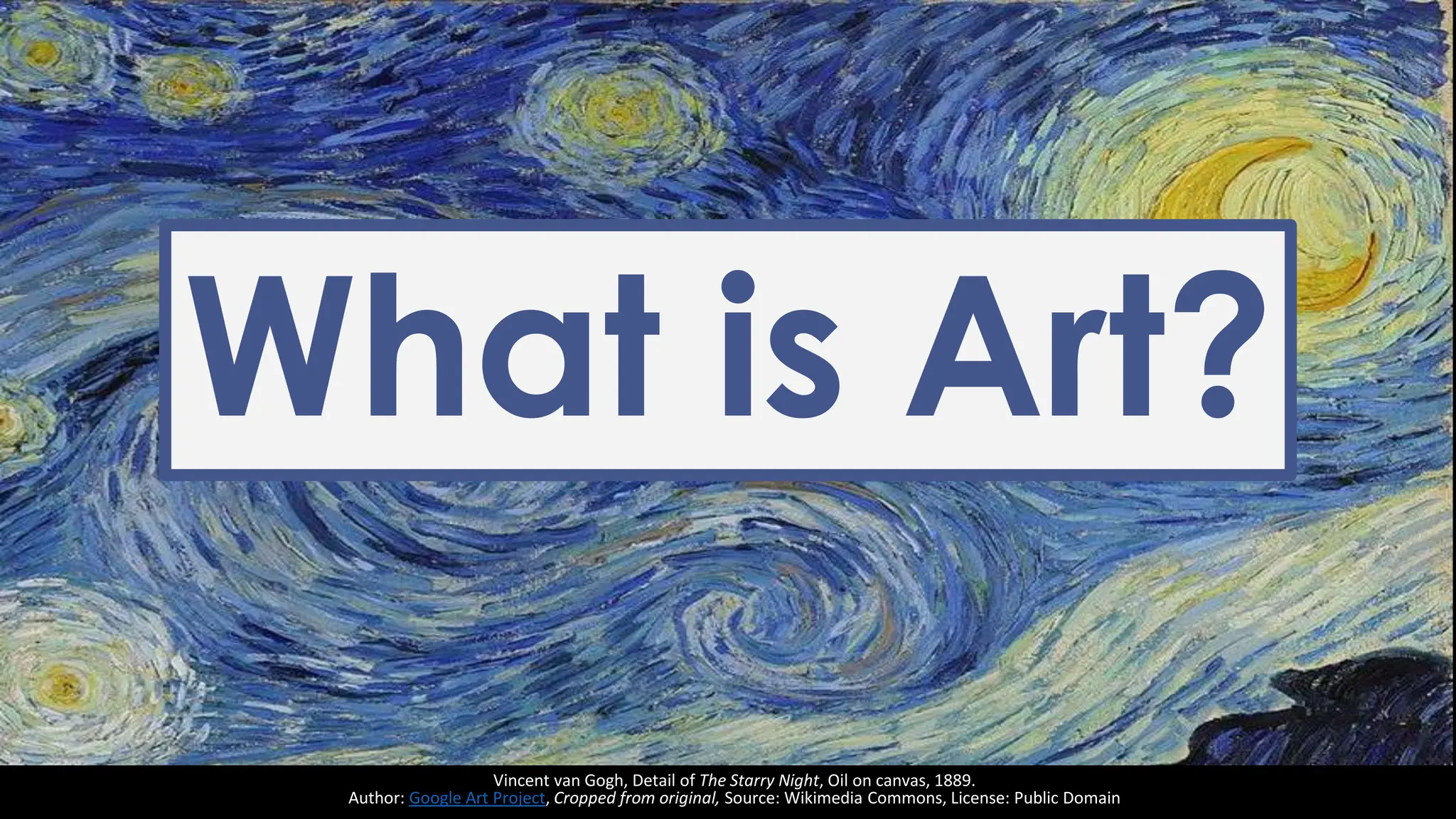
Vincent van Gogh, Detail of The Starry Night, Oil on canvas, 1889.
Author: Google Art Project, Cropped from original, Source: Wikimedia Commons, License: Public Domain
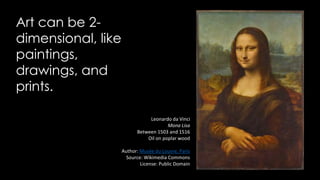
Art can be 2-
dimensional, like
paintings,
drawings, and
prints.
Leonardo da Vinci
Mona Lisa
Between 1503 and 1516
Oil on poplar wood
Author: Musée du Louvre, Paris
Source: Wikimedia Commons
License: Public Domain
Art can be 3-
dimensional,
like sculptures
and ceramics.
Jeff Koons
Balloon Dog (Yellow) on the roof of the Metropolitan Museum.
1994–2000.
High chromium stainless steel with transparent color coating.
Author: Kim, Source: Flickr, License: CC BY-SA 2.0
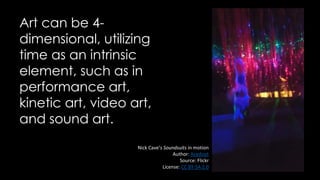
Art can be 4-
dimensional, utilizing
time as an intrinsic
element, such as in
performance art,
kinetic art, video art,
and sound art.
Nick Cave’s Soundsuits in motion
Author: Acedout
Source: Flickr
License: CC BY-SA 2.0
We find it in
museums and
galleries.
Louvre Museum, Paris. Author: Dr. Jennifer Bauer
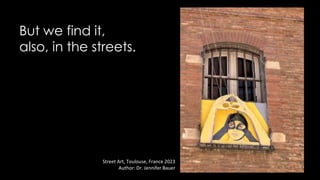
But we find it,
also, in the streets.
Street Art, Toulouse, France 2023
Author: Dr. Jennifer Bauer
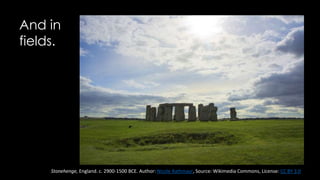
And in
fields.
Stonehenge, England. c. 2900-1500 BCE. Author: Nicole Rathmayr, Source: Wikimedia Commons, License: CC BY 3.0
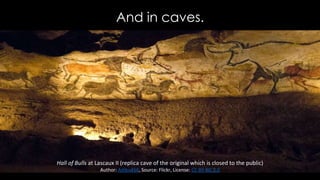
And in caves.
Hall of Bulls at Lascaux II (replica cave of the original which is closed to the public)
Author: Adibu456, Source: Flickr, License: CC BY-NC 2.0
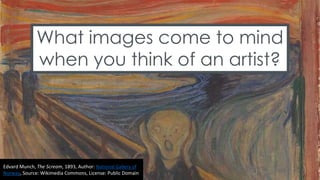
What images come to mind
when you think of an artist?
Edvard Munch, The Scream, 1893, Author: National Gallery of
Norway, Source: Wikimedia Commons, License: Public Domain
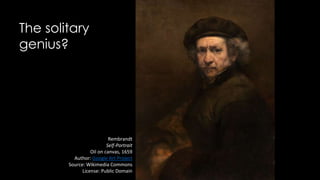
The solitary
genius?
Rembrandt
Self-Portrait
Oil on canvas, 1659
Author: Google Art Project
Source: Wikimedia Commons
License: Public Domain
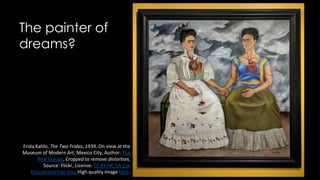
The painter of
dreams?
Frida Kahlo, The Two Fridas, 1939. On view at the
Museum of Modern Art, Mexico City, Author: The
Real Duluoz, Cropped to remove distortion,
Source: Flickr, License: CC BY-NC-SA 2.0.
Educational Fair Use, High quality image here.
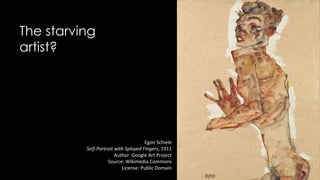
The starving
artist?
Egon Schiele
Self-Portrait with Splayed Fingers, 1911
Author: Google Art Project
Source: Wikimedia Commons
License: Public Domain
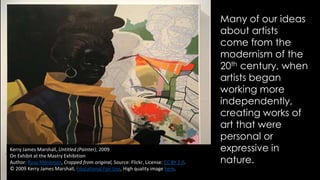
Kerry James Marshall, Untitled (Painter), 2009
On Exhibit at the Mastry Exhibition
Author: Rosa Menkman, Cropped from original, Source: Flickr, License: CC BY 2.0.
© 2009 Kerry James Marshall, Educational Fair Use, High quality image here.
Many of our ideas
about artists
come from the
modernism of the
20th century, when
artists began
working more
independently,
creating works of
art that were
personal or
expressive in
nature.
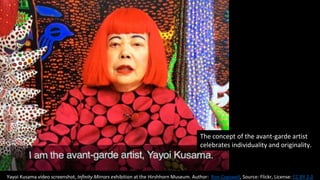
Yayoi Kusama video screenshot, Infinity Mirrors exhibition at the Hirshhorn Museum. Author: Ron Cogswell, Source: Flickr, License: CC BY 2.0
The concept of the avant-garde artist
celebrates individuality and originality.
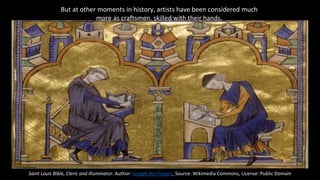
But at other moments in history, artists have been considered much
more as craftsmen, skilled with their hands.
Saint Louis Bible, Cleric and Illuminator. Author: Google Art Project, Source: Wikimedia Commons, License: Public Domain
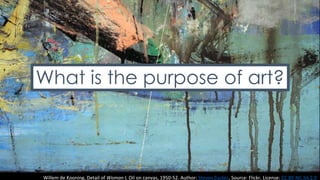
Willem de Kooning, Detail of Woman I, Oil on canvas, 1950-52. Author: Steven Zucker, Source: Flickr, License: CC BY-NC-SA 2.0
What is the purpose of art?
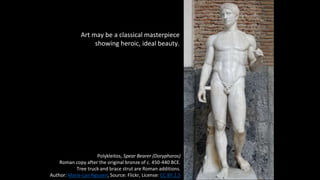
Art may be a classical masterpiece
showing heroic, ideal beauty.
Polykleitos, Spear Bearer (Doryphoros)
Roman copy after the original bronze of c. 450-440 BCE.
Tree truck and brace strut are Roman additions.
Author: Marie-Lan Nguyen, Source: Flickr, License: CC BY 2.5
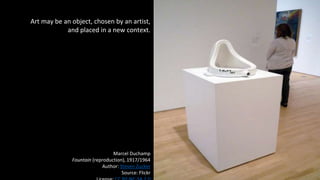
Art may be an object, chosen by an artist,
and placed in a new context.
Marcel Duchamp
Fountain (reproduction), 1917/1964
Author: Steven Zucker
Source: Flickr
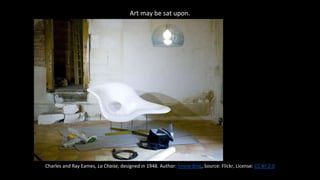
Art may be sat upon.
Charles and Ray Eames, La Chaise, designed in 1948. Author: Smow Blog, Source: Flickr, License: CC BY 2.0
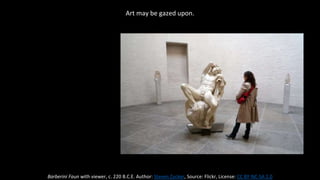
Art may be gazed upon.
Barberini Faun with viewer, c. 220 B.C.E. Author: Steven Zucker, Source: Flickr, License: CC BY-NC-SA 2.0
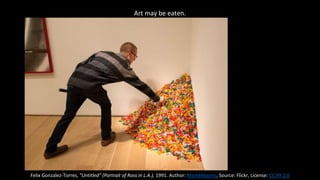
Art may be eaten.
Felix Gonzalez-Torres, "Untitled" (Portrait of Ross in L.A.), 1991. Author: Mark6Mauno, Source: Flickr, License: CC BY 2.0
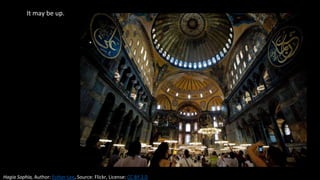
It may be up.
Hagia Sophia, Author: Esther Lee, Source: Flickr, License: CC BY 2.0
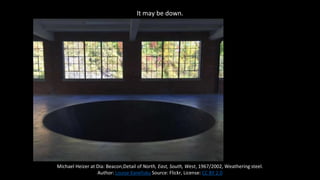
It may be down.
Michael Heizer at Dia: Beacon,Detail of North, East, South, West, 1967/2002, Weathering steel.
Author: Louise Kanefuku Source: Flickr, License: CC BY 2.0
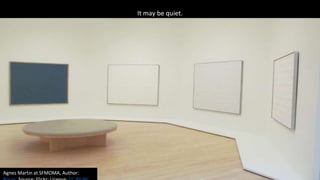
Agnes Martin at SFMOMA, Author:
It may be quiet.
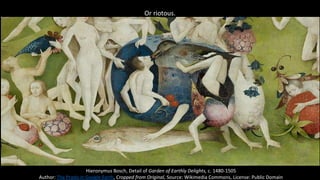
Or riotous.
Hieronymus Bosch, Detail of Garden of Earthly Delights, c. 1480-1505
Author: The Prado in Google Earth, Cropped from Original, Source: Wikimedia Commons, License: Public Domain
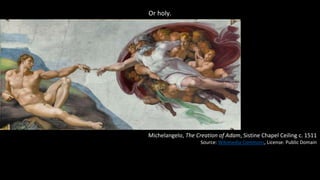
Or holy.
Michelangelo, The Creation of Adam, Sistine Chapel Ceiling c. 1511
Source: Wikimedia Commons, License: Public Domain
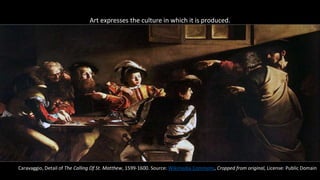
Art expresses the culture in which it is produced.
Caravaggio, Detail of The Calling Of St. Matthew, 1599-1600. Source: Wikimedia Commons, Cropped from original, License: Public Domain
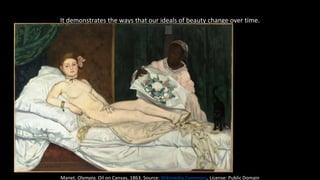
It demonstrates the ways that our ideals of beauty change over time.
Manet, Olympia, Oil on Canvas, 1863. Source: Wikimedia Commons, License: Public Domain
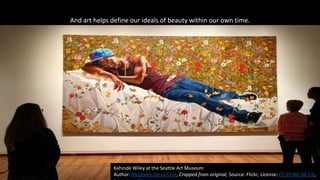
Kehinde Wiley at the Seattle Art Museum
Author: Alejandro De La Cruz, Cropped from original, Source: Flickr, License: CC BY-NC-SA 2.0,
And art helps define our ideals of beauty within our own time.
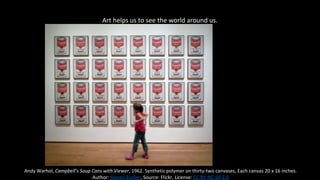
Art helps us to see the world around us.
Andy Warhol, Campbell’s Soup Cans with Viewer, 1962. Synthetic polymer on thirty-two canvases, Each canvas 20 x 16 inches.
Author: Steven Zucker, Source: Flickr, License: CC BY-NC-SA 2.0
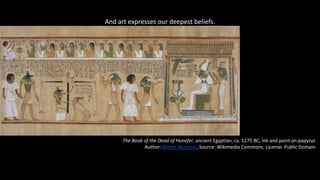
And art expresses our deepest beliefs.
The Book of the Dead of Hunefer, ancient Egyptian, ca. 1275 BC, Ink and paint on papyrus
Author: British Museum, Source: Wikimedia Commons, License: Public Domain
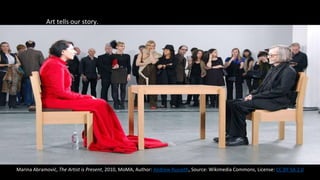
Art tells our story.
Marina Abramović, The Artist is Present, 2010, MoMA, Author: Andrew Russeth, Source: Wikimedia Commons, License: CC BY-SA 2.0
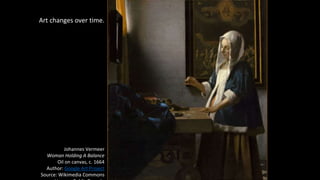
Art changes over time.
Johannes Vermeer
Woman Holding A Balance
Oil on canvas, c. 1664
Author: Google Art Project
Source: Wikimedia Commons
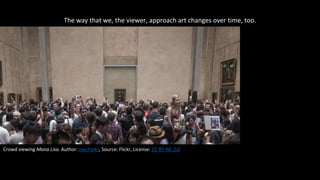
The way that we, the viewer, approach art changes over time, too.
Crowd viewing Mona Lisa. Author: Joe Parks, Source: Flickr, License: CC BY-NC 2.0
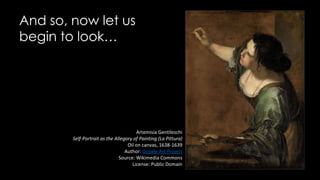
And so, now let us
begin to look…
Artemisia Gentileschi
Self-Portrait as the Allegory of Painting (La Pittura)
Oil on canvas, 1638-1639
Author: Google Art Project
Source: Wikimedia Commons
License: Public Domain
Porterfield, Marie. 2020. "Lesson 01: Introduction to Art Appreciation." Art Appreciation Open Educational Resource. Johnson City, TN: East
Tennessee State University.
https://dc.etsu.edu/art-appreciation-oer/2

Intro to Art Appreciation

  • 1.
    What is Art? Vincentvan Gogh, Detail of The Starry Night, Oil on canvas, 1889. Author: Google Art Project, Cropped from original, Source: Wikimedia Commons, License: Public Domain
  • 2.
    Art can be2- dimensional, like paintings, drawings, and prints. Leonardo da Vinci Mona Lisa Between 1503 and 1516 Oil on poplar wood Author: Musée du Louvre, Paris Source: Wikimedia Commons License: Public Domain
  • 3.
    Art can be3- dimensional, like sculptures and ceramics. Jeff Koons Balloon Dog (Yellow) on the roof of the Metropolitan Museum. 1994–2000. High chromium stainless steel with transparent color coating. Author: Kim, Source: Flickr, License: CC BY-SA 2.0
  • 4.
    Art can be4- dimensional, utilizing time as an intrinsic element, such as in performance art, kinetic art, video art, and sound art. Nick Cave’s Soundsuits in motion Author: Acedout Source: Flickr License: CC BY-SA 2.0
  • 5.
    We find itin museums and galleries. Louvre Museum, Paris. Author: Dr. Jennifer Bauer
  • 6.
    But we findit, also, in the streets. Street Art, Toulouse, France 2023 Author: Dr. Jennifer Bauer
  • 7.
    And in fields. Stonehenge, England.c. 2900-1500 BCE. Author: Nicole Rathmayr, Source: Wikimedia Commons, License: CC BY 3.0
  • 8.
    And in caves. Hallof Bulls at Lascaux II (replica cave of the original which is closed to the public) Author: Adibu456, Source: Flickr, License: CC BY-NC 2.0
  • 9.
    What images cometo mind when you think of an artist? Edvard Munch, The Scream, 1893, Author: National Gallery of Norway, Source: Wikimedia Commons, License: Public Domain
  • 10.
    The solitary genius? Rembrandt Self-Portrait Oil oncanvas, 1659 Author: Google Art Project Source: Wikimedia Commons License: Public Domain
  • 11.
    The painter of dreams? FridaKahlo, The Two Fridas, 1939. On view at the Museum of Modern Art, Mexico City, Author: The Real Duluoz, Cropped to remove distortion, Source: Flickr, License: CC BY-NC-SA 2.0. Educational Fair Use, High quality image here.
  • 12.
    The starving artist? Egon Schiele Self-Portraitwith Splayed Fingers, 1911 Author: Google Art Project Source: Wikimedia Commons License: Public Domain
  • 13.
    Kerry James Marshall,Untitled (Painter), 2009 On Exhibit at the Mastry Exhibition Author: Rosa Menkman, Cropped from original, Source: Flickr, License: CC BY 2.0. © 2009 Kerry James Marshall, Educational Fair Use, High quality image here. Many of our ideas about artists come from the modernism of the 20th century, when artists began working more independently, creating works of art that were personal or expressive in nature.
  • 14.
    Yayoi Kusama videoscreenshot, Infinity Mirrors exhibition at the Hirshhorn Museum. Author: Ron Cogswell, Source: Flickr, License: CC BY 2.0 The concept of the avant-garde artist celebrates individuality and originality.
  • 15.
    But at othermoments in history, artists have been considered much more as craftsmen, skilled with their hands. Saint Louis Bible, Cleric and Illuminator. Author: Google Art Project, Source: Wikimedia Commons, License: Public Domain
  • 16.
    Willem de Kooning,Detail of Woman I, Oil on canvas, 1950-52. Author: Steven Zucker, Source: Flickr, License: CC BY-NC-SA 2.0 What is the purpose of art?
  • 17.
    Art may bea classical masterpiece showing heroic, ideal beauty. Polykleitos, Spear Bearer (Doryphoros) Roman copy after the original bronze of c. 450-440 BCE. Tree truck and brace strut are Roman additions. Author: Marie-Lan Nguyen, Source: Flickr, License: CC BY 2.5
  • 18.
    Art may bean object, chosen by an artist, and placed in a new context. Marcel Duchamp Fountain (reproduction), 1917/1964 Author: Steven Zucker Source: Flickr
  • 19.
    Art may besat upon. Charles and Ray Eames, La Chaise, designed in 1948. Author: Smow Blog, Source: Flickr, License: CC BY 2.0
  • 20.
    Art may begazed upon. Barberini Faun with viewer, c. 220 B.C.E. Author: Steven Zucker, Source: Flickr, License: CC BY-NC-SA 2.0
  • 21.
    Art may beeaten. Felix Gonzalez-Torres, "Untitled" (Portrait of Ross in L.A.), 1991. Author: Mark6Mauno, Source: Flickr, License: CC BY 2.0
  • 22.
    It may beup. Hagia Sophia, Author: Esther Lee, Source: Flickr, License: CC BY 2.0
  • 23.
    It may bedown. Michael Heizer at Dia: Beacon,Detail of North, East, South, West, 1967/2002, Weathering steel. Author: Louise Kanefuku Source: Flickr, License: CC BY 2.0
  • 24.
    Agnes Martin atSFMOMA, Author: It may be quiet.
  • 25.
    Or riotous. Hieronymus Bosch,Detail of Garden of Earthly Delights, c. 1480-1505 Author: The Prado in Google Earth, Cropped from Original, Source: Wikimedia Commons, License: Public Domain
  • 26.
    Or holy. Michelangelo, TheCreation of Adam, Sistine Chapel Ceiling c. 1511 Source: Wikimedia Commons, License: Public Domain
  • 27.
    Art expresses theculture in which it is produced. Caravaggio, Detail of The Calling Of St. Matthew, 1599-1600. Source: Wikimedia Commons, Cropped from original, License: Public Domain
  • 28.
    It demonstrates theways that our ideals of beauty change over time. Manet, Olympia, Oil on Canvas, 1863. Source: Wikimedia Commons, License: Public Domain
  • 29.
    Kehinde Wiley atthe Seattle Art Museum Author: Alejandro De La Cruz, Cropped from original, Source: Flickr, License: CC BY-NC-SA 2.0, And art helps define our ideals of beauty within our own time.
  • 30.
    Art helps usto see the world around us. Andy Warhol, Campbell’s Soup Cans with Viewer, 1962. Synthetic polymer on thirty-two canvases, Each canvas 20 x 16 inches. Author: Steven Zucker, Source: Flickr, License: CC BY-NC-SA 2.0
  • 31.
    And art expressesour deepest beliefs. The Book of the Dead of Hunefer, ancient Egyptian, ca. 1275 BC, Ink and paint on papyrus Author: British Museum, Source: Wikimedia Commons, License: Public Domain
  • 32.
    Art tells ourstory. Marina Abramović, The Artist is Present, 2010, MoMA, Author: Andrew Russeth, Source: Wikimedia Commons, License: CC BY-SA 2.0
  • 33.
    Art changes overtime. Johannes Vermeer Woman Holding A Balance Oil on canvas, c. 1664 Author: Google Art Project Source: Wikimedia Commons
  • 34.
    The way thatwe, the viewer, approach art changes over time, too. Crowd viewing Mona Lisa. Author: Joe Parks, Source: Flickr, License: CC BY-NC 2.0
  • 35.
    And so, nowlet us begin to look… Artemisia Gentileschi Self-Portrait as the Allegory of Painting (La Pittura) Oil on canvas, 1638-1639 Author: Google Art Project Source: Wikimedia Commons License: Public Domain
  • 36.
    Porterfield, Marie. 2020."Lesson 01: Introduction to Art Appreciation." Art Appreciation Open Educational Resource. Johnson City, TN: East Tennessee State University. https://dc.etsu.edu/art-appreciation-oer/2