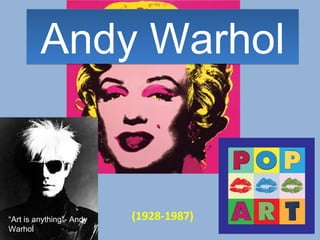
Andy WarholAndy Warhol
(1928-1987)“Art is anything”- Andy
Warhol
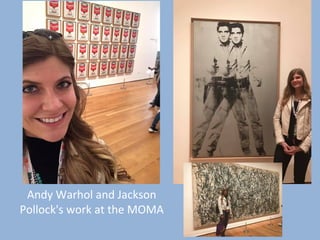
Andy Warhol and Jackson
Pollock's work at the MOMA
When I state my goals and
expectations for my lessons
• basic printmaking techniques such as stamping, rubbing, and
collagraphing;
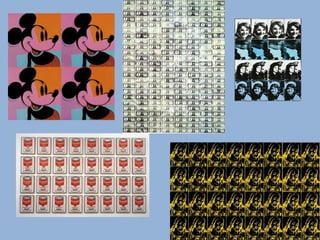
• creating a print that demonstrates textures, colors, and
shapes;
• honing observation skills;
• developing the ability to discuss works of art;
• developing visual arts vocabulary;
• developing the ability to reflect on the process of making art
• recognizing the societal, cultural, and historical significance of
art
• accessing local resources to extend learning beyond the
classroom.
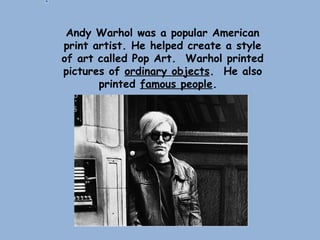
Andy Warhol was a popular American
print artist. He helped create a style
of art called Pop Art. Warhol printed
pictures of ordinary objects. He also
printed famous people.
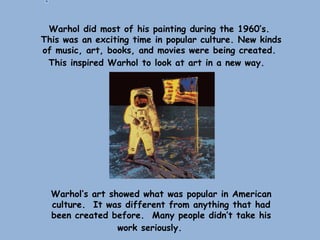
Warhol did most of his painting during the 1960’s.
This was an exciting time in popular culture. New kinds
of music, art, books, and movies were being created.
This inspired Warhol to look at art in a new way.
Warhol’s art showed what was popular in American
culture. It was different from anything that had
been created before. Many people didn’t take his
work seriously.
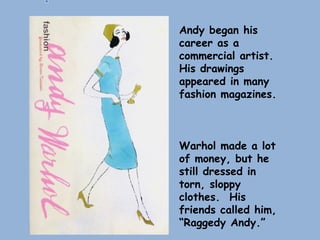
Andy began his
career as a
commercial artist.
His drawings
appeared in many
fashion magazines.
Warhol made a lot
of money, but he
still dressed in
torn, sloppy
clothes. His
friends called him,
“Raggedy Andy.”
Many commercial
artists admired
Warhol’s work, but
many in the fine arts
did not consider him
to be a real artist.
This upset Warhol.
He wanted people to
think of him as a real
artist and not just a
magazine illustrator.
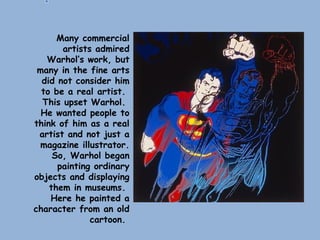
So, Warhol began
painting ordinary
objects and displaying
them in museums.
Here he painted a
character from an old
cartoon.
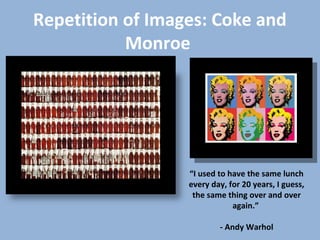
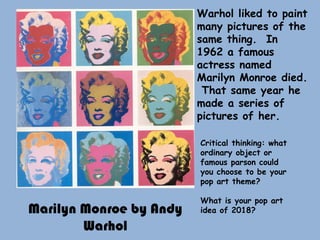
Marilyn Monroe by Andy
Warhol
Warhol liked to paint
many pictures of the
same thing. In
1962 a famous
actress named
Marilyn Monroe died.
That same year he
made a series of
pictures of her.
Critical thinking: what
ordinary object or
famous parson could
you choose to be your
pop art theme?
What is your pop art
idea of 2018?
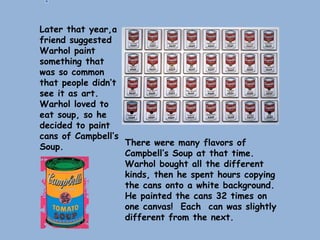
Later that year,a
friend suggested
Warhol paint
something that
was so common
that people didn’t
see it as art.
Warhol loved to
eat soup, so he
decided to paint
cans of Campbell’s
Soup. There were many flavors of
Campbell’s Soup at that time.
Warhol bought all the different
kinds, then he spent hours copying
the cans onto a white background.
He painted the cans 32 times on
one canvas! Each can was slightly
different from the next.
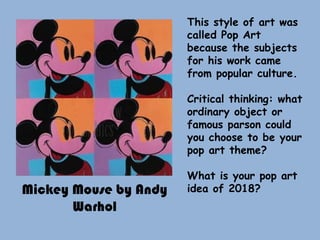
Mickey Mouse by Andy
Warhol
This style of art was
called Pop Art
because the subjects
for his work came
from popular culture.
Critical thinking: what
ordinary object or
famous parson could
you choose to be your
pop art theme?
What is your pop art
idea of 2018?
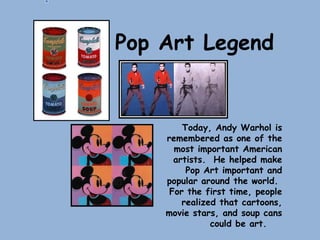
Today, Andy Warhol is
remembered as one of the
most important American
artists. He helped make
Pop Art important and
popular around the world.
For the first time, people
realized that cartoons,
movie stars, and soup cans
could be art.
Pop Art Legend
Poster in the style of Andy Warhol
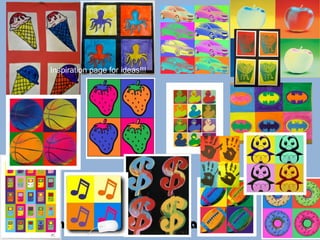
Inspiration page for ideas!!!
][
“”””””
Inspiration page for ideas!!!
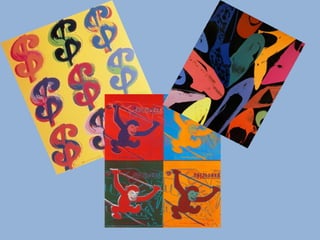
Eight Elvises
Repetition of Images: Coke and
Monroe
“I used to have the same lunch
every day, for 20 years, I guess,
the same thing over and over
again.”
- Andy Warhol
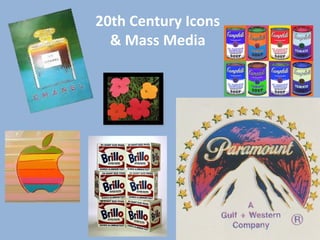
20th Century Icons
& Mass Media
What is POP ART?
• Pop art is an art movement that emerged in the mid 1950s.
• Pop art takes popular imagery that is currently in use in
advertising and turns it into art!
• popular images
• POPular ART
Learning Objective: Tiered
Assessment Readiness
• Task/ Objective: The students will identify and discuss Warhol's artwork
• Assessment: The students will read information from the slides. The student will
turn and talk to a partner and share some of the interesting things that they
learned about Warhol.
• Levels of readiness:
• Tier one: (low emerging) demonstrate, identify
write, share one thing that interested you
• Tier two: (intermediate) Demonstrate, write,
complete, check and reflect, share and sketch ideas
• Tier three: (advanced) demonstrate, write and
explain the significance of the artist.
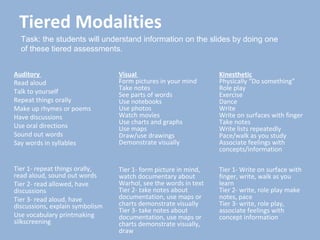
Tiered Modalities
Auditory
Read aloud
Talk to yourself
Repeat things orally
Make up rhymes or poems
Have discussions
Use oral directions
Sound out words
Say words in syllables
Tier 1- repeat things orally,
read aloud, sound out words
Tier 2- read allowed, have
discussions
Tier 3- read aloud, have
discussions, explain symbolism
Use vocabulary printmaking
silkscreening
Visual
Form pictures in your mind
Take notes
See parts of words
Use notebooks
Use photos
Watch movies
Use charts and graphs
Use maps
Draw/use drawings
Demonstrate visually
Tier 1- form picture in mind,
watch documentary about
Warhol, see the words in text
Tier 2- take notes about
documentation, use maps or
charts demonstrate visually
Tier 3- take notes about
documentation, use maps or
charts demonstrate visually,
draw
Kinesthetic
Physically “Do something”
Role play
Exercise
Dance
Write
Write on surfaces with finger
Take notes
Write lists repeatedly
Pace/walk as you study
Associate feelings with
concepts/information
Tier 1- Write on surface with
finger, write, walk as you
learn
Tier 2- write, role play make
notes, pace
Tier 3- write, role play,
associate feelings with
concept information
Task: the students will understand information on the slides by doing one
of these tiered assessments.
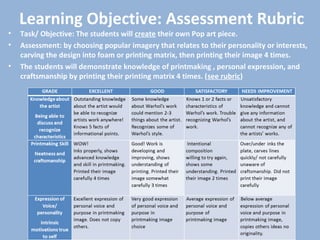
Learning Objective: Assessment Rubric
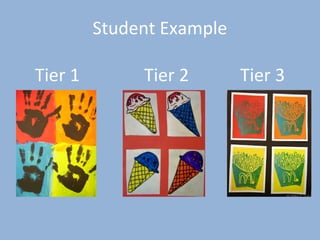
• Task/ Objective: The students will create their own Pop art piece.
• Assessment: by choosing popular imagery that relates to their personality or interests,
carving the design into foam or printing matrix, then printing their image 4 times.
• The students will demonstrate knowledge of printmaking , personal expression, and
craftsmanship by printing their printing matrix 4 times. (see rubric)
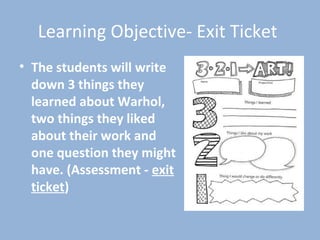
Learning Objective- Exit Ticket
• The students will write
down 3 things they
learned about Warhol,
two things they liked
about their work and
one question they might
have. (Assessment - exit
ticket)
Student Example
Tier 1 Tier 2 Tier 3
Use of Bright Colors
• Warhol used the primary colors-blue, red and
yellow-in many of his pieces.
• These colors gave his work the feeling of pop
culture.
• These colors were eye catching and exciting making
his paintings extremely popular
1. What does Pop art mean?
A. Popular art
B. Nothing
C. Colorful
2. What does Repetition mean?
A. To stop
B. To repeat
C. To look
3. What are the primary colors?
A. red, purple, blue
B. Red, orange, yellow
C. Red, yellow, blue
4. What imagery did Andy Warhol NOT
use for the subject of his artwork?
A. Cartoons
B. Landscapes
C. Movie stars
D. Soup cans
5. True or False: Andy Warhol was a popular
American print artist. He helped create a style
of art called Pop Art.
A. True
B. False
References
• http://planetgroupentertainment.squarespace.com/storage/WarholSilkScreening%20inth
• http://www.depthography.com/movies/chw3.gif
• http://www.phlf.org/spotlightonmainstreet/fieldtrips/images/large/0213.jpg
• http://www.wizardtrivia.com/media/marilyn.jpg
• http://www.life123.com/arts-culture/artists/andy-warhol/andy-warhol-facts.shtml
• http://www.vistawallpaper.org/vista-wallpapers/colour-rainbow.jpg
• http://www.chrysler.org/warhol/images/DollarSign.jpg
• http://parisandpascual.files.wordpress.com/2008/08/andy-warhol-diamond-dust-
shoes-1980-181010.jpg
• http://www.55max.com/images/prod/10293892A_LG.jpg
• http://3.bp.blogspot.com/_t7lJOsjSZxY/SfzF1PGQ3HI/AAAAAAAAATY/dmW4r0p6c
L0/s320/Andy-Warhol-Mickey-Mouse-8380.jpg
• http://www.all-art.org/art_20th_century/pop_art/warhol/17.jpg
• http://www.cbc.ca/arts/images/pics/warhol2.jpg
• http://www.cbc.ca/arts/images/pics/warhol2.jpghttp://www.georgetownframesh
oppe.com/img/warhol_myth8.jpg

Andy Warhol

  • 1.
    Andy WarholAndy Warhol (1928-1987)“Artis anything”- Andy Warhol
  • 2.
    Andy Warhol andJackson Pollock's work at the MOMA
  • 3.
    When I statemy goals and expectations for my lessons • basic printmaking techniques such as stamping, rubbing, and collagraphing; • creating a print that demonstrates textures, colors, and shapes; • honing observation skills; • developing the ability to discuss works of art; • developing visual arts vocabulary; • developing the ability to reflect on the process of making art • recognizing the societal, cultural, and historical significance of art • accessing local resources to extend learning beyond the classroom.
  • 4.
    Andy Warhol wasa popular American print artist. He helped create a style of art called Pop Art. Warhol printed pictures of ordinary objects. He also printed famous people.
  • 5.
    Warhol did mostof his painting during the 1960’s. This was an exciting time in popular culture. New kinds of music, art, books, and movies were being created. This inspired Warhol to look at art in a new way. Warhol’s art showed what was popular in American culture. It was different from anything that had been created before. Many people didn’t take his work seriously.
  • 6.
    Andy began his careeras a commercial artist. His drawings appeared in many fashion magazines. Warhol made a lot of money, but he still dressed in torn, sloppy clothes. His friends called him, “Raggedy Andy.”
  • 7.
    Many commercial artists admired Warhol’swork, but many in the fine arts did not consider him to be a real artist. This upset Warhol. He wanted people to think of him as a real artist and not just a magazine illustrator. So, Warhol began painting ordinary objects and displaying them in museums. Here he painted a character from an old cartoon.
  • 8.
    Marilyn Monroe byAndy Warhol Warhol liked to paint many pictures of the same thing. In 1962 a famous actress named Marilyn Monroe died. That same year he made a series of pictures of her. Critical thinking: what ordinary object or famous parson could you choose to be your pop art theme? What is your pop art idea of 2018?
  • 9.
    Later that year,a friendsuggested Warhol paint something that was so common that people didn’t see it as art. Warhol loved to eat soup, so he decided to paint cans of Campbell’s Soup. There were many flavors of Campbell’s Soup at that time. Warhol bought all the different kinds, then he spent hours copying the cans onto a white background. He painted the cans 32 times on one canvas! Each can was slightly different from the next.
  • 10.
    Mickey Mouse byAndy Warhol This style of art was called Pop Art because the subjects for his work came from popular culture. Critical thinking: what ordinary object or famous parson could you choose to be your pop art theme? What is your pop art idea of 2018?
  • 11.
    Today, Andy Warholis remembered as one of the most important American artists. He helped make Pop Art important and popular around the world. For the first time, people realized that cartoons, movie stars, and soup cans could be art. Pop Art Legend
  • 12.
    Poster in thestyle of Andy Warhol Inspiration page for ideas!!!
  • 13.
  • 16.
  • 17.
    Repetition of Images:Coke and Monroe “I used to have the same lunch every day, for 20 years, I guess, the same thing over and over again.” - Andy Warhol
  • 18.
  • 19.
    What is POPART? • Pop art is an art movement that emerged in the mid 1950s. • Pop art takes popular imagery that is currently in use in advertising and turns it into art! • popular images • POPular ART
  • 20.
    Learning Objective: Tiered AssessmentReadiness • Task/ Objective: The students will identify and discuss Warhol's artwork • Assessment: The students will read information from the slides. The student will turn and talk to a partner and share some of the interesting things that they learned about Warhol. • Levels of readiness: • Tier one: (low emerging) demonstrate, identify write, share one thing that interested you • Tier two: (intermediate) Demonstrate, write, complete, check and reflect, share and sketch ideas • Tier three: (advanced) demonstrate, write and explain the significance of the artist.
  • 21.
    Tiered Modalities Auditory Read aloud Talkto yourself Repeat things orally Make up rhymes or poems Have discussions Use oral directions Sound out words Say words in syllables Tier 1- repeat things orally, read aloud, sound out words Tier 2- read allowed, have discussions Tier 3- read aloud, have discussions, explain symbolism Use vocabulary printmaking silkscreening Visual Form pictures in your mind Take notes See parts of words Use notebooks Use photos Watch movies Use charts and graphs Use maps Draw/use drawings Demonstrate visually Tier 1- form picture in mind, watch documentary about Warhol, see the words in text Tier 2- take notes about documentation, use maps or charts demonstrate visually Tier 3- take notes about documentation, use maps or charts demonstrate visually, draw Kinesthetic Physically “Do something” Role play Exercise Dance Write Write on surfaces with finger Take notes Write lists repeatedly Pace/walk as you study Associate feelings with concepts/information Tier 1- Write on surface with finger, write, walk as you learn Tier 2- write, role play make notes, pace Tier 3- write, role play, associate feelings with concept information Task: the students will understand information on the slides by doing one of these tiered assessments.
  • 22.
    Learning Objective: AssessmentRubric • Task/ Objective: The students will create their own Pop art piece. • Assessment: by choosing popular imagery that relates to their personality or interests, carving the design into foam or printing matrix, then printing their image 4 times. • The students will demonstrate knowledge of printmaking , personal expression, and craftsmanship by printing their printing matrix 4 times. (see rubric)
  • 23.
    Learning Objective- ExitTicket • The students will write down 3 things they learned about Warhol, two things they liked about their work and one question they might have. (Assessment - exit ticket)
  • 24.
  • 25.
    Use of BrightColors • Warhol used the primary colors-blue, red and yellow-in many of his pieces. • These colors gave his work the feeling of pop culture. • These colors were eye catching and exciting making his paintings extremely popular
  • 26.
    1. What doesPop art mean? A. Popular art B. Nothing C. Colorful
  • 27.
    2. What doesRepetition mean? A. To stop B. To repeat C. To look
  • 28.
    3. What arethe primary colors? A. red, purple, blue B. Red, orange, yellow C. Red, yellow, blue
  • 29.
    4. What imagerydid Andy Warhol NOT use for the subject of his artwork? A. Cartoons B. Landscapes C. Movie stars D. Soup cans
  • 30.
    5. True orFalse: Andy Warhol was a popular American print artist. He helped create a style of art called Pop Art. A. True B. False
  • 31.
    References • http://planetgroupentertainment.squarespace.com/storage/WarholSilkScreening%20inth • http://www.depthography.com/movies/chw3.gif •http://www.phlf.org/spotlightonmainstreet/fieldtrips/images/large/0213.jpg • http://www.wizardtrivia.com/media/marilyn.jpg • http://www.life123.com/arts-culture/artists/andy-warhol/andy-warhol-facts.shtml • http://www.vistawallpaper.org/vista-wallpapers/colour-rainbow.jpg • http://www.chrysler.org/warhol/images/DollarSign.jpg • http://parisandpascual.files.wordpress.com/2008/08/andy-warhol-diamond-dust- shoes-1980-181010.jpg • http://www.55max.com/images/prod/10293892A_LG.jpg • http://3.bp.blogspot.com/_t7lJOsjSZxY/SfzF1PGQ3HI/AAAAAAAAATY/dmW4r0p6c L0/s320/Andy-Warhol-Mickey-Mouse-8380.jpg • http://www.all-art.org/art_20th_century/pop_art/warhol/17.jpg • http://www.cbc.ca/arts/images/pics/warhol2.jpg • http://www.cbc.ca/arts/images/pics/warhol2.jpghttp://www.georgetownframesh oppe.com/img/warhol_myth8.jpg