Microbial Taxonomy and
Diversity
Dr. S. Sivasankara Narayani
Assistant Professor
Department of Microbiology
Ayya Nadar Janaki Ammal College
Sivakasi
UNIT–I
TAXONOMY
 Contributors of Microbiology. Taxonomy: Principles-
numerical- genetic- serotaxonomy and chemotaxonomy
-Binomial Nomenclature. Kingdom concept: Carl
Woese’s three domain concept -Whittaker’s five
kingdom. General characteristic and structure:
Acellular microorganisms (Viruses, Prions) - cellular
microorganisms (Bacterial, Algae, Fungi and Protozoa).
UNIT–II
CLASSIFICATION
OFBACTERIA
 Taxonomy: Traditional approaches of classification:
Morphological- physiological - metabolic - ecological
characters. Modern approaches of classification:
Genetic and molecular characteristics. Outline
classification of bacteria based on Bergey’s manual
(Brief). Reproduction of bacteria. General
characteristics: Archaebacteria – Actinobacteria -
Cyanobacteria. Economic importance of bacteria.
UNIT–III
CLASSIFICATION
OFVIRUS
 Viruses: Physical, chemical and biological properties.
Baltimore classification. Types of viruses based on
structure and Host. Cultivation of viruses: Cell line -
embryonated eggs - cytopathic effect. Structure of
viruses: TMV- T4bacteriophage. Replication of virus:
Lytic and lysogenic cycle. Phage typing.
UNIT–IV
CLASSIFICATION
OFALGAE
 Algae: Classification of algae by Fritsch system.
General characters, reproduction and life cycle:
Myxophyceae (Nostoc) – Chlorophyceae (Chlorella) -
Chrysophyceae (Chara) – Xanthophyceae (Vaucheria) –
Bacillariophyceae (Diatoms) - Phaeophyceae
(Sargassum) – Rhodophyceae (Gelidium). Economic
importance of algae.
UNIT–V
CLASSIFICATION
OFFUNGIAND
PROTOZOA
 Fungi: Classification by Alexopoulos. General
characters, reproduction and life cycle: Myxomycetes
(Stemonitis) - Oomycetes (Pythium) – Zygo mycetes
(Mucor) – Ascomycetes (Aspergillus). Structure and
reproduction of yeast. Economic importance of fungi.
Protozoa: General characteristics. Classification of
protozoa. Reproduction and life cycle: Rhizopoda
(Amoeba) - Ciliata (Paramecium).
Baltimore
Classification
 Baltimore classification
 (first defined in 1971)
 nucleic acid (DNA or RNA)
 strandedness
 (single-stranded
 double-stranded)
 Sense
 method of replication
Baltimore
classification
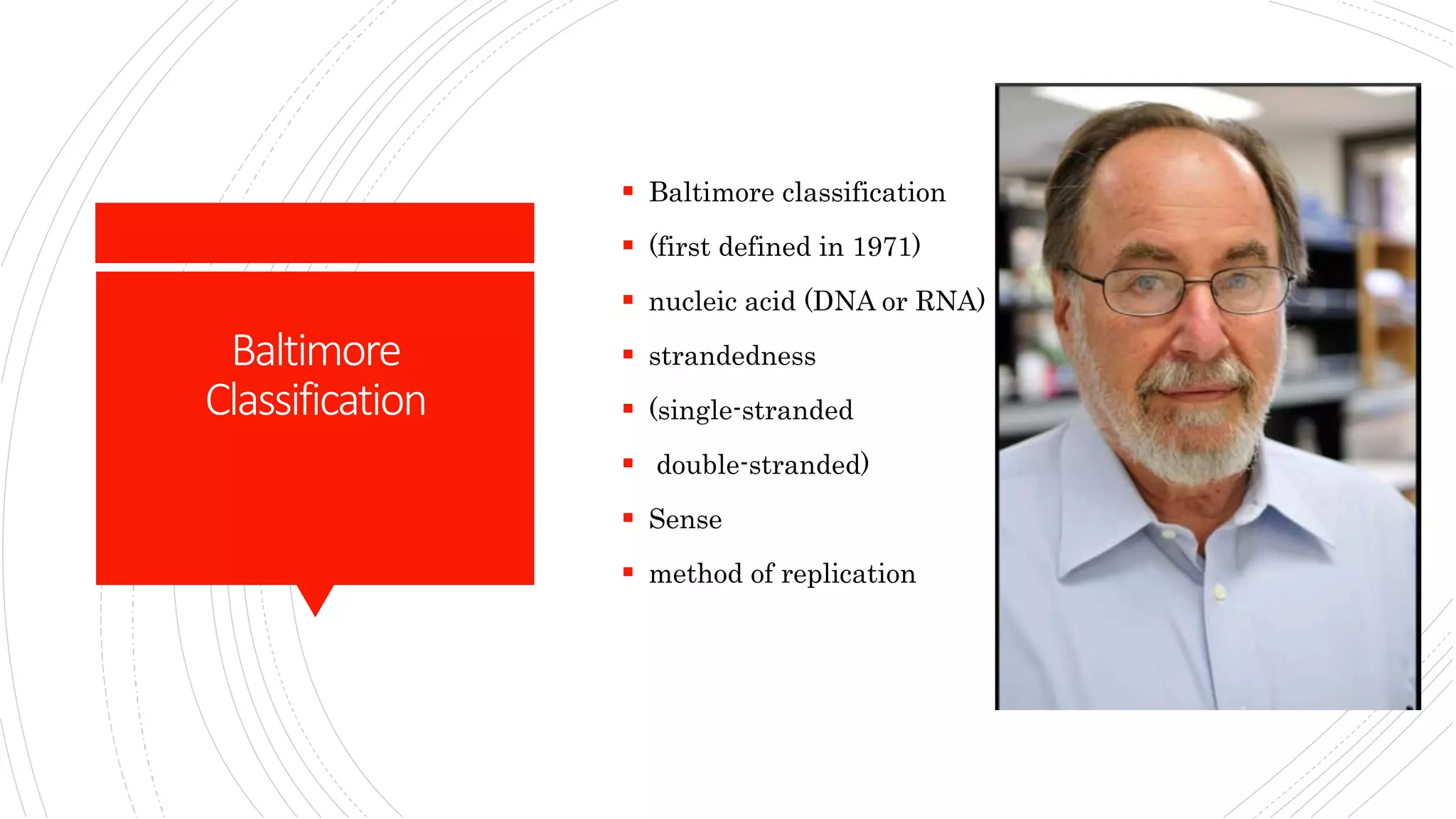
 Named after David Baltimore, a Nobel Prize-winning
biologist, these groups are designated by Roman
numerals and discriminate viruses depending on their
mode of replication and genome type.
 the virus or its morphology
 Different viruses either causing the same disease or
looking very similar.
 In addition, viral structures are often difficult to
determine under the microscope.
Viruses–
Baltimore
classification
 I: dsDNA viruses (e.g. Adenoviruses, Herpesviruses,
Poxviruses)
 II: ssDNA viruses (+)sense DNA (e.g. Parvoviruses)
 III: dsRNA viruses (e.g. Reoviruses)
 IV: (+)ssRNA viruses (+)sense RNA (e.g.
Picornaviruses, Togaviruses)
 V: (−)ssRNA viruses (−)sense RNA (e.g.
Orthomyxoviruses, Rhabdoviruses)
 VI: ssRNA-RT viruses (+)sense RNA with DNA
intermediate in life-cycle (e.g. Retroviruses)
 VII: dsDNA-RT viruses (e.g. Hepadnaviruses)
Double
StrandedDNA
VIRUS
 The first Baltimore group contains viruses that have a
double-stranded DNA (dsDNA) genome.
 All dsDNA viruses have their mRNA synthesized in a
three-step process.
 First, a transcription preinitiation complex binds to the
DNA upstream of the site where transcription begins,
allowing for the recruitment of a host RNA polymerase.
 Second, once the RNA polymerase is recruited, it uses
the negative strand as a template for synthesizing
mRNA strands.
 Third, the RNA polymerase terminates transcription
upon reaching a specific signal, such as
a polyadenylation site
Double
StrandedDNA
VIRUS
 dsDNA viruses can be subdivided between those that
replicate in the nucleus, and as such are relatively
dependent on host cell machinery for transcription and
replication
 replicate in the cytoplasm, in which case they have
evolved or acquired their own means of executing
transcription and replication
Double
StrandedDNA
VIRUS
 dsDNA viruses are also commonly divided between
tailed dsDNA viruses, referring to members of the
realm Duplodnaviria, usually the tailed bacteriophages
of the order Caudovirales, and tailless or non-tailed
dsDNA viruses of the realm Varidnaviria
Examples
 All viruses in Duplodnaviria are dsDNA viruses.
 Viruses in this realm belong to two groups: tailed
bacteriophages in Caudovirales and herpesviruses
in Herpesvirales.[12]
 In Monodnaviria, members of the
class Papovaviricetes are dsDNA viruses.
 Viruses in Papovaviricetes constitute two
groups: papillomaviruses and polyomaviruses.
 All viruses in Varidnaviria are dsDNA viruses.
 Viruses in this realm include adenoviruses, giant
viruses, and poxviruses.[13]
GroupII:single-
strandedDNA
viruses
 The second Baltimore group contains viruses that have
a single-stranded DNA (ssDNA) genome.
 ssDNA viruses have the same manner of transcription
as dsDNA viruses.
 However, because the genome is single-stranded, it is
first made into a double-stranded form by a DNA
polymerase upon entering a host cell.
 mRNA is then synthesized from the double-stranded
form.
 The double-stranded form of a ssDNA viruses may be
produced either directly after entry into a cell or as a
consequence of replication of the viral genome.
 Eukaryotic ssDNA viruses are replicated in the
nucleus.
GroupII:single-
strandedDNA
viruses
 Nearly all ssDNA viruses have positive sense genomes,
but a few exceptions and peculiarities exist.
 The family Anelloviridae is the only ssDNA family
whose members have negative sense genomes, which
are circular.
 Parvoviruses, as previously mentioned, may package
either the positive or negative sense strand into
virions.
 Lastly, bidnaviruses package both the positive and
negative linear strands.
 In any case, the sense of ssDNA viruses, unlike for
ssRNA viruses, is not sufficient to separate ssDNA
viruses into two groups since all ssDNA viral genomes
are converted to dsDNA forms prior to transcription
and replication
GroupIII:double-
strandedRNA
viruses
 The third Baltimore group contains viruses that have a
double-stranded RNA (dsRNA) genome.
 After entering a host cell, the dsRNA genome is
transcribed to mRNA from the negative strand by the
viral RNA-dependent RNA polymerase (RdRp).
 The mRNA may be used for translation or replication.
 Single-stranded mRNA is replicated to form the dsRNA
genome.
 The 5'-end of the genome may be naked, capped, or
covalently bound to a viral protein.
 All viruses in Duplornaviricota are dsRNA viruses.
 In Pisuviricota, all members of the
class Duplopiviricetes are dsRNA viruses.
GroupIV:positive
sensesingle-
strandedRNA
viruses
 The fourth Baltimore group contains viruses that have
a positive sense single-stranded RNA (+ssRNA)
genome.
 For +ssRNA viruses, the genome functions as mRNA,
so no transcription is required for translation.
 However, +ssRNA viruses will also produce positive
sense copies of the genome from negative sense strands
of an intermediate dsRNA genome.
 This acts as both a transcription and a replication
process since the replicated RNA is also mRNA.
 The 5'-end may be naked, capped, or covalently bound
to a viral protein, and the 3'-end may be naked or
polyadenylated.
GroupIV:positive
sensesingle-
strandedRNA
viruses
 +ssRNA viruses can be subdivided between those that
have polycistronic mRNA, which encodes a polyprotein
that is cleaved to form multiple mature proteins.
 produce subgenomic mRNAs and therefore undergo
two or more rounds of translation.
 +ssRNA viruses are included in three phyla in the
kingdom Orthornavirae in the realm Riboviria.
 All viruses in Lenarviricota are +ssRNA viruses.
 All viruses in Pisuviricota are +ssRNA viruses,
excluding the class Duplopiviricetes, whose members
have dsRNA genomes.
 All viruses in Kitrinoviricota are +ssRNA viruses.
GroupV:negative
sensesingle-
strandedRNA
viruses
 The fifth Baltimore group contains viruses that have a
negative sense, single-stranded RNA (-ssRNA) genome.
 mRNA, which is positive sense, is transcribed directly
from the negative sense genome.
 The first process for -ssRNA transcription involves
RdRp binding to a leader sequence on the 3' end of the
genome, transcribing a 5' triphosphate-leader RNA
that is capped, then stopping and restarting on a
transcription signal which is capped, continuing until a
stop signal is reached
GroupV:negative
sensesingle-
strandedRNA
viruses
 The second manner is similar but instead of
synthesizing a cap, RdRp may make use of cap
snatching, whereby a short sequence of host cell mRNA
is taken and used as the 5' cap of the viral mRNA.
 Genomic -ssRNA is replicated from the positive sense
antigenome in a similar manner as transcription,
except in reverse using the antigenome as a template
for the genome.
 RdRp moves from the 3'-end to the 5'-end of the
antigenome and ignores all transcription signals when
synthesizing genomic –ssRNA.
GroupV:negative
sensesingle-
strandedRNA
viruses
 -ssRNA viruses can be subdivided informally between
those that have nonsegmented and segmented genomes.
 Nonsegmented -ssRNA viruses replicate in the cytoplasm,
and segmented -ssRNA viruses replicate in the nucleus.
 During transcription, the RdRp produces one
monocistronic mRNA strand from each segment of the
genome.
 All -ssRNA viruses are classified in the
phylum Negarnaviricota in the kingdom Orthornavirae in
the realm Riboviria.
 Negarnaviricota only contains -ssRNA viruses,
 Negarnaviricota is divided into two
subphyla: Haploviricotina, whose members synthesize a
cap structure on viral mRNA required for protein
synthesis.
 Polyploviricotina, whose members instead obtain caps on
mRNA via cap snatching
GroupVI:single-
strandedRNA
viruseswithaDNA
intermediate
 The sixth Baltimore group contains viruses that have a (positive-
sense) single-stranded RNA genome that has a DNA intermediate
((+)ssRNA-RT) in its replication cycle.
 ssRNA-RT viruses are transcribed in the same manner as DNA
viruses, but their linear genomes are first converted to a dsDNA
form through a process called reverse transcription.
 The viral reverse transcriptase enzyme synthesizes a DNA strand
from the ssRNA strand, and the RNA strand is degraded and
replaced with a DNA strand to create a dsDNA genome.
 The genome is then integrated into the DNA of the host cell,
where it is now called a provirus.
 The host cell's RNA polymerase II then transcribes RNA in the
nucleus from the proviral DNA.
 Some of this RNA may become mRNA whereas other strands will
become copies of the viral genome for replication
GroupVI:single-
strandedRNA
viruseswithaDNA
intermediate
 ssRNA-RT viruses are all included in the
class Revtraviricetes, phylum Arterviricota,
kingdom Pararnavirae of the realm Riboviria.
Excluding Caulimoviridae, which belongs to Group VII,
all members of
the Revtraviricetes order Ortervirales are ssRNA-RT
viruses
GroupVII:double-
strandedDNA
viruseswithan
RNAintermediate
 The seventh Baltimore group contains viruses that have a double-
stranded DNA genome that has an RNA intermediate (dsDNA-
RT) in its replication cycle.
 dsDNA-RT viruses have a gap in one strand, which is repaired to
create a complete dsDNA genome prior to transcription.
 dsDNA-RT viruses are transcribed in the same manner as dsDNA
viruses,but make use of reverse transcription to replicate their
circular genome while it is still in the capsid.
 The host cell's RNA polymerase II transcribes RNA strands from
the genome in the cytoplasm, and the genome is replicated from
these RNA strands.
 The dsDNA genome is produced from pregenomic RNA strands via
the same general mechanism as ssRNA-RT viruses, but with
replication occurring in a loop around the circular genome.
 After replication, the dsDNA genome may be packed or sent to the
nucleus for further rounds of transcription
GroupVII:double-
strandedDNA
viruseswithan
RNAintermediate
 dsDNA-RT viruses are, like ssRNA-RT, all included in
the class Revtraviricetes. Two families of dsDNA-RT
viruses are recognized: Caulimoviridae, which belongs
to the order Ortervirales, and Hepadnaviridae, which
is the sole family in the order Blubervirales
Clarifications
sivasan91@gmail.com
Questionsto
think
 Who invented virus classification? How? What ?
 Mechanism behind Ds DNA virus replication
 Differentiate Postive sense from negative sense ssRNA
 Mechanism involved in Reverse Transcription
 Example for all seven categories of virus
Intro + baltimore classification

Intro + baltimore classification

  • 1.
    Microbial Taxonomy and Diversity Dr.S. Sivasankara Narayani Assistant Professor Department of Microbiology Ayya Nadar Janaki Ammal College Sivakasi
  • 2.
    UNIT–I TAXONOMY  Contributors ofMicrobiology. Taxonomy: Principles- numerical- genetic- serotaxonomy and chemotaxonomy -Binomial Nomenclature. Kingdom concept: Carl Woese’s three domain concept -Whittaker’s five kingdom. General characteristic and structure: Acellular microorganisms (Viruses, Prions) - cellular microorganisms (Bacterial, Algae, Fungi and Protozoa).
  • 3.
    UNIT–II CLASSIFICATION OFBACTERIA  Taxonomy: Traditionalapproaches of classification: Morphological- physiological - metabolic - ecological characters. Modern approaches of classification: Genetic and molecular characteristics. Outline classification of bacteria based on Bergey’s manual (Brief). Reproduction of bacteria. General characteristics: Archaebacteria – Actinobacteria - Cyanobacteria. Economic importance of bacteria.
  • 4.
    UNIT–III CLASSIFICATION OFVIRUS  Viruses: Physical,chemical and biological properties. Baltimore classification. Types of viruses based on structure and Host. Cultivation of viruses: Cell line - embryonated eggs - cytopathic effect. Structure of viruses: TMV- T4bacteriophage. Replication of virus: Lytic and lysogenic cycle. Phage typing.
  • 5.
    UNIT–IV CLASSIFICATION OFALGAE  Algae: Classificationof algae by Fritsch system. General characters, reproduction and life cycle: Myxophyceae (Nostoc) – Chlorophyceae (Chlorella) - Chrysophyceae (Chara) – Xanthophyceae (Vaucheria) – Bacillariophyceae (Diatoms) - Phaeophyceae (Sargassum) – Rhodophyceae (Gelidium). Economic importance of algae.
  • 6.
    UNIT–V CLASSIFICATION OFFUNGIAND PROTOZOA  Fungi: Classificationby Alexopoulos. General characters, reproduction and life cycle: Myxomycetes (Stemonitis) - Oomycetes (Pythium) – Zygo mycetes (Mucor) – Ascomycetes (Aspergillus). Structure and reproduction of yeast. Economic importance of fungi. Protozoa: General characteristics. Classification of protozoa. Reproduction and life cycle: Rhizopoda (Amoeba) - Ciliata (Paramecium).
  • 7.
    Baltimore Classification  Baltimore classification (first defined in 1971)  nucleic acid (DNA or RNA)  strandedness  (single-stranded  double-stranded)  Sense  method of replication
  • 8.
    Baltimore classification  Named afterDavid Baltimore, a Nobel Prize-winning biologist, these groups are designated by Roman numerals and discriminate viruses depending on their mode of replication and genome type.  the virus or its morphology  Different viruses either causing the same disease or looking very similar.  In addition, viral structures are often difficult to determine under the microscope.
  • 10.
    Viruses– Baltimore classification  I: dsDNAviruses (e.g. Adenoviruses, Herpesviruses, Poxviruses)  II: ssDNA viruses (+)sense DNA (e.g. Parvoviruses)  III: dsRNA viruses (e.g. Reoviruses)  IV: (+)ssRNA viruses (+)sense RNA (e.g. Picornaviruses, Togaviruses)  V: (−)ssRNA viruses (−)sense RNA (e.g. Orthomyxoviruses, Rhabdoviruses)  VI: ssRNA-RT viruses (+)sense RNA with DNA intermediate in life-cycle (e.g. Retroviruses)  VII: dsDNA-RT viruses (e.g. Hepadnaviruses)
  • 11.
    Double StrandedDNA VIRUS  The firstBaltimore group contains viruses that have a double-stranded DNA (dsDNA) genome.  All dsDNA viruses have their mRNA synthesized in a three-step process.  First, a transcription preinitiation complex binds to the DNA upstream of the site where transcription begins, allowing for the recruitment of a host RNA polymerase.  Second, once the RNA polymerase is recruited, it uses the negative strand as a template for synthesizing mRNA strands.  Third, the RNA polymerase terminates transcription upon reaching a specific signal, such as a polyadenylation site
  • 12.
    Double StrandedDNA VIRUS  dsDNA virusescan be subdivided between those that replicate in the nucleus, and as such are relatively dependent on host cell machinery for transcription and replication  replicate in the cytoplasm, in which case they have evolved or acquired their own means of executing transcription and replication
  • 13.
    Double StrandedDNA VIRUS  dsDNA virusesare also commonly divided between tailed dsDNA viruses, referring to members of the realm Duplodnaviria, usually the tailed bacteriophages of the order Caudovirales, and tailless or non-tailed dsDNA viruses of the realm Varidnaviria
  • 14.
    Examples  All virusesin Duplodnaviria are dsDNA viruses.  Viruses in this realm belong to two groups: tailed bacteriophages in Caudovirales and herpesviruses in Herpesvirales.[12]  In Monodnaviria, members of the class Papovaviricetes are dsDNA viruses.  Viruses in Papovaviricetes constitute two groups: papillomaviruses and polyomaviruses.  All viruses in Varidnaviria are dsDNA viruses.  Viruses in this realm include adenoviruses, giant viruses, and poxviruses.[13]
  • 15.
    GroupII:single- strandedDNA viruses  The secondBaltimore group contains viruses that have a single-stranded DNA (ssDNA) genome.  ssDNA viruses have the same manner of transcription as dsDNA viruses.  However, because the genome is single-stranded, it is first made into a double-stranded form by a DNA polymerase upon entering a host cell.  mRNA is then synthesized from the double-stranded form.  The double-stranded form of a ssDNA viruses may be produced either directly after entry into a cell or as a consequence of replication of the viral genome.  Eukaryotic ssDNA viruses are replicated in the nucleus.
  • 16.
    GroupII:single- strandedDNA viruses  Nearly allssDNA viruses have positive sense genomes, but a few exceptions and peculiarities exist.  The family Anelloviridae is the only ssDNA family whose members have negative sense genomes, which are circular.  Parvoviruses, as previously mentioned, may package either the positive or negative sense strand into virions.  Lastly, bidnaviruses package both the positive and negative linear strands.  In any case, the sense of ssDNA viruses, unlike for ssRNA viruses, is not sufficient to separate ssDNA viruses into two groups since all ssDNA viral genomes are converted to dsDNA forms prior to transcription and replication
  • 17.
    GroupIII:double- strandedRNA viruses  The thirdBaltimore group contains viruses that have a double-stranded RNA (dsRNA) genome.  After entering a host cell, the dsRNA genome is transcribed to mRNA from the negative strand by the viral RNA-dependent RNA polymerase (RdRp).  The mRNA may be used for translation or replication.  Single-stranded mRNA is replicated to form the dsRNA genome.  The 5'-end of the genome may be naked, capped, or covalently bound to a viral protein.  All viruses in Duplornaviricota are dsRNA viruses.  In Pisuviricota, all members of the class Duplopiviricetes are dsRNA viruses.
  • 18.
    GroupIV:positive sensesingle- strandedRNA viruses  The fourthBaltimore group contains viruses that have a positive sense single-stranded RNA (+ssRNA) genome.  For +ssRNA viruses, the genome functions as mRNA, so no transcription is required for translation.  However, +ssRNA viruses will also produce positive sense copies of the genome from negative sense strands of an intermediate dsRNA genome.  This acts as both a transcription and a replication process since the replicated RNA is also mRNA.  The 5'-end may be naked, capped, or covalently bound to a viral protein, and the 3'-end may be naked or polyadenylated.
  • 19.
    GroupIV:positive sensesingle- strandedRNA viruses  +ssRNA virusescan be subdivided between those that have polycistronic mRNA, which encodes a polyprotein that is cleaved to form multiple mature proteins.  produce subgenomic mRNAs and therefore undergo two or more rounds of translation.  +ssRNA viruses are included in three phyla in the kingdom Orthornavirae in the realm Riboviria.  All viruses in Lenarviricota are +ssRNA viruses.  All viruses in Pisuviricota are +ssRNA viruses, excluding the class Duplopiviricetes, whose members have dsRNA genomes.  All viruses in Kitrinoviricota are +ssRNA viruses.
  • 20.
    GroupV:negative sensesingle- strandedRNA viruses  The fifthBaltimore group contains viruses that have a negative sense, single-stranded RNA (-ssRNA) genome.  mRNA, which is positive sense, is transcribed directly from the negative sense genome.  The first process for -ssRNA transcription involves RdRp binding to a leader sequence on the 3' end of the genome, transcribing a 5' triphosphate-leader RNA that is capped, then stopping and restarting on a transcription signal which is capped, continuing until a stop signal is reached
  • 21.
    GroupV:negative sensesingle- strandedRNA viruses  The secondmanner is similar but instead of synthesizing a cap, RdRp may make use of cap snatching, whereby a short sequence of host cell mRNA is taken and used as the 5' cap of the viral mRNA.  Genomic -ssRNA is replicated from the positive sense antigenome in a similar manner as transcription, except in reverse using the antigenome as a template for the genome.  RdRp moves from the 3'-end to the 5'-end of the antigenome and ignores all transcription signals when synthesizing genomic –ssRNA.
  • 22.
    GroupV:negative sensesingle- strandedRNA viruses  -ssRNA virusescan be subdivided informally between those that have nonsegmented and segmented genomes.  Nonsegmented -ssRNA viruses replicate in the cytoplasm, and segmented -ssRNA viruses replicate in the nucleus.  During transcription, the RdRp produces one monocistronic mRNA strand from each segment of the genome.  All -ssRNA viruses are classified in the phylum Negarnaviricota in the kingdom Orthornavirae in the realm Riboviria.  Negarnaviricota only contains -ssRNA viruses,  Negarnaviricota is divided into two subphyla: Haploviricotina, whose members synthesize a cap structure on viral mRNA required for protein synthesis.  Polyploviricotina, whose members instead obtain caps on mRNA via cap snatching
  • 23.
    GroupVI:single- strandedRNA viruseswithaDNA intermediate  The sixthBaltimore group contains viruses that have a (positive- sense) single-stranded RNA genome that has a DNA intermediate ((+)ssRNA-RT) in its replication cycle.  ssRNA-RT viruses are transcribed in the same manner as DNA viruses, but their linear genomes are first converted to a dsDNA form through a process called reverse transcription.  The viral reverse transcriptase enzyme synthesizes a DNA strand from the ssRNA strand, and the RNA strand is degraded and replaced with a DNA strand to create a dsDNA genome.  The genome is then integrated into the DNA of the host cell, where it is now called a provirus.  The host cell's RNA polymerase II then transcribes RNA in the nucleus from the proviral DNA.  Some of this RNA may become mRNA whereas other strands will become copies of the viral genome for replication
  • 24.
    GroupVI:single- strandedRNA viruseswithaDNA intermediate  ssRNA-RT virusesare all included in the class Revtraviricetes, phylum Arterviricota, kingdom Pararnavirae of the realm Riboviria. Excluding Caulimoviridae, which belongs to Group VII, all members of the Revtraviricetes order Ortervirales are ssRNA-RT viruses
  • 25.
    GroupVII:double- strandedDNA viruseswithan RNAintermediate  The seventhBaltimore group contains viruses that have a double- stranded DNA genome that has an RNA intermediate (dsDNA- RT) in its replication cycle.  dsDNA-RT viruses have a gap in one strand, which is repaired to create a complete dsDNA genome prior to transcription.  dsDNA-RT viruses are transcribed in the same manner as dsDNA viruses,but make use of reverse transcription to replicate their circular genome while it is still in the capsid.  The host cell's RNA polymerase II transcribes RNA strands from the genome in the cytoplasm, and the genome is replicated from these RNA strands.  The dsDNA genome is produced from pregenomic RNA strands via the same general mechanism as ssRNA-RT viruses, but with replication occurring in a loop around the circular genome.  After replication, the dsDNA genome may be packed or sent to the nucleus for further rounds of transcription
  • 26.
    GroupVII:double- strandedDNA viruseswithan RNAintermediate  dsDNA-RT virusesare, like ssRNA-RT, all included in the class Revtraviricetes. Two families of dsDNA-RT viruses are recognized: Caulimoviridae, which belongs to the order Ortervirales, and Hepadnaviridae, which is the sole family in the order Blubervirales
  • 27.
  • 28.
    Questionsto think  Who inventedvirus classification? How? What ?  Mechanism behind Ds DNA virus replication  Differentiate Postive sense from negative sense ssRNA  Mechanism involved in Reverse Transcription  Example for all seven categories of virus