Copyright © 2004, Oracle. All rights reserved.
Introduction
Copyright © 2004, Oracle. All rights reserved.
Lesson Objectives
After completing this lesson, you should be able to do
the following:
• List the features of Oracle10g
• Discuss the theoretical and physical aspects of a
relational database
• Describe the Oracle implementation of the RDBMS
and ORDBMS
• Understand the goals of the course
Copyright © 2004, Oracle. All rights reserved.
Goals of the Course
After completing this course, you should be able to do
the following:
• Identify the major structural components of
Oracle Database 10g
• Retrieve row and column data from tables with the
SELECT statement
• Create reports of sorted and restricted data
• Employ SQL functions to generate and retrieve
customized data
• Run data manipulation language (DML) statements
to update data in Oracle Database 10g
• Obtain metadata by querying the dictionary views
Copyright © 2004, Oracle. All rights reserved.
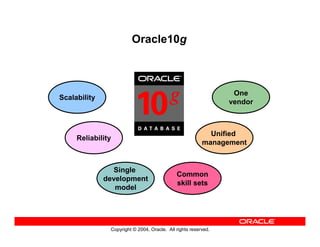
Oracle10g
Single
development
model
Common
skill sets
Reliability
Unified
management
Scalability
One
vendor
Copyright © 2004, Oracle. All rights reserved.
Oracle10g
Copyright © 2004, Oracle. All rights reserved.
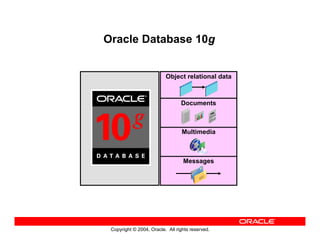
Oracle Database 10g
Multimedia
Object relational data
Messages
Documents
Copyright © 2004, Oracle. All rights reserved.
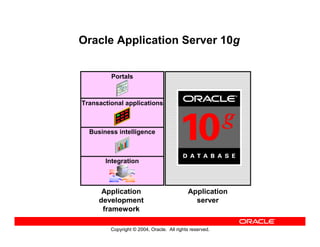
Oracle Application Server 10g
Application
development
framework
Application
server
Business intelligence
Portals
Integration
Transactional applications
Copyright © 2004, Oracle. All rights reserved.
Oracle Enterprise Manager 10g
Grid Control
• Software provisioning
• Application service level monitoring
Copyright © 2004, Oracle. All rights reserved.
Relational and Object Relational
Database Management Systems
• Relational model and object relational model
• User-defined data types and objects
• Fully compatible with relational database
• Support of multimedia and large objects
• High-quality database server features
Copyright © 2004, Oracle. All rights reserved.
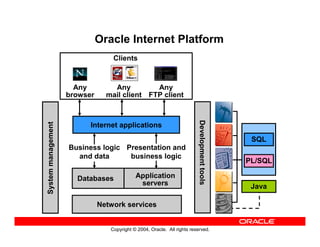
Oracle Internet Platform
Systemmanagement
Network services
Databases Application
servers
Internet applications
Any
browser
Any
FTP client
Any
mail client
SQL
PL/SQL
Java
Clients
Presentation and
business logic
Business logic
and data
Developmenttools
Copyright © 2004, Oracle. All rights reserved.
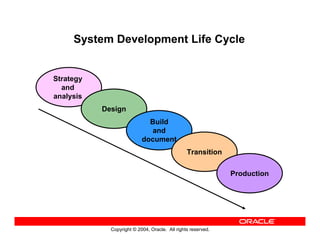
System Development Life Cycle
Strategy
and
analysis
Design
Build
and
document
Transition
Production
Copyright © 2004, Oracle. All rights reserved.
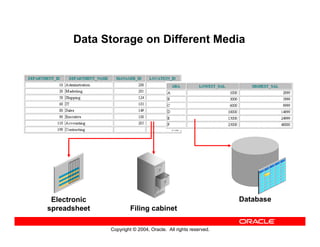
Data Storage on Different Media
Electronic
spreadsheet Filing cabinet
Database
Copyright © 2004, Oracle. All rights reserved.
Relational Database Concept
• Dr. E. F. Codd proposed the relational model for
database systems in 1970.
• It is the basis for the relational database
management system (RDBMS).
• The relational model consists of the following:
– Collection of objects or relations
– Set of operators to act on the relations
– Data integrity for accuracy and consistency
Copyright © 2004, Oracle. All rights reserved.
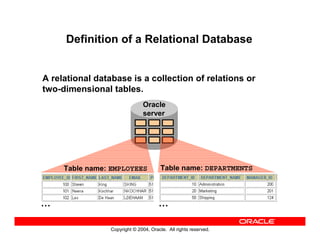
Definition of a Relational Database
A relational database is a collection of relations or
two-dimensional tables.
Oracle
server
Table name: EMPLOYEES Table name: DEPARTMENTS
… …
Copyright © 2004, Oracle. All rights reserved.
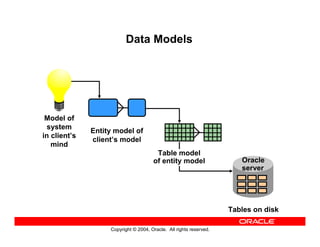
Data Models
Model of
system
in client’s
mind
Entity model of
client’s model
Tables on disk
Oracle
server
Table model
of entity model
Copyright © 2004, Oracle. All rights reserved.
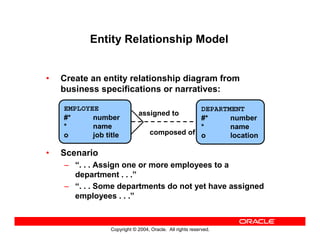
• Create an entity relationship diagram from
business specifications or narratives:
• Scenario
– “. . . Assign one or more employees to a
department . . .”
– “. . . Some departments do not yet have assigned
employees . . .”
Entity Relationship Model
EMPLOYEE
#* number
* name
o job title
DEPARTMENT
#* number
* name
o location
assigned to
composed of
Copyright © 2004, Oracle. All rights reserved.
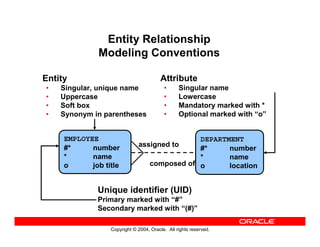
Entity Relationship
Modeling Conventions
Entity
• Singular, unique name
• Uppercase
• Soft box
• Synonym in parentheses
Unique identifier (UID)
Primary marked with “#”
Secondary marked with “(#)”
EMPLOYEE
#* number
* name
o job title
DEPARTMENT
#* number
* name
o location
Attribute
• Singular name
• Lowercase
• Mandatory marked with *
• Optional marked with “o”
assigned to
composed of
Copyright © 2004, Oracle. All rights reserved.
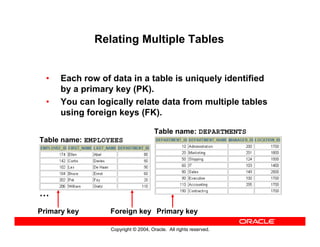
Relating Multiple Tables
• Each row of data in a table is uniquely identified
by a primary key (PK).
• You can logically relate data from multiple tables
using foreign keys (FK).
Table name: EMPLOYEES
Table name: DEPARTMENTS
Primary key Primary keyForeign key
…
Copyright © 2004, Oracle. All rights reserved.
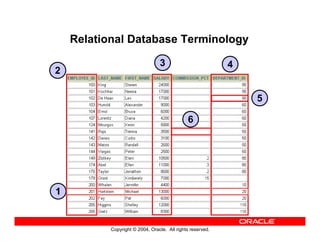
Relational Database Terminology
1
2
3 4
6
5
Copyright © 2004, Oracle. All rights reserved.
Relational Database Properties
A relational database:
• Can be accessed and modified by executing
structured query language (SQL) statements
• Contains a collection of tables with no physical
pointers
• Uses a set of operators
Copyright © 2004, Oracle. All rights reserved.
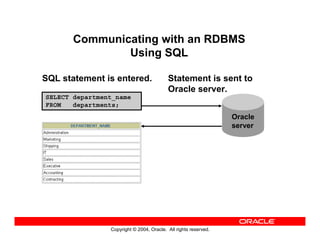
Communicating with an RDBMS
Using SQL
SQL statement is entered. Statement is sent to
Oracle server.
Oracle
server
SELECT department_name
FROM departments;
Copyright © 2004, Oracle. All rights reserved.
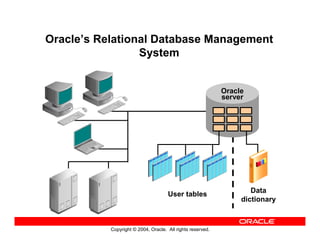
Oracle’s Relational Database Management
System
User tables Data
dictionary
Oracle
server
Copyright © 2004, Oracle. All rights reserved.
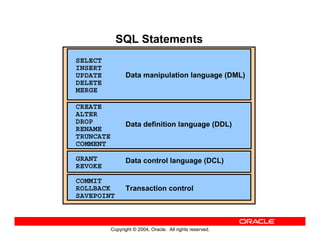
SQL Statements
SELECT
INSERT
UPDATE
DELETE
MERGE
CREATE
ALTER
DROP
RENAME
TRUNCATE
COMMENT
GRANT
REVOKE
COMMIT
ROLLBACK
SAVEPOINT
Data manipulation language (DML)
Data definition language (DDL)
Transaction control
Data control language (DCL)
Copyright © 2004, Oracle. All rights reserved.
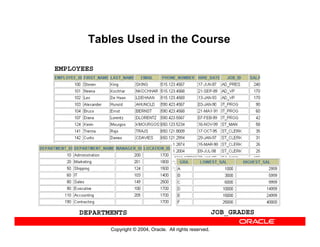
Tables Used in the Course
EMPLOYEES
DEPARTMENTS JOB_GRADES
Copyright © 2004, Oracle. All rights reserved.
Summary
• Oracle Database 10g is the database for grid
computing.
• The database is based on the object relational
database management system.
• Relational databases are composed of relations,
managed by relational operations, and governed
by data integrity constraints.
• With the Oracle server, you can store and manage
information by using the SQL language and
PL/SQL engine.

Intro

  • 1.
    Copyright © 2004,Oracle. All rights reserved. Introduction
  • 2.
    Copyright © 2004,Oracle. All rights reserved. Lesson Objectives After completing this lesson, you should be able to do the following: • List the features of Oracle10g • Discuss the theoretical and physical aspects of a relational database • Describe the Oracle implementation of the RDBMS and ORDBMS • Understand the goals of the course
  • 3.
    Copyright © 2004,Oracle. All rights reserved. Goals of the Course After completing this course, you should be able to do the following: • Identify the major structural components of Oracle Database 10g • Retrieve row and column data from tables with the SELECT statement • Create reports of sorted and restricted data • Employ SQL functions to generate and retrieve customized data • Run data manipulation language (DML) statements to update data in Oracle Database 10g • Obtain metadata by querying the dictionary views
  • 4.
    Copyright © 2004,Oracle. All rights reserved. Oracle10g Single development model Common skill sets Reliability Unified management Scalability One vendor
  • 5.
    Copyright © 2004,Oracle. All rights reserved. Oracle10g
  • 6.
    Copyright © 2004,Oracle. All rights reserved. Oracle Database 10g Multimedia Object relational data Messages Documents
  • 7.
    Copyright © 2004,Oracle. All rights reserved. Oracle Application Server 10g Application development framework Application server Business intelligence Portals Integration Transactional applications
  • 8.
    Copyright © 2004,Oracle. All rights reserved. Oracle Enterprise Manager 10g Grid Control • Software provisioning • Application service level monitoring
  • 9.
    Copyright © 2004,Oracle. All rights reserved. Relational and Object Relational Database Management Systems • Relational model and object relational model • User-defined data types and objects • Fully compatible with relational database • Support of multimedia and large objects • High-quality database server features
  • 10.
    Copyright © 2004,Oracle. All rights reserved. Oracle Internet Platform Systemmanagement Network services Databases Application servers Internet applications Any browser Any FTP client Any mail client SQL PL/SQL Java Clients Presentation and business logic Business logic and data Developmenttools
  • 11.
    Copyright © 2004,Oracle. All rights reserved. System Development Life Cycle Strategy and analysis Design Build and document Transition Production
  • 12.
    Copyright © 2004,Oracle. All rights reserved. Data Storage on Different Media Electronic spreadsheet Filing cabinet Database
  • 13.
    Copyright © 2004,Oracle. All rights reserved. Relational Database Concept • Dr. E. F. Codd proposed the relational model for database systems in 1970. • It is the basis for the relational database management system (RDBMS). • The relational model consists of the following: – Collection of objects or relations – Set of operators to act on the relations – Data integrity for accuracy and consistency
  • 14.
    Copyright © 2004,Oracle. All rights reserved. Definition of a Relational Database A relational database is a collection of relations or two-dimensional tables. Oracle server Table name: EMPLOYEES Table name: DEPARTMENTS … …
  • 15.
    Copyright © 2004,Oracle. All rights reserved. Data Models Model of system in client’s mind Entity model of client’s model Tables on disk Oracle server Table model of entity model
  • 16.
    Copyright © 2004,Oracle. All rights reserved. • Create an entity relationship diagram from business specifications or narratives: • Scenario – “. . . Assign one or more employees to a department . . .” – “. . . Some departments do not yet have assigned employees . . .” Entity Relationship Model EMPLOYEE #* number * name o job title DEPARTMENT #* number * name o location assigned to composed of
  • 17.
    Copyright © 2004,Oracle. All rights reserved. Entity Relationship Modeling Conventions Entity • Singular, unique name • Uppercase • Soft box • Synonym in parentheses Unique identifier (UID) Primary marked with “#” Secondary marked with “(#)” EMPLOYEE #* number * name o job title DEPARTMENT #* number * name o location Attribute • Singular name • Lowercase • Mandatory marked with * • Optional marked with “o” assigned to composed of
  • 18.
    Copyright © 2004,Oracle. All rights reserved. Relating Multiple Tables • Each row of data in a table is uniquely identified by a primary key (PK). • You can logically relate data from multiple tables using foreign keys (FK). Table name: EMPLOYEES Table name: DEPARTMENTS Primary key Primary keyForeign key …
  • 19.
    Copyright © 2004,Oracle. All rights reserved. Relational Database Terminology 1 2 3 4 6 5
  • 20.
    Copyright © 2004,Oracle. All rights reserved. Relational Database Properties A relational database: • Can be accessed and modified by executing structured query language (SQL) statements • Contains a collection of tables with no physical pointers • Uses a set of operators
  • 21.
    Copyright © 2004,Oracle. All rights reserved. Communicating with an RDBMS Using SQL SQL statement is entered. Statement is sent to Oracle server. Oracle server SELECT department_name FROM departments;
  • 22.
    Copyright © 2004,Oracle. All rights reserved. Oracle’s Relational Database Management System User tables Data dictionary Oracle server
  • 23.
    Copyright © 2004,Oracle. All rights reserved. SQL Statements SELECT INSERT UPDATE DELETE MERGE CREATE ALTER DROP RENAME TRUNCATE COMMENT GRANT REVOKE COMMIT ROLLBACK SAVEPOINT Data manipulation language (DML) Data definition language (DDL) Transaction control Data control language (DCL)
  • 24.
    Copyright © 2004,Oracle. All rights reserved. Tables Used in the Course EMPLOYEES DEPARTMENTS JOB_GRADES
  • 25.
    Copyright © 2004,Oracle. All rights reserved. Summary • Oracle Database 10g is the database for grid computing. • The database is based on the object relational database management system. • Relational databases are composed of relations, managed by relational operations, and governed by data integrity constraints. • With the Oracle server, you can store and manage information by using the SQL language and PL/SQL engine.