Chemical Warfare
Agents
Anna Healey, MD PGY-2
4/30/2014
Objectives
Warfare history
Qualities of chemical agents
Classes of chemical agents
Management of exposures
Decontamination and protection
Chemical Warfare in
History
Poisoned spears and arrows
Peloponnesian War: burning wood and sulfur to
create noxious smoke to stall the Athenians
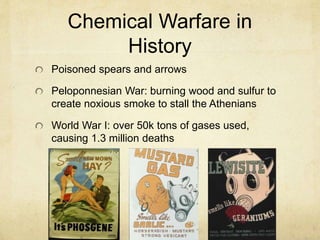
World War I: over 50k tons of gases used,
causing 1.3 million deaths
Syrian Conflict
http://www.cnn.com/video/?/video/world/2014/04/
21/tsr-dnt-labott-syria-new-chemical-
weapons.cnn&video_referrer=http%3A%2F%2F
www.cnn.com%2Fvideo%2Fdata%2F2.0%2Fvid
eo%2Fworld%2F2014%2F04%2F21%2Ftsr-dnt-
labott-syria-new-chemical-
weapons.cnn.html%3Fhpt%3Dhp_t2
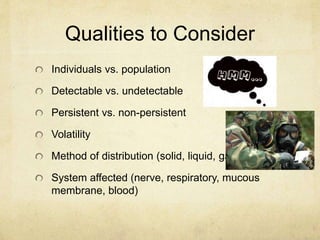
Qualities to Consider
Individuals vs. population
Detectable vs. undetectable
Persistent vs. non-persistent
Volatility
Method of distribution (solid, liquid, gas)
System affected (nerve, respiratory, mucous
membrane, blood)
Classes of Agents
Nerve agents
Asphyxiants/blood agents
Vesicant/blister agents
Choking/pulmonary agents
Tear agents
Cytotoxic agents
Nerve Agents
Main effects on nicotinic and muscarinic receptors via
acetylcholinesterase inhibition
Inhalation or absorption through skin
Signs/symptoms: SLUDGE, killer Bs, seizures, muscle
fasciculations
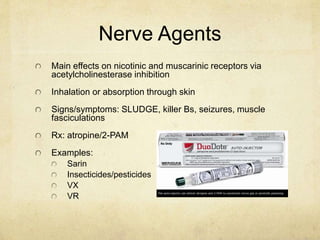
Rx: atropine/2-PAM
Examples:
Sarin
Insecticides/pesticides
VX
VR
Nerve Agents
https://www.youtube.com/watch?v=doytZVNltc4
Asphyxiants
Arsine: causes hemolysis
Cyanogen chloride/hydrogen cyanide, carbon
monoxide: blocks oxidative phosphorylation
Generally via inhalation
Signs/symptoms: confusion, nausea, altered
mental status, lactic acidosis, cherry red skin,
seizures
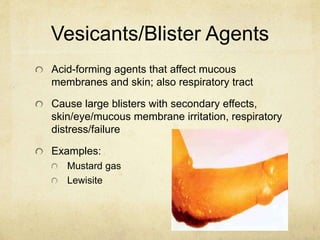
Vesicants/Blister Agents
Acid-forming agents that affect mucous
membranes and skin; also respiratory tract
Cause large blisters with secondary effects,
skin/eye/mucous membrane irritation, respiratory
distress/failure
Examples:
Mustard gas
Lewisite
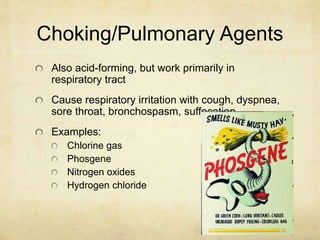
Choking/Pulmonary Agents
Also acid-forming, but work primarily in
respiratory tract
Cause respiratory irritation with cough, dyspnea,
sore throat, bronchospasm, suffocation
Examples:
Chlorine gas
Phosgene
Nitrogen oxides
Hydrogen chloride
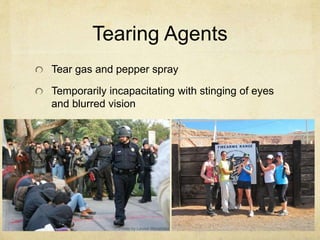
Tearing Agents
Tear gas and pepper spray
Temporarily incapacitating with stinging of eyes
and blurred vision
Cytotoxic Agents
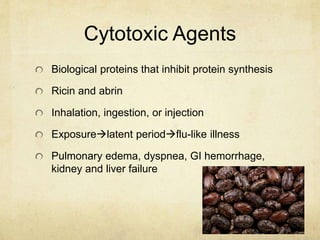
Biological proteins that inhibit protein synthesis
Ricin and abrin
Inhalation, ingestion, or injection
Exposurelatent periodflu-like illness
Pulmonary edema, dyspnea, GI hemorrhage,
kidney and liver failure
Management of Exposures
PERSONAL PROTECTION
DECONTAMINATION
SUPPORTIVE CARE
Specific antidotes:
Nerve agents—atropine/2-PAM
Asphyxiants—Cyanokit
All others—no antidote
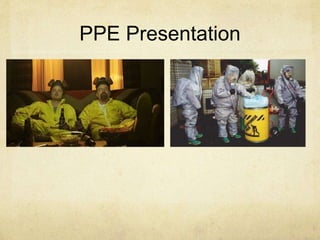
PPE Presentation

Chemical warfare healey

Editor's Notes

  • #14 February 2008, Las Vegas, Nevada, US[edit] In February 2008, a man who stayed in a Las Vegas motel room where ricin was found was taken to the hospital in critical condition. The man, Roger Von Bergendorff, was hospitalized on February 14; however, the ricin was not found until February 27 when a relative retrieved his luggage because the motel had not been paid for two weeks. Firearms and an "anarchist type textbook" were found in the same motel room where several vials of ricin were found, police reported. According to Las Vegas 8 Television news, police noted the ricin section of the textbook was highlighted.[19][20] On March 3, FBI agents searched at Riverton, Utah house and several storage lockers in West Jordan, Utah linked to Bergendorff, but did not find any traces of ricin.[21][22] Bergendorff awoke from a coma on March 14. He was questioned by police as to why he had such a large quantity of ricin.[22] Subsequently, he was arrested on April 16 and charged with possession of a biological toxin and two weapons offenses.[23]