Intra & Post-operative Analgesia
N.T. Shimhanda
07.05.2019
Dept of Anaesthesia
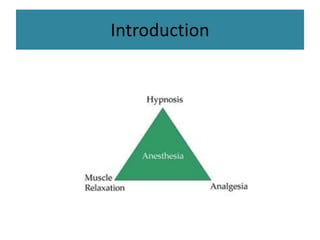
Introduction
• Before 19th century, at the best pain was
alleviated with either alcohol or opiates
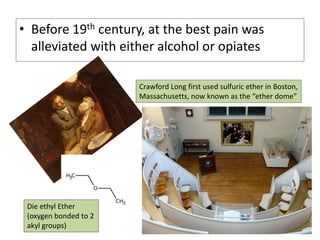
Crawford Long first used sulfuric ether in Boston,
Massachusetts, now known as the “ether dome”
Die ethyl Ether
(oxygen bonded to 2
akyl groups)
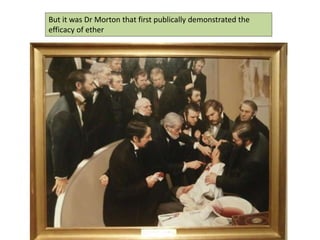
But it was Dr Morton that first publically demonstrated the
efficacy of ether
What is Pain
• A protective signal to alert an individual to stay off?
• Punishment?
• A natural signal for malfunctioning of a body part?
• A test of bravery?
• An unpleasant sensory and emotional
experience associated with actual or potential
tissue damage, or described in terms of such
damage.
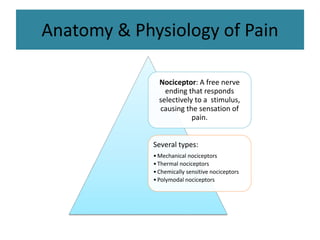
Anatomy & Physiology of Pain
Nociceptor: A free nerve
ending that responds
selectively to a stimulus,
causing the sensation of
pain.
Several types:
•Mechanical nociceptors
•Thermal nociceptors
•Chemically sensitive nociceptors
•Polymodal nociceptors
Transmission of impulses from
nociceptors
• Impulses are transmitted to the CNS via two fibre types:
– Thinly myelinated A-delta fibres [found in hairy and glabrous skin and
deep tissue]
– Unmyelinated C fibres which conduct at lower rates.
• Activation of A-delta fibre which release glutamate, is
responsible for first pain(fast pain), a rapid response and
mediates the discriminative aspect of pain (the ability to
localize the site and intensity of the noxious stimulus).
• Activation of C fibre, release a combination of glutamate and
substance P, and is responsible for delayed second pain (slow
or protopathic pain) which is dull, intense, diffuse, and
unpleasant feeling associated with a noxious stimulus.
Intra & Post-op monitoring
• Airway and circulation
• Neuromuscular function
• PAIN
• Nausea & vomiting
• Temperature
• Fluid Intake & output
• Incision site /bleeding.
• Pain affects the physical & psychological wellbeing of
patients.
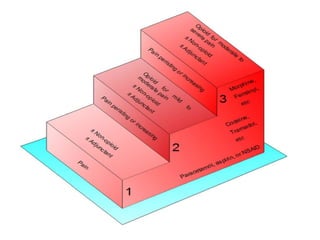
• The WHO pain(analgesic) ladder is a major tool in
management.
• It is a 3 step approach of sequential use of
pharmacological agents commensurate with the pain
level as reported by the patient.
• It involves regular assessment of pain with
individualised Rx, preferably orally given at regular
intervals rather than on demand.
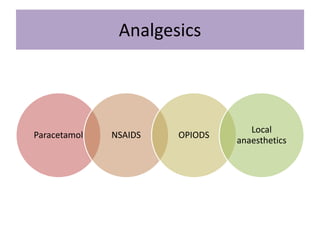
Analgesics
Paracetamol NSAIDS OPIODS
Local
anaesthetics
• Mild Pain
• Non-opiod
• Paracetamol
• NSAIDs
• -Ibuprofen
• -Diclofenac
• -Celecoxib
• ±Adjuvants
Step 1
 Paracetamol
• Thought to act centrally and peripherally and it has anti-
prostaglandin effects via the Cox-3 enzyme. Mild analgesic
properties but effective in mx of inta & post op pain.
• Adults: 1g TDS P.O/rectally (max 6g in 24hrs)
• Children: 15mg/kg QID (max 90mg/kg/24;60 neonates-
immature liver)
• Can be combined with NSAIDs
• Few side effects— Hypersensitivity reactions; Overdose-
fulminant hepatic necrosis
• Perfalgan (1g iv – 10mg IM morphine)
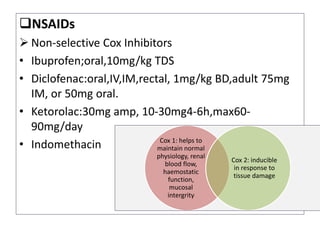
NSAIDs
 Non-selective Cox Inhibitors
• Ibuprofen;oral,10mg/kg TDS
• Diclofenac:oral,IV,IM,rectal, 1mg/kg BD,adult 75mg
IM, or 50mg oral.
• Ketorolac:30mg amp, 10-30mg4-6h,max60-
90mg/day
• Indomethacin Cox 1: helps to
maintain normal
physiology, renal
blood flow,
haemostatic
function,
mucosal
intergrity
Cox 2: inducible
in response to
tissue damage
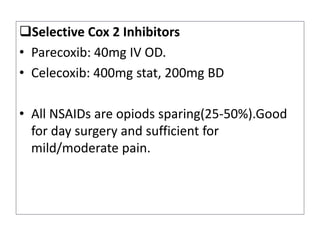
Selective Cox 2 Inhibitors
• Parecoxib: 40mg IV OD.
• Celecoxib: 400mg stat, 200mg BD
• All NSAIDs are opiods sparing(25-50%).Good
for day surgery and sufficient for
mild/moderate pain.
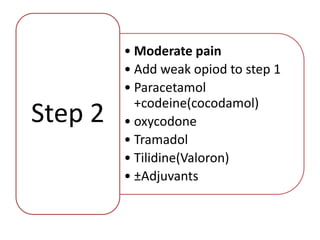
• Moderate pain
• Add weak opiod to step 1
• Paracetamol
+codeine(cocodamol)
• oxycodone
• Tramadol
• Tilidine(Valoron)
• ±Adjuvants
Step 2
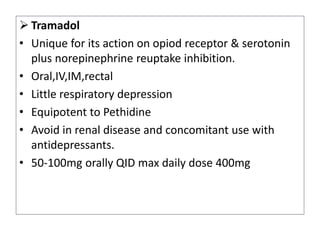
 Tramadol
• Unique for its action on opiod receptor & serotonin
plus norepinephrine reuptake inhibition.
• Oral,IV,IM,rectal
• Little respiratory depression
• Equipotent to Pethidine
• Avoid in renal disease and concomitant use with
antidepressants.
• 50-100mg orally QID max daily dose 400mg
Codeine
• Oral,IM
• Less potent than morphine
• 10% metabolised to morphine
• Not used in children<12yrs.
Step 3
• Severe Pain
If a weak opiod has been used
to its maximum dose and
patient still has pain , move to
high potency opiod instead of
substituting another medicine
in the same group.
Severe Pain
– Morphine
– Pethidine
– Fentanyl
– Methadone
• ±Adjuvants
Pethidine
• IV,IM,Oral unpredictable
• Onset iv 2-5min
• Not so sedating
• Active metabolite:Norpethidine potentially
convulsive,avoid in renal failure.
• Contraindicated in MAOI intake
• 50-150mg 4hrly.
 MORPHINE
• Gold standard analgesic
• Oral(good absorption,1st pass effect) IV,IM
• 0.1-0.2mg/kg lasts3-4hrs
• Onset 3-5min,peak 15-20min IV
• Avoid in neonates(unless ventilated)
• Accumulates in renal failure, reduce dose and interval.
• The effective dose is that which suppresses the
patient’s pain.
• Any of the steps can be complemented with addition
of wound infiltration and nerve blocks with local
anaesthetic
• Step 3 can be complemented with neuroaxial
anaesthesia in the form of epidural catheters with
titration of opiods e.g morphine or fentanyl
Adjuvant therapy
• They are not analgesics in the true
pharmacological sense but they contribute
significantly to pain relief used alone or in
combination with analgesics on the WHO 3 step
ladder.
• They have analgesic sparing effects
• Corticosteroids—Bone pain, pain assoc with oedema
& inflammation
• Antidepressant(Amitriptyline)—- neuropathic pain
• Anticonvulsant(Gabapentin,Carba mazepine)—
neuropathic pain
• Patient Controlled Analgesia (PCA)
• This is a concept where a fully awake patient is
connected to an infusion pump via i.v means
that is set to deliver specific dose with
minimum interval b/ w doses and amount of
opiod administered in a given time.
References
• South African Acute Pain Guidelines. Official
publication of The South African Society of
Anaesthesiologists (SASA)

Intra &amp; post op analgesia ppt

  • 1.
    Intra & Post-operativeAnalgesia N.T. Shimhanda 07.05.2019 Dept of Anaesthesia
  • 2.
  • 3.
    • Before 19thcentury, at the best pain was alleviated with either alcohol or opiates Crawford Long first used sulfuric ether in Boston, Massachusetts, now known as the “ether dome” Die ethyl Ether (oxygen bonded to 2 akyl groups)
  • 4.
    But it wasDr Morton that first publically demonstrated the efficacy of ether
  • 5.
    What is Pain •A protective signal to alert an individual to stay off? • Punishment? • A natural signal for malfunctioning of a body part? • A test of bravery? • An unpleasant sensory and emotional experience associated with actual or potential tissue damage, or described in terms of such damage.
  • 6.
    Anatomy & Physiologyof Pain Nociceptor: A free nerve ending that responds selectively to a stimulus, causing the sensation of pain. Several types: •Mechanical nociceptors •Thermal nociceptors •Chemically sensitive nociceptors •Polymodal nociceptors
  • 7.
    Transmission of impulsesfrom nociceptors • Impulses are transmitted to the CNS via two fibre types: – Thinly myelinated A-delta fibres [found in hairy and glabrous skin and deep tissue] – Unmyelinated C fibres which conduct at lower rates. • Activation of A-delta fibre which release glutamate, is responsible for first pain(fast pain), a rapid response and mediates the discriminative aspect of pain (the ability to localize the site and intensity of the noxious stimulus). • Activation of C fibre, release a combination of glutamate and substance P, and is responsible for delayed second pain (slow or protopathic pain) which is dull, intense, diffuse, and unpleasant feeling associated with a noxious stimulus.
  • 8.
    Intra & Post-opmonitoring • Airway and circulation • Neuromuscular function • PAIN • Nausea & vomiting • Temperature • Fluid Intake & output • Incision site /bleeding.
  • 9.
    • Pain affectsthe physical & psychological wellbeing of patients. • The WHO pain(analgesic) ladder is a major tool in management. • It is a 3 step approach of sequential use of pharmacological agents commensurate with the pain level as reported by the patient. • It involves regular assessment of pain with individualised Rx, preferably orally given at regular intervals rather than on demand.
  • 11.
  • 12.
    • Mild Pain •Non-opiod • Paracetamol • NSAIDs • -Ibuprofen • -Diclofenac • -Celecoxib • ±Adjuvants Step 1
  • 13.
     Paracetamol • Thoughtto act centrally and peripherally and it has anti- prostaglandin effects via the Cox-3 enzyme. Mild analgesic properties but effective in mx of inta & post op pain. • Adults: 1g TDS P.O/rectally (max 6g in 24hrs) • Children: 15mg/kg QID (max 90mg/kg/24;60 neonates- immature liver) • Can be combined with NSAIDs • Few side effects— Hypersensitivity reactions; Overdose- fulminant hepatic necrosis • Perfalgan (1g iv – 10mg IM morphine)
  • 14.
    NSAIDs  Non-selective CoxInhibitors • Ibuprofen;oral,10mg/kg TDS • Diclofenac:oral,IV,IM,rectal, 1mg/kg BD,adult 75mg IM, or 50mg oral. • Ketorolac:30mg amp, 10-30mg4-6h,max60- 90mg/day • Indomethacin Cox 1: helps to maintain normal physiology, renal blood flow, haemostatic function, mucosal intergrity Cox 2: inducible in response to tissue damage
  • 15.
    Selective Cox 2Inhibitors • Parecoxib: 40mg IV OD. • Celecoxib: 400mg stat, 200mg BD • All NSAIDs are opiods sparing(25-50%).Good for day surgery and sufficient for mild/moderate pain.
  • 16.
    • Moderate pain •Add weak opiod to step 1 • Paracetamol +codeine(cocodamol) • oxycodone • Tramadol • Tilidine(Valoron) • ±Adjuvants Step 2
  • 17.
     Tramadol • Uniquefor its action on opiod receptor & serotonin plus norepinephrine reuptake inhibition. • Oral,IV,IM,rectal • Little respiratory depression • Equipotent to Pethidine • Avoid in renal disease and concomitant use with antidepressants. • 50-100mg orally QID max daily dose 400mg
  • 18.
    Codeine • Oral,IM • Lesspotent than morphine • 10% metabolised to morphine • Not used in children<12yrs.
  • 19.
    Step 3 • SeverePain If a weak opiod has been used to its maximum dose and patient still has pain , move to high potency opiod instead of substituting another medicine in the same group.
  • 20.
    Severe Pain – Morphine –Pethidine – Fentanyl – Methadone • ±Adjuvants
  • 21.
    Pethidine • IV,IM,Oral unpredictable •Onset iv 2-5min • Not so sedating • Active metabolite:Norpethidine potentially convulsive,avoid in renal failure. • Contraindicated in MAOI intake • 50-150mg 4hrly.
  • 22.
     MORPHINE • Goldstandard analgesic • Oral(good absorption,1st pass effect) IV,IM • 0.1-0.2mg/kg lasts3-4hrs • Onset 3-5min,peak 15-20min IV • Avoid in neonates(unless ventilated) • Accumulates in renal failure, reduce dose and interval. • The effective dose is that which suppresses the patient’s pain.
  • 23.
    • Any ofthe steps can be complemented with addition of wound infiltration and nerve blocks with local anaesthetic • Step 3 can be complemented with neuroaxial anaesthesia in the form of epidural catheters with titration of opiods e.g morphine or fentanyl
  • 24.
    Adjuvant therapy • Theyare not analgesics in the true pharmacological sense but they contribute significantly to pain relief used alone or in combination with analgesics on the WHO 3 step ladder. • They have analgesic sparing effects
  • 25.
    • Corticosteroids—Bone pain,pain assoc with oedema & inflammation • Antidepressant(Amitriptyline)—- neuropathic pain • Anticonvulsant(Gabapentin,Carba mazepine)— neuropathic pain
  • 26.
    • Patient ControlledAnalgesia (PCA) • This is a concept where a fully awake patient is connected to an infusion pump via i.v means that is set to deliver specific dose with minimum interval b/ w doses and amount of opiod administered in a given time.
  • 27.
    References • South AfricanAcute Pain Guidelines. Official publication of The South African Society of Anaesthesiologists (SASA)

Editor's Notes

  • #4 The Ether Dome is a surgical operating amphitheater in the Bulfinch Building at Massachusetts General Hospital in Boston. It served as the hospital's operating room from its opening in 1821 until 1867. It was the site of the first public demonstration of the use of inhaled ether as a surgical anesthetic on October 16, 1846 Crawford Long, a surgeon in Georgia, had previously administered sulfuric ether in 1842, but this went unpublished until 1849. The Ether Dome event occurred when William Thomas Green Morton, a local dentist, used ether to anesthetize Edward Gilbert Abbott. John Collins Warren, the first dean of Harvard Medical School, then painlessly removed part of a tumor from Abbott's neck. After Warren had finished, and Abbott regained consciousness, Warren asked the patient how he felt. Reportedly, Abbott said, "Feels as if my neck's been scratched". Warren then turned to his medical audience and uttered "Gentlemen, this is no Humbug". This was presumably a reference to the unsuccessful demonstration of nitrous oxide anesthesia by Horace Wells in the same theater the previous year, which was ended by cries of "Humbug!" after the patient groaned with pain.