Perioperative multimodal analgesia
2023. 11. 9
BoohwiHong, ChungnamNational University, Korea
koho0127@gmail.com
2
03. PROSPECT guidelines
02. Guidelines of APS, ASRA and ASA
04. Basic analgesics
05. Epidural analgesia, Intrathecal morphine
01. Introduction of multimodal analgesia
Contents
3
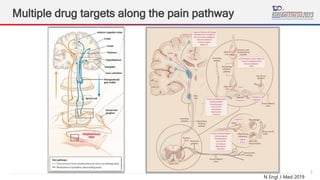
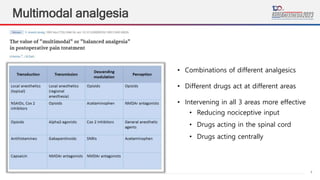
Multiple drug targets along the pain pathway
N Engl J Med 2019
4
Multimodal analgesia
• Combinations of different analgesics
• Different drugs act at different areas
• Intervening in all 3 areas more effective
• Reducing nociceptive input
• Drugs acting in the spinal cord
• Drugs acting centrally
5
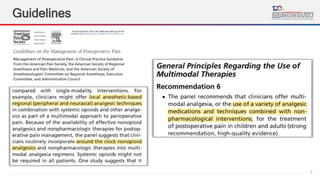
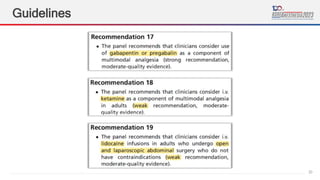
Guidelines
6
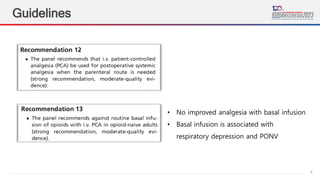
Guidelines
• No improved analgesia with basal infusion
• Basal infusion is associated with
respiratory depression and PONV
7
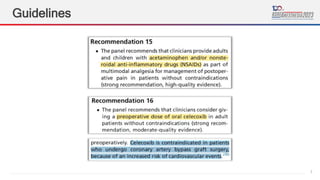
Guidelines
8
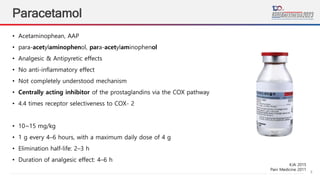
Paracetamol
• Acetaminophean, AAP
• para-acetylaminophenol, para-acetylaminophenol
• Analgesic & Antipyretic effects
• No anti-inflammatory effect
• Not completely understood mechanism
• Centrally acting inhibitor of the prostaglandins via the COX pathway
• 4.4 times receptor selectiveness to COX- 2
• 10~15 mg/kg
• 1 g every 4–6 hours, with a maximum daily dose of 4 g
• Elimination half-life: 2–3 h
• Duration of analgesic effect: 4–6 h
KJA 2015
Pain Medicine 2011
9
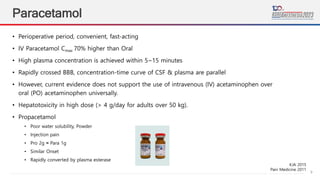
Paracetamol
• Perioperative period, convenient, fast-acting
• IV Paracetamol Cmax 70% higher than Oral
• High plasma concentration is achieved within 5~15 minutes
• Rapidly crossed BBB, concentration-time curve of CSF & plasma are parallel
• However, current evidence does not support the use of intravenous (IV) acetaminophen over
oral (PO) acetaminophen universally.
• Hepatotoxicity in high dose (> 4 g/day for adults over 50 kg).
• Propacetamol
• Poor water solubility, Powder
• Injection pain
• Pro 2g ≈ Para 1g
• Similar Onset
• Rapidly converted by plasma esterase
KJA 2015
Pain Medicine 2011
10
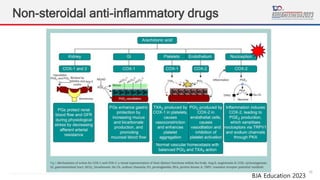
Non-steroidal anti-inflammatory drugs
BJA Education 2023
11
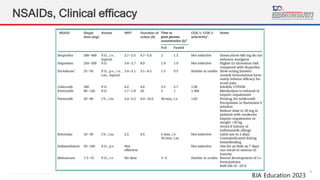
NSAIDs, Clinical efficacy
BJA Education 2023
12
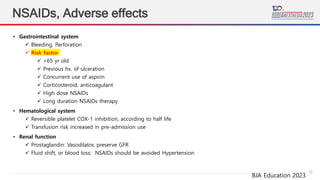
NSAIDs, Adverse effects
BJA Education 2023
• Gastrointestinal system
 Bleeding, Perforation
 Risk factor
 >65 yr old
 Previous hx. of ulceration
 Concurrent use of aspirin
 Corticosteroid, anticoagulant
 High dose NSAIDs
 Long duration NSAIDs therapy
• Hematological system
 Reversible platelet COX-1 inhibition, according to half life
 Transfusion risk increased in pre-admission use
• Renal function
 Prostaglandin: Vasodilator, preserve GFR
 Fluid shift, or blood loss: NSAIDs should be avoided Hypertension
13
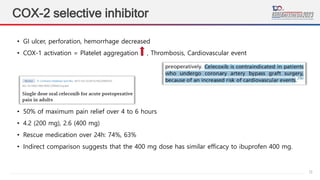
COX-2 selective inhibitor
• GI ulcer, perforation, hemorrhage decreased
• COX-1 activation = Platelet aggregation , Thrombosis, Cardiovascular event
• 50% of maximum pain relief over 4 to 6 hours
• 4.2 (200 mg), 2.6 (400 mg)
• Rescue medication over 24h: 74%, 63%
• Indirect comparison suggests that the 400 mg dose has similar efficacy to ibuprofen 400 mg.
14
Ketorolac
• First parenteral Non-selective NSAID
• Half life 5.5 hr, Maximum effect onset within 1~2 hr
• Duration 4~6 hr
• Cost effective
• 30 mg ≈ Propacetamol 2g ≈ Paracetamol 1g
• Contraindicated as preemptive before major surgery
• Prolonged PLT effects and increased risk of perioperative bleeding
• -> near end of surgery after surgeon has achieved hemostasis
Anesth Analg. 2012
15
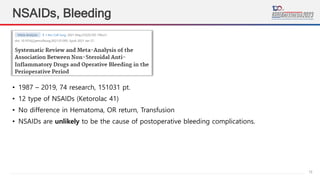
NSAIDs, Bleeding
• 1987 – 2019, 74 research, 151031 pt.
• 12 type of NSAIDs (Ketorolac 41)
• No difference in Hematoma, OR return, Transfusion
• NSAIDs are unlikely to be the cause of postoperative bleeding complications.
16
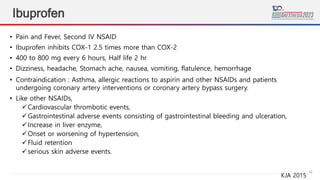
Ibuprofen
• Pain and Fever, Second IV NSAID
• Ibuprofen inhibits COX-1 2.5 times more than COX-2
• 400 to 800 mg every 6 hours, Half life 2 hr
• Dizziness, headache, Stomach ache, nausea, vomiting, flatulence, hemorrhage
• Contraindication : Asthma, allergic reactions to aspirin and other NSAIDs and patients
undergoing coronary artery interventions or coronary artery bypass surgery.
• Like other NSAIDs,
Cardiovascular thrombotic events,
Gastrointestinal adverse events consisting of gastrointestinal bleeding and ulceration,
Increase in liver enzyme,
Onset or worsening of hypertension,
Fluid retention
serious skin adverse events.
KJA 2015
17
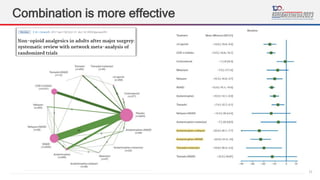
Combination is more effective
18
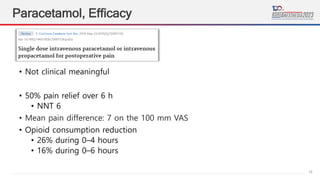
Paracetamol, Efficacy
Cochrane Database of Systematic Reviews
2016
• Not clinical meaningful
• 50% pain relief over 6 h
• NNT 6
• Mean pain difference: 7 on the 100 mm VAS
• Opioid consumption reduction
• 26% during 0–4 hours
• 16% during 0–6 hours
19
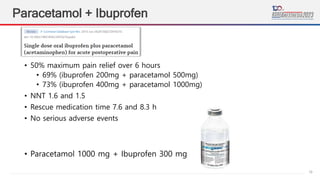
Paracetamol + Ibuprofen
• 50% maximum pain relief over 6 hours
• 69% (ibuprofen 200mg + paracetamol 500mg)
• 73% (ibuprofen 400mg + paracetamol 1000mg)
• NNT 1.6 and 1.5
• Rescue medication time 7.6 and 8.3 h
• No serious adverse events
• Paracetamol 1000 mg + Ibuprofen 300 mg
20
Guidelines
21
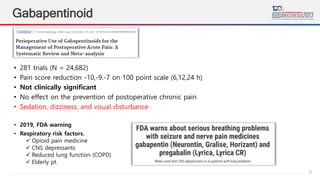
Gabapentinoid
• 281 trials (N = 24,682)
• Pain score reduction -10,-9.-7 on 100 point scale (6,12,24 h)
• Not clinically significant
• No effect on the prevention of postoperative chronic pain
• Sedation, dizziness, and visual disturbance
• 2019, FDA warning
• Respiratory risk factors.
 Opioid pain medicine
 CNS depressants
 Reduced lung function (COPD)
 Elderly pt.
22
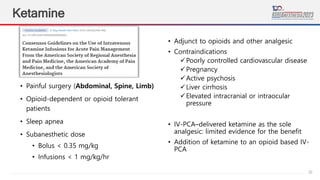
Ketamine
• Painful surgery (Abdominal, Spine, Limb)
• Opioid-dependent or opioid tolerant
patients
• Sleep apnea
• Subanesthetic dose
• Bolus < 0.35 mg/kg
• Infusions < 1 mg/kg/hr
• Adjunct to opioids and other analgesic
• Contraindications
Poorly controlled cardiovascular disease
Pregnancy
Active psychosis
Liver cirrhosis
Elevated intracranial or intraocular
pressure
• IV-PCA–delivered ketamine as the sole
analgesic: limited evidence for the benefit
• Addition of ketamine to an opioid based IV-
PCA
23
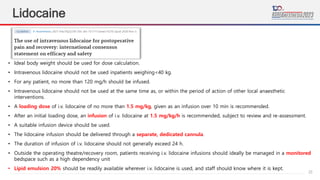
Lidocaine
• Ideal body weight should be used for dose calculation.
• Intravenous lidocaine should not be used inpatients weighing<40 kg.
• For any patient, no more than 120 mg/h should be infused.
• Intravenous lidocaine should not be used at the same time as, or within the period of action of other local anaesthetic
interventions.
• A loading dose of i.v. lidocaine of no more than 1.5 mg/kg, given as an infusion over 10 min is recommended.
• After an initial loading dose, an infusion of i.v. lidocaine at 1.5 mg/kg/h is recommended, subject to review and re-assessment.
• A suitable infusion device should be used.
• The lidocaine infusion should be delivered through a separate, dedicated cannula.
• The duration of infusion of i.v. lidocaine should not generally exceed 24 h.
• Outside the operating theatre/recovery room, patients receiving i.v. lidocaine infusions should ideally be managed in a monitored
bedspace such as a high dependency unit
• Lipid emulsion 20% should be readily available wherever i.v. lidocaine is used, and staff should know where it is kept.
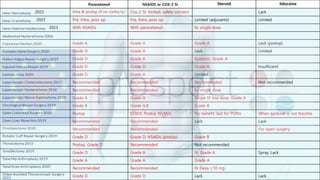
Paracetamol NSAIDS or COX-2 SI Steroid lidocaine
2023 Intra & postop (if no contra Ix.) Cox-2 SI, limited, safety concern Lack
2023 Pre, Intra, post op Pre, Intra, post op Limited (adjuvants) Limited
2023 With NSAIDs With paracetamol IV, single dose
Grade A Grade A Grade A Lack (postop)
Grade D Grade A Lack Limited
Grade D Grade A Systemic, Grade A
Grade D Grade D Grade B Insufficient
Grade D Grade A Limited
Recommended Recommended Recommended Not recommended
Recommended Recommended IV, single dose
Grade A Grade A Single IV low dose, Grade A
Grade B Grade A,B Grade B
Postop COX2I, Postop NSAIDs No benefit, but for PONV When epidural is not feasible
Recommended Recommended Lack Lack
Recommended Recommended For open surgery
Grade D Grade D, NSAIDs (postop) Grade B
Postop, Grade D Recommended Not recommended
Grade D Grade A IV, Grade A Spray, Lack
Grade A Grade A Grade A
Recommended Recommended IV Dexa ≥10 mg
Grade D Grade D Lack Lack
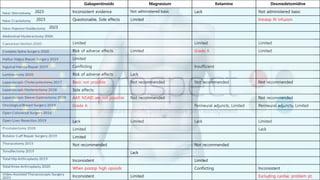
Gabapentinoids Magnesium Ketamine Dexmedetomidine
2023 Inconsistent evidence Not administered basic Lack Not administered basic
2023 Questionable, Side effects Limited Intraop IV infusion
2023
Limited Limited Limited
Risk of adverse effects Limited Grade A Limited
Limited
Conflicting Insufficient
Risk of adverse effects Lack
Basic not possible Not recommended Not recommended Not recommended
Side effects
AAP, NSAID are not possible Not recommended Not recommended
Grade A Perineural adjuncts, Limited Perineural adjuncts, Limited
Lack Limited Lack Limited
Limited Lack
Limited
Not recommended Not recommended
Lack
Inconsistent Limited
When postop high opioids Conflicting Inconsistent
Inconsistent Limited Excluding cardiac problem pt.
26
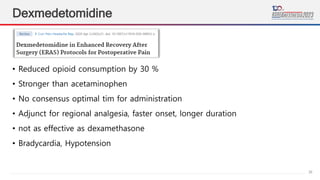
Dexmedetomidine
• Reduced opioid consumption by 30 %
• Stronger than acetaminophen
• No consensus optimal tim for administration
• Adjunct for regional analgesia, faster onset, longer duration
• not as effective as dexamethasone
• Bradycardia, Hypotension
27
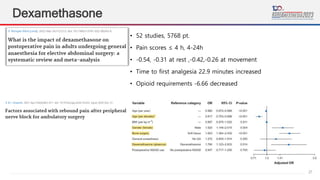
Dexamethasone
• 52 studies, 5768 pt.
• Pain scores ≤ 4 h, 4-24h
• -0.54, -0.31 at rest ,-0.42,-0.26 at movement
• Time to first analgesia 22.9 minutes increased
• Opioid requirements -6.66 decreased
28
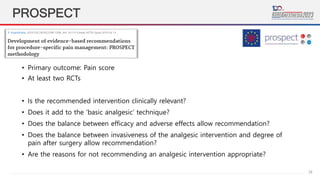
PROSPECT
• Primary outcome: Pain score
• At least two RCTs
• Is the recommended intervention clinically relevant?
• Does it add to the ‘basic analgesic’ technique?
• Does the balance between efficacy and adverse effects allow recommendation?
• Does the balance between invasiveness of the analgesic intervention and degree of
pain after surgery allow recommendation?
• Are the reasons for not recommending an analgesic intervention appropriate?
29
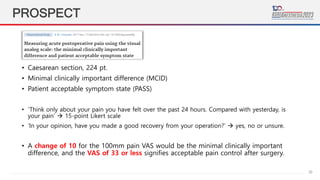
PROSPECT
• Caesarean section, 224 pt.
• Minimal clinically important difference (MCID)
• Patient acceptable symptom state (PASS)
• ‘Think only about your pain you have felt over the past 24 hours. Compared with yesterday, is
your pain’  15-point Likert scale
• ‘In your opinion, have you made a good recovery from your operation?’  yes, no or unsure.
• A change of 10 for the 100mm pain VAS would be the minimal clinically important
difference, and the VAS of 33 or less signifies acceptable pain control after surgery.
30
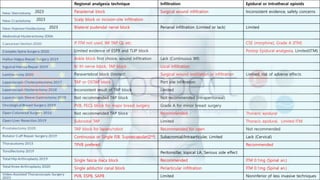
Guidelines
Regional analgesia technique Infiltration Epidural or Intrathecal opioids
2023 Parasternal block Surgical wound infiltration Inconsistent evidence, safety concerns
2023 Scalp block or incision-site infiltration
2023 Bilateral pudendal nerve block Perianal infiltration (Limited or lack) Limited
If ITM not used, WI TAP QL etc. CSE (morphine), Grade A (ITM)
Limited evidence of ESPB and TLIP block Postop Epidural analgesia, Limited(ITM)
Ankle block first choice, wound infiltration Lack (Continuous WI)
II/ IH nerve block, TAP block Local infiltration
Paravertebral block (limited) Surgical wound instillation or infiltration Limited, risk of adverse effects
TAP or OSTAP block Port site infiltration
Inconsistent result of TAP block Limited
Not recommended TAP block Not recommended (intraperitoneal)
PVB, PECS block for major breast surgery Grade A for minor breast surgery
Not recommended TAP block Recommended Thoracic epidural
Subcostal TAP Limited Thoracic epidural, Limited ITM
TAP block for laparo/robot Recommended for open Not recommended
Continuous or Single ISB, Suprascapular(2nd) Subacromial/Intraarticular, Limited Lack (Cervical)
TPVB prefered Recommended
Peritonsillar, topical LA, Serious side effect
Single fascia iliaca block Recommended ITM 0.1mg (Spinal an.)
Single adductor canal block Periarticular infiltration ITM 0.1mg (Spinal an.)
PVB, ESPB, SAPB Limited Noninferior of less invasive techniques
32
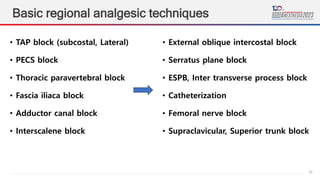
Basic regional analgesic techniques
• TAP block (subcostal, Lateral)
• PECS block
• Thoracic paravertebral block
• Fascia iliaca block
• Adductor canal block
• Interscalene block
• External oblique intercostal block
• Serratus plane block
• ESPB, Inter transverse process block
• Catheterization
• Femoral nerve block
• Supraclavicular, Superior trunk block
33
34
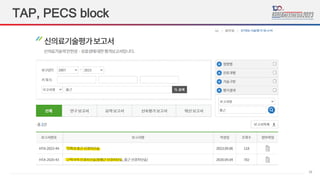
TAP, PECS block
35
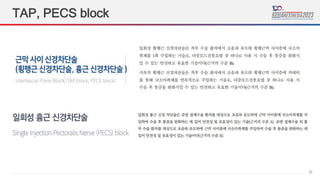
TAP, PECS block
36
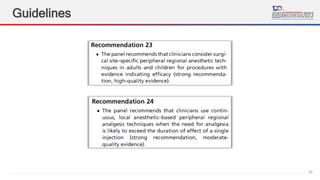
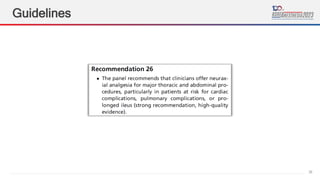
Guidelines
37
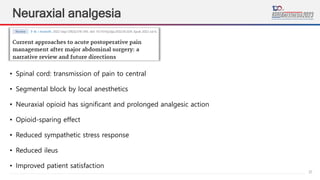
Neuraxial analgesia
• Spinal cord: transmission of pain to central
• Segmental block by local anesthetics
• Neuraxial opioid has significant and prolonged analgesic action
• Opioid-sparing effect
• Reduced sympathetic stress response
• Reduced ileus
• Improved patient satisfaction
38
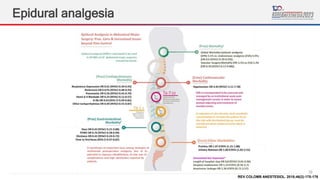
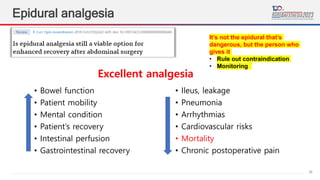
Epidural analgesia
• Bowel function
• Patient mobility
• Mental condition
• Patient’s recovery
• Intestinal perfusion
• Gastrointestinal recovery
• Ileus, leakage
• Pneumonia
• Arrhythmias
• Cardiovascular risks
• Mortality
• Chronic postoperative pain
Excellent analgesia
It’s not the epidural that’s
dangerous, but the person who
gives it
• Rule out contraindication
• Monitoring
39
Epidural analgesia
REV COLOMB ANESTESIOL. 2018;46(2):175-176
40
Diminishing role of epidural analgesia
• Prophylactic anticoagulant techniques  DVT reduce
• Epidural analgesia benefit reduced
• Obstacles for epidural catheter management
• Postoperative pulmonary complications
• Overall improvements in postoperative rehabilitation and physiotherapy routines
• Minimally invasive and endoscopic surgical techniques
• Day-case or overnight stay procedures
• High failure rates (30 to 50 %)
• Unaware of their failure rates because audits are not performed
• Intra and postoperative hypotension
EJA 2016
41
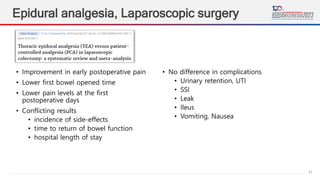
Epidural analgesia, Laparoscopic surgery
• Improvement in early postoperative pain
• Lower first bowel opened time
• Lower pain levels at the first
postoperative days
• Conflicting results
• incidence of side-effects
• time to return of bowel function
• hospital length of stay
• No difference in complications
• Urinary retention, UTI
• SSI
• Leak
• Ileus
• Vomiting, Nausea
42
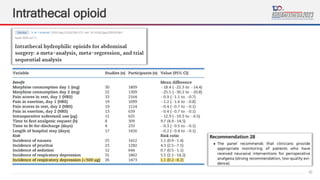
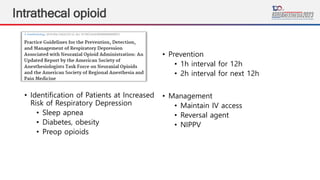
Intrathecal opioid
Intrathecal opioid
• Identification of Patients at Increased
Risk of Respiratory Depression
• Sleep apnea
• Diabetes, obesity
• Preop opioids
• Prevention
• 1h interval for 12h
• 2h interval for next 12h
• Management
• Maintain IV access
• Reversal agent
• NIPPV
44
Thank you !

2023 KoreAnesthesia_1109_refresh 2_Boohwi Hong_multimodal.pptx

  • 1.
    Perioperative multimodal analgesia 2023.11. 9 BoohwiHong, ChungnamNational University, Korea koho0127@gmail.com
  • 2.
    2 03. PROSPECT guidelines 02.Guidelines of APS, ASRA and ASA 04. Basic analgesics 05. Epidural analgesia, Intrathecal morphine 01. Introduction of multimodal analgesia Contents
  • 3.
    3 Multiple drug targetsalong the pain pathway N Engl J Med 2019
  • 4.
    4 Multimodal analgesia • Combinationsof different analgesics • Different drugs act at different areas • Intervening in all 3 areas more effective • Reducing nociceptive input • Drugs acting in the spinal cord • Drugs acting centrally
  • 5.
  • 6.
    6 Guidelines • No improvedanalgesia with basal infusion • Basal infusion is associated with respiratory depression and PONV
  • 7.
  • 8.
    8 Paracetamol • Acetaminophean, AAP •para-acetylaminophenol, para-acetylaminophenol • Analgesic & Antipyretic effects • No anti-inflammatory effect • Not completely understood mechanism • Centrally acting inhibitor of the prostaglandins via the COX pathway • 4.4 times receptor selectiveness to COX- 2 • 10~15 mg/kg • 1 g every 4–6 hours, with a maximum daily dose of 4 g • Elimination half-life: 2–3 h • Duration of analgesic effect: 4–6 h KJA 2015 Pain Medicine 2011
  • 9.
    9 Paracetamol • Perioperative period,convenient, fast-acting • IV Paracetamol Cmax 70% higher than Oral • High plasma concentration is achieved within 5~15 minutes • Rapidly crossed BBB, concentration-time curve of CSF & plasma are parallel • However, current evidence does not support the use of intravenous (IV) acetaminophen over oral (PO) acetaminophen universally. • Hepatotoxicity in high dose (> 4 g/day for adults over 50 kg). • Propacetamol • Poor water solubility, Powder • Injection pain • Pro 2g ≈ Para 1g • Similar Onset • Rapidly converted by plasma esterase KJA 2015 Pain Medicine 2011
  • 10.
  • 11.
  • 12.
    12 NSAIDs, Adverse effects BJAEducation 2023 • Gastrointestinal system  Bleeding, Perforation  Risk factor  >65 yr old  Previous hx. of ulceration  Concurrent use of aspirin  Corticosteroid, anticoagulant  High dose NSAIDs  Long duration NSAIDs therapy • Hematological system  Reversible platelet COX-1 inhibition, according to half life  Transfusion risk increased in pre-admission use • Renal function  Prostaglandin: Vasodilator, preserve GFR  Fluid shift, or blood loss: NSAIDs should be avoided Hypertension
  • 13.
    13 COX-2 selective inhibitor •GI ulcer, perforation, hemorrhage decreased • COX-1 activation = Platelet aggregation , Thrombosis, Cardiovascular event • 50% of maximum pain relief over 4 to 6 hours • 4.2 (200 mg), 2.6 (400 mg) • Rescue medication over 24h: 74%, 63% • Indirect comparison suggests that the 400 mg dose has similar efficacy to ibuprofen 400 mg.
  • 14.
    14 Ketorolac • First parenteralNon-selective NSAID • Half life 5.5 hr, Maximum effect onset within 1~2 hr • Duration 4~6 hr • Cost effective • 30 mg ≈ Propacetamol 2g ≈ Paracetamol 1g • Contraindicated as preemptive before major surgery • Prolonged PLT effects and increased risk of perioperative bleeding • -> near end of surgery after surgeon has achieved hemostasis Anesth Analg. 2012
  • 15.
    15 NSAIDs, Bleeding • 1987– 2019, 74 research, 151031 pt. • 12 type of NSAIDs (Ketorolac 41) • No difference in Hematoma, OR return, Transfusion • NSAIDs are unlikely to be the cause of postoperative bleeding complications.
  • 16.
    16 Ibuprofen • Pain andFever, Second IV NSAID • Ibuprofen inhibits COX-1 2.5 times more than COX-2 • 400 to 800 mg every 6 hours, Half life 2 hr • Dizziness, headache, Stomach ache, nausea, vomiting, flatulence, hemorrhage • Contraindication : Asthma, allergic reactions to aspirin and other NSAIDs and patients undergoing coronary artery interventions or coronary artery bypass surgery. • Like other NSAIDs, Cardiovascular thrombotic events, Gastrointestinal adverse events consisting of gastrointestinal bleeding and ulceration, Increase in liver enzyme, Onset or worsening of hypertension, Fluid retention serious skin adverse events. KJA 2015
  • 17.
  • 18.
    18 Paracetamol, Efficacy Cochrane Databaseof Systematic Reviews 2016 • Not clinical meaningful • 50% pain relief over 6 h • NNT 6 • Mean pain difference: 7 on the 100 mm VAS • Opioid consumption reduction • 26% during 0–4 hours • 16% during 0–6 hours
  • 19.
    19 Paracetamol + Ibuprofen •50% maximum pain relief over 6 hours • 69% (ibuprofen 200mg + paracetamol 500mg) • 73% (ibuprofen 400mg + paracetamol 1000mg) • NNT 1.6 and 1.5 • Rescue medication time 7.6 and 8.3 h • No serious adverse events • Paracetamol 1000 mg + Ibuprofen 300 mg
  • 20.
  • 21.
    21 Gabapentinoid • 281 trials(N = 24,682) • Pain score reduction -10,-9.-7 on 100 point scale (6,12,24 h) • Not clinically significant • No effect on the prevention of postoperative chronic pain • Sedation, dizziness, and visual disturbance • 2019, FDA warning • Respiratory risk factors.  Opioid pain medicine  CNS depressants  Reduced lung function (COPD)  Elderly pt.
  • 22.
    22 Ketamine • Painful surgery(Abdominal, Spine, Limb) • Opioid-dependent or opioid tolerant patients • Sleep apnea • Subanesthetic dose • Bolus < 0.35 mg/kg • Infusions < 1 mg/kg/hr • Adjunct to opioids and other analgesic • Contraindications Poorly controlled cardiovascular disease Pregnancy Active psychosis Liver cirrhosis Elevated intracranial or intraocular pressure • IV-PCA–delivered ketamine as the sole analgesic: limited evidence for the benefit • Addition of ketamine to an opioid based IV- PCA
  • 23.
    23 Lidocaine • Ideal bodyweight should be used for dose calculation. • Intravenous lidocaine should not be used inpatients weighing<40 kg. • For any patient, no more than 120 mg/h should be infused. • Intravenous lidocaine should not be used at the same time as, or within the period of action of other local anaesthetic interventions. • A loading dose of i.v. lidocaine of no more than 1.5 mg/kg, given as an infusion over 10 min is recommended. • After an initial loading dose, an infusion of i.v. lidocaine at 1.5 mg/kg/h is recommended, subject to review and re-assessment. • A suitable infusion device should be used. • The lidocaine infusion should be delivered through a separate, dedicated cannula. • The duration of infusion of i.v. lidocaine should not generally exceed 24 h. • Outside the operating theatre/recovery room, patients receiving i.v. lidocaine infusions should ideally be managed in a monitored bedspace such as a high dependency unit • Lipid emulsion 20% should be readily available wherever i.v. lidocaine is used, and staff should know where it is kept.
  • 24.
    Paracetamol NSAIDS orCOX-2 SI Steroid lidocaine 2023 Intra & postop (if no contra Ix.) Cox-2 SI, limited, safety concern Lack 2023 Pre, Intra, post op Pre, Intra, post op Limited (adjuvants) Limited 2023 With NSAIDs With paracetamol IV, single dose Grade A Grade A Grade A Lack (postop) Grade D Grade A Lack Limited Grade D Grade A Systemic, Grade A Grade D Grade D Grade B Insufficient Grade D Grade A Limited Recommended Recommended Recommended Not recommended Recommended Recommended IV, single dose Grade A Grade A Single IV low dose, Grade A Grade B Grade A,B Grade B Postop COX2I, Postop NSAIDs No benefit, but for PONV When epidural is not feasible Recommended Recommended Lack Lack Recommended Recommended For open surgery Grade D Grade D, NSAIDs (postop) Grade B Postop, Grade D Recommended Not recommended Grade D Grade A IV, Grade A Spray, Lack Grade A Grade A Grade A Recommended Recommended IV Dexa ≥10 mg Grade D Grade D Lack Lack
  • 25.
    Gabapentinoids Magnesium KetamineDexmedetomidine 2023 Inconsistent evidence Not administered basic Lack Not administered basic 2023 Questionable, Side effects Limited Intraop IV infusion 2023 Limited Limited Limited Risk of adverse effects Limited Grade A Limited Limited Conflicting Insufficient Risk of adverse effects Lack Basic not possible Not recommended Not recommended Not recommended Side effects AAP, NSAID are not possible Not recommended Not recommended Grade A Perineural adjuncts, Limited Perineural adjuncts, Limited Lack Limited Lack Limited Limited Lack Limited Not recommended Not recommended Lack Inconsistent Limited When postop high opioids Conflicting Inconsistent Inconsistent Limited Excluding cardiac problem pt.
  • 26.
    26 Dexmedetomidine • Reduced opioidconsumption by 30 % • Stronger than acetaminophen • No consensus optimal tim for administration • Adjunct for regional analgesia, faster onset, longer duration • not as effective as dexamethasone • Bradycardia, Hypotension
  • 27.
    27 Dexamethasone • 52 studies,5768 pt. • Pain scores ≤ 4 h, 4-24h • -0.54, -0.31 at rest ,-0.42,-0.26 at movement • Time to first analgesia 22.9 minutes increased • Opioid requirements -6.66 decreased
  • 28.
    28 PROSPECT • Primary outcome:Pain score • At least two RCTs • Is the recommended intervention clinically relevant? • Does it add to the ‘basic analgesic’ technique? • Does the balance between efficacy and adverse effects allow recommendation? • Does the balance between invasiveness of the analgesic intervention and degree of pain after surgery allow recommendation? • Are the reasons for not recommending an analgesic intervention appropriate?
  • 29.
    29 PROSPECT • Caesarean section,224 pt. • Minimal clinically important difference (MCID) • Patient acceptable symptom state (PASS) • ‘Think only about your pain you have felt over the past 24 hours. Compared with yesterday, is your pain’  15-point Likert scale • ‘In your opinion, have you made a good recovery from your operation?’  yes, no or unsure. • A change of 10 for the 100mm pain VAS would be the minimal clinically important difference, and the VAS of 33 or less signifies acceptable pain control after surgery.
  • 30.
  • 31.
    Regional analgesia techniqueInfiltration Epidural or Intrathecal opioids 2023 Parasternal block Surgical wound infiltration Inconsistent evidence, safety concerns 2023 Scalp block or incision-site infiltration 2023 Bilateral pudendal nerve block Perianal infiltration (Limited or lack) Limited If ITM not used, WI TAP QL etc. CSE (morphine), Grade A (ITM) Limited evidence of ESPB and TLIP block Postop Epidural analgesia, Limited(ITM) Ankle block first choice, wound infiltration Lack (Continuous WI) II/ IH nerve block, TAP block Local infiltration Paravertebral block (limited) Surgical wound instillation or infiltration Limited, risk of adverse effects TAP or OSTAP block Port site infiltration Inconsistent result of TAP block Limited Not recommended TAP block Not recommended (intraperitoneal) PVB, PECS block for major breast surgery Grade A for minor breast surgery Not recommended TAP block Recommended Thoracic epidural Subcostal TAP Limited Thoracic epidural, Limited ITM TAP block for laparo/robot Recommended for open Not recommended Continuous or Single ISB, Suprascapular(2nd) Subacromial/Intraarticular, Limited Lack (Cervical) TPVB prefered Recommended Peritonsillar, topical LA, Serious side effect Single fascia iliaca block Recommended ITM 0.1mg (Spinal an.) Single adductor canal block Periarticular infiltration ITM 0.1mg (Spinal an.) PVB, ESPB, SAPB Limited Noninferior of less invasive techniques
  • 32.
    32 Basic regional analgesictechniques • TAP block (subcostal, Lateral) • PECS block • Thoracic paravertebral block • Fascia iliaca block • Adductor canal block • Interscalene block • External oblique intercostal block • Serratus plane block • ESPB, Inter transverse process block • Catheterization • Femoral nerve block • Supraclavicular, Superior trunk block
  • 33.
  • 34.
  • 35.
  • 36.
  • 37.
    37 Neuraxial analgesia • Spinalcord: transmission of pain to central • Segmental block by local anesthetics • Neuraxial opioid has significant and prolonged analgesic action • Opioid-sparing effect • Reduced sympathetic stress response • Reduced ileus • Improved patient satisfaction
  • 38.
    38 Epidural analgesia • Bowelfunction • Patient mobility • Mental condition • Patient’s recovery • Intestinal perfusion • Gastrointestinal recovery • Ileus, leakage • Pneumonia • Arrhythmias • Cardiovascular risks • Mortality • Chronic postoperative pain Excellent analgesia It’s not the epidural that’s dangerous, but the person who gives it • Rule out contraindication • Monitoring
  • 39.
    39 Epidural analgesia REV COLOMBANESTESIOL. 2018;46(2):175-176
  • 40.
    40 Diminishing role ofepidural analgesia • Prophylactic anticoagulant techniques  DVT reduce • Epidural analgesia benefit reduced • Obstacles for epidural catheter management • Postoperative pulmonary complications • Overall improvements in postoperative rehabilitation and physiotherapy routines • Minimally invasive and endoscopic surgical techniques • Day-case or overnight stay procedures • High failure rates (30 to 50 %) • Unaware of their failure rates because audits are not performed • Intra and postoperative hypotension EJA 2016
  • 41.
    41 Epidural analgesia, Laparoscopicsurgery • Improvement in early postoperative pain • Lower first bowel opened time • Lower pain levels at the first postoperative days • Conflicting results • incidence of side-effects • time to return of bowel function • hospital length of stay • No difference in complications • Urinary retention, UTI • SSI • Leak • Ileus • Vomiting, Nausea
  • 42.
  • 43.
    Intrathecal opioid • Identificationof Patients at Increased Risk of Respiratory Depression • Sleep apnea • Diabetes, obesity • Preop opioids • Prevention • 1h interval for 12h • 2h interval for next 12h • Management • Maintain IV access • Reversal agent • NIPPV
  • 44.