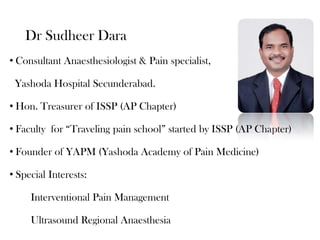
Dr Sudheer Dara
• Consultant Anaesthesiologist & Pain specialist,
Yashoda Hospital Secunderabad.
• Hon. Treasurer of ISSP (AP Chapter)
• Faculty for “Traveling pain school” started by ISSP (AP Chapter)
• Founder of YAPM (Yashoda Academy of Pain Medicine)
• Special Interests:

Interventional Pain Management
Ultrasound Regional Anaesthesia
Post operative pain & acute pain services

DR.SUDHEER DARA
ANAESTHESIOLOGIST
PAIN SPECIALIST
YASHODA HOSPITAL
SECUNDERABAD
Drugs

(oral & injectable)
Epidural analgesia
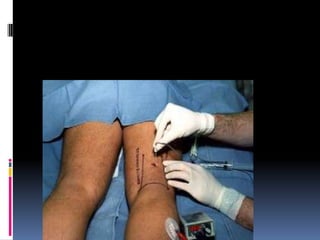
Periphral nerve blocks
Where are we ?
Questionnaire
1)The % of your patients comfortable in post
operative ward?
2)Are you satisfied with your post operative
rounds?
3)How frequently you use opioids in
postoperative period?
4) Do you have acute pain services?
Sub optimal analgesia
? lack of knowledge about drugs
?
? many myths associate with pain
? pain is not harmful to patient
? pain relief obscures signs of complications
?
? patient will become addicted to opioids
? risk of respiratory depression is high
? PRN: means
?
give as infrequently as possible’
Sources of postoperative pain
•Acute nociceptive pain from incision.

• Musculoskeletal pain from abnormal
body positioning and immobility during and
after surgery
• Neuropathic pain from excessive
stretching or direct trauma to peripheral
nerves
Postoperative pain is nociceptive
Perception

Modulation
Is responsive to NSAID’s,coxibs, paracetamol and
opiates

Transmission

Transduction
Reuben et al. J Bone Joint Surg. 2000;82:1754-1766.
Pain pathway and modulation1
Ascending nociceptive pathways
Interpretation in
cerebral cortex:
pain

Stimulation of nociceptors
(A and C fibers) /
Release of
neurotransmitters and
neuromodulators (i.e. PG)

Descending inhibitory controls /
Diffuse noxious inhibitory controls
Activation of serotoninergic
and noradrenergic pathways

Release of
serotonin, noradrenalin and
enkephalins at spinal level

Injury
1. Adapted from: Bonica JJ. Postoperative pain. In Bonica JJ, ed. The management of pain. Philadelphia: Lea
and Febiger;1990:461-80.
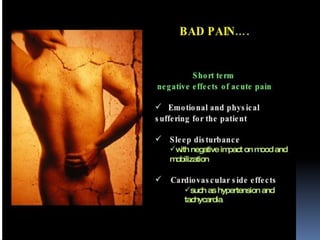
Post operative pain- effects
Adverse Effects of Poor Pain Control
“… it remains a common misconception
amongst clinicians that acute
postoperative pain is a transient condition
involving physiological nociceptive
stimulation, with a variable affective
component, that differs markedly in its
pathophysiological basis from chronic pain
syndromes.”
Cousins MJ, Power I, and Smith G.
Regional Analgesia and Pain Medicine, 25 (2000) 6-21
No one likes it
Consequences of Unrelieved Pain
Acute Pain
Increased
sympathetic
activity

GI effects

Splinting,
shallow
breathing

Increased
catabolic
demands

Anxiety
and fear

Peripheral/
central
sensitization

Myocardial
O2
consumption

GI motility

Atelectasis,
hypoxemia,
hypercarbia

Poor wound
healing/muscle
breakdown

Sleeplessness,
helplessness

Available
drugs

Myocardial
ischemia

Delayed
recovery

Pneumonia

Weakness
and impaired
rehabilitation

Psychological
Chronic
pain

Courtesy of Sunil J Panchal, MD
Pain is subjective
Pain is subjective
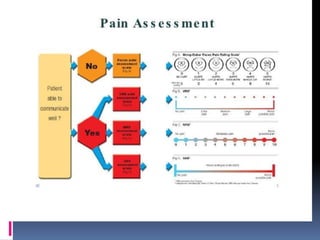
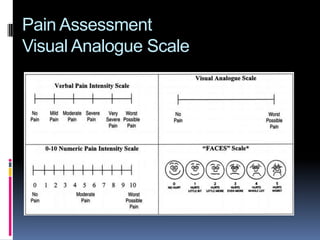
Pain Assessment
Visual Analogue Scale
Different modalities of pain
control






Drugs- oral,intramuscular,intravenous,rectal,
Epiduralanalgesia
Nerve blocks
Skin infiltration
Accessory methods: TENS, ACUPUNCTURE
COGNITVE THERAPIES
Modes of action of analgesics1,2,3,4
Paracetamol

Inhibition of central Cox-3 (?)
(Inhibition of PG synthesis)

Opioids

Activation of
opioid receptors
Paracetamol

Interaction with
serotoninergic descending
inhibitory pathway
NSAIDs / Coxibs

Inhibition of peripheral and
central Cox-1 / Cox-2
(Inhibition of PG synthesis)
1. D’Amours RH et al. JOSPT 1996;24(4):227-36.
2. Piguet V et al. Eur J Clin Pharmacol 1998;53:321-4.
3. Pini LA et al. JPET 1997;280(2):934-40.
4. Chandrasekharan NV et al. PNAS 2002;99(21):13926-31.
 How much we are successful?
Where is the problem?
First contact (PAC)
 Explaining about the nature of surgery
 Explaining about the expected amount of






pain
Explaining the self assessment of pain
Explaining about the management offered
Explaining about the reassessment
Clearing the faulty thoughts (spiritual)
Operation theatre
 Preemptive analgesia
 Pre incision infiltration

 Epidural analgesia (continous)
 Parentral medication continuing into post

operative period (dosing)
 Peripheral nerve blocks (technique ?)
 Neuropathic pain
 Patches ( fancy but questionable)
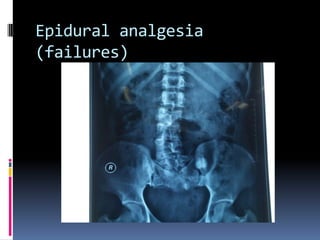
Epidural analgesia(failures)

 Technical difficulties
Epidural analgesia
(failures)
Epidural failures (guess?)
Epidural failures
 Loss of resistance
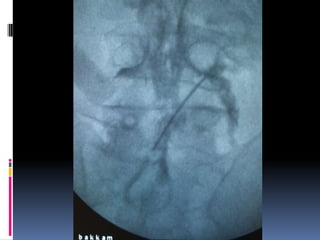
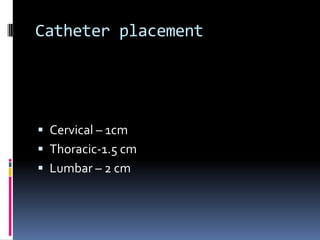
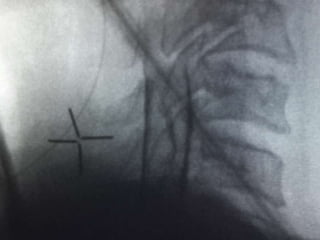
Catheter placement

 Cervical – 1cm
 Thoracic-1.5 cm
 Lumbar – 2 cm
 Dermatomal involvement

 Calculation
Drug concentration & dosages
(epidural)
 Bupivacaine hydrochloride ( 0.125% to 0.5%)
 Ropivacaine ( 0.2%)

Additives : fentanyl citrate, morphine,clonidine
Precise and strict monitoring
Bolus dosage:
Post operative room
Pain assessment:

rarely done
Pain Assessment
Visual Analogue Scale
Principles of assessment of
pain








At rest and on movement
Evaluate before and after therapy
Character of the pain
Severe the pain more the evaluation
Document the response and adverse effects
Attention towards those unable to express
Family members are involved
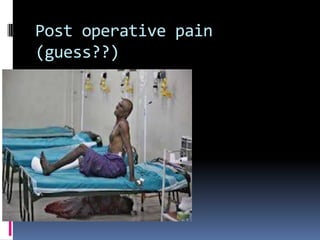
Post operative pain
(guess??)
 Isolated
Be compassionate
 Pp

Assurance

 Done by a nurse or the physician
 Explain the measures and administer
 Reassess the pain

 Multimodal approach
Treat according to the scale

 Upto 4/10 ---- NSAID AND PARACETOMOL
 4/10 and above ---- NSAID AND OPIOID
Epidural is not the sole
saviour

Combination therapy

WHO LADDER
Combination analgesia

 Epidural drug(opioid) + Nsaid
 Nsaid and paracetomol
 Nsaid and opioid
 Do not add opioid to opioid

 Paracetomol--- ?????( alone)
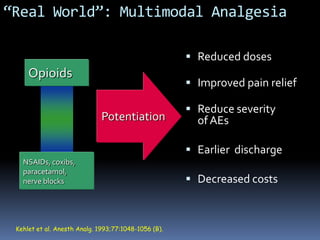
“Real World”: Multimodal Analgesia
 Reduced doses

Opioids

 Improved pain relief

Potentiation

 Reduce severity

of AEs

 Earlier discharge
NSAIDs, coxibs,
paracetamol,
nerve blocks

Kehlet et al. Anesth Analg. 1993;77:1048-1056 (B).

 Decreased costs
BJA 2002
Comparative effect of
paracetomol(pct),NSAID,or their
combination

Systematic review of literature in medline
1996 to 2001
Bja 2002
Major abdominal surgeries:
Nsaid are superior to pct
Gynaecological :
Nsaid superior to pct
ENT:
pct = Nsaid
Dental: Nsaid superior to pct
Result

Paracetomol is additive to
nsaids and opioids
Assessment of pain in
critically ill ( non verbal)

 Critical care pain observation tool (CPOT)
 Adult non verbal pain scale(NVPS)
 Faces legs activity cry consolibility

scale(FLACC)
Assessment
CPOT
. Facial description
. Body movements
.muscle tension
. Compliance with ventilator
.vocalization
Assessment
 NVPS
. Face
. Activity
. Guarding
. Physiology
. Respiration
Precise dosing and timing
PRN based monotherapy

 Analgesic gaps

 Break through pains
 Failure of NSAID and paracetomol

 Failure of epidural analgesia
Opioids!!!!!!!!!!!
Opioid !!!!
 Gold standard

 Needs understanding
 Side effects

 Antidote
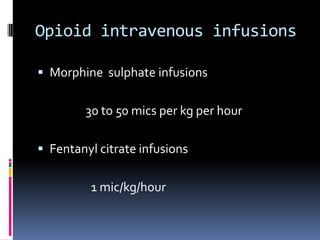
Opioid intravenous infusions
 Morphine sulphate infusions

30 to 50 mics per kg per hour
 Fentanyl citrate infusions

1 mic/kg/hour
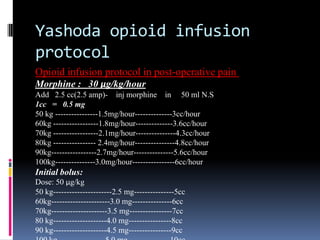
Yashoda opioid infusion
protocol
Opioid infusion protocol in post-operative pain
Morphine : 30 µg/kg/hour
Add 2.5 cc(2.5 amp)- inj morphine in 50 ml N.S
1cc = 0.5 mg
50 kg ----------------1.5mg/hour--------------3cc/hour
60kg -----------------1.8mg/hour--------------3.6cc/hour
70kg -----------------2.1mg/hour---------------4.3cc/hour
80kg ---------------- 2.4mg/hour---------------4.8cc/hour
90kg-----------------2.7mg/hour---------------5.6cc/hour
100kg---------------3.0mg/hour----------------6cc/hour

Initial bolus:
Dose: 50 µg/kg
50 kg----------------------2.5 mg---------------5cc
60kg----------------------3.0 mg---------------6cc
70kg---------------------3.5 mg----------------7cc
80 kg--------------------4.0 mg----------------8cc
90 kg--------------------4.5 mg----------------9cc
















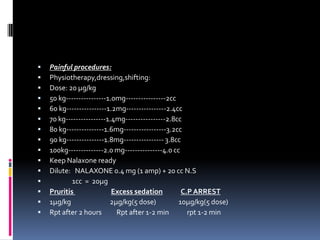
Painful procedures:
Physiotherapy,dressing,shifting:
Dose: 20 µg/kg
50 kg----------------1.0mg----------------2cc
60 kg----------------1.2mg----------------2.4cc
70 kg----------------1.4mg----------------2.8cc
80 kg---------------1.6mg-----------------3.2cc
90 kg---------------1.8mg---------------- 3.8cc
100kg--------------2.0 mg---------------4.0 cc
Keep Nalaxone ready
Dilute: NALAXONE 0.4 mg (1 amp) + 20 cc N.S
1cc = 20µg
Pruritis
Excess sedation
C.P ARREST
1µg/kg
2µg/kg(5 dose)
10µg/kg(5 dose)
Rpt after 2 hours
Rpt after 1-2 min
rpt 1-2 min
Transdermal patches??
 Buprigesic patches

 Fentanyl patches
Patches for acute pain????

 Delayed onset

 Respiratory complications
Transdermal fentanyl. A review of its pharmacological properties and therapeutic
efficacy in pain control.
Jeal W, Benfield P.
Source
Adis International Limited, Auckland, New Zealand. demail@adis.co.nz
Initially, much of the clinical experience with fentanyl TTS was obtained in
patients with acute postoperative pain. However, because of the increased risk
of respiratory complications, fentanyl TTS is contraindicated in this setting.

 The most serious adverse event was hypoventilation, which occurred more

frequently in postoperative (4%) than in cancer patients (2%).
Opioid adverse effects
Common
Uncommon
Constipation
Bad dreams / hallucination
Dry mouth
Dysphoria / delirium
Nausea / vomiting
Myoclonus / seizures
Sedation
Pruritus / urticaria
Sweats
Respiratory depression
Urinary retention
POST OP ANALGESIA????
 Opioid infusion

 Combination with others
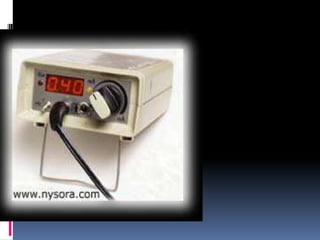
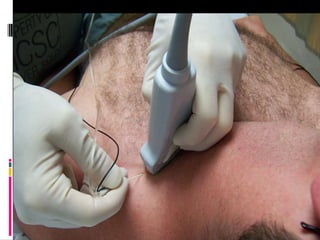
Peripheral nerve blocks
Anatomy
CONTINOUS CATHETER TECHNIQUE
patient-controlled analgesia (PCA)
negative feed back loop
microprocessor-controlled pump
basal (infusion) rate
incremental (bolus) dose
lockout interval
4-hour limit
monitoring: pain score, sedation score,
RR, other side effects
SO!!!!!

 WHAT’S THE SOLUTION
Acute pain services
The important components of APS are as
follows:
(a)
Multidisciplinary committee comprising
anesthetists, surgeons, nurses and
pharmacists, supported by the secretarial
staff. The committee should define the needs
and suggest the equipments and
infrastructure besides providing guidance to
develop and manage the APS.
(b)
Acute pain management protocols and
modalities of APS.
(c)
Regular pain assessment methods and
guidelines to control pain within a defined
time scale.
(d)
Continuous professional development and
teaching programs.
(e)
Regular meetings, cooperation and
networking amongst the members
Guidelines for optimising
POP management1,2,3,4,5,6


Adequate and thorough patient information2,3,4,5,6



Use of written protocols1,3,4,5,6



Regular assessment of pain intensity1,2,3,4,5,6



Adequate medical and nursing staff training1,3,4,5,6

Use of balanced analgesia, PCA, and epidural drug
administration1,2,3,4,5,6


1. The Royal College of Surgeons of England and the College of Anaesthetists. Commission on the provision
of surgical services, report of the working party on pain after surgery. London, UK, HMSO.1990.
2. Agency for Health Care Policy and Research, Public Health Service, US Department of Health and Human Services. Acute Pain Management in
Adults: Operative Procedures. Quick Reference Guide for Clinicians. AHCPR Pub. No. 92-0019. Rockville, MD.1992.
3. International Association for the Study of Pain, Management of acute pain: a practical guide. In: Ready LB, Edwards WT, eds. Seattle, 1992.
4. Wulf H et al. Die Behandlung akuter perioperativer und posttraumatischer Schmerzen Empfehlungen einer
interdisziplinaeren Expertenkommision. G. Thieme, Stuttgart, New York. 1997.
5. EuroPain. European Minimum Standards for the Management of Postoperative Pain.1998.
6. SFAR. Conférence de consensus. Prise en charge de la douleur postopératoire chez l’adulte et l’enfant.
Ann Fr Anesth Réanim 1998;17:445-61.
Thanks for your patient
hearing
DR.SUDHEER DARA
ANAESTHESIOLOGIST & PAIN SPECIALIST
YASHODA HOSPITAL
SECUNDERABAD

Dr. Sudheer Dhara

  • 1.
    Dr Sudheer Dara •Consultant Anaesthesiologist & Pain specialist, Yashoda Hospital Secunderabad. • Hon. Treasurer of ISSP (AP Chapter) • Faculty for “Traveling pain school” started by ISSP (AP Chapter) • Founder of YAPM (Yashoda Academy of Pain Medicine) • Special Interests: Interventional Pain Management Ultrasound Regional Anaesthesia
  • 2.
    Post operative pain& acute pain services DR.SUDHEER DARA ANAESTHESIOLOGIST PAIN SPECIALIST YASHODA HOSPITAL SECUNDERABAD
  • 3.
  • 4.
  • 5.
  • 6.
  • 7.
    Questionnaire 1)The % ofyour patients comfortable in post operative ward? 2)Are you satisfied with your post operative rounds? 3)How frequently you use opioids in postoperative period? 4) Do you have acute pain services?
  • 8.
    Sub optimal analgesia ?lack of knowledge about drugs ? ? many myths associate with pain ? pain is not harmful to patient ? pain relief obscures signs of complications ? ? patient will become addicted to opioids ? risk of respiratory depression is high ? PRN: means ? give as infrequently as possible’
  • 9.
    Sources of postoperativepain •Acute nociceptive pain from incision. • Musculoskeletal pain from abnormal body positioning and immobility during and after surgery • Neuropathic pain from excessive stretching or direct trauma to peripheral nerves
  • 10.
    Postoperative pain isnociceptive Perception Modulation Is responsive to NSAID’s,coxibs, paracetamol and opiates Transmission Transduction Reuben et al. J Bone Joint Surg. 2000;82:1754-1766.
  • 11.
    Pain pathway andmodulation1 Ascending nociceptive pathways Interpretation in cerebral cortex: pain Stimulation of nociceptors (A and C fibers) / Release of neurotransmitters and neuromodulators (i.e. PG) Descending inhibitory controls / Diffuse noxious inhibitory controls Activation of serotoninergic and noradrenergic pathways Release of serotonin, noradrenalin and enkephalins at spinal level Injury 1. Adapted from: Bonica JJ. Postoperative pain. In Bonica JJ, ed. The management of pain. Philadelphia: Lea and Febiger;1990:461-80.
  • 12.
  • 13.
    Adverse Effects ofPoor Pain Control “… it remains a common misconception amongst clinicians that acute postoperative pain is a transient condition involving physiological nociceptive stimulation, with a variable affective component, that differs markedly in its pathophysiological basis from chronic pain syndromes.” Cousins MJ, Power I, and Smith G. Regional Analgesia and Pain Medicine, 25 (2000) 6-21
  • 14.
  • 17.
    Consequences of UnrelievedPain Acute Pain Increased sympathetic activity GI effects Splinting, shallow breathing Increased catabolic demands Anxiety and fear Peripheral/ central sensitization Myocardial O2 consumption GI motility Atelectasis, hypoxemia, hypercarbia Poor wound healing/muscle breakdown Sleeplessness, helplessness Available drugs Myocardial ischemia Delayed recovery Pneumonia Weakness and impaired rehabilitation Psychological Chronic pain Courtesy of Sunil J Panchal, MD
  • 19.
  • 21.
  • 22.
    Different modalities ofpain control      Drugs- oral,intramuscular,intravenous,rectal, Epiduralanalgesia Nerve blocks Skin infiltration Accessory methods: TENS, ACUPUNCTURE COGNITVE THERAPIES
  • 23.
    Modes of actionof analgesics1,2,3,4 Paracetamol  Inhibition of central Cox-3 (?) (Inhibition of PG synthesis) Opioids  Activation of opioid receptors Paracetamol  Interaction with serotoninergic descending inhibitory pathway NSAIDs / Coxibs  Inhibition of peripheral and central Cox-1 / Cox-2 (Inhibition of PG synthesis) 1. D’Amours RH et al. JOSPT 1996;24(4):227-36. 2. Piguet V et al. Eur J Clin Pharmacol 1998;53:321-4. 3. Pini LA et al. JPET 1997;280(2):934-40. 4. Chandrasekharan NV et al. PNAS 2002;99(21):13926-31.
  • 24.
     How muchwe are successful?
  • 25.
    Where is theproblem?
  • 26.
    First contact (PAC) Explaining about the nature of surgery  Explaining about the expected amount of     pain Explaining the self assessment of pain Explaining about the management offered Explaining about the reassessment Clearing the faulty thoughts (spiritual)
  • 27.
    Operation theatre  Preemptiveanalgesia  Pre incision infiltration  Epidural analgesia (continous)  Parentral medication continuing into post operative period (dosing)  Peripheral nerve blocks (technique ?)  Neuropathic pain  Patches ( fancy but questionable)
  • 28.
  • 29.
  • 30.
  • 31.
  • 34.
    Catheter placement  Cervical– 1cm  Thoracic-1.5 cm  Lumbar – 2 cm
  • 35.
  • 37.
    Drug concentration &dosages (epidural)  Bupivacaine hydrochloride ( 0.125% to 0.5%)  Ropivacaine ( 0.2%) Additives : fentanyl citrate, morphine,clonidine Precise and strict monitoring Bolus dosage:
  • 38.
    Post operative room Painassessment: rarely done
  • 39.
  • 41.
    Principles of assessmentof pain        At rest and on movement Evaluate before and after therapy Character of the pain Severe the pain more the evaluation Document the response and adverse effects Attention towards those unable to express Family members are involved
  • 42.
  • 43.
  • 44.
  • 45.
    Assurance  Done bya nurse or the physician  Explain the measures and administer  Reassess the pain  Multimodal approach
  • 46.
    Treat according tothe scale  Upto 4/10 ---- NSAID AND PARACETOMOL  4/10 and above ---- NSAID AND OPIOID
  • 47.
    Epidural is notthe sole saviour Combination therapy WHO LADDER
  • 48.
    Combination analgesia  Epiduraldrug(opioid) + Nsaid  Nsaid and paracetomol  Nsaid and opioid  Do not add opioid to opioid  Paracetomol--- ?????( alone)
  • 49.
    “Real World”: MultimodalAnalgesia  Reduced doses Opioids  Improved pain relief Potentiation  Reduce severity of AEs  Earlier discharge NSAIDs, coxibs, paracetamol, nerve blocks Kehlet et al. Anesth Analg. 1993;77:1048-1056 (B).  Decreased costs
  • 50.
    BJA 2002 Comparative effectof paracetomol(pct),NSAID,or their combination Systematic review of literature in medline 1996 to 2001
  • 51.
    Bja 2002 Major abdominalsurgeries: Nsaid are superior to pct Gynaecological : Nsaid superior to pct ENT: pct = Nsaid Dental: Nsaid superior to pct
  • 52.
    Result Paracetomol is additiveto nsaids and opioids
  • 53.
    Assessment of painin critically ill ( non verbal)  Critical care pain observation tool (CPOT)  Adult non verbal pain scale(NVPS)  Faces legs activity cry consolibility scale(FLACC)
  • 55.
    Assessment CPOT . Facial description .Body movements .muscle tension . Compliance with ventilator .vocalization
  • 56.
    Assessment  NVPS . Face .Activity . Guarding . Physiology . Respiration
  • 57.
  • 59.
    PRN based monotherapy Analgesic gaps  Break through pains
  • 60.
     Failure ofNSAID and paracetomol  Failure of epidural analgesia
  • 61.
  • 62.
    Opioid !!!!  Goldstandard  Needs understanding  Side effects  Antidote
  • 63.
    Opioid intravenous infusions Morphine sulphate infusions 30 to 50 mics per kg per hour  Fentanyl citrate infusions 1 mic/kg/hour
  • 64.
    Yashoda opioid infusion protocol Opioidinfusion protocol in post-operative pain Morphine : 30 µg/kg/hour Add 2.5 cc(2.5 amp)- inj morphine in 50 ml N.S 1cc = 0.5 mg 50 kg ----------------1.5mg/hour--------------3cc/hour 60kg -----------------1.8mg/hour--------------3.6cc/hour 70kg -----------------2.1mg/hour---------------4.3cc/hour 80kg ---------------- 2.4mg/hour---------------4.8cc/hour 90kg-----------------2.7mg/hour---------------5.6cc/hour 100kg---------------3.0mg/hour----------------6cc/hour Initial bolus: Dose: 50 µg/kg 50 kg----------------------2.5 mg---------------5cc 60kg----------------------3.0 mg---------------6cc 70kg---------------------3.5 mg----------------7cc 80 kg--------------------4.0 mg----------------8cc 90 kg--------------------4.5 mg----------------9cc
  • 65.
                   Painful procedures: Physiotherapy,dressing,shifting: Dose: 20µg/kg 50 kg----------------1.0mg----------------2cc 60 kg----------------1.2mg----------------2.4cc 70 kg----------------1.4mg----------------2.8cc 80 kg---------------1.6mg-----------------3.2cc 90 kg---------------1.8mg---------------- 3.8cc 100kg--------------2.0 mg---------------4.0 cc Keep Nalaxone ready Dilute: NALAXONE 0.4 mg (1 amp) + 20 cc N.S 1cc = 20µg Pruritis Excess sedation C.P ARREST 1µg/kg 2µg/kg(5 dose) 10µg/kg(5 dose) Rpt after 2 hours Rpt after 1-2 min rpt 1-2 min
  • 66.
    Transdermal patches??  Buprigesicpatches  Fentanyl patches
  • 67.
    Patches for acutepain????  Delayed onset  Respiratory complications
  • 68.
    Transdermal fentanyl. Areview of its pharmacological properties and therapeutic efficacy in pain control. Jeal W, Benfield P. Source Adis International Limited, Auckland, New Zealand. demail@adis.co.nz
  • 69.
    Initially, much ofthe clinical experience with fentanyl TTS was obtained in patients with acute postoperative pain. However, because of the increased risk of respiratory complications, fentanyl TTS is contraindicated in this setting.  The most serious adverse event was hypoventilation, which occurred more frequently in postoperative (4%) than in cancer patients (2%).
  • 70.
    Opioid adverse effects Common Uncommon Constipation Baddreams / hallucination Dry mouth Dysphoria / delirium Nausea / vomiting Myoclonus / seizures Sedation Pruritus / urticaria Sweats Respiratory depression Urinary retention
  • 71.
  • 72.
     Opioid infusion Combination with others
  • 73.
  • 74.
  • 78.
  • 79.
    patient-controlled analgesia (PCA) negativefeed back loop microprocessor-controlled pump basal (infusion) rate incremental (bolus) dose lockout interval 4-hour limit monitoring: pain score, sedation score, RR, other side effects
  • 80.
  • 81.
  • 82.
    The important componentsof APS are as follows: (a) Multidisciplinary committee comprising anesthetists, surgeons, nurses and pharmacists, supported by the secretarial staff. The committee should define the needs and suggest the equipments and infrastructure besides providing guidance to develop and manage the APS. (b) Acute pain management protocols and modalities of APS. (c) Regular pain assessment methods and guidelines to control pain within a defined time scale. (d) Continuous professional development and teaching programs. (e) Regular meetings, cooperation and networking amongst the members
  • 83.
    Guidelines for optimising POPmanagement1,2,3,4,5,6  Adequate and thorough patient information2,3,4,5,6  Use of written protocols1,3,4,5,6  Regular assessment of pain intensity1,2,3,4,5,6  Adequate medical and nursing staff training1,3,4,5,6 Use of balanced analgesia, PCA, and epidural drug administration1,2,3,4,5,6  1. The Royal College of Surgeons of England and the College of Anaesthetists. Commission on the provision of surgical services, report of the working party on pain after surgery. London, UK, HMSO.1990. 2. Agency for Health Care Policy and Research, Public Health Service, US Department of Health and Human Services. Acute Pain Management in Adults: Operative Procedures. Quick Reference Guide for Clinicians. AHCPR Pub. No. 92-0019. Rockville, MD.1992. 3. International Association for the Study of Pain, Management of acute pain: a practical guide. In: Ready LB, Edwards WT, eds. Seattle, 1992. 4. Wulf H et al. Die Behandlung akuter perioperativer und posttraumatischer Schmerzen Empfehlungen einer interdisziplinaeren Expertenkommision. G. Thieme, Stuttgart, New York. 1997. 5. EuroPain. European Minimum Standards for the Management of Postoperative Pain.1998. 6. SFAR. Conférence de consensus. Prise en charge de la douleur postopératoire chez l’adulte et l’enfant. Ann Fr Anesth Réanim 1998;17:445-61.
  • 85.
    Thanks for yourpatient hearing DR.SUDHEER DARA ANAESTHESIOLOGIST & PAIN SPECIALIST YASHODA HOSPITAL SECUNDERABAD

Editor's Notes

  • #22 Be sure to ask about pre-existing pain scores (ie. Pre-hospital)
  • #40 Be sure to ask about pre-existing pain scores (ie. Pre-hospital)