Essential Interview SkillsEssential Interview Skills
Presented by Vinh Nguyen
Overview
Interview Definition
Interview Experiences
Preparing for Interviews
Dressing for Interviews
Arriving on time
Check the Competition
Types of Interviews
Behavioral Interview
Phone Interview
Other Interviews
Body Language
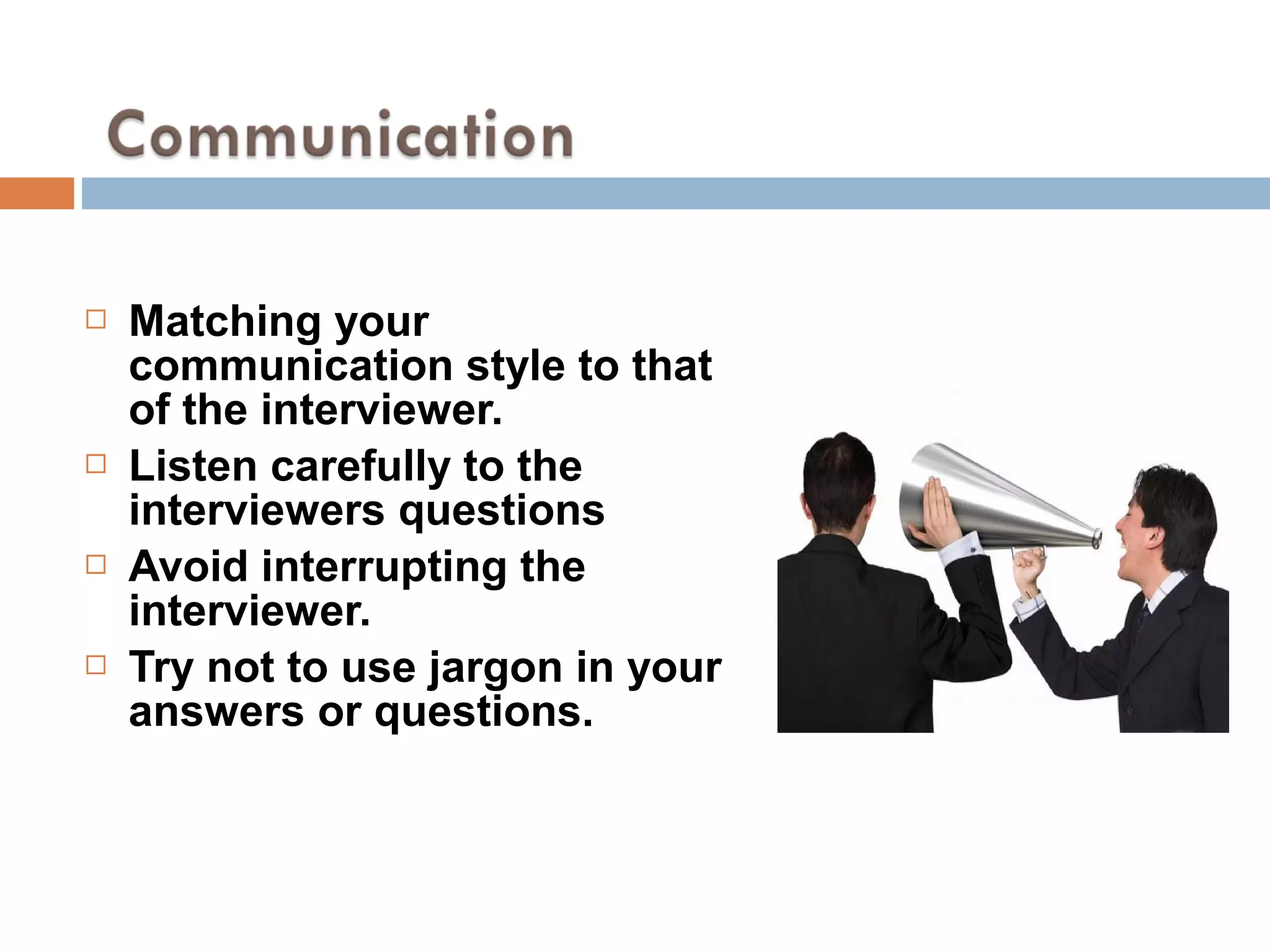
Communication
Dealing with Nerves
Closing the Interview
Common Questions
Interview Caveats
Lunch Break (30 mins)
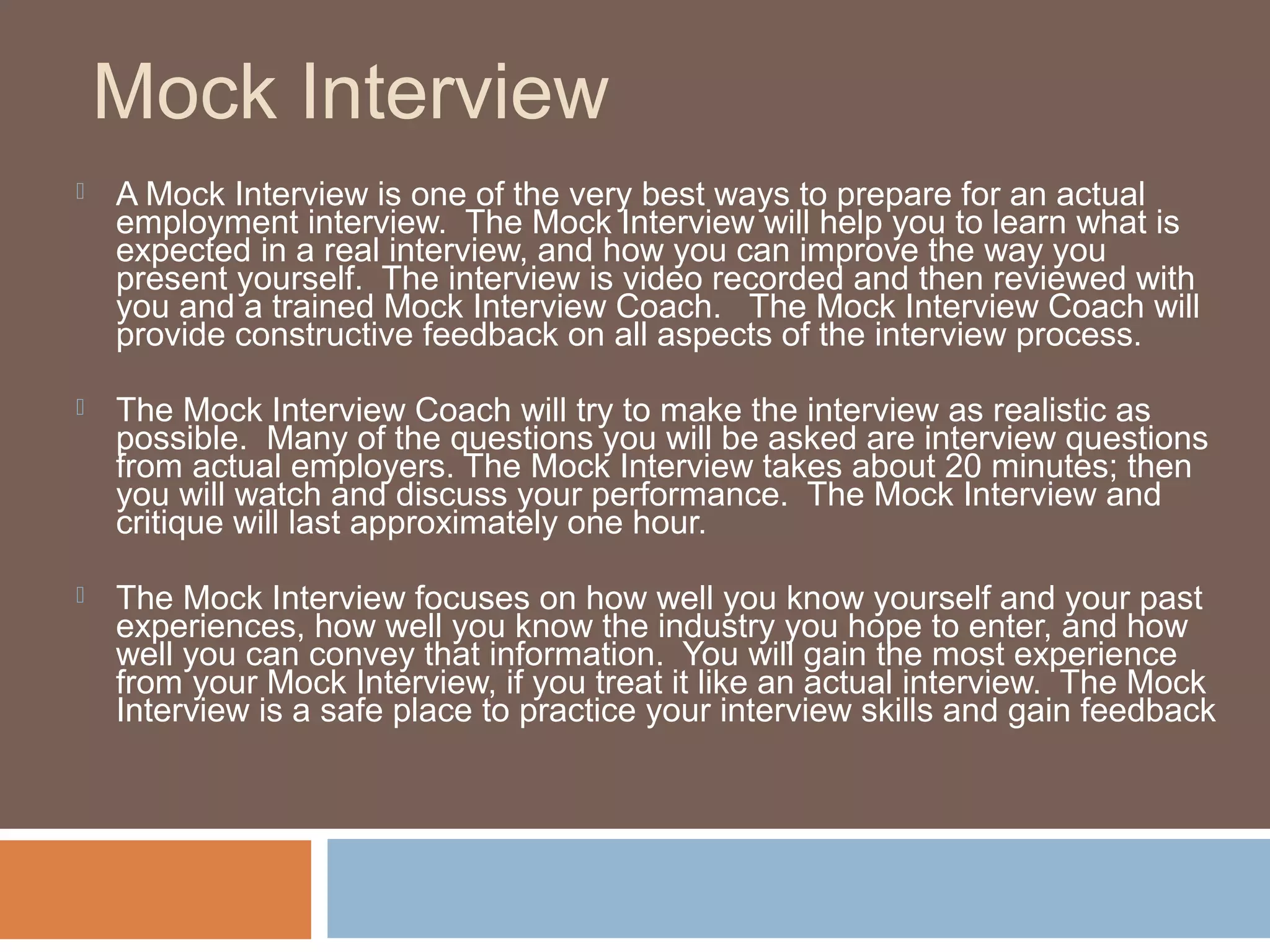
Mock Interview
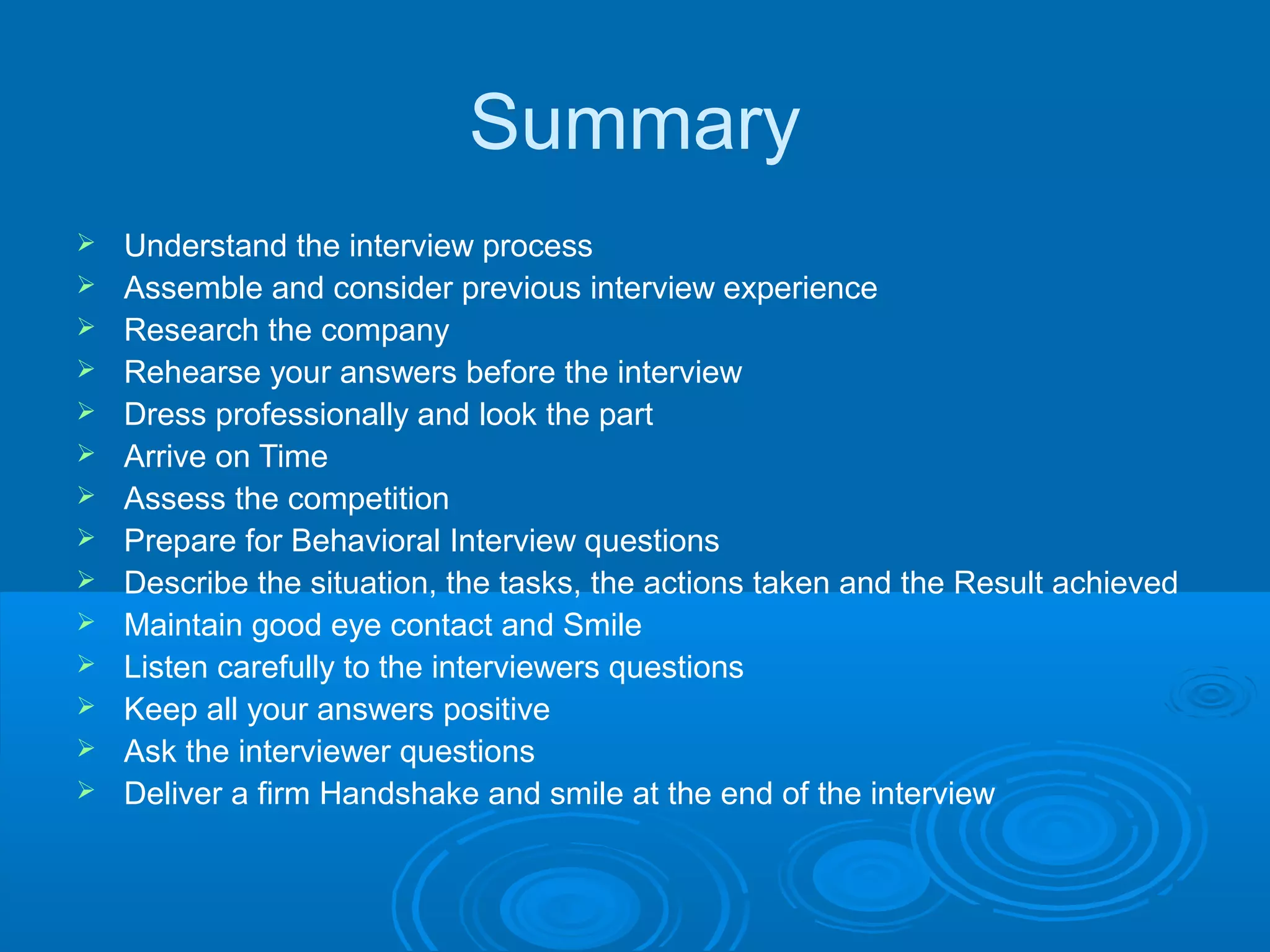
Summary
Conclusion
Interview Definition
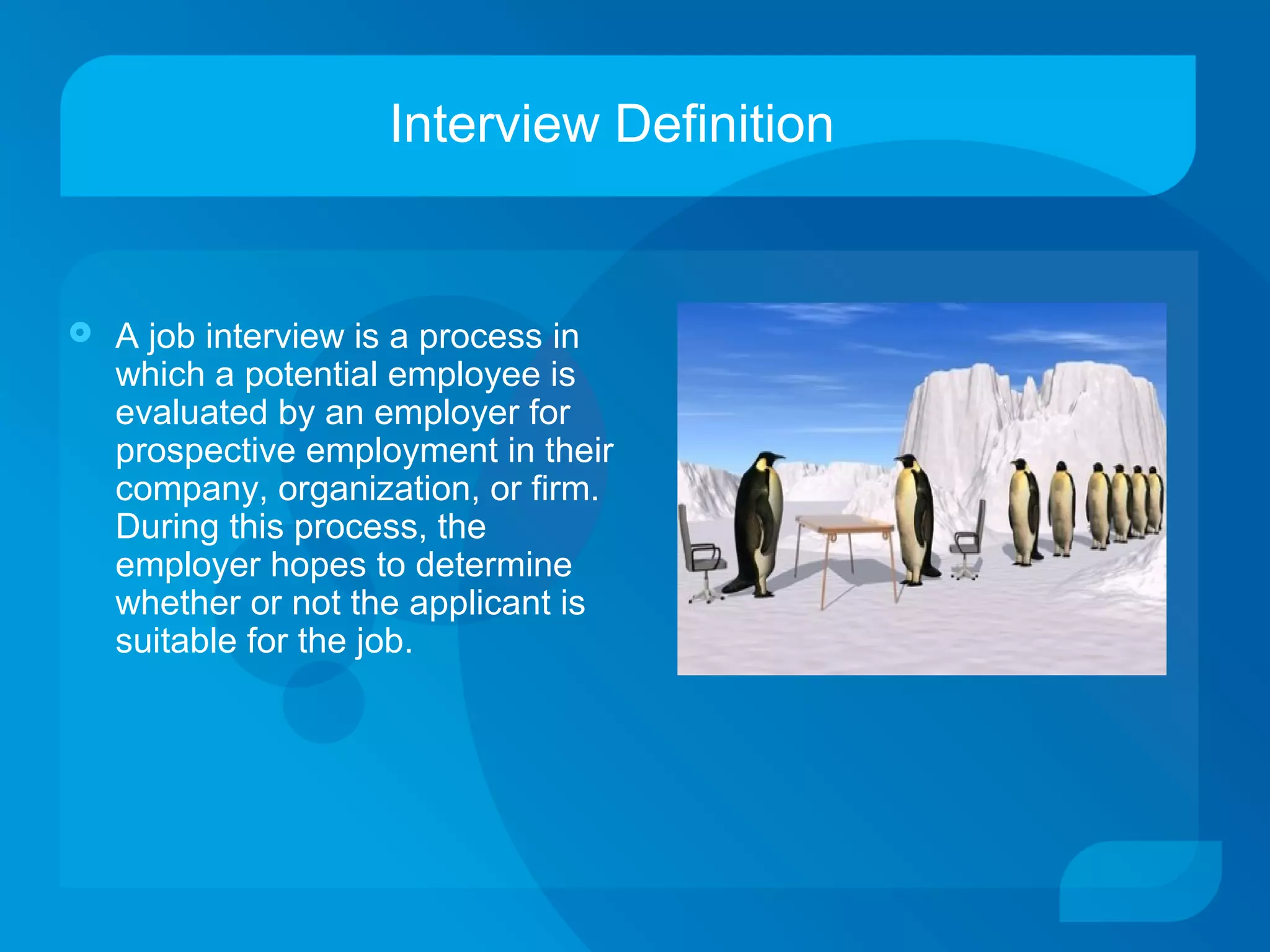
 A job interview is a process in
which a potential employee is
evaluated by an employer for
prospective employment in their
company, organization, or firm.
During this process, the
employer hopes to determine
whether or not the applicant is
suitable for the job.
Interview Experience
 Was it successful?
 How long did it go for?
 What impression did you make?
 What questions were asked?
 What were your answers?
 How did you think you went?
 Any areas for improvement?
Tell me about your previous Interviews
Preparing for Interviews
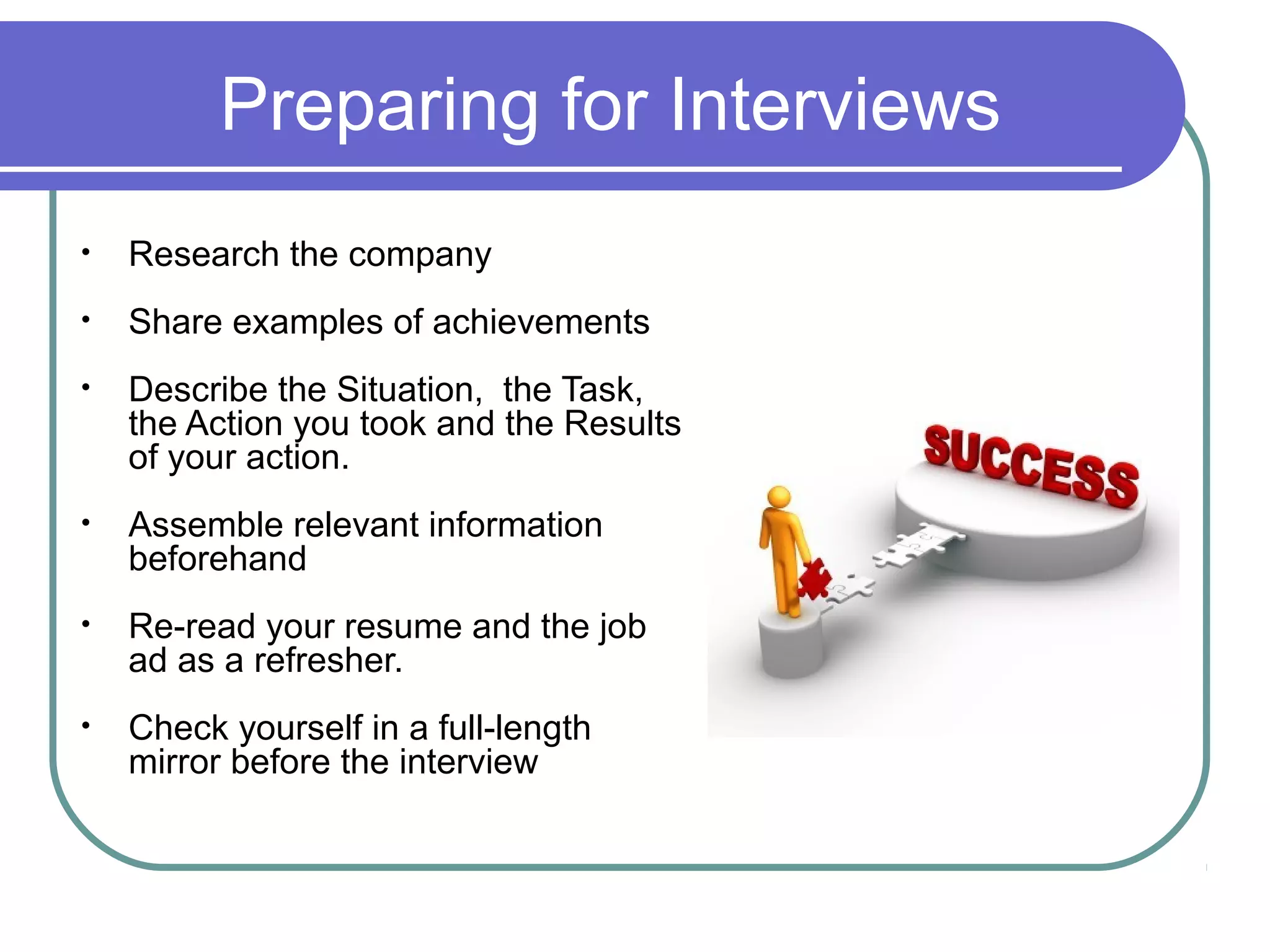
• Research the company
• Share examples of achievements
• Describe the Situation, the Task,
the Action you took and the Results
of your action.
• Assemble relevant information
beforehand
• Re-read your resume and the job
ad as a refresher.
• Check yourself in a full-length
mirror before the interview
Preparing for Interviews
Rehearsing for your InterviewRehearsing for your Interview
1.1. Rehearse your answers out loud before the interview to test howRehearse your answers out loud before the interview to test how
well prepared you arewell prepared you are
2.2. Identify any gaps in your delivery and answering techniquesIdentify any gaps in your delivery and answering techniques
3.3. Rehearse with a real person. Your rehearsal partner can provideRehearse with a real person. Your rehearsal partner can provide
you with feedback and constructive criticism which is vital toyou with feedback and constructive criticism which is vital to
improving your chances for successimproving your chances for success
4.4. Rehearsing will help you build your confidence and deliveryRehearsing will help you build your confidence and delivery
techniquetechnique
5.5. Rehearse multiple times until you feel your answers are flowing.Rehearse multiple times until you feel your answers are flowing.
Preparing for Interviews
Researching the CompanyResearching the Company
1.1. Research the company and speak about what you know aboutResearch the company and speak about what you know about
the company during interviewthe company during interview
2.2. Use the internet, catalogues, and other sources of informationUse the internet, catalogues, and other sources of information
to find out as much as possibleto find out as much as possible
3.3. Speak to people that works in the company to find more aboutSpeak to people that works in the company to find more about
out the culture and working environmentout the culture and working environment
4.4. Research the company (using published materials andResearch the company (using published materials and
contacts) so that you are able to ask "intelligent questions".contacts) so that you are able to ask "intelligent questions".
5.5. Reflect the image of someone working within the companyReflect the image of someone working within the company
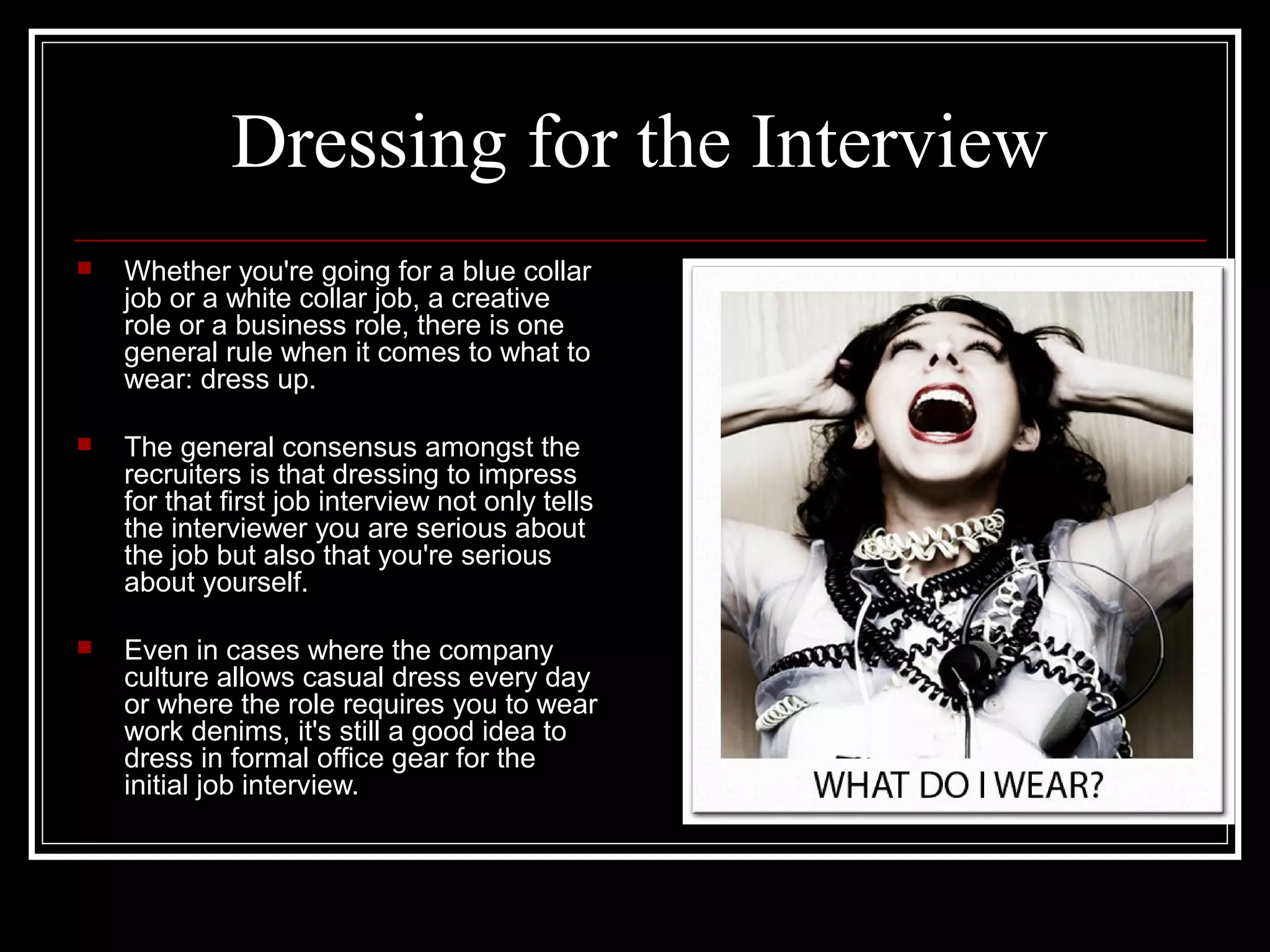
Dressing for the InterviewDressing for the Interview
 Whether you're going for a blue collarWhether you're going for a blue collar
job or a white collar job, a creativejob or a white collar job, a creative
role or a business role, there is onerole or a business role, there is one
general rule when it comes to what togeneral rule when it comes to what to
wear: dress up.wear: dress up.
 The general consensus amongst theThe general consensus amongst the
recruiters is that dressing to impressrecruiters is that dressing to impress
for that first job interview not only tellsfor that first job interview not only tells
the interviewer you are serious aboutthe interviewer you are serious about
the job but also that you're seriousthe job but also that you're serious
about yourself.about yourself.
 Even in cases where the companyEven in cases where the company
culture allows casual dress every dayculture allows casual dress every day
or where the role requires you to wearor where the role requires you to wear
work denims, it's still a good idea towork denims, it's still a good idea to
dress in formal office gear for thedress in formal office gear for the
initial job interview.initial job interview.
Dressing for the Interview
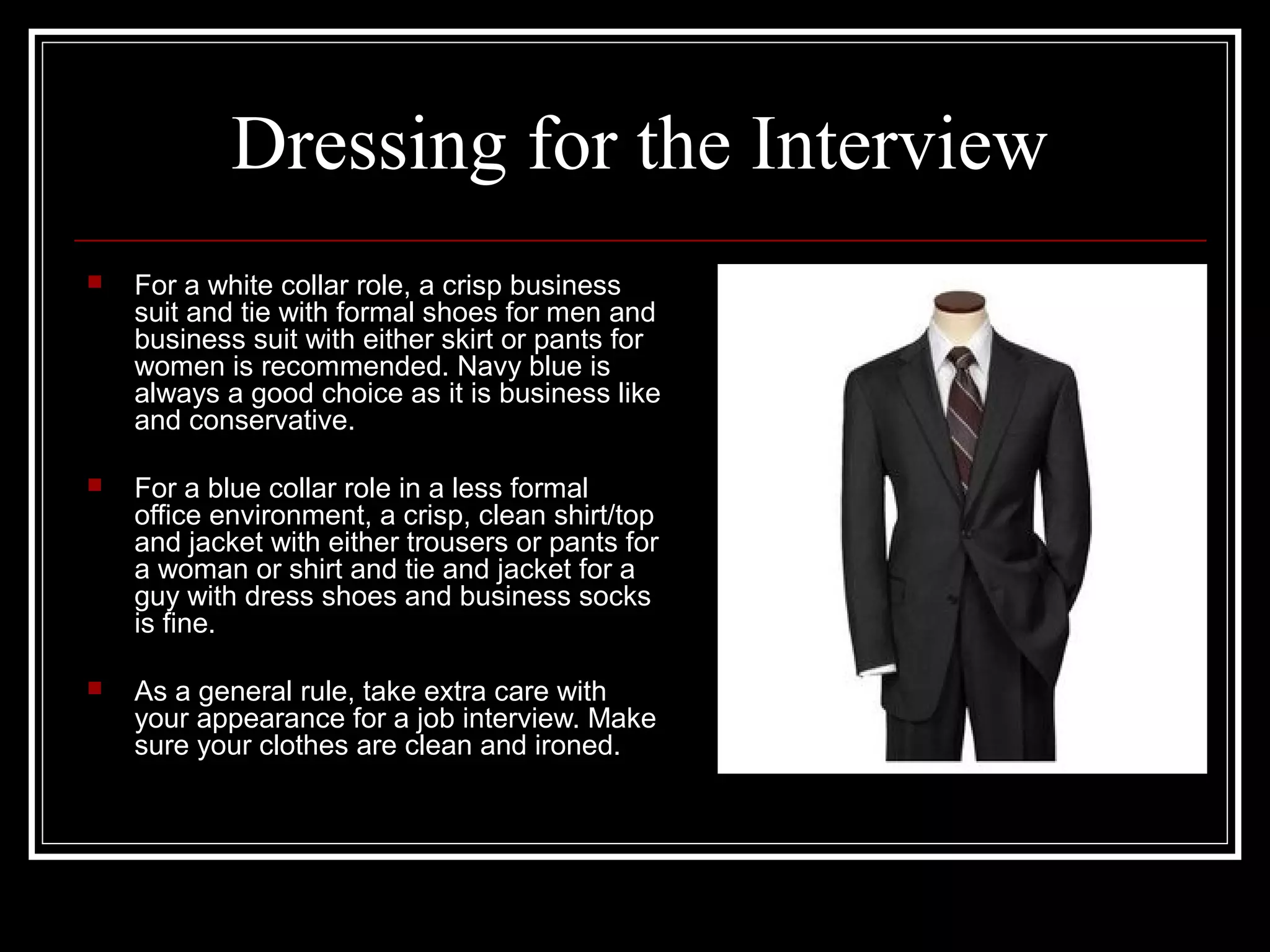
 For a white collar role, a crisp business
suit and tie with formal shoes for men and
business suit with either skirt or pants for
women is recommended. Navy blue is
always a good choice as it is business like
and conservative.
 For a blue collar role in a less formal
office environment, a crisp, clean shirt/top
and jacket with either trousers or pants for
a woman or shirt and tie and jacket for a
guy with dress shoes and business socks
is fine.
 As a general rule, take extra care with
your appearance for a job interview. Make
sure your clothes are clean and ironed.
Dressing for the Interview
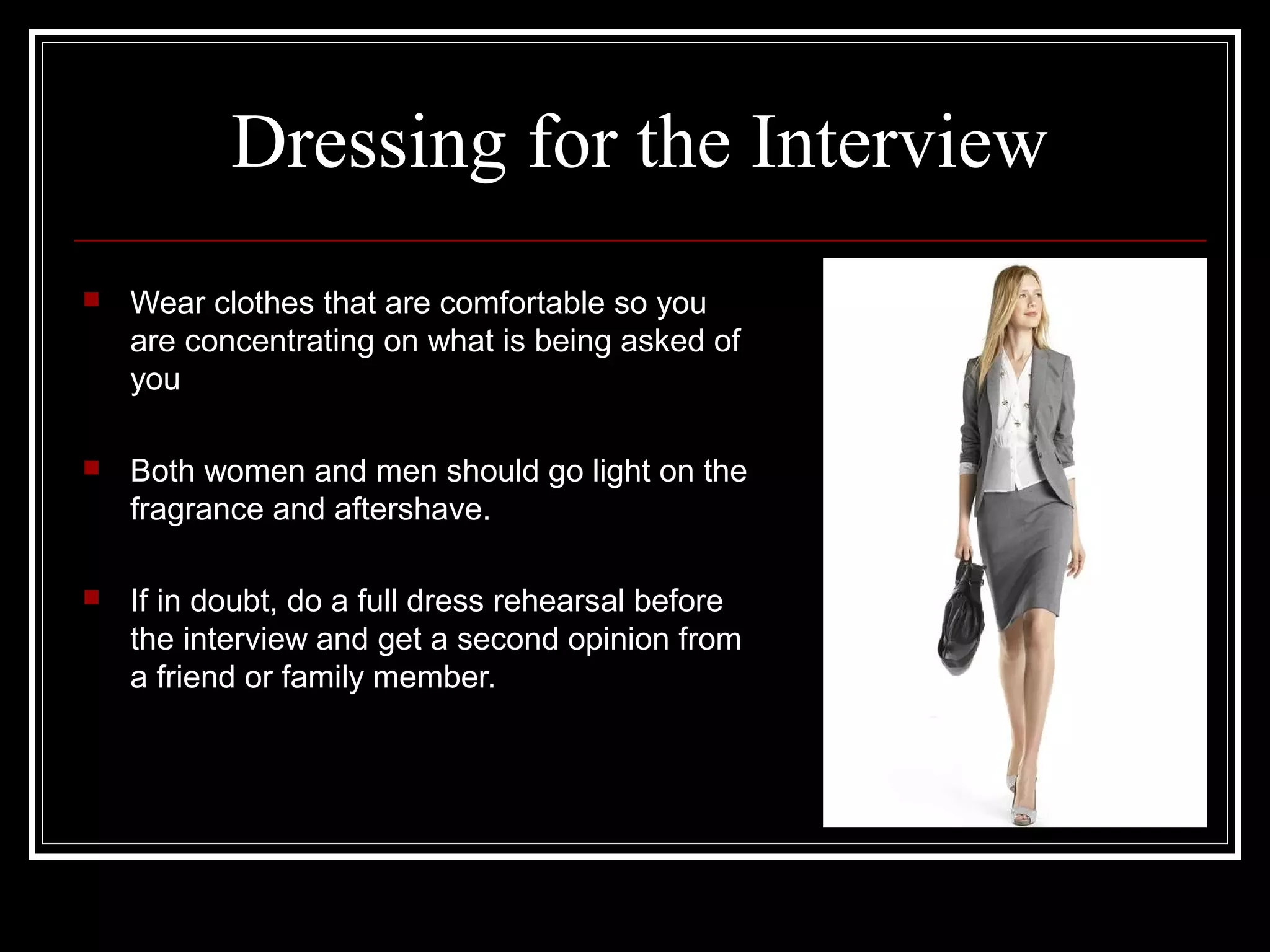
 Wear clothes that are comfortable so you
are concentrating on what is being asked of
you
 Both women and men should go light on the
fragrance and aftershave.
 If in doubt, do a full dress rehearsal before
the interview and get a second opinion from
a friend or family member.
Dressing for the Interview
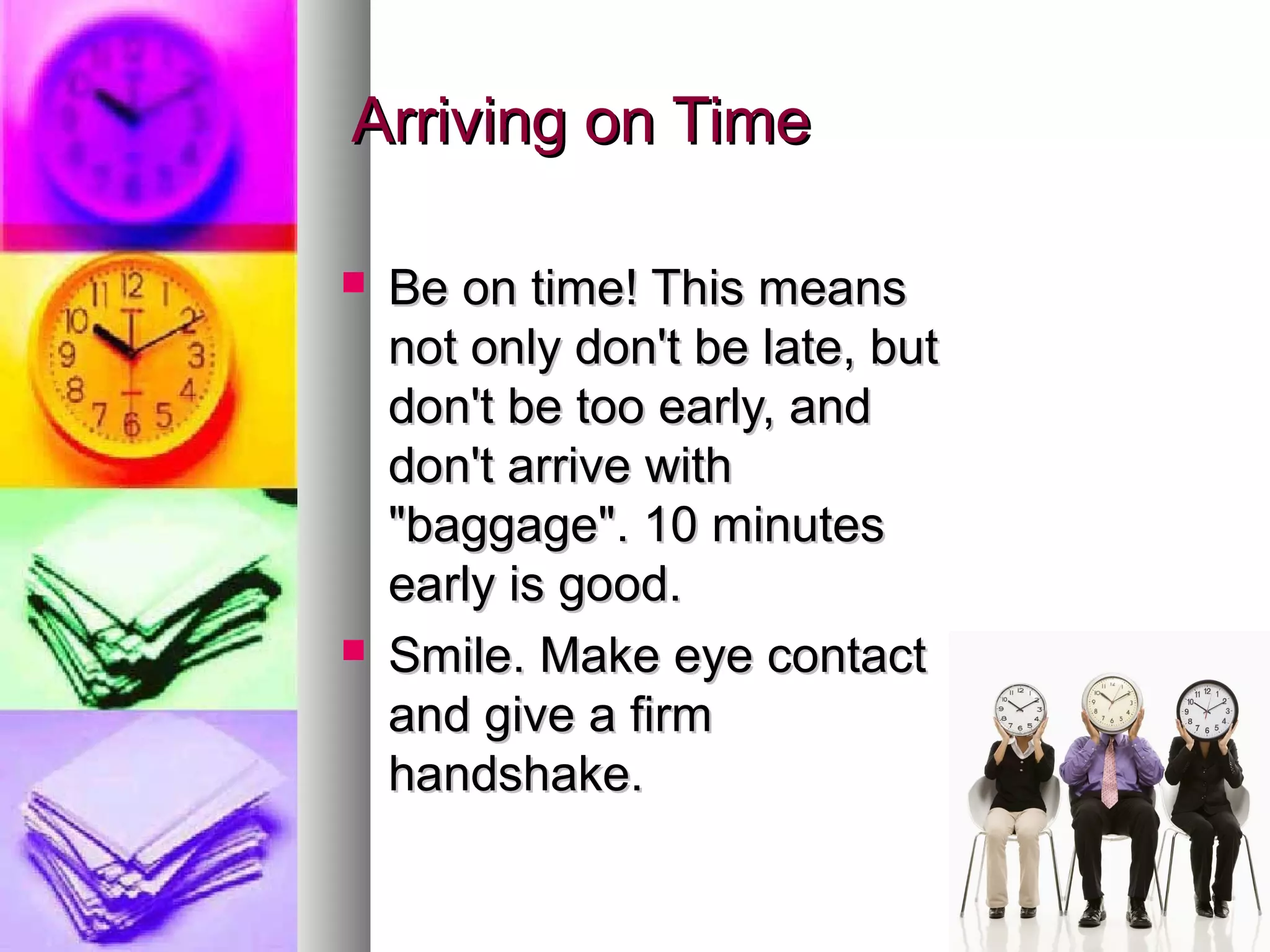
Arriving on TimeArriving on Time
 Be on time! This meansBe on time! This means
not only don't be late, butnot only don't be late, but
don't be too early, anddon't be too early, and
don't arrive withdon't arrive with
"baggage". 10 minutes"baggage". 10 minutes
early is good.early is good.
 Smile. Make eye contactSmile. Make eye contact
and give a firmand give a firm
handshake.handshake.
Check out the Competition
 Who is sitting next to you?
 How many people applying for the
position?
 How do you rate compared to
them?
 What are their qualifications and
experiences?
 Ask them if they know any other
company looking for people?
Types of Interviews
 Behavioral Interview
 Stress Interview
 Phone Interview
 Technical Interview
 Group interviews
 Panel Interview
 Role Plays
Behavioral Interview
 A common type of job interview in the modern
workplace is the behavioral interview or
behavioral event interview, also called a
competency-based interview. This type of
interview is based on the notion that a job
candidate's previous behaviors are the best
indicators of future performance. In behavioral
interviews, the interviewer asks candidates to
recall specific instances where they were faced
with a set of circumstances, and how they
reacted.
Behavioral Interview Questions
 Tell me about a project you worked on where the requirements
changed midstream. What did you do?"
 "Tell me about a time when you took the lead on a project. What
did you do?"
 "Describe the worst project you worked on."
 "Describe a time you had to work with someone you didn't like."
 "Tell me about a time when you had to stick by a decision you
had made, even though it made you very unpopular."
 "Give us an example of something particularly innovative that you
have done that made a difference in the workplace."
 "What happened the last time you were late with a project?"
 "Have you ever witnessed a person doing something that you felt
was against company policy. What did you do and why?"
Tell me about yourself
Phone Interviews
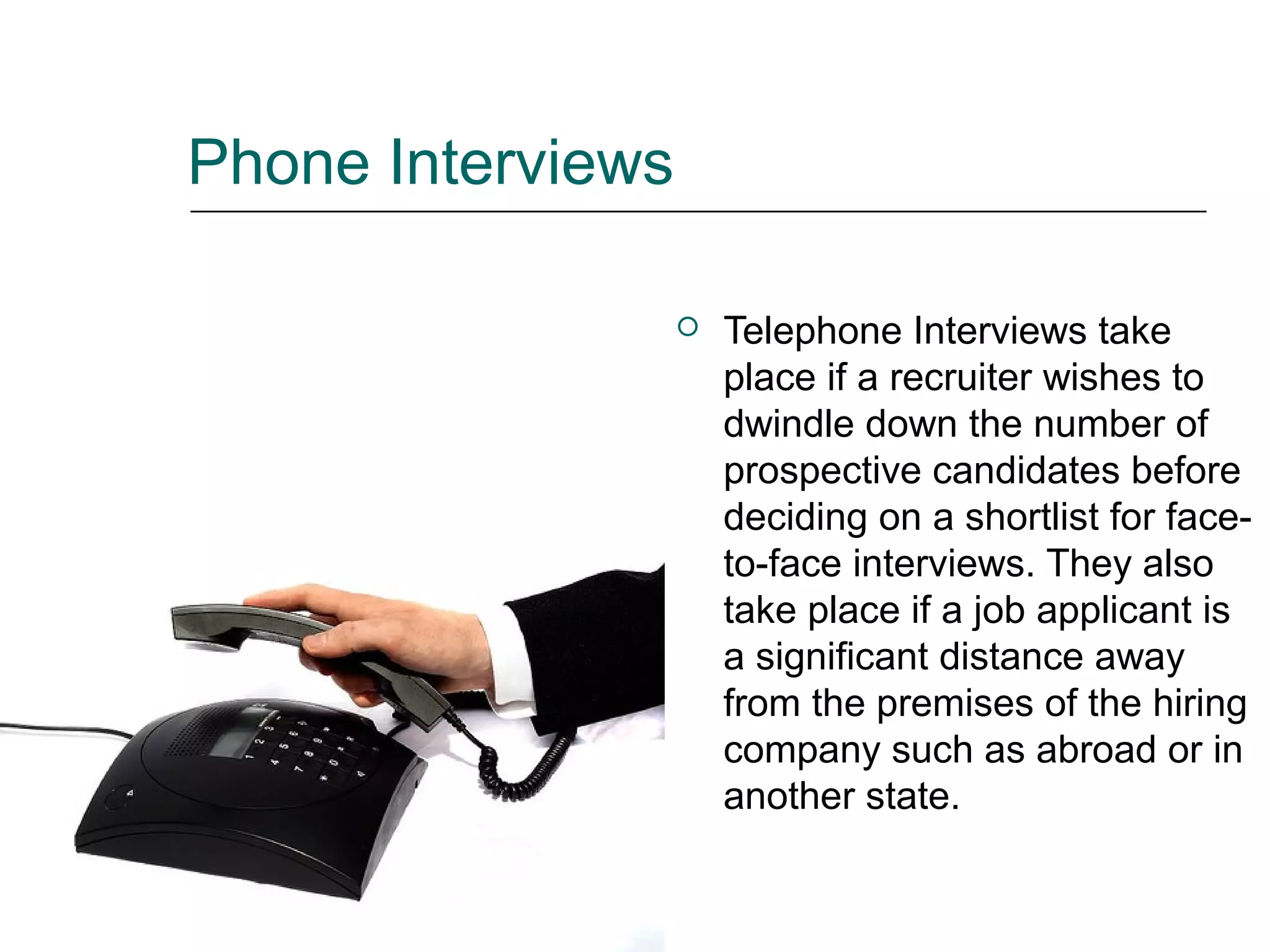
 Telephone Interviews take
place if a recruiter wishes to
dwindle down the number of
prospective candidates before
deciding on a shortlist for face-
to-face interviews. They also
take place if a job applicant is
a significant distance away
from the premises of the hiring
company such as abroad or in
another state.
Other Types of Interviews
 Stress Interview - Stress interviews are still in common
use. One type of stress interview is where the employer
uses a succession of interviewers (one at a time or en
masse) whose mission is to intimidate the candidate and
keep him/her off-balance. The ostensible purpose of this
interview: to find out how the candidate handles stress.
Stress interviews might involve testing an applicant's
behavior in a busy environment. Questions about
handling work overload, dealing with multiple projects,
and handling conflict are typical.
 Technical Interview - This kind of interview focuses on
problem solving and creativity. The questions aim at your
problem-solving skills and likely show your ability and
creativity. Sometimes these interviews will be on a
computer module with multiple-choice questions.
Body Language
Body Language
 Body language is a form of non-verbal
communication, consisting of body pose,
gestures, and eye movements. Humans send
and interpret such signals subconsciously.
 Some research has stated that human
communication consists of 93% body language
and paralinguistic cues, while only 7% of
communication consists of words themselves -
however, other research assert that between 60
and 70 percent of all meaning is derived from
nonverbal behavior.
 Body language may provide cues as to the
attitude or state of mind of a person. For
example, it may indicate aggression,
attentiveness, boredom, relaxed state, pleasure,
amusement, besides many other cues.
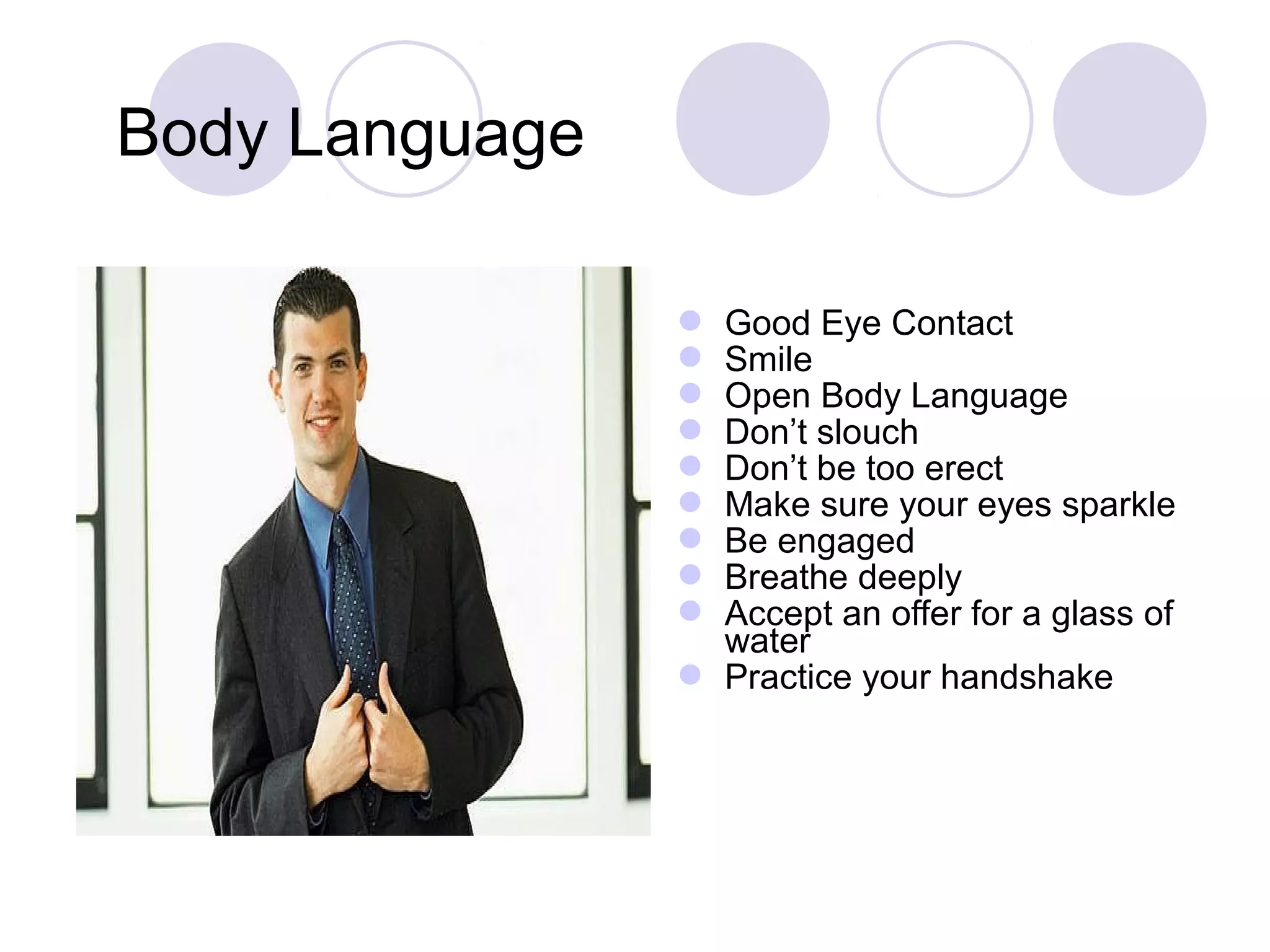
 Good Eye Contact
 Smile
 Open Body Language
 Don’t slouch
 Don’t be too erect
 Make sure your eyes sparkle
 Be engaged
 Breathe deeply
 Accept an offer for a glass of
water
 Practice your handshake
Body Language
Body Language
 Matching your
communication style to that
of the interviewer.
 Listen carefully to the
interviewers questions
 Avoid interrupting the
interviewer.
 Try not to use jargon in your
answers or questions.
 A good handshake
 Pronounce the interviewer's name PROPERLY.
 Get the interviewer to do a lot of the talking.
 Maintain Good eye contact with your interviewer.
 Smile. Look as if you are enjoying the conversation.
 Have a Confident posture.
 Mirror your interviewer's body language.
 Keep all your answers positive.
 Show ENTHUSIASM.
 LISTEN carefully to the interviewer's question.
 Ask the interviewer questions when the opportunity arises
Interview Communication skills
Dealing with Nerves
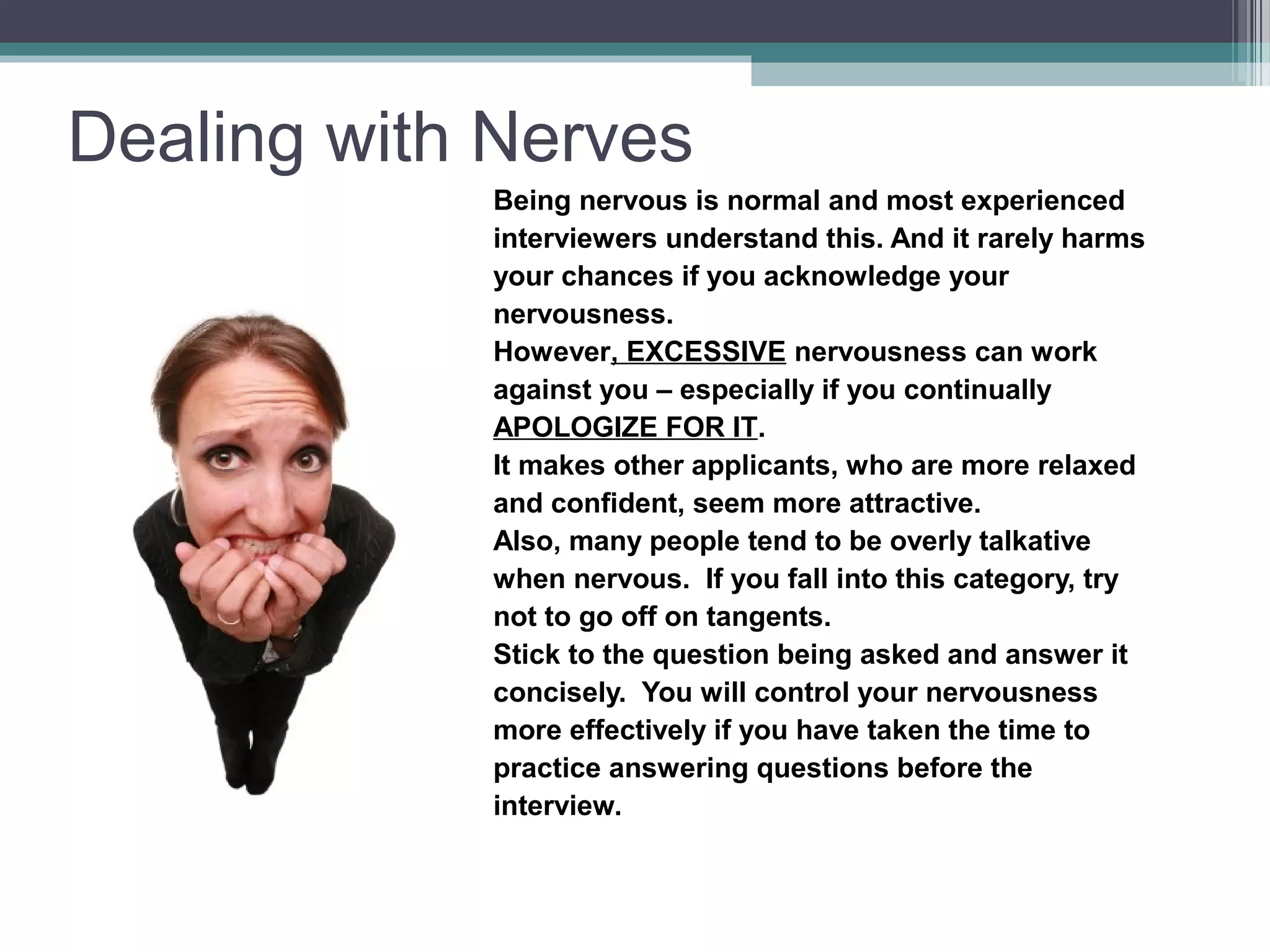
Being nervous is normal and most experienced
interviewers understand this. And it rarely harms
your chances if you acknowledge your
nervousness.
However, EXCESSIVE nervousness can work
against you – especially if you continually
APOLOGIZE FOR IT.
It makes other applicants, who are more relaxed
and confident, seem more attractive.
Also, many people tend to be overly talkative
when nervous. If you fall into this category, try
not to go off on tangents.
Stick to the question being asked and answer it
concisely. You will control your nervousness
more effectively if you have taken the time to
practice answering questions before the
interview.
Closing the Interview
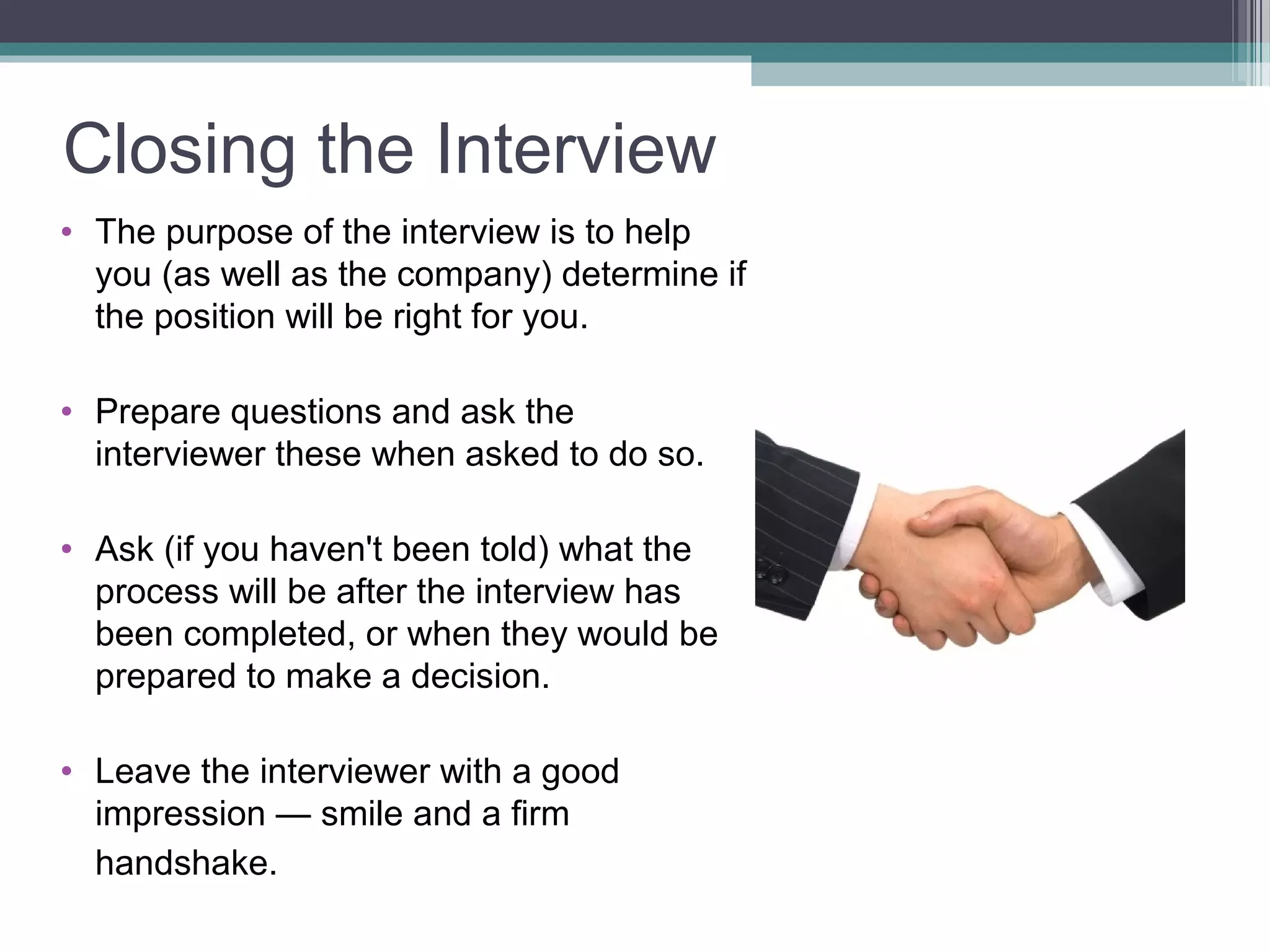
• The purpose of the interview is to help
you (as well as the company) determine if
the position will be right for you.
• Prepare questions and ask the
interviewer these when asked to do so.
• Ask (if you haven't been told) what the
process will be after the interview has
been completed, or when they would be
prepared to make a decision.
• Leave the interviewer with a good
impression — smile and a firm
handshake.
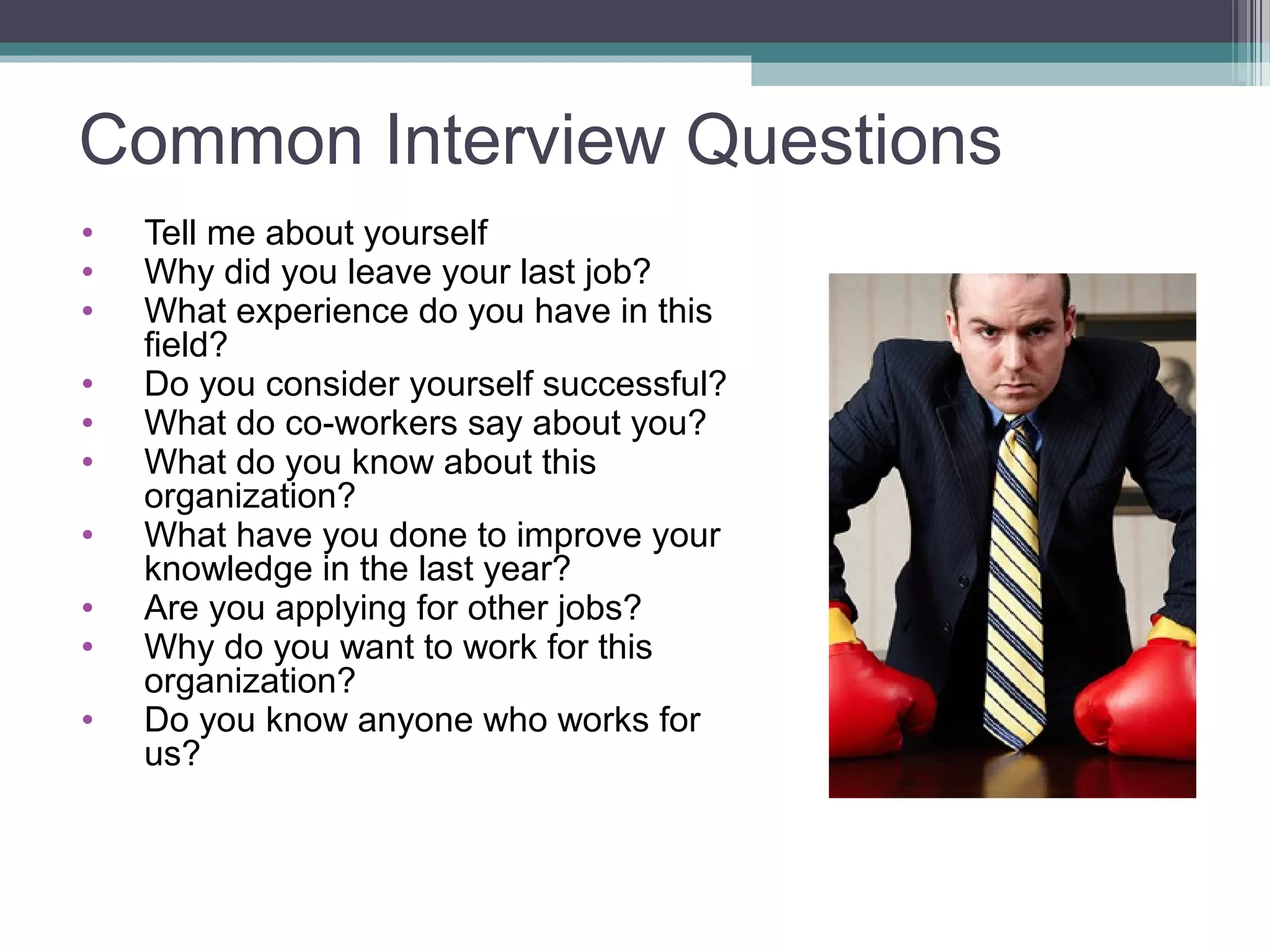
Common Interview Questions
• Tell me about yourself
• Why did you leave your last job?
• What experience do you have in this
field?
• Do you consider yourself successful?
• What do co-workers say about you?
• What do you know about this
organization?
• What have you done to improve your
knowledge in the last year?
• Are you applying for other jobs?
• Why do you want to work for this
organization?
• Do you know anyone who works for
us?
Interview Caveats
• Being too friendly.
• Not listening to questions carefully.
• Saying "we" instead of referring to your own achievements.
• Making very general statements which lack substance.
• Being over enthusiastic.
• Being poorly prepared.
• Slouching, mumbling, speaking slowly.
• Knowing nothing about the company to whom you are talking.
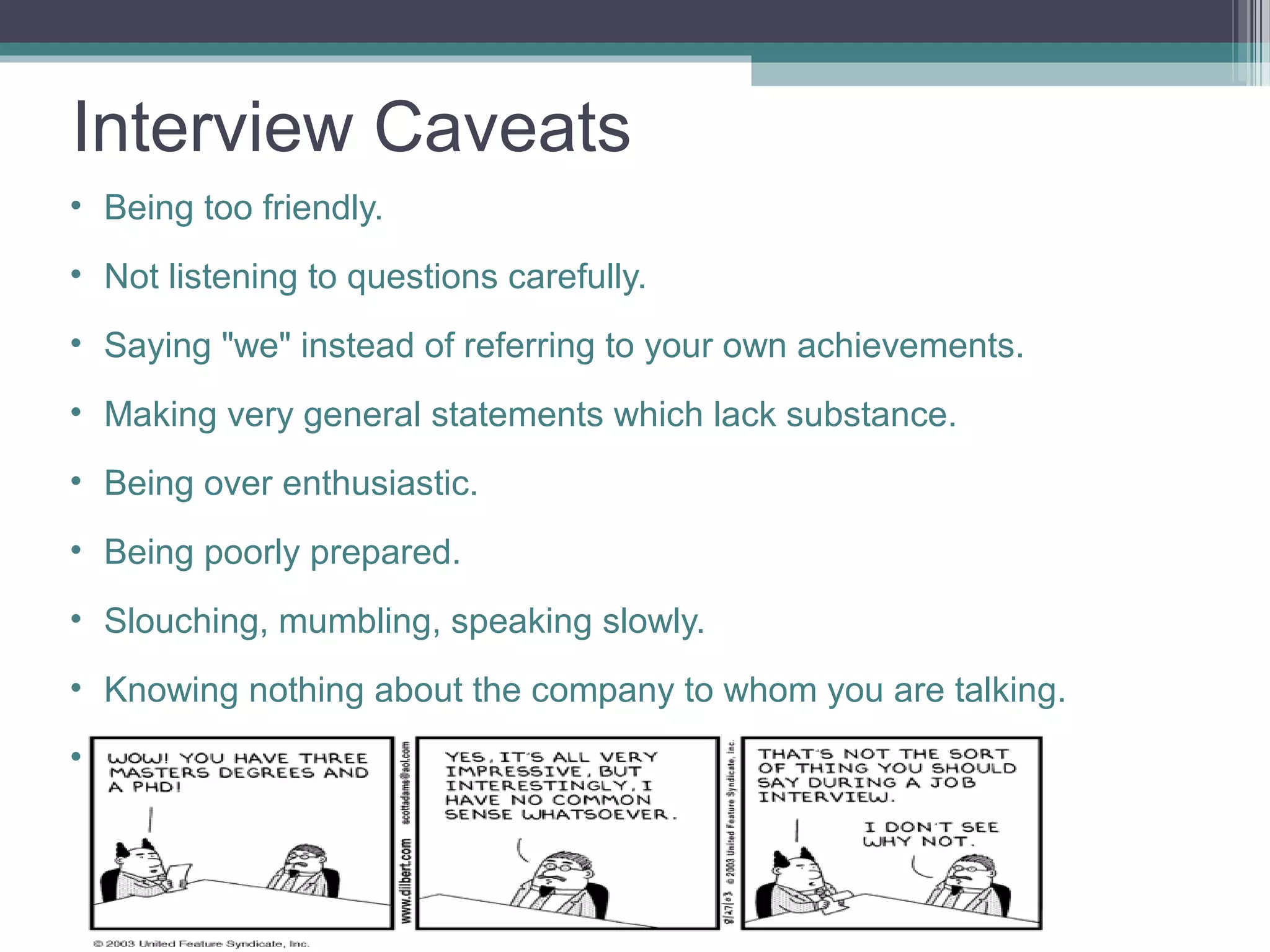
• Making derogatory remarks about your previous employers
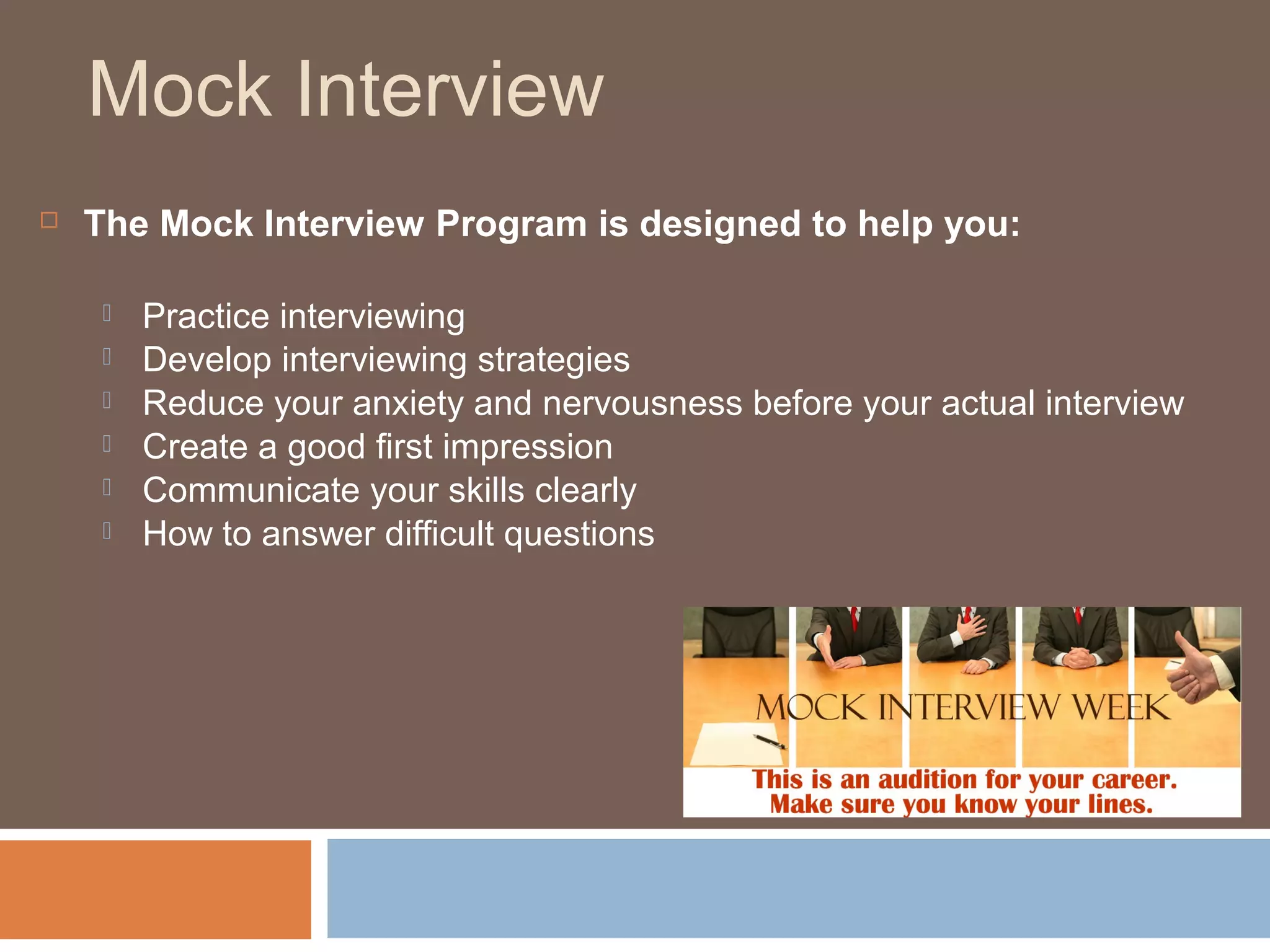
Mock Interview
 The Mock Interview Program is designed to help you:
 Practice interviewing
 Develop interviewing strategies
 Reduce your anxiety and nervousness before your actual interview
 Create a good first impression
 Communicate your skills clearly
 How to answer difficult questions
Mock Interview
 A Mock Interview is one of the very best ways to prepare for an actual
employment interview. The Mock Interview will help you to learn what is
expected in a real interview, and how you can improve the way you
present yourself. The interview is video recorded and then reviewed with
you and a trained Mock Interview Coach. The Mock Interview Coach will
provide constructive feedback on all aspects of the interview process.
 The Mock Interview Coach will try to make the interview as realistic as
possible. Many of the questions you will be asked are interview questions
from actual employers. The Mock Interview takes about 20 minutes; then
you will watch and discuss your performance. The Mock Interview and
critique will last approximately one hour.
 The Mock Interview focuses on how well you know yourself and your past
experiences, how well you know the industry you hope to enter, and how
well you can convey that information. You will gain the most experience
from your Mock Interview, if you treat it like an actual interview. The Mock
Interview is a safe place to practice your interview skills and gain feedback
Summary
 Understand the interview process
 Assemble and consider previous interview experience
 Research the company
 Rehearse your answers before the interview
 Dress professionally and look the part
 Arrive on Time
 Assess the competition
 Prepare for Behavioral Interview questions
 Describe the situation, the tasks, the actions taken and the Result achieved
 Maintain good eye contact and Smile
 Listen carefully to the interviewers questions
 Keep all your answers positive
 Ask the interviewer questions
 Deliver a firm Handshake and smile at the end of the interview
Conclusion - Final Tips
• Know the company: You should be pretty well acquainted with the
company and the type of work they do. You will need to do your
homework and know something of their corporate culture, internal
systems, business history, annual reports, mission statement etc.
You can do this using several resources including company
brochures, pamphlets, annual reports, newsletters and the company
Web site.
• Confirm important details: Confirm times and arrive at least fifteen
minutes early to create a good first impression, travel to the
interview location a day before using the same method of transport
to ensure you will be on time and memorize the name of the
interviewer.
• Switch off your mobile: make sure it is switched off during the
interview to avoid distractions.
• No wet fish handshakes: Shake hands warmly with a firm grip.
Handshakes have a far deeper significance than most people give
credit for.
• Ask questions: At the end of the interview, ask questions. This is
your chance to really impress the interviewer with your research
skills about the company and list of planned questions about the
role.
• Body language: Don’t smoke, relax, smile, look at people as you
speak to them, avoid one word answers, ask questions if something
seems unclear and keep your answers simple and honest.
• Job Offer: Finally: If you accept the job, you have given your word,
it is a "Verbal Contract". If you have any doubts, ask for time to think
but give a time within 24 hours by which you will respond, and stick
to it.
Conclusion – Final Tips

Interview skills by Helen Hendrickson

  • 1.
    Essential Interview SkillsEssentialInterview Skills Presented by Vinh Nguyen
  • 2.
    Overview Interview Definition Interview Experiences Preparingfor Interviews Dressing for Interviews Arriving on time Check the Competition Types of Interviews Behavioral Interview Phone Interview Other Interviews Body Language Communication Dealing with Nerves Closing the Interview Common Questions Interview Caveats Lunch Break (30 mins) Mock Interview Summary Conclusion
  • 3.
    Interview Definition  Ajob interview is a process in which a potential employee is evaluated by an employer for prospective employment in their company, organization, or firm. During this process, the employer hopes to determine whether or not the applicant is suitable for the job.
  • 4.
    Interview Experience  Wasit successful?  How long did it go for?  What impression did you make?  What questions were asked?  What were your answers?  How did you think you went?  Any areas for improvement? Tell me about your previous Interviews
  • 5.
  • 6.
    Preparing for Interviews •Research the company • Share examples of achievements • Describe the Situation, the Task, the Action you took and the Results of your action. • Assemble relevant information beforehand • Re-read your resume and the job ad as a refresher. • Check yourself in a full-length mirror before the interview
  • 7.
    Preparing for Interviews Rehearsingfor your InterviewRehearsing for your Interview 1.1. Rehearse your answers out loud before the interview to test howRehearse your answers out loud before the interview to test how well prepared you arewell prepared you are 2.2. Identify any gaps in your delivery and answering techniquesIdentify any gaps in your delivery and answering techniques 3.3. Rehearse with a real person. Your rehearsal partner can provideRehearse with a real person. Your rehearsal partner can provide you with feedback and constructive criticism which is vital toyou with feedback and constructive criticism which is vital to improving your chances for successimproving your chances for success 4.4. Rehearsing will help you build your confidence and deliveryRehearsing will help you build your confidence and delivery techniquetechnique 5.5. Rehearse multiple times until you feel your answers are flowing.Rehearse multiple times until you feel your answers are flowing.
  • 8.
    Preparing for Interviews Researchingthe CompanyResearching the Company 1.1. Research the company and speak about what you know aboutResearch the company and speak about what you know about the company during interviewthe company during interview 2.2. Use the internet, catalogues, and other sources of informationUse the internet, catalogues, and other sources of information to find out as much as possibleto find out as much as possible 3.3. Speak to people that works in the company to find more aboutSpeak to people that works in the company to find more about out the culture and working environmentout the culture and working environment 4.4. Research the company (using published materials andResearch the company (using published materials and contacts) so that you are able to ask "intelligent questions".contacts) so that you are able to ask "intelligent questions". 5.5. Reflect the image of someone working within the companyReflect the image of someone working within the company
  • 9.
    Dressing for theInterviewDressing for the Interview  Whether you're going for a blue collarWhether you're going for a blue collar job or a white collar job, a creativejob or a white collar job, a creative role or a business role, there is onerole or a business role, there is one general rule when it comes to what togeneral rule when it comes to what to wear: dress up.wear: dress up.  The general consensus amongst theThe general consensus amongst the recruiters is that dressing to impressrecruiters is that dressing to impress for that first job interview not only tellsfor that first job interview not only tells the interviewer you are serious aboutthe interviewer you are serious about the job but also that you're seriousthe job but also that you're serious about yourself.about yourself.  Even in cases where the companyEven in cases where the company culture allows casual dress every dayculture allows casual dress every day or where the role requires you to wearor where the role requires you to wear work denims, it's still a good idea towork denims, it's still a good idea to dress in formal office gear for thedress in formal office gear for the initial job interview.initial job interview.
  • 10.
    Dressing for theInterview  For a white collar role, a crisp business suit and tie with formal shoes for men and business suit with either skirt or pants for women is recommended. Navy blue is always a good choice as it is business like and conservative.  For a blue collar role in a less formal office environment, a crisp, clean shirt/top and jacket with either trousers or pants for a woman or shirt and tie and jacket for a guy with dress shoes and business socks is fine.  As a general rule, take extra care with your appearance for a job interview. Make sure your clothes are clean and ironed.
  • 11.
    Dressing for theInterview  Wear clothes that are comfortable so you are concentrating on what is being asked of you  Both women and men should go light on the fragrance and aftershave.  If in doubt, do a full dress rehearsal before the interview and get a second opinion from a friend or family member.
  • 12.
  • 13.
    Arriving on TimeArrivingon Time  Be on time! This meansBe on time! This means not only don't be late, butnot only don't be late, but don't be too early, anddon't be too early, and don't arrive withdon't arrive with "baggage". 10 minutes"baggage". 10 minutes early is good.early is good.  Smile. Make eye contactSmile. Make eye contact and give a firmand give a firm handshake.handshake.
  • 14.
    Check out theCompetition  Who is sitting next to you?  How many people applying for the position?  How do you rate compared to them?  What are their qualifications and experiences?  Ask them if they know any other company looking for people?
  • 15.
    Types of Interviews Behavioral Interview  Stress Interview  Phone Interview  Technical Interview  Group interviews  Panel Interview  Role Plays
  • 16.
    Behavioral Interview  Acommon type of job interview in the modern workplace is the behavioral interview or behavioral event interview, also called a competency-based interview. This type of interview is based on the notion that a job candidate's previous behaviors are the best indicators of future performance. In behavioral interviews, the interviewer asks candidates to recall specific instances where they were faced with a set of circumstances, and how they reacted.
  • 17.
    Behavioral Interview Questions Tell me about a project you worked on where the requirements changed midstream. What did you do?"  "Tell me about a time when you took the lead on a project. What did you do?"  "Describe the worst project you worked on."  "Describe a time you had to work with someone you didn't like."  "Tell me about a time when you had to stick by a decision you had made, even though it made you very unpopular."  "Give us an example of something particularly innovative that you have done that made a difference in the workplace."  "What happened the last time you were late with a project?"  "Have you ever witnessed a person doing something that you felt was against company policy. What did you do and why?"
  • 18.
    Tell me aboutyourself
  • 19.
    Phone Interviews  TelephoneInterviews take place if a recruiter wishes to dwindle down the number of prospective candidates before deciding on a shortlist for face- to-face interviews. They also take place if a job applicant is a significant distance away from the premises of the hiring company such as abroad or in another state.
  • 20.
    Other Types ofInterviews  Stress Interview - Stress interviews are still in common use. One type of stress interview is where the employer uses a succession of interviewers (one at a time or en masse) whose mission is to intimidate the candidate and keep him/her off-balance. The ostensible purpose of this interview: to find out how the candidate handles stress. Stress interviews might involve testing an applicant's behavior in a busy environment. Questions about handling work overload, dealing with multiple projects, and handling conflict are typical.  Technical Interview - This kind of interview focuses on problem solving and creativity. The questions aim at your problem-solving skills and likely show your ability and creativity. Sometimes these interviews will be on a computer module with multiple-choice questions.
  • 21.
  • 22.
    Body Language  Bodylanguage is a form of non-verbal communication, consisting of body pose, gestures, and eye movements. Humans send and interpret such signals subconsciously.  Some research has stated that human communication consists of 93% body language and paralinguistic cues, while only 7% of communication consists of words themselves - however, other research assert that between 60 and 70 percent of all meaning is derived from nonverbal behavior.  Body language may provide cues as to the attitude or state of mind of a person. For example, it may indicate aggression, attentiveness, boredom, relaxed state, pleasure, amusement, besides many other cues.
  • 23.
     Good EyeContact  Smile  Open Body Language  Don’t slouch  Don’t be too erect  Make sure your eyes sparkle  Be engaged  Breathe deeply  Accept an offer for a glass of water  Practice your handshake Body Language
  • 24.
  • 25.
     Matching your communicationstyle to that of the interviewer.  Listen carefully to the interviewers questions  Avoid interrupting the interviewer.  Try not to use jargon in your answers or questions.
  • 26.
     A goodhandshake  Pronounce the interviewer's name PROPERLY.  Get the interviewer to do a lot of the talking.  Maintain Good eye contact with your interviewer.  Smile. Look as if you are enjoying the conversation.  Have a Confident posture.  Mirror your interviewer's body language.  Keep all your answers positive.  Show ENTHUSIASM.  LISTEN carefully to the interviewer's question.  Ask the interviewer questions when the opportunity arises
  • 27.
  • 28.
    Dealing with Nerves Beingnervous is normal and most experienced interviewers understand this. And it rarely harms your chances if you acknowledge your nervousness. However, EXCESSIVE nervousness can work against you – especially if you continually APOLOGIZE FOR IT. It makes other applicants, who are more relaxed and confident, seem more attractive. Also, many people tend to be overly talkative when nervous. If you fall into this category, try not to go off on tangents. Stick to the question being asked and answer it concisely. You will control your nervousness more effectively if you have taken the time to practice answering questions before the interview.
  • 29.
    Closing the Interview •The purpose of the interview is to help you (as well as the company) determine if the position will be right for you. • Prepare questions and ask the interviewer these when asked to do so. • Ask (if you haven't been told) what the process will be after the interview has been completed, or when they would be prepared to make a decision. • Leave the interviewer with a good impression — smile and a firm handshake.
  • 30.
    Common Interview Questions •Tell me about yourself • Why did you leave your last job? • What experience do you have in this field? • Do you consider yourself successful? • What do co-workers say about you? • What do you know about this organization? • What have you done to improve your knowledge in the last year? • Are you applying for other jobs? • Why do you want to work for this organization? • Do you know anyone who works for us?
  • 31.
    Interview Caveats • Beingtoo friendly. • Not listening to questions carefully. • Saying "we" instead of referring to your own achievements. • Making very general statements which lack substance. • Being over enthusiastic. • Being poorly prepared. • Slouching, mumbling, speaking slowly. • Knowing nothing about the company to whom you are talking. • Making derogatory remarks about your previous employers
  • 32.
    Mock Interview  TheMock Interview Program is designed to help you:  Practice interviewing  Develop interviewing strategies  Reduce your anxiety and nervousness before your actual interview  Create a good first impression  Communicate your skills clearly  How to answer difficult questions
  • 33.
    Mock Interview  AMock Interview is one of the very best ways to prepare for an actual employment interview. The Mock Interview will help you to learn what is expected in a real interview, and how you can improve the way you present yourself. The interview is video recorded and then reviewed with you and a trained Mock Interview Coach. The Mock Interview Coach will provide constructive feedback on all aspects of the interview process.  The Mock Interview Coach will try to make the interview as realistic as possible. Many of the questions you will be asked are interview questions from actual employers. The Mock Interview takes about 20 minutes; then you will watch and discuss your performance. The Mock Interview and critique will last approximately one hour.  The Mock Interview focuses on how well you know yourself and your past experiences, how well you know the industry you hope to enter, and how well you can convey that information. You will gain the most experience from your Mock Interview, if you treat it like an actual interview. The Mock Interview is a safe place to practice your interview skills and gain feedback
  • 34.
    Summary  Understand theinterview process  Assemble and consider previous interview experience  Research the company  Rehearse your answers before the interview  Dress professionally and look the part  Arrive on Time  Assess the competition  Prepare for Behavioral Interview questions  Describe the situation, the tasks, the actions taken and the Result achieved  Maintain good eye contact and Smile  Listen carefully to the interviewers questions  Keep all your answers positive  Ask the interviewer questions  Deliver a firm Handshake and smile at the end of the interview
  • 35.
    Conclusion - FinalTips • Know the company: You should be pretty well acquainted with the company and the type of work they do. You will need to do your homework and know something of their corporate culture, internal systems, business history, annual reports, mission statement etc. You can do this using several resources including company brochures, pamphlets, annual reports, newsletters and the company Web site. • Confirm important details: Confirm times and arrive at least fifteen minutes early to create a good first impression, travel to the interview location a day before using the same method of transport to ensure you will be on time and memorize the name of the interviewer.
  • 36.
    • Switch offyour mobile: make sure it is switched off during the interview to avoid distractions. • No wet fish handshakes: Shake hands warmly with a firm grip. Handshakes have a far deeper significance than most people give credit for. • Ask questions: At the end of the interview, ask questions. This is your chance to really impress the interviewer with your research skills about the company and list of planned questions about the role. • Body language: Don’t smoke, relax, smile, look at people as you speak to them, avoid one word answers, ask questions if something seems unclear and keep your answers simple and honest. • Job Offer: Finally: If you accept the job, you have given your word, it is a "Verbal Contract". If you have any doubts, ask for time to think but give a time within 24 hours by which you will respond, and stick to it. Conclusion – Final Tips

Editor's Notes

  • #6 http://www.youtube.com/watch?v=0p_A2P_uvzc
  • #13 http://www.youtube.com/watch?v=g6xufGeyaMU
  • #19 - http://www.youtube.com/watch?v=-ezFNrWMTlc
  • #22 http://www.youtube.com/watch?v=Wjn_rOTgRTo
  • #25 http://www.youtube.com/v/ckHT_omM_R4
  • #28 - http://www.youtube.com/watch?v=PapEY2EcoMI