Prepared by :
Suniti M Patel
Sub : Communication Skills
En. No.:120110120015
TOPICS
• Introduction
• Objectives
• Types of interview
• Job interviews
• Face to face interview
• Telephone interview
WHAT IS INTERVIEW?????
• An interview is a
psychological and
sociological instrument.
• It is an interaction
between two or more
persons for a specific
purpose, in which the
interviewer asks the
interviewee specific
questions in order to
access his suitability for
recruitment, admission, or
promotion, or for an
opinion.
OBJECTIVES OF
INTERVIEW
• Generally interviews are
conducted to achieve some of the
following reasons…..
• to select a person for a specific
task
• to monitor performance
• to collect information
• to exchange information
• to counsel
TYPES OF INTERVIEW
There are many types of interviews like:
• Job
• Information
• Persuasive
• Exit
• Evaluation
• Disciplinary
• Counselling
FACE TO FACE INTERVIEW
Employer’s expectation:
• Disposition
• Career objectives
• Subject knowledge
• General knowledge
• Communication skills
• Mental agility
• Consistency
• Self confidence
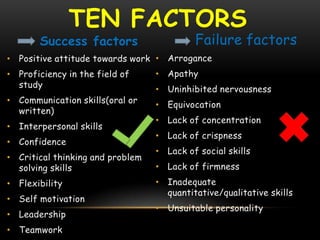
Success factors
• Positive attitude towards work
• Proficiency in the field of
study
• Communication skills(oral or
written)
• Interpersonal skills
• Confidence
• Critical thinking and problem
solving skills
• Flexibility
• Self motivation
• Leadership
• Teamwork
Failure factors
• Arrogance
• Apathy
• Uninhibited nervousness
• Equivocation
• Lack of concentration
• Lack of crispness
• Lack of social skills
• Lack of firmness
• Inadequate
quantitative/qualitative skills
• Unsuitable personality
TEN FACTORS
HOW TO PREPARE FOR AN
INTERVIEW???
• Go through a mock interview
• Gather adequate inside information
• Dress appropriately
• Be prepared to ask questions
• Memorise your resume
• Be punctual
• Relax
FOLLOW UP
• There are two simplest steps
you can take after completion
of your interview…..
1. Call the interviewers to
thank them for their time.
2. Immediately write the
interviewers a short note
thanking them for their
time and restating your
interest in the position.
TIPS FOR SUCCESS
• Be well prepared
• Know about the company
• Be smart, clean and over groomed
• Be yourself, be honest
• Show a real interest in the job
• Be aware of all the answering techniques
• Speak clearly using positive words….
• Appropriately use the top 5 non verbal
 Eye Contact
 Posture
 Gesture
 Space
 Facial Expression
TELEPHONE INTERVIEW
• The first contact many people have with
you is over the phone.
• They will probably form a lasting impression
of you on the basis of that conversation.
PREPARATION
• Keep all of your documents within
easy reach of the phone.
• Have a note pad and pen to take
notes.
• Keep a mirror near by you…...
• Try to match your speaking rate and
pitch with that of interviewer.
• Place a “DO NOT DISTURB” board on
your door.
• Turn off your stereo, TV, and any
other potential distraction.
GUIDELINES
• Take a surprise call in your
stride
• Always refer to the
interviewer by the first name
• Beware of giving YES/NO
answers
• Speak directly into the
telephone
• Take notes
Bibliography :
Technical Communication by Meenakshi
Raman and Sangeeta Sharma
Webliography:
images.google.com
THANK YOU!!


Interview skills

  • 1.
    Prepared by : SunitiM Patel Sub : Communication Skills En. No.:120110120015
  • 2.
    TOPICS • Introduction • Objectives •Types of interview • Job interviews • Face to face interview • Telephone interview
  • 3.
    WHAT IS INTERVIEW????? •An interview is a psychological and sociological instrument. • It is an interaction between two or more persons for a specific purpose, in which the interviewer asks the interviewee specific questions in order to access his suitability for recruitment, admission, or promotion, or for an opinion.
  • 4.
    OBJECTIVES OF INTERVIEW • Generallyinterviews are conducted to achieve some of the following reasons….. • to select a person for a specific task • to monitor performance • to collect information • to exchange information • to counsel
  • 5.
    TYPES OF INTERVIEW Thereare many types of interviews like: • Job • Information • Persuasive • Exit • Evaluation • Disciplinary • Counselling
  • 6.
    FACE TO FACEINTERVIEW Employer’s expectation: • Disposition • Career objectives • Subject knowledge • General knowledge • Communication skills • Mental agility • Consistency • Self confidence
  • 7.
    Success factors • Positiveattitude towards work • Proficiency in the field of study • Communication skills(oral or written) • Interpersonal skills • Confidence • Critical thinking and problem solving skills • Flexibility • Self motivation • Leadership • Teamwork Failure factors • Arrogance • Apathy • Uninhibited nervousness • Equivocation • Lack of concentration • Lack of crispness • Lack of social skills • Lack of firmness • Inadequate quantitative/qualitative skills • Unsuitable personality TEN FACTORS
  • 8.
    HOW TO PREPAREFOR AN INTERVIEW??? • Go through a mock interview • Gather adequate inside information • Dress appropriately • Be prepared to ask questions • Memorise your resume • Be punctual • Relax
  • 9.
    FOLLOW UP • Thereare two simplest steps you can take after completion of your interview….. 1. Call the interviewers to thank them for their time. 2. Immediately write the interviewers a short note thanking them for their time and restating your interest in the position.
  • 10.
    TIPS FOR SUCCESS •Be well prepared • Know about the company • Be smart, clean and over groomed • Be yourself, be honest • Show a real interest in the job • Be aware of all the answering techniques • Speak clearly using positive words…. • Appropriately use the top 5 non verbal  Eye Contact  Posture  Gesture  Space  Facial Expression
  • 11.
    TELEPHONE INTERVIEW • Thefirst contact many people have with you is over the phone. • They will probably form a lasting impression of you on the basis of that conversation.
  • 12.
    PREPARATION • Keep allof your documents within easy reach of the phone. • Have a note pad and pen to take notes. • Keep a mirror near by you…... • Try to match your speaking rate and pitch with that of interviewer. • Place a “DO NOT DISTURB” board on your door. • Turn off your stereo, TV, and any other potential distraction.
  • 13.
    GUIDELINES • Take asurprise call in your stride • Always refer to the interviewer by the first name • Beware of giving YES/NO answers • Speak directly into the telephone • Take notes
  • 14.
    Bibliography : Technical Communicationby Meenakshi Raman and Sangeeta Sharma Webliography: images.google.com THANK YOU!! 