Interview Skills
Objective
 Importance of Interview
 Important Questions
 Interview Etiquettes
 Other Important Things
related to interview
Interviewing-What is it?
 A structured meeting
between you and an employer
Interviewing-What is it?
 A structured meeting
between you and an employer
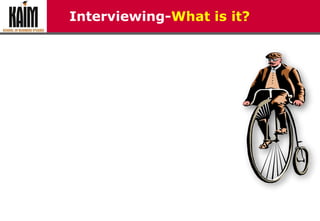
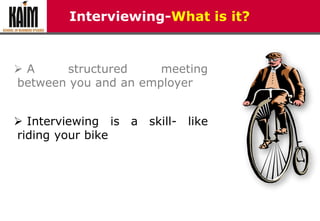
 Interviewing is a skill- like
riding your bike
Interviewing-What is it?
 A structured meeting
between you and an employer
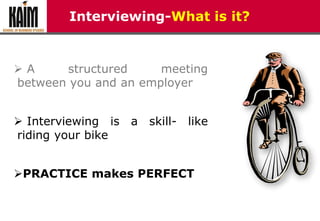
 Interviewing is a skill- like
riding your bike
PRACTICE makes PERFECT
Interviewing is a two-way
street
 Employers are
attempting to determine if
you are an appropriate fit
for the job and their
culture
 You decide if the
environment and job work
are right for you.
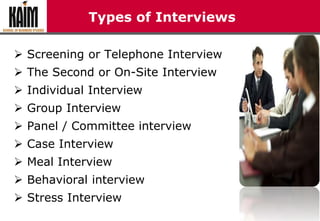
Types of Interviews
 Screening or Telephone Interview
 The Second or On-Site Interview
 Individual Interview
 Group Interview
 Panel / Committee interview
 Case Interview
 Meal Interview
 Behavioral interview
 Stress Interview
Pre-Interview Preparation
• Prepare for Verbal and non-verbal
communication
• Research position, company, &
industry
• Know yourself and be able to
articulate skills, strengths,
accomplishments, and career goals
• Prepare necessary materials
(Copies of resume, references,
pen, organizer, breath mints etc)
Ask for directions and where to park
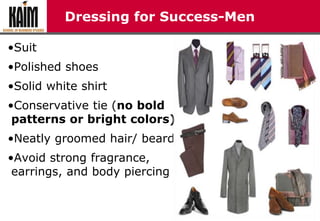
Dressing for Success-Men
•Suit
•Polished shoes
•Solid white shirt
•Conservative tie (no bold
patterns or bright colors)
•Neatly groomed hair/ beard
•Avoid strong fragrance,
earrings, and body piercing
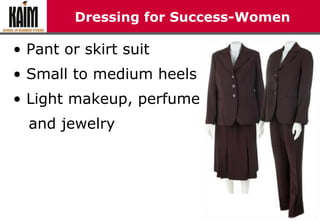
Dressing for Success-Women
• Pant or skirt suit
• Small to medium heels
• Light makeup, perfume
and jewelry
Arriving
• Be sure to allow yourself
plenty of time to arrive at
your destination (you may
want to conduct a dry run
prior to your interview day)
• Try to arrive 10-15 minutes
early at the site to allow you
to park, walk to the
interview, use the restroom,
or just gather yourself
Interview Greeting
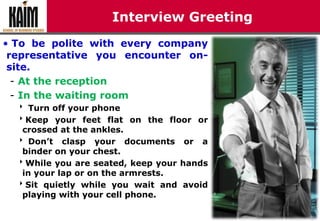
• To be polite with every company
representative you encounter on-
site.
- At the reception
- In the waiting room
 Turn off your phone
Keep your feet flat on the floor or
crossed at the ankles.
 Don’t clasp your documents or a
binder on your chest.
While you are seated, keep your hands
in your lap or on the armrests.
Sit quietly while you wait and avoid
playing with your cell phone.
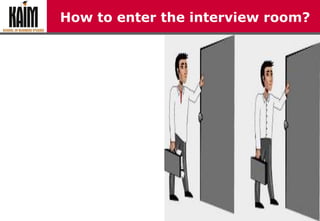
How to enter the interview room?
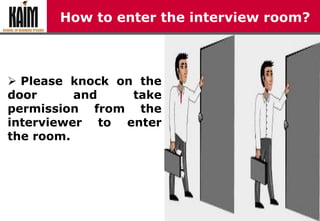
 Please knock on the
door and take
permission from the
interviewer to enter
the room.
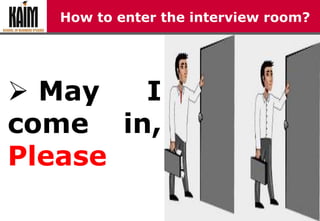
How to enter the interview room?
 May I
come in,
Please
How to take a seat the interview
room?
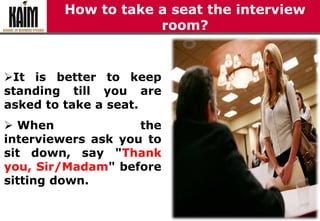
How to take a seat the interview
room?
It is better to keep
standing till you are
asked to take a seat.
 When the
interviewers ask you to
sit down, say "Thank
you, Sir/Madam" before
sitting down.
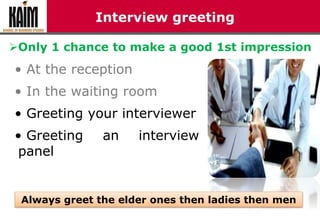
Interview greeting
• At the reception
• In the waiting room
• Greeting your interviewer
• Greeting an interview
panel
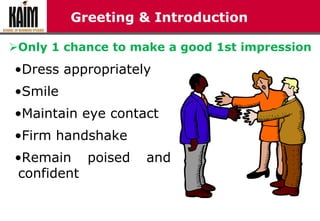
Only 1 chance to make a good 1st impression
Always greet the elder ones then ladies then men
Greeting & Introduction
•Dress appropriately
•Smile
•Maintain eye contact
•Firm handshake
•Remain poised and
confident
Only 1 chance to make a good 1st impression
Body Language:
What signals are you sending?
Positive Signals
•Leaning forward = interest
•Smiling = friendly
•Nodding = attentive and
alert
•Eye contact = curious and
focused
Negative Signals
•Crossed arms = defensive
•Fidgeting hands or tapping
feet = nervous or bored
•Lack of eye contact =
untrustworthy
•Leaning back= discomfort
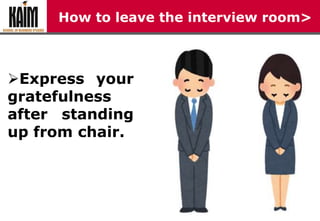
How to leave the interview room>
Express your
gratefulness
after standing
up from chair.
Types of Interview Questions
Standard or traditional
Targeting your education, work experiences, and career goals
Sample Questions
•Tell me about yourself?
•What is your greatest strength?
Weakness?
•Why did you choose to interview with
us?
•What did you like most about your
last job? Least?
•What are your short and long term
career goals?
Types of Interview Questions
Behavioral Questions
• These focus on your
actions and / or behaviors in
a previous setting.
• Past behavior provides
clues to future behavior.
Sample Questions
•Describe a time you had to make
a difficult decision?
•Tell me about a time you worked
under a deadline?
•What do you do when a team
member is not pulling his/her
weight?
•Think about a time you made a
mistake. What did you learn
from it?
Types of Interview Questions
Inappropriate or
unethical questions
• Questions which probe into your
private life or personal
background
• Questions about your ethnicity,
religion, sexual orientation,
disabilities, marital status
Sample Questions
•How old are you?
•Do you have children?
•Do you have a disability?
•What religion do you
practice?
Types of Interview Questions
Questions asked by
the interviewee
To determine if you are an
appropriate fit for the
company and position,
prepare a list of questions
for the interviewer
Sample Questions
•What type of assignments can I
expect within the first year?
•What is the biggest challenge
facing this department right
now?
•What skills are you looking for in
this position?
•What is the next course of
action?
General Interview Strategies
• Be prepared to talk about yourself and
your experiences
• Master the art of storytelling
• Provide specific and concrete examples
of your results/accomplishments
• Remain positive, enthusiastic, poised,
and confident throughout the interview
process
• Remain calm, relaxed, and be yourself
• Try to focus on the message you are
trying to convey--NOT how well you are
doing!
• Think before speaking
• Avoid long verbose answers--limit your
response to 1-2 minutes
• If you do not hear or understand a
question, ask them to repeat or clarify it
for you
Suggestions
• Conduct a test run the day before the
interview
• Practice! Practice! Practice!
• Obtain a list of practice interview
questions and jot down short answers
• Stand in front of a mirror and rehearse
your answers
• Schedule an appointment for a mock
interview with Career Services
• Get a good night’s sleep-be well rested
and alert for the interview
• Be relaxed and be yourself!
Final Thoughts
• Remember that only 15% of the
success of an interview is out of
your control
• Take some time to reflect
- Overall, how well did I do?
- What went well?
- What steps can I take next
time to improve?
Interview Skills.ppt

Interview Skills.ppt

  • 1.
  • 2.
    Objective  Importance ofInterview  Important Questions  Interview Etiquettes  Other Important Things related to interview
  • 3.
  • 4.
    Interviewing-What is it? A structured meeting between you and an employer
  • 5.
    Interviewing-What is it? A structured meeting between you and an employer  Interviewing is a skill- like riding your bike
  • 6.
    Interviewing-What is it? A structured meeting between you and an employer  Interviewing is a skill- like riding your bike PRACTICE makes PERFECT
  • 7.
    Interviewing is atwo-way street  Employers are attempting to determine if you are an appropriate fit for the job and their culture  You decide if the environment and job work are right for you.
  • 8.
    Types of Interviews Screening or Telephone Interview  The Second or On-Site Interview  Individual Interview  Group Interview  Panel / Committee interview  Case Interview  Meal Interview  Behavioral interview  Stress Interview
  • 9.
    Pre-Interview Preparation • Preparefor Verbal and non-verbal communication • Research position, company, & industry • Know yourself and be able to articulate skills, strengths, accomplishments, and career goals • Prepare necessary materials (Copies of resume, references, pen, organizer, breath mints etc) Ask for directions and where to park
  • 10.
    Dressing for Success-Men •Suit •Polishedshoes •Solid white shirt •Conservative tie (no bold patterns or bright colors) •Neatly groomed hair/ beard •Avoid strong fragrance, earrings, and body piercing
  • 11.
    Dressing for Success-Women •Pant or skirt suit • Small to medium heels • Light makeup, perfume and jewelry
  • 12.
    Arriving • Be sureto allow yourself plenty of time to arrive at your destination (you may want to conduct a dry run prior to your interview day) • Try to arrive 10-15 minutes early at the site to allow you to park, walk to the interview, use the restroom, or just gather yourself
  • 13.
    Interview Greeting • Tobe polite with every company representative you encounter on- site. - At the reception - In the waiting room  Turn off your phone Keep your feet flat on the floor or crossed at the ankles.  Don’t clasp your documents or a binder on your chest. While you are seated, keep your hands in your lap or on the armrests. Sit quietly while you wait and avoid playing with your cell phone.
  • 14.
    How to enterthe interview room?
  • 15.
    How to enterthe interview room?  Please knock on the door and take permission from the interviewer to enter the room.
  • 16.
    How to enterthe interview room?  May I come in, Please
  • 17.
    How to takea seat the interview room?
  • 18.
    How to takea seat the interview room? It is better to keep standing till you are asked to take a seat.  When the interviewers ask you to sit down, say "Thank you, Sir/Madam" before sitting down.
  • 19.
    Interview greeting • Atthe reception • In the waiting room • Greeting your interviewer • Greeting an interview panel Only 1 chance to make a good 1st impression Always greet the elder ones then ladies then men
  • 20.
    Greeting & Introduction •Dressappropriately •Smile •Maintain eye contact •Firm handshake •Remain poised and confident Only 1 chance to make a good 1st impression
  • 21.
    Body Language: What signalsare you sending? Positive Signals •Leaning forward = interest •Smiling = friendly •Nodding = attentive and alert •Eye contact = curious and focused Negative Signals •Crossed arms = defensive •Fidgeting hands or tapping feet = nervous or bored •Lack of eye contact = untrustworthy •Leaning back= discomfort
  • 22.
    How to leavethe interview room> Express your gratefulness after standing up from chair.
  • 23.
    Types of InterviewQuestions Standard or traditional Targeting your education, work experiences, and career goals Sample Questions •Tell me about yourself? •What is your greatest strength? Weakness? •Why did you choose to interview with us? •What did you like most about your last job? Least? •What are your short and long term career goals?
  • 24.
    Types of InterviewQuestions Behavioral Questions • These focus on your actions and / or behaviors in a previous setting. • Past behavior provides clues to future behavior. Sample Questions •Describe a time you had to make a difficult decision? •Tell me about a time you worked under a deadline? •What do you do when a team member is not pulling his/her weight? •Think about a time you made a mistake. What did you learn from it?
  • 25.
    Types of InterviewQuestions Inappropriate or unethical questions • Questions which probe into your private life or personal background • Questions about your ethnicity, religion, sexual orientation, disabilities, marital status Sample Questions •How old are you? •Do you have children? •Do you have a disability? •What religion do you practice?
  • 26.
    Types of InterviewQuestions Questions asked by the interviewee To determine if you are an appropriate fit for the company and position, prepare a list of questions for the interviewer Sample Questions •What type of assignments can I expect within the first year? •What is the biggest challenge facing this department right now? •What skills are you looking for in this position? •What is the next course of action?
  • 27.
    General Interview Strategies •Be prepared to talk about yourself and your experiences • Master the art of storytelling • Provide specific and concrete examples of your results/accomplishments • Remain positive, enthusiastic, poised, and confident throughout the interview process • Remain calm, relaxed, and be yourself • Try to focus on the message you are trying to convey--NOT how well you are doing! • Think before speaking • Avoid long verbose answers--limit your response to 1-2 minutes • If you do not hear or understand a question, ask them to repeat or clarify it for you
  • 28.
    Suggestions • Conduct atest run the day before the interview • Practice! Practice! Practice! • Obtain a list of practice interview questions and jot down short answers • Stand in front of a mirror and rehearse your answers • Schedule an appointment for a mock interview with Career Services • Get a good night’s sleep-be well rested and alert for the interview • Be relaxed and be yourself!
  • 29.
    Final Thoughts • Rememberthat only 15% of the success of an interview is out of your control • Take some time to reflect - Overall, how well did I do? - What went well? - What steps can I take next time to improve?