INTERPENETRATION OF SOLIDS
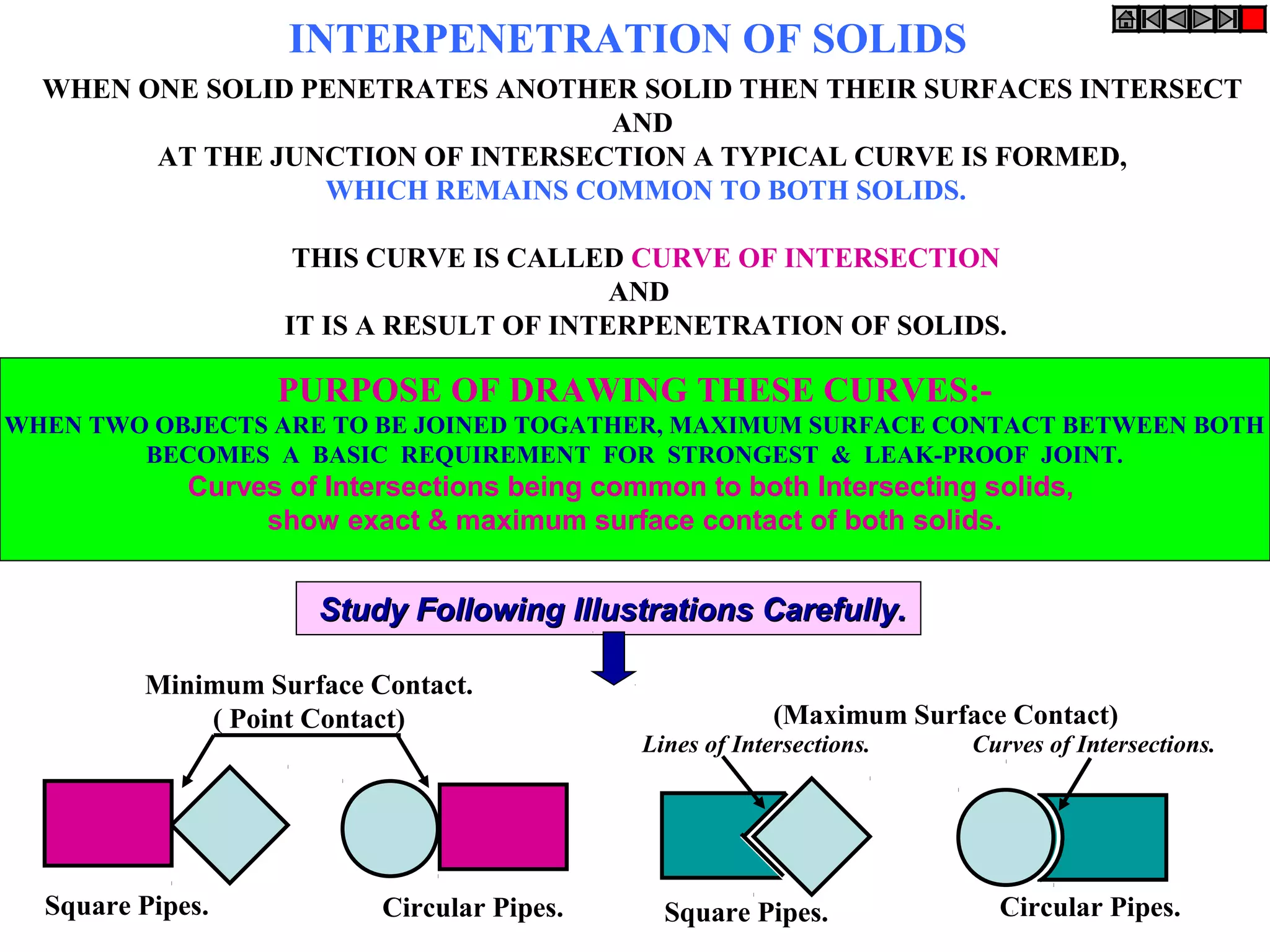
WHEN ONE SOLID PENETRATES ANOTHER SOLID THEN THEIR SURFACES INTERSECT
AND
AT THE JUNCTION OF INTERSECTION A TYPICAL CURVE IS FORMED,
WHICH REMAINS COMMON TO BOTH SOLIDS.
THIS CURVE IS CALLED CURVE OF INTERSECTION
AND
IT IS A RESULT OF INTERPENETRATION OF SOLIDS.

PURPOSE OF DRAWING THESE CURVES:WHEN TWO OBJECTS ARE TO BE JOINED TOGATHER, MAXIMUM SURFACE CONTACT BETWEEN BOTH
BECOMES A BASIC REQUIREMENT FOR STRONGEST & LEAK-PROOF JOINT.

Curves of Intersections being common to both Intersecting solids,
show exact & maximum surface contact of both solids.

Study Following Illustrations Carefully.
Minimum Surface Contact.
( Point Contact)

Square Pipes.

Circular Pipes.

(Maximum Surface Contact)
Lines of Intersections.

Square Pipes.

Curves of Intersections.

Circular Pipes.
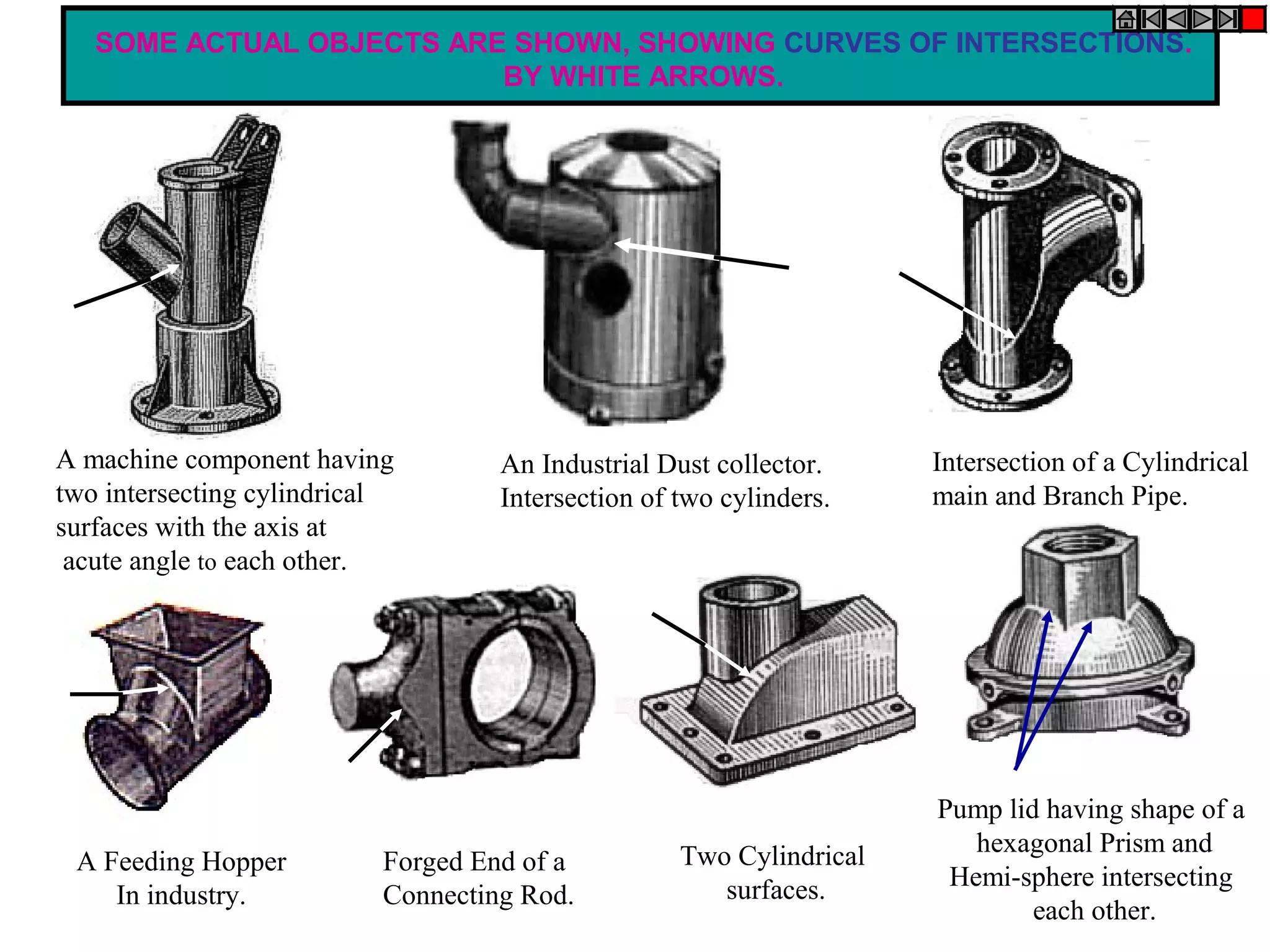
SOME ACTUAL OBJECTS ARE SHOWN, SHOWING CURVES OF INTERSECTIONS.
BY WHITE ARROWS.

A machine component having
two intersecting cylindrical
surfaces with the axis at
acute angle to each other.

A Feeding Hopper
In industry.

An Industrial Dust collector.
Intersection of two cylinders.

Forged End of a
Connecting Rod.

Two Cylindrical
surfaces.

Intersection of a Cylindrical
main and Branch Pipe.

Pump lid having shape of a
hexagonal Prism and
Hemi-sphere intersecting
each other.
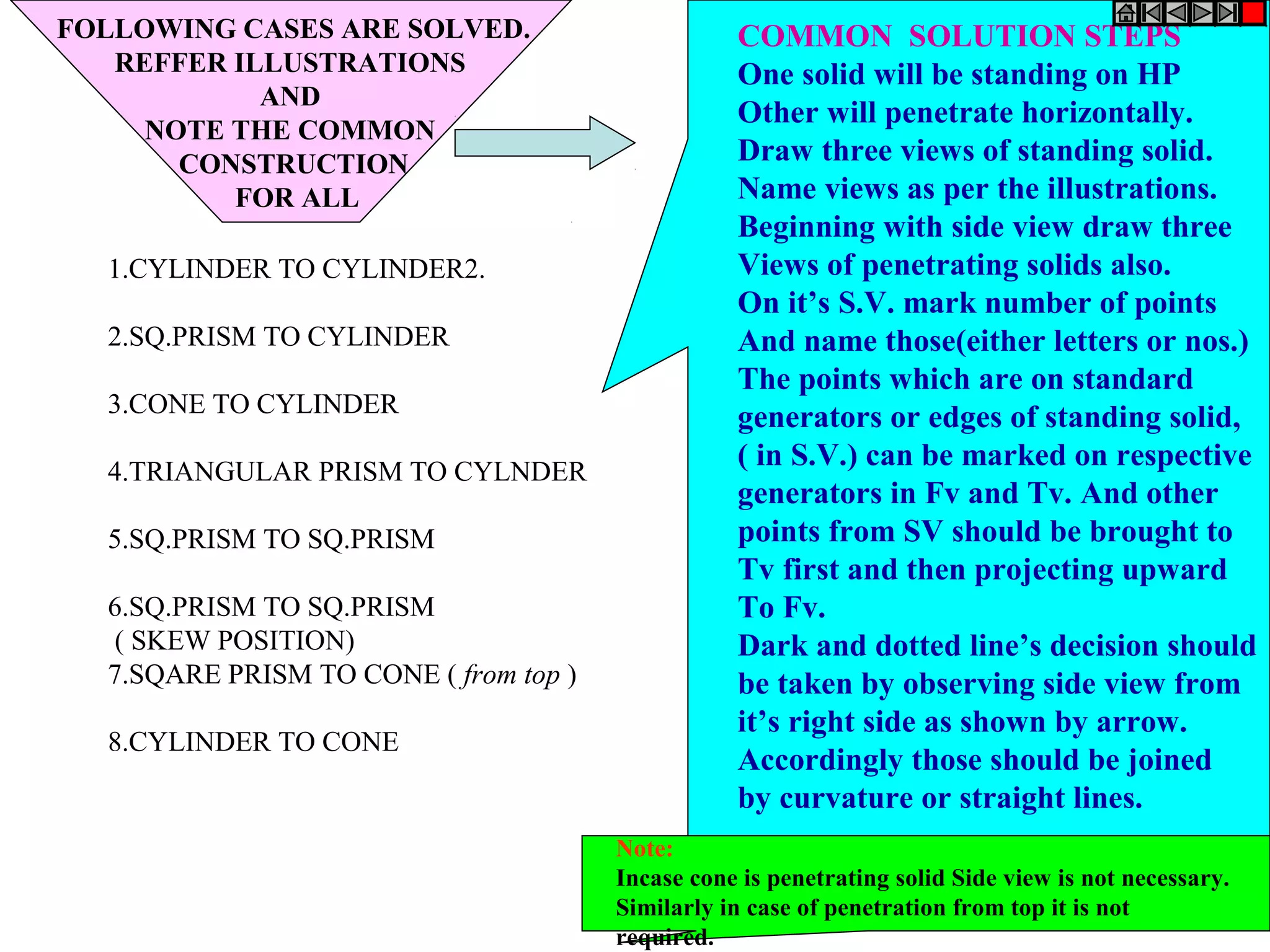
FOLLOWING CASES ARE SOLVED.
REFFER ILLUSTRATIONS
AND
NOTE THE COMMON
CONSTRUCTION
FOR ALL
1.CYLINDER TO CYLINDER2.
2.SQ.PRISM TO CYLINDER
3.CONE TO CYLINDER
4.TRIANGULAR PRISM TO CYLNDER
5.SQ.PRISM TO SQ.PRISM
6.SQ.PRISM TO SQ.PRISM
( SKEW POSITION)
7.SQARE PRISM TO CONE ( from top )
8.CYLINDER TO CONE

COMMON SOLUTION STEPS
One solid will be standing on HP
Other will penetrate horizontally.
Draw three views of standing solid.
Name views as per the illustrations.
Beginning with side view draw three
Views of penetrating solids also.
On it’s S.V. mark number of points
And name those(either letters or nos.)
The points which are on standard
generators or edges of standing solid,
( in S.V.) can be marked on respective
generators in Fv and Tv. And other
points from SV should be brought to
Tv first and then projecting upward
To Fv.
Dark and dotted line’s decision should
be taken by observing side view from
it’s right side as shown by arrow.
Accordingly those should be joined
by curvature or straight lines.
Note:
Incase cone is penetrating solid Side view is not necessary.
Similarly in case of penetration from top it is not
required.
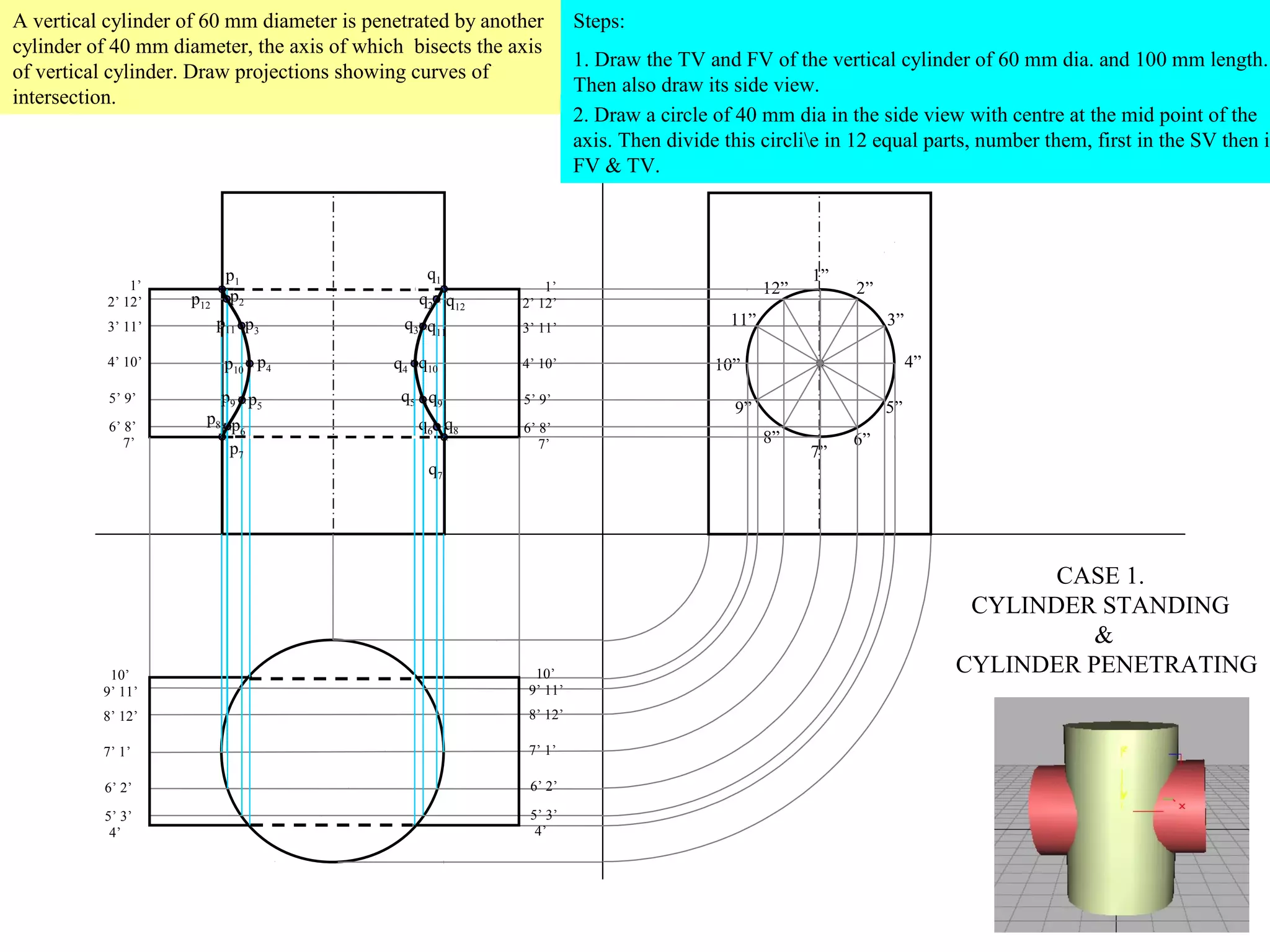
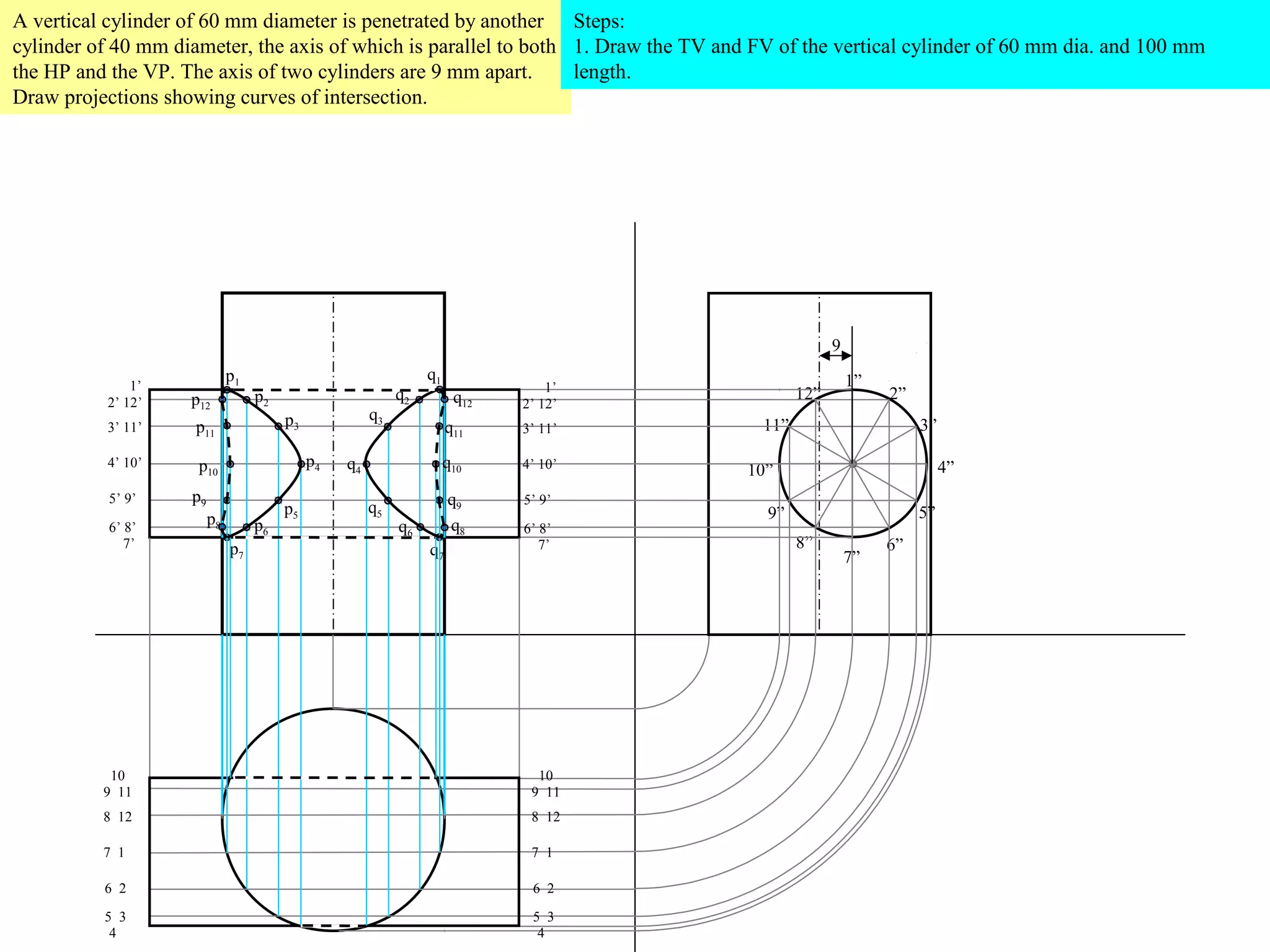
A vertical cylinder of 60 mm diameter is penetrated by another
cylinder of 40 mm diameter, the axis of which bisects the axis
of vertical cylinder. Draw projections showing curves of
intersection.

1’
2’ 12’
3’ 11’
4’ 10’
5’ 9’
6’ 8’
7’

p12

p1
p2
p11 p3
p10 p4

p9 p5
p8 p
6
p7

q1
q2 q12
q3 q11
q4 q10
q5 q9
q6 q8

1’
2’ 12’
3’ 11’
4’ 10’
5’ 9’
6’ 8’
7’

q7

10’
9’ 11’

10’
9’ 11’

8’ 12’

8’ 12’

7’ 1’

7’ 1’

6’ 2’

6’ 2’

5’ 3’
4’

5’ 3’
4’

Steps:

1. Draw the TV and FV of the vertical cylinder of 60 mm dia. and 100 mm length.
Then also draw its side view.
2. Draw a circle of 40 mm dia in the side view with centre at the mid point of the
axis. Then divide this circlie in 12 equal parts, number them, first in the SV then in
FV & TV.

12”

1”

2”

11”

3”
4”

10”
5”

9”
8”

7”

6”

CASE 1.
CYLINDER STANDING
&
CYLINDER PENETRATING
A vertical cylinder of 60 mm diameter is penetrated by another Steps:
cylinder of 40 mm diameter, the axis of which is parallel to both 1. Draw the TV and FV of the vertical cylinder of 60 mm dia. and 100 mm
the HP and the VP. The axis of two cylinders are 9 mm apart.
length.
Draw projections showing curves of intersection.

9
1’
2’ 12’

p1
p12

3’ 11’

p10

5’ 9’
6’ 8’
7’

q3

p3

p11

4’ 10’

p2
p4

p9
p8

p6
p7

p5

q2

q1
q12

1’
2’ 12’

q11
q10

q4
q5

3’ 11’
4’ 10’

q9
q8

q6
q7

5’ 9’
6’ 8’
7’

10
9 11

10
9 11

8 12

8 12

7 1

7 1

6 2

6 2

5 3
4

5 3
4

12”

1”

2”

11”

3”
4”

10”
5”

9”
8”

7”

6”
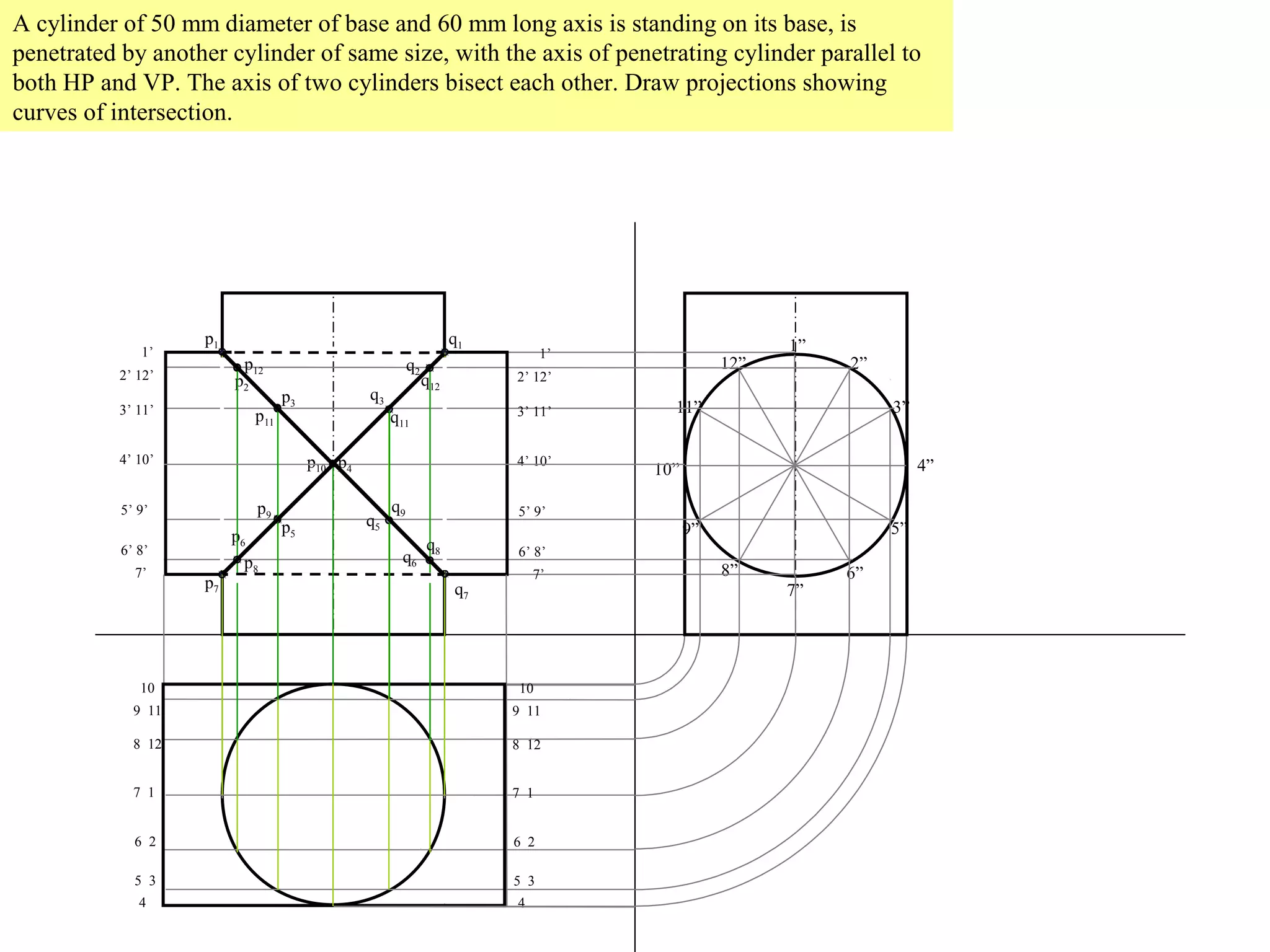
A cylinder of 50 mm diameter of base and 60 mm long axis is standing on its base, is
penetrated by another cylinder of same size, with the axis of penetrating cylinder parallel to
both HP and VP. The axis of two cylinders bisect each other. Draw projections showing
curves of intersection.

1’

p1

q1
p12

2’ 12’

p2

3’ 11’

p11

q2

4’ 10’

p9

6’ 8’

p7

p6
p8

p5

3’ 11’

q11

4’ 10’

q5

q9
q6

12”

2’ 12’

q12

p10 p4

5’ 9’

7’

q3

p3

1’

5’ 9’

q8

1”

2”

11”

3”
4”

10”
5”

9”

6’ 8’
7’

q7

10

10

9 11

9 11

8 12

8 12

7 1

7 1

6 2

6 2

5 3

5 3

4

4

8”
7”

6”
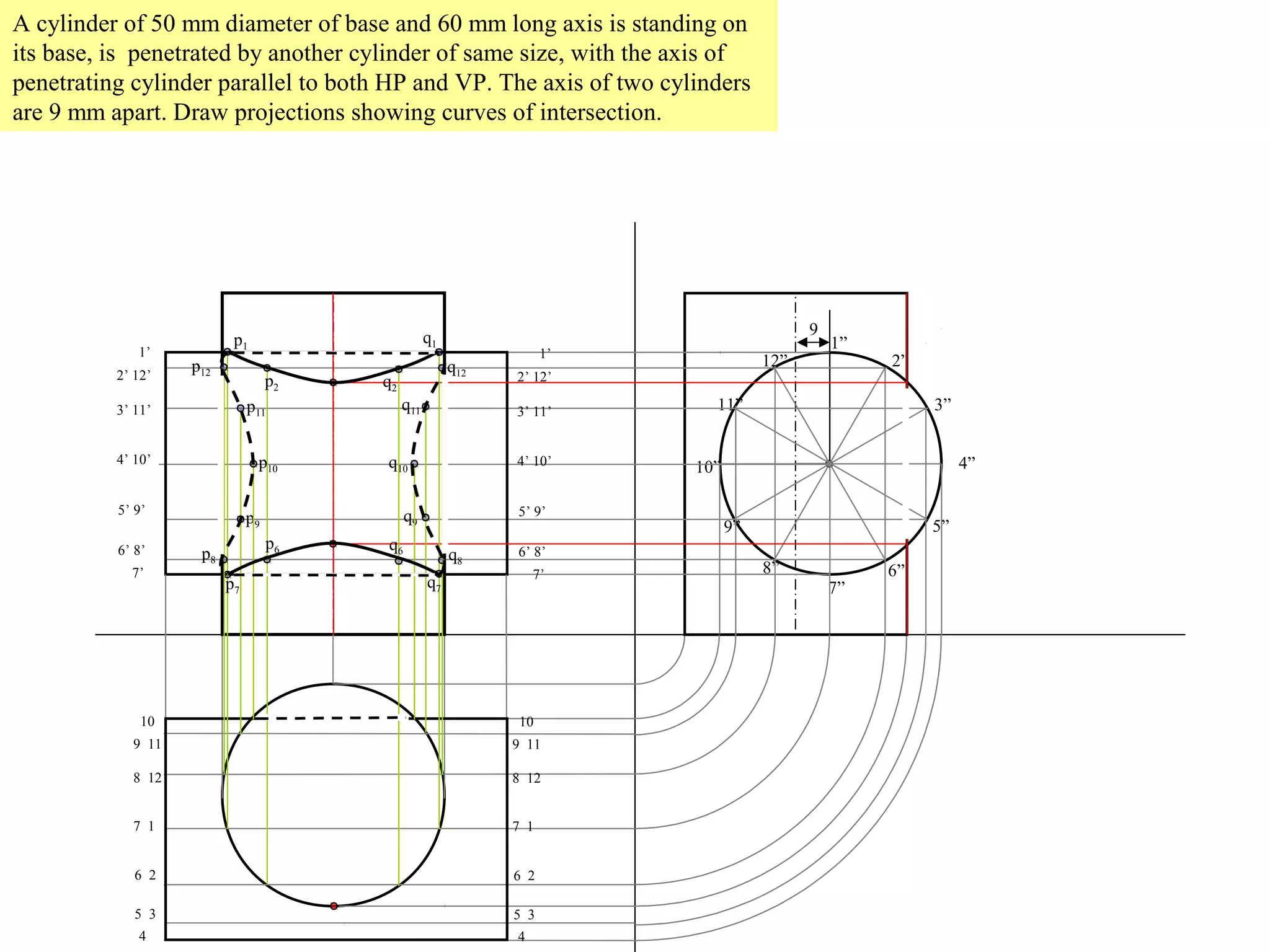
A cylinder of 50 mm diameter of base and 60 mm long axis is standing on
its base, is penetrated by another cylinder of same size, with the axis of
penetrating cylinder parallel to both HP and VP. The axis of two cylinders
are 9 mm apart. Draw projections showing curves of intersection.

1’
2’ 12’

p12

p2
p11

3’ 11’
4’ 10’

p10

5’ 9’
6’ 8’
7’

q12

q2
q11

p7

5’ 9’

q6

q8

12”

2’ 12’

4’ 10’

q9
p6

1’

3’ 11’

q10

p9
p8

9

q1

p1

6’ 8’
7’

q7

10

10

9 11

9 11

8 12

8 12

7 1

7 1

6 2

6 2

5 3

5 3

4

4

1”

2”

11”

3”
4”

10”
5”

9”
8”
7”

6”
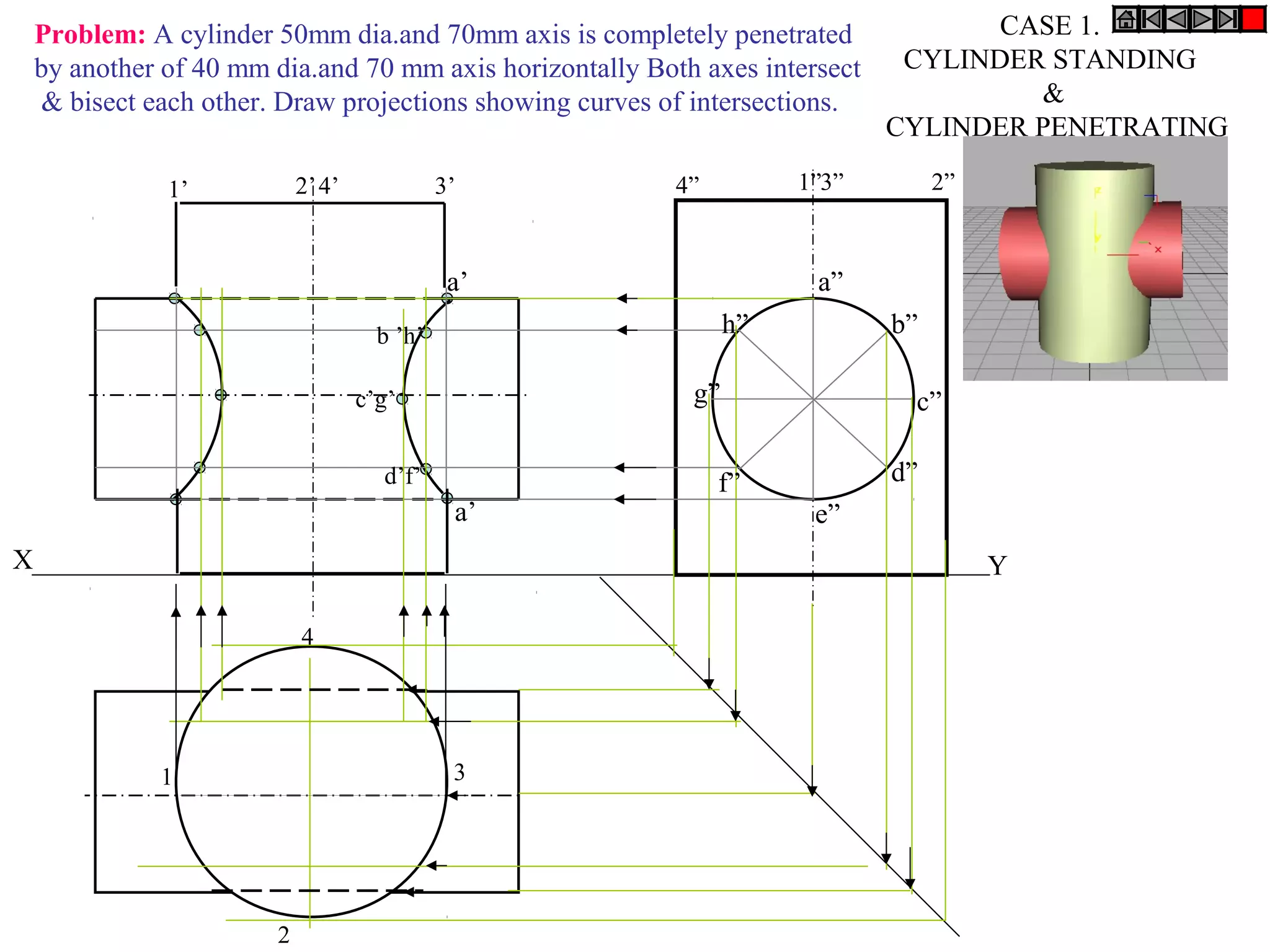
Problem: A cylinder 50mm dia.and 70mm axis is completely penetrated
by another of 40 mm dia.and 70 mm axis horizontally Both axes intersect
& bisect each other. Draw projections showing curves of intersections.
2’4’

1’

3’

1”3”

4”

a’
h”

b”

g”

d’f’

a’
X

2”

a”

b ’h’
c’g’

CASE 1.
CYLINDER STANDING
&
CYLINDER PENETRATING

f”

c”
d”
e”
Y

4

3

1

2
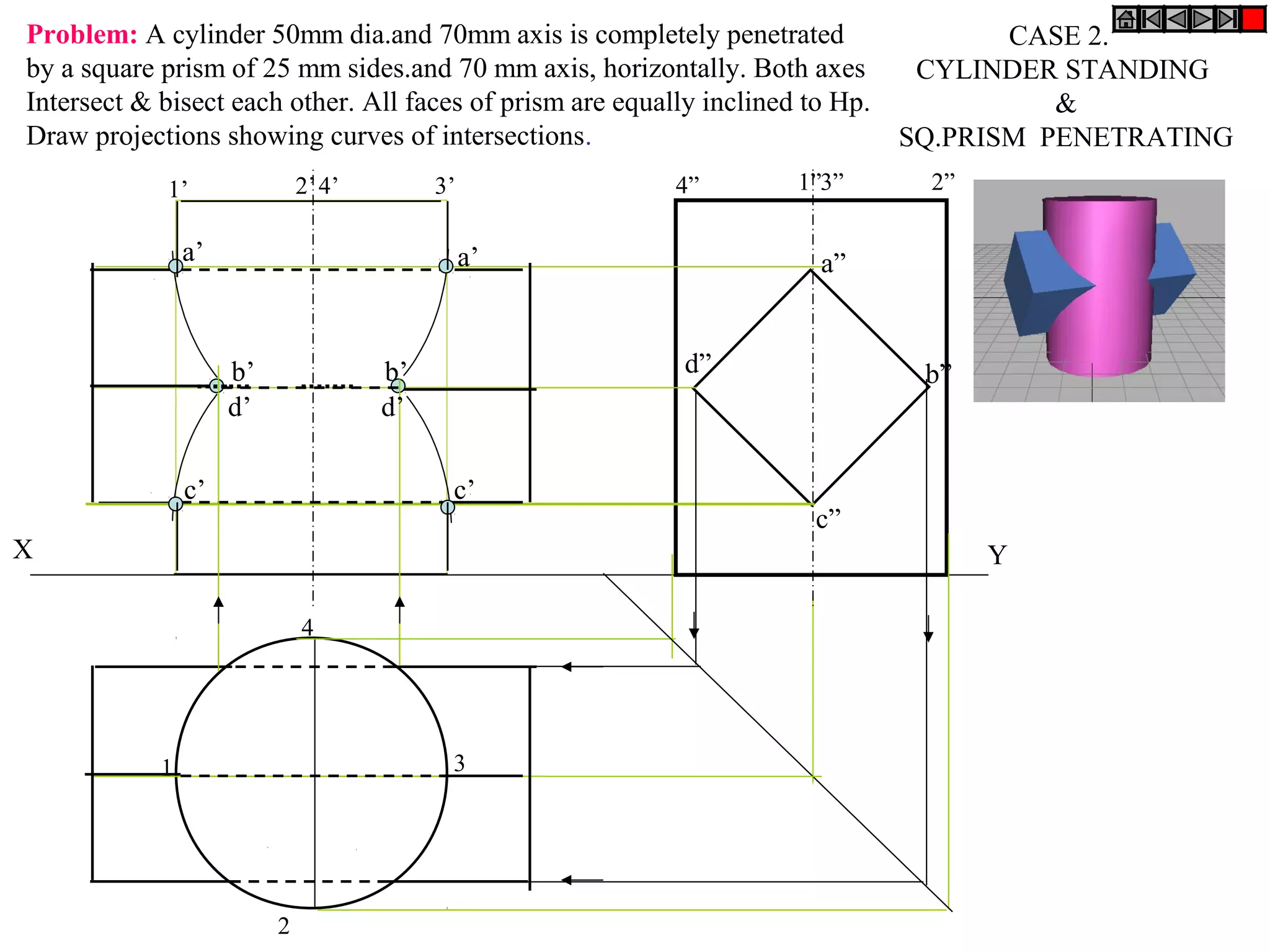
Problem: A cylinder 50mm dia.and 70mm axis is completely penetrated
CASE 2.
by a square prism of 25 mm sides.and 70 mm axis, horizontally. Both axes
CYLINDER STANDING
Intersect & bisect each other. All faces of prism are equally inclined to Hp.
&
Draw projections showing curves of intersections.
SQ.PRISM PENETRATING
2’4’

1’

4”

3’

a’

a’

b’
d’

c’

X

2”

a”
d”

b’
d’

c’

1”3”

b”

c”
Y

4

3

1

2
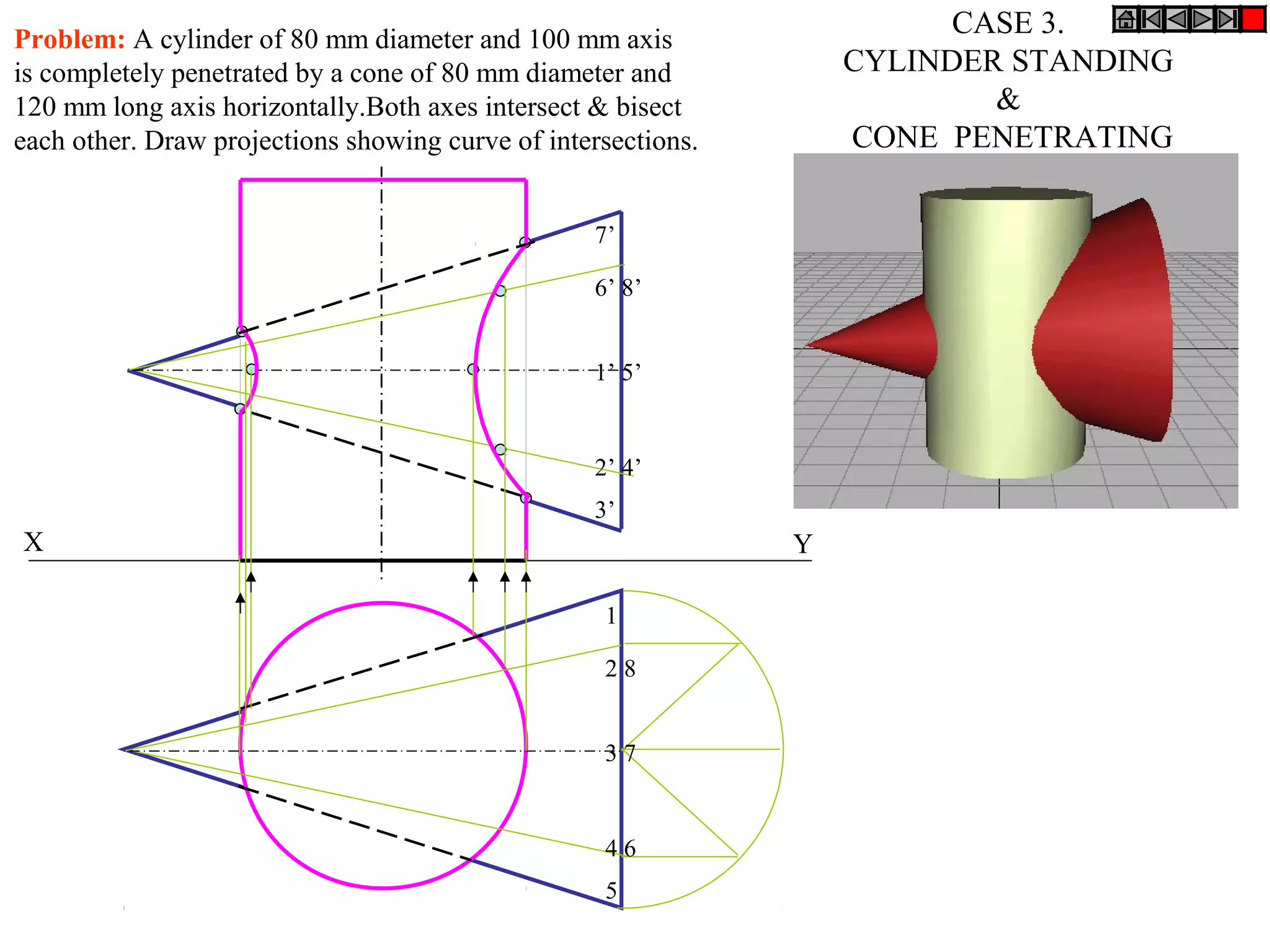
CASE 3.
CYLINDER STANDING
&
CONE PENETRATING

Problem: A cylinder of 80 mm diameter and 100 mm axis
is completely penetrated by a cone of 80 mm diameter and
120 mm long axis horizontally.Both axes intersect & bisect
each other. Draw projections showing curve of intersections.
7’
6’ 8’
1’ 5’

2’ 4’
3’

X

Y
1
28
37

46
5
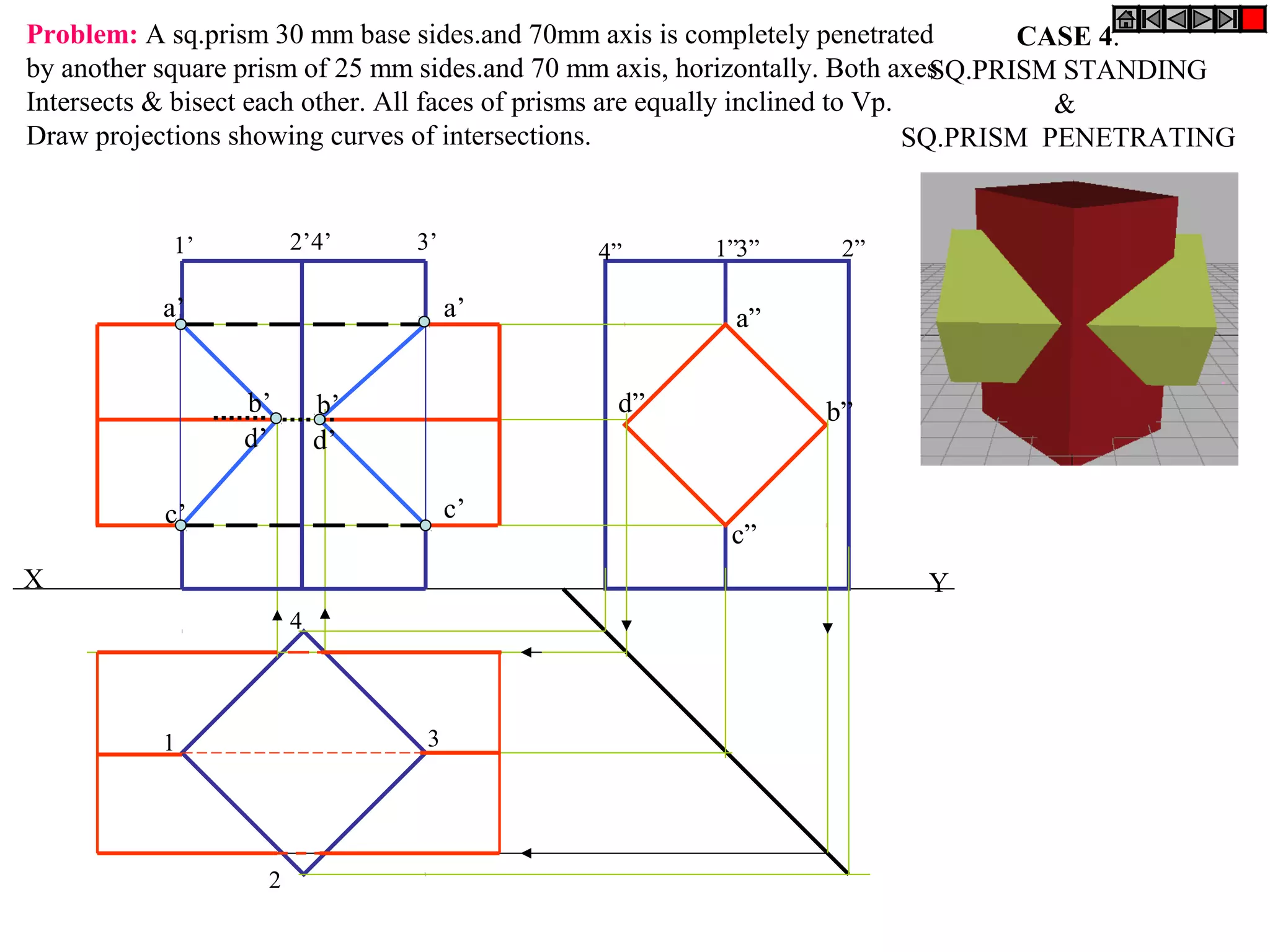
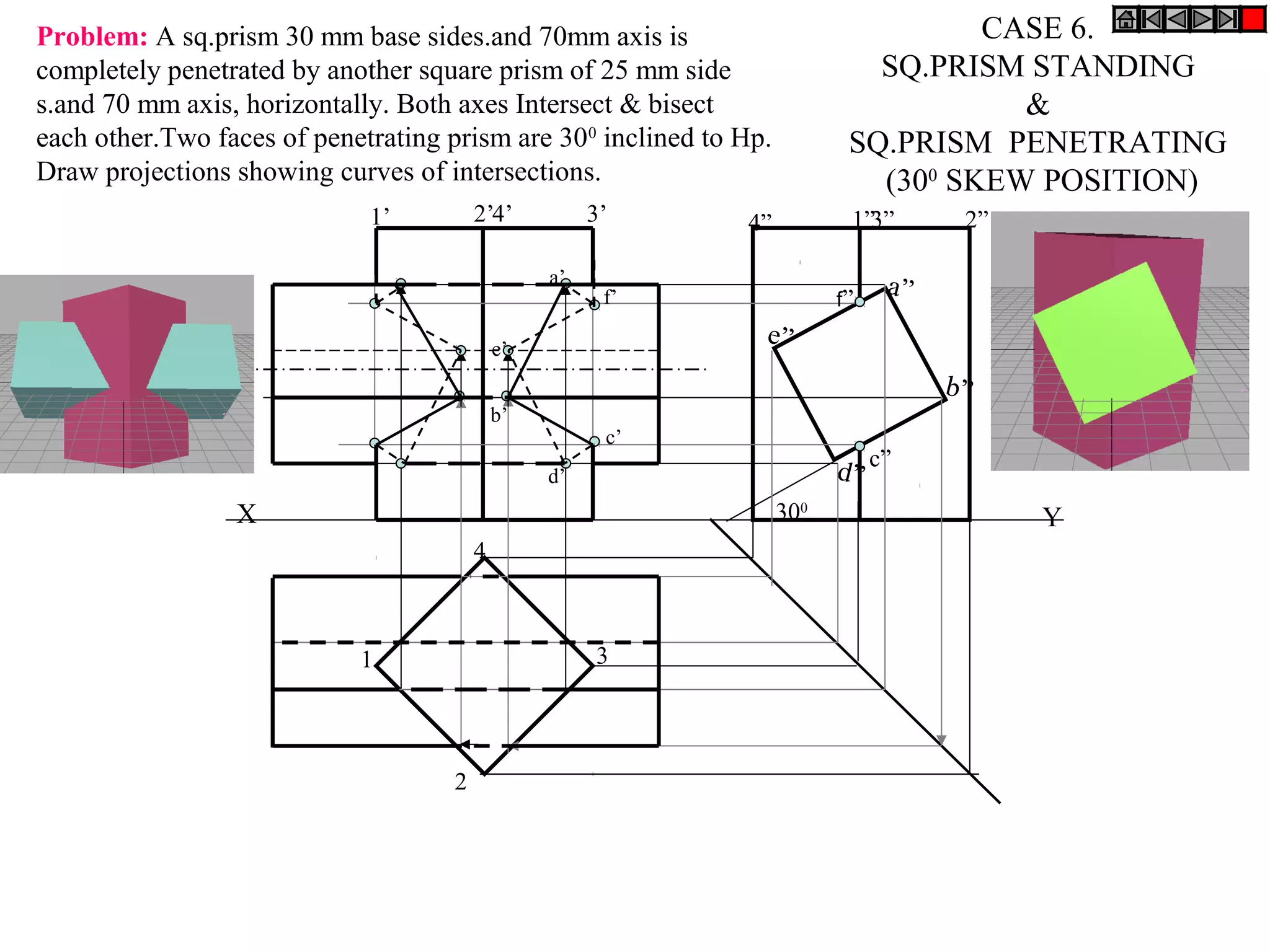
Problem: A sq.prism 30 mm base sides.and 70mm axis is completely penetrated
CASE 4.
by another square prism of 25 mm sides.and 70 mm axis, horizontally. Both axes
SQ.PRISM STANDING
Intersects & bisect each other. All faces of prisms are equally inclined to Vp.
&
Draw projections showing curves of intersections.
SQ.PRISM PENETRATING

2’4’

1’

3’

a’

4”

a’
b’
d’

1”3”

a”
d”

b’
d’
c’

c’
X

2”

b”

c”
Y

4

3

1

2
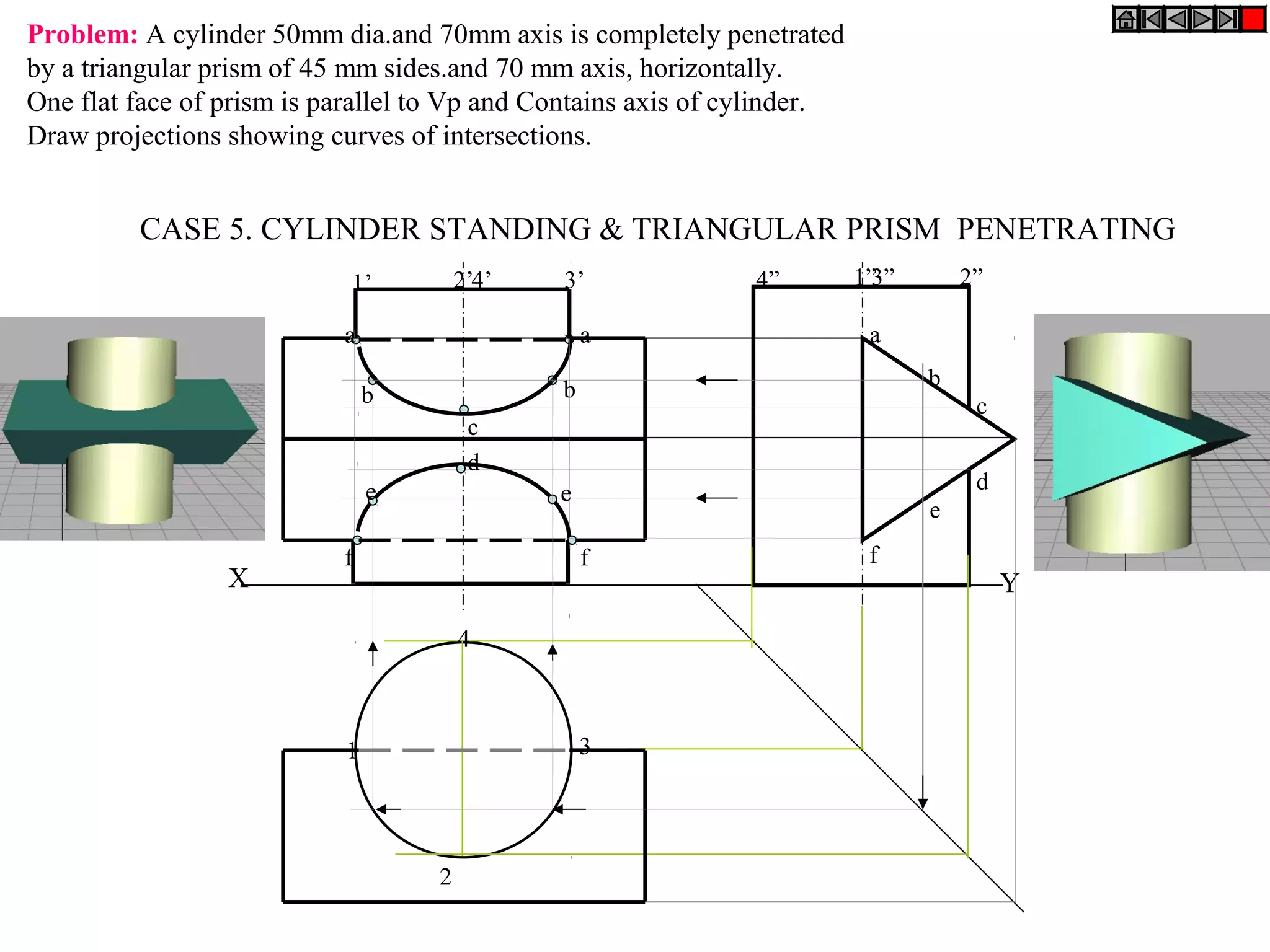
Problem: A cylinder 50mm dia.and 70mm axis is completely penetrated
by a triangular prism of 45 mm sides.and 70 mm axis, horizontally.
One flat face of prism is parallel to Vp and Contains axis of cylinder.
Draw projections showing curves of intersections.

CASE 5. CYLINDER STANDING & TRIANGULAR PRISM PENETRATING
2’4’

1’

3’

a

a

4”

1”
3”
a
b

b

b

2”

c

c
d
e

X

d

e

f

e
f

4

3

1

2

f

Y
CASE 6.
SQ.PRISM STANDING
&
SQ.PRISM PENETRATING
(300 SKEW POSITION)

Problem: A sq.prism 30 mm base sides.and 70mm axis is
completely penetrated by another square prism of 25 mm side
s.and 70 mm axis, horizontally. Both axes Intersect & bisect
each other.Two faces of penetrating prism are 300 inclined to Hp.
Draw projections showing curves of intersections.
2’4’

1’

3’
a’

1”3”

4”

f”

f’

b”

b’

c’

d” c”

d’

300

X
4

3

2

a”

e”

e’

1

2”

Y
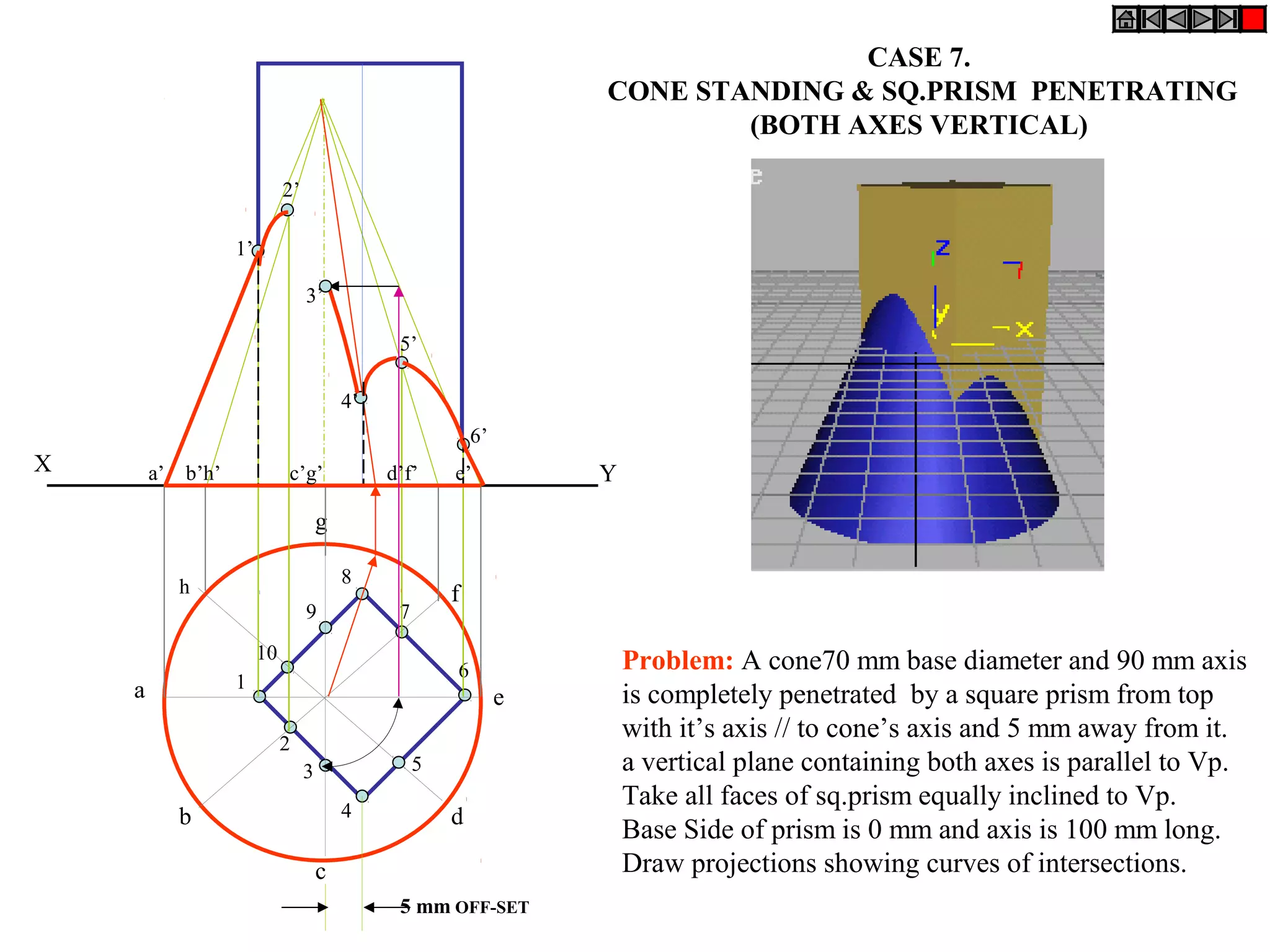
CASE 7.
CONE STANDING & SQ.PRISM PENETRATING
(BOTH AXES VERTICAL)
2’
1’
3’
5’
4’
6’

X

a’

b’h’

c’g’

d’f’

Y

e’

g
8

h
9

f

7

10

6

1

a

e
2

5

3
4

b

d

c
5 mm OFF-SET

Problem: A cone70 mm base diameter and 90 mm axis
is completely penetrated by a square prism from top
with it’s axis // to cone’s axis and 5 mm away from it.
a vertical plane containing both axes is parallel to Vp.
Take all faces of sq.prism equally inclined to Vp.
Base Side of prism is 0 mm and axis is 100 mm long.
Draw projections showing curves of intersections.
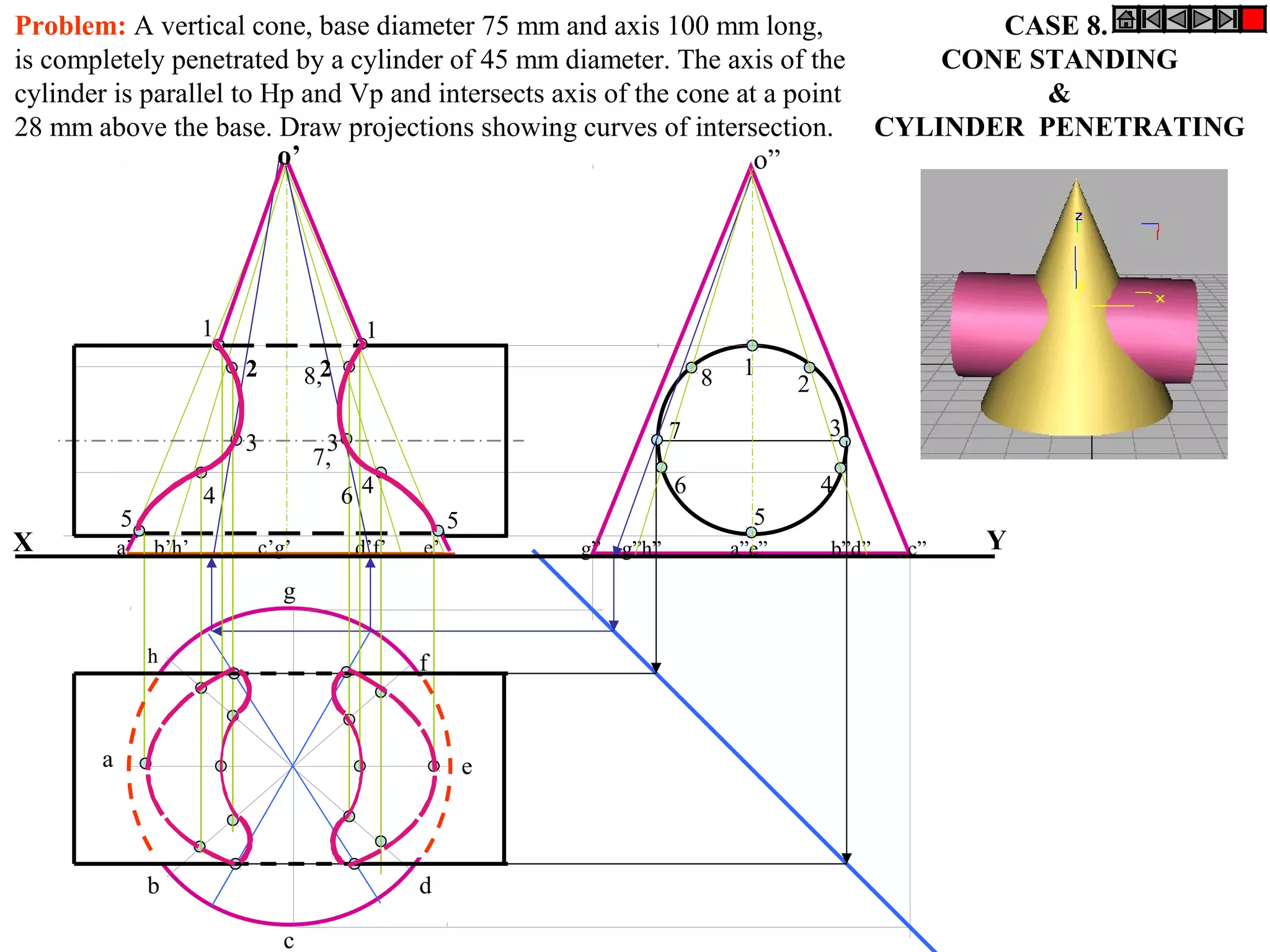
Problem: A vertical cone, base diameter 75 mm and axis 100 mm long,
is completely penetrated by a cylinder of 45 mm diameter. The axis of the
cylinder is parallel to Hp and Vp and intersects axis of the cone at a point
28 mm above the base. Draw projections showing curves of intersection.
o’
o”

1

1
2

X

a’

8,2

3

3
7,

b’h’

8

c’g’

d’f’

e’

g” g”h”

f

e

b

d
c

4
5

5

a

2
3

6

g
h

1

7
64

4

5

CASE 8.
CONE STANDING
&
CYLINDER PENETRATING

a”e”

b”d”

c”

Y

Intersection

  • 1.
    INTERPENETRATION OF SOLIDS WHENONE SOLID PENETRATES ANOTHER SOLID THEN THEIR SURFACES INTERSECT AND AT THE JUNCTION OF INTERSECTION A TYPICAL CURVE IS FORMED, WHICH REMAINS COMMON TO BOTH SOLIDS. THIS CURVE IS CALLED CURVE OF INTERSECTION AND IT IS A RESULT OF INTERPENETRATION OF SOLIDS. PURPOSE OF DRAWING THESE CURVES:WHEN TWO OBJECTS ARE TO BE JOINED TOGATHER, MAXIMUM SURFACE CONTACT BETWEEN BOTH BECOMES A BASIC REQUIREMENT FOR STRONGEST & LEAK-PROOF JOINT. Curves of Intersections being common to both Intersecting solids, show exact & maximum surface contact of both solids. Study Following Illustrations Carefully. Minimum Surface Contact. ( Point Contact) Square Pipes. Circular Pipes. (Maximum Surface Contact) Lines of Intersections. Square Pipes. Curves of Intersections. Circular Pipes.
  • 2.
    SOME ACTUAL OBJECTSARE SHOWN, SHOWING CURVES OF INTERSECTIONS. BY WHITE ARROWS. A machine component having two intersecting cylindrical surfaces with the axis at acute angle to each other. A Feeding Hopper In industry. An Industrial Dust collector. Intersection of two cylinders. Forged End of a Connecting Rod. Two Cylindrical surfaces. Intersection of a Cylindrical main and Branch Pipe. Pump lid having shape of a hexagonal Prism and Hemi-sphere intersecting each other.
  • 3.
    FOLLOWING CASES ARESOLVED. REFFER ILLUSTRATIONS AND NOTE THE COMMON CONSTRUCTION FOR ALL 1.CYLINDER TO CYLINDER2. 2.SQ.PRISM TO CYLINDER 3.CONE TO CYLINDER 4.TRIANGULAR PRISM TO CYLNDER 5.SQ.PRISM TO SQ.PRISM 6.SQ.PRISM TO SQ.PRISM ( SKEW POSITION) 7.SQARE PRISM TO CONE ( from top ) 8.CYLINDER TO CONE COMMON SOLUTION STEPS One solid will be standing on HP Other will penetrate horizontally. Draw three views of standing solid. Name views as per the illustrations. Beginning with side view draw three Views of penetrating solids also. On it’s S.V. mark number of points And name those(either letters or nos.) The points which are on standard generators or edges of standing solid, ( in S.V.) can be marked on respective generators in Fv and Tv. And other points from SV should be brought to Tv first and then projecting upward To Fv. Dark and dotted line’s decision should be taken by observing side view from it’s right side as shown by arrow. Accordingly those should be joined by curvature or straight lines. Note: Incase cone is penetrating solid Side view is not necessary. Similarly in case of penetration from top it is not required.
  • 4.
    A vertical cylinderof 60 mm diameter is penetrated by another cylinder of 40 mm diameter, the axis of which bisects the axis of vertical cylinder. Draw projections showing curves of intersection. 1’ 2’ 12’ 3’ 11’ 4’ 10’ 5’ 9’ 6’ 8’ 7’ p12 p1 p2 p11 p3 p10 p4 p9 p5 p8 p 6 p7 q1 q2 q12 q3 q11 q4 q10 q5 q9 q6 q8 1’ 2’ 12’ 3’ 11’ 4’ 10’ 5’ 9’ 6’ 8’ 7’ q7 10’ 9’ 11’ 10’ 9’ 11’ 8’ 12’ 8’ 12’ 7’ 1’ 7’ 1’ 6’ 2’ 6’ 2’ 5’ 3’ 4’ 5’ 3’ 4’ Steps: 1. Draw the TV and FV of the vertical cylinder of 60 mm dia. and 100 mm length. Then also draw its side view. 2. Draw a circle of 40 mm dia in the side view with centre at the mid point of the axis. Then divide this circlie in 12 equal parts, number them, first in the SV then in FV & TV. 12” 1” 2” 11” 3” 4” 10” 5” 9” 8” 7” 6” CASE 1. CYLINDER STANDING & CYLINDER PENETRATING
  • 5.
    A vertical cylinderof 60 mm diameter is penetrated by another Steps: cylinder of 40 mm diameter, the axis of which is parallel to both 1. Draw the TV and FV of the vertical cylinder of 60 mm dia. and 100 mm the HP and the VP. The axis of two cylinders are 9 mm apart. length. Draw projections showing curves of intersection. 9 1’ 2’ 12’ p1 p12 3’ 11’ p10 5’ 9’ 6’ 8’ 7’ q3 p3 p11 4’ 10’ p2 p4 p9 p8 p6 p7 p5 q2 q1 q12 1’ 2’ 12’ q11 q10 q4 q5 3’ 11’ 4’ 10’ q9 q8 q6 q7 5’ 9’ 6’ 8’ 7’ 10 9 11 10 9 11 8 12 8 12 7 1 7 1 6 2 6 2 5 3 4 5 3 4 12” 1” 2” 11” 3” 4” 10” 5” 9” 8” 7” 6”
  • 6.
    A cylinder of50 mm diameter of base and 60 mm long axis is standing on its base, is penetrated by another cylinder of same size, with the axis of penetrating cylinder parallel to both HP and VP. The axis of two cylinders bisect each other. Draw projections showing curves of intersection. 1’ p1 q1 p12 2’ 12’ p2 3’ 11’ p11 q2 4’ 10’ p9 6’ 8’ p7 p6 p8 p5 3’ 11’ q11 4’ 10’ q5 q9 q6 12” 2’ 12’ q12 p10 p4 5’ 9’ 7’ q3 p3 1’ 5’ 9’ q8 1” 2” 11” 3” 4” 10” 5” 9” 6’ 8’ 7’ q7 10 10 9 11 9 11 8 12 8 12 7 1 7 1 6 2 6 2 5 3 5 3 4 4 8” 7” 6”
  • 7.
    A cylinder of50 mm diameter of base and 60 mm long axis is standing on its base, is penetrated by another cylinder of same size, with the axis of penetrating cylinder parallel to both HP and VP. The axis of two cylinders are 9 mm apart. Draw projections showing curves of intersection. 1’ 2’ 12’ p12 p2 p11 3’ 11’ 4’ 10’ p10 5’ 9’ 6’ 8’ 7’ q12 q2 q11 p7 5’ 9’ q6 q8 12” 2’ 12’ 4’ 10’ q9 p6 1’ 3’ 11’ q10 p9 p8 9 q1 p1 6’ 8’ 7’ q7 10 10 9 11 9 11 8 12 8 12 7 1 7 1 6 2 6 2 5 3 5 3 4 4 1” 2” 11” 3” 4” 10” 5” 9” 8” 7” 6”
  • 8.
    Problem: A cylinder50mm dia.and 70mm axis is completely penetrated by another of 40 mm dia.and 70 mm axis horizontally Both axes intersect & bisect each other. Draw projections showing curves of intersections. 2’4’ 1’ 3’ 1”3” 4” a’ h” b” g” d’f’ a’ X 2” a” b ’h’ c’g’ CASE 1. CYLINDER STANDING & CYLINDER PENETRATING f” c” d” e” Y 4 3 1 2
  • 9.
    Problem: A cylinder50mm dia.and 70mm axis is completely penetrated CASE 2. by a square prism of 25 mm sides.and 70 mm axis, horizontally. Both axes CYLINDER STANDING Intersect & bisect each other. All faces of prism are equally inclined to Hp. & Draw projections showing curves of intersections. SQ.PRISM PENETRATING 2’4’ 1’ 4” 3’ a’ a’ b’ d’ c’ X 2” a” d” b’ d’ c’ 1”3” b” c” Y 4 3 1 2
  • 10.
    CASE 3. CYLINDER STANDING & CONEPENETRATING Problem: A cylinder of 80 mm diameter and 100 mm axis is completely penetrated by a cone of 80 mm diameter and 120 mm long axis horizontally.Both axes intersect & bisect each other. Draw projections showing curve of intersections. 7’ 6’ 8’ 1’ 5’ 2’ 4’ 3’ X Y 1 28 37 46 5
  • 11.
    Problem: A sq.prism30 mm base sides.and 70mm axis is completely penetrated CASE 4. by another square prism of 25 mm sides.and 70 mm axis, horizontally. Both axes SQ.PRISM STANDING Intersects & bisect each other. All faces of prisms are equally inclined to Vp. & Draw projections showing curves of intersections. SQ.PRISM PENETRATING 2’4’ 1’ 3’ a’ 4” a’ b’ d’ 1”3” a” d” b’ d’ c’ c’ X 2” b” c” Y 4 3 1 2
  • 12.
    Problem: A cylinder50mm dia.and 70mm axis is completely penetrated by a triangular prism of 45 mm sides.and 70 mm axis, horizontally. One flat face of prism is parallel to Vp and Contains axis of cylinder. Draw projections showing curves of intersections. CASE 5. CYLINDER STANDING & TRIANGULAR PRISM PENETRATING 2’4’ 1’ 3’ a a 4” 1” 3” a b b b 2” c c d e X d e f e f 4 3 1 2 f Y
  • 13.
    CASE 6. SQ.PRISM STANDING & SQ.PRISMPENETRATING (300 SKEW POSITION) Problem: A sq.prism 30 mm base sides.and 70mm axis is completely penetrated by another square prism of 25 mm side s.and 70 mm axis, horizontally. Both axes Intersect & bisect each other.Two faces of penetrating prism are 300 inclined to Hp. Draw projections showing curves of intersections. 2’4’ 1’ 3’ a’ 1”3” 4” f” f’ b” b’ c’ d” c” d’ 300 X 4 3 2 a” e” e’ 1 2” Y
  • 14.
    CASE 7. CONE STANDING& SQ.PRISM PENETRATING (BOTH AXES VERTICAL) 2’ 1’ 3’ 5’ 4’ 6’ X a’ b’h’ c’g’ d’f’ Y e’ g 8 h 9 f 7 10 6 1 a e 2 5 3 4 b d c 5 mm OFF-SET Problem: A cone70 mm base diameter and 90 mm axis is completely penetrated by a square prism from top with it’s axis // to cone’s axis and 5 mm away from it. a vertical plane containing both axes is parallel to Vp. Take all faces of sq.prism equally inclined to Vp. Base Side of prism is 0 mm and axis is 100 mm long. Draw projections showing curves of intersections.
  • 15.
    Problem: A verticalcone, base diameter 75 mm and axis 100 mm long, is completely penetrated by a cylinder of 45 mm diameter. The axis of the cylinder is parallel to Hp and Vp and intersects axis of the cone at a point 28 mm above the base. Draw projections showing curves of intersection. o’ o” 1 1 2 X a’ 8,2 3 3 7, b’h’ 8 c’g’ d’f’ e’ g” g”h” f e b d c 4 5 5 a 2 3 6 g h 1 7 64 4 5 CASE 8. CONE STANDING & CYLINDER PENETRATING a”e” b”d” c” Y