Best Practices in
Psychiatry
and
Long Term Care:
TELEPSYCHIATRY

            Erin Morrison, MD
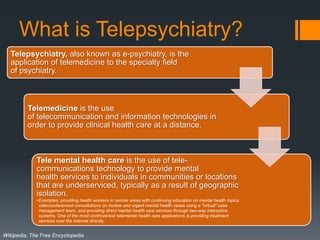
What is Telepsychiatry?
   Telepsychiatry, also known as e-psychiatry, is the
   application of telemedicine to the specialty field
   of psychiatry.


         Telemedicine is the use
         of telecommunication and information technologies in
         order to provide clinical health care at a distance.


             Tele mental health care is the use of tele-
             communications technology to provide mental
             health services to individuals in communities or locations
             that are underserviced, typically as a result of geographic
             isolation.
             โ€ข Examples: providing health workers in remote areas with continuing education on mental health topics,
               videoconferenced consultations on routine and urgent mental health cases using a "virtual" case
               management team, and providing direct mental health care services through two-way interactive
               systems. One of the most controversial telemental health care applications is providing treatment
               services over the Internet directly.


Wikipedia, The Free Encyclopedia
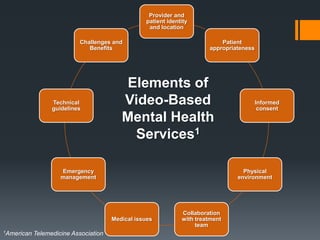
Provider and
                                                  patient identity
                                                   and location

                           Challenges and                                   Patient
                              Benefits                                  appropriateness


                                          Elements of
                  Technical
                  guidelines
                                          Video-Based                                     Informed
                                                                                           consent
                                          Mental Health
                                           Services1

                     Emergency                                                     Physical
                     management                                                  environment


                                                               Collaboration
                                       Medical issues          with treatment
                                                                    team
1American   Telemedicine Association
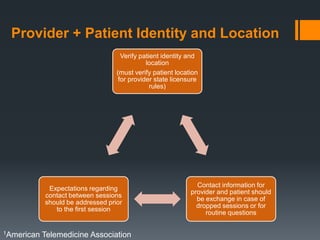
Provider + Patient Identity and Location
                                     Verify patient identity and
                                              location
                                   (must verify patient location
                                    for provider state licensure
                                                rules)


                                                               Contact information for
             Expectations regarding
                                                             provider and patient should
            contact between sessions
                                                               be exchange in case of
            should be addressed prior
                                                               dropped sessions or for
               to the first session
                                                                  routine questions


1American   Telemedicine Association
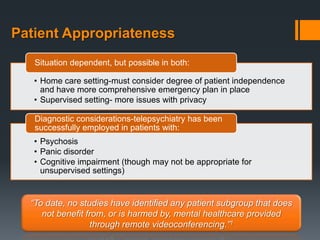
Patient Appropriateness
   Situation dependent, but possible in both:

   โ€ข Home care setting-must consider degree of patient independence
     and have more comprehensive emergency plan in place
   โ€ข Supervised setting- more issues with privacy

   Diagnostic considerations-telepsychiatry has been
   successfully employed in patients with:
   โ€ข Psychosis
   โ€ข Panic disorder
   โ€ข Cognitive impairment (though may not be appropriate for
     unsupervised settings)


  โ€œTo date, no studies have identified any patient subgroup that does
     not benefit from, or is harmed by, mental healthcare provided
                  through remote videoconferencing.โ€1
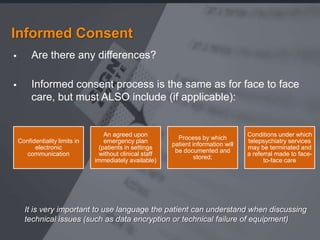
Informed Consent
๏‚ง        Are there any differences?

๏‚ง        Informed consent process is the same as for face to face
         care, but must ALSO include (if applicable):


                                   An agreed upon                                    Conditions under which
                                                            Process by which
    Confidentiality limits in      emergency plan                                    telepsychiatry services
                                                          patient information will
          electronic             (patients in settings                               may be terminated and
                                                           be documented and
       communication             without clinical staff                              a referral made to face-
                                                                   stored;
                                immediately available)                                     to-face care


      It is very important to use language the patient can understand when discussing
      technical issues (such as data encryption or technical failure of equipment)
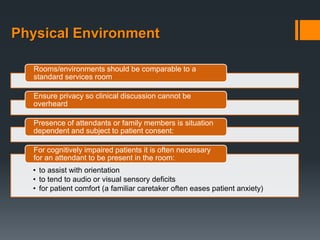
Physical Environment

   Rooms/environments should be comparable to a
   standard services room

   Ensure privacy so clinical discussion cannot be
   overheard

   Presence of attendants or family members is situation
   dependent and subject to patient consent:

   For cognitively impaired patients it is often necessary
   for an attendant to be present in the room:
  โ€ข to assist with orientation
  โ€ข to tend to audio or visual sensory deficits
  โ€ข for patient comfort (a familiar caretaker often eases patient anxiety)
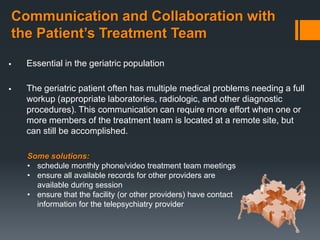
Communication and Collaboration with
the Patientโ€™s Treatment Team
๏‚ง   Essential in the geriatric population

๏‚ง   The geriatric patient often has multiple medical problems needing a full
    workup (appropriate laboratories, radiologic, and other diagnostic
    procedures). This communication can require more effort when one or
    more members of the treatment team is located at a remote site, but
    can still be accomplished.

    Some solutions:
    โ€ข schedule monthly phone/video treatment team meetings
    โ€ข ensure all available records for other providers are
      available during session
    โ€ข ensure that the facility (or other providers) have contact
      information for the telepsychiatry provider
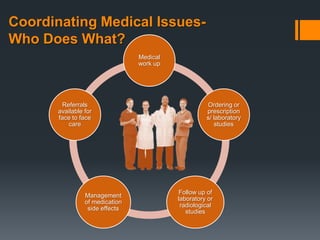
Coordinating Medical Issues-
Who Does What?
                                 Medical
                                 work up


        Referrals                                    Ordering or
       available for                                 prescription
       face to face                                  s/ laboratory
          care                                          studies


                                            Follow up of
                 Management
                                           laboratory or
                 of medication
                                            radiological
                  side effects
                                              studies
Emergency Management


๏‚ง Based on the facilityโ€™s emergency procedures
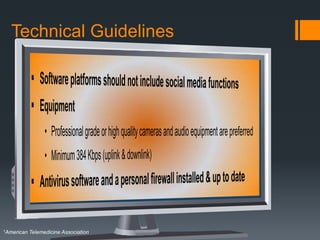
Technical Guidelines


1American   Telemedicine Association
Technical Contingencies

๏‚ง Technology โ€œbreakdownโ€
 โ€ข Poor/no audio
 โ€ข Poor/no video
 โ€ข Dropped sessions


๏‚ง Backup plans
 โ€ข Discussed with patient before session
 โ€ข Alternate contact information


  Backup plans include calling the patient or facility via telephone and
  attempting to troubleshoot the issue. Sessions may be continued by
                    telephone (situation dependent).
Privacy
๏‚ง Recognized encryption standards for
  transmission of video & audio
  โ€ข   Federal Information Processing Standard
  โ€ข   Advanced Encryption Standard (AES)


๏‚ง Physical environment (facility limitations)

๏‚ง Appropriate security of medical records


1American   Telemedicine Association
Challenges
๏‚ง       Remote facilities and available internet speed
๏‚ง       Patients with sensory impairments - The patient
        end would ideally have large monitors, good audio
        capabilities, and high bandwidth and video
        resolution to make sure there is a large and clear
        picture for the elderly
๏‚ง       Increased reliance on facility staff, e.g.:
    ๏‚ง    to assist with patients with disabilities,
    ๏‚ง    to give limited physical exams (AIMS test), and
    ๏‚ง    occasionally track down or confirm medication/lab values
Overall Benefits - Options!


 ๏ƒ˜   Choice of providers
 ๏ƒ˜   Transportation
 ๏ƒ˜   Scheduling


                               Bottom Line:
     Delivering services to patients who would otherwise go without
References
1. Coleman, M., Dennison, O., Drude, K., Goldenson, M., Hirsch, P.,
   Kramer, G., โ€ฆ Zucker, M. (2013). Practice Guidelines for Video-
   Based Online Mental Health Services-DRAFT. American
   Telemedicine Association. Retrieved from
   http://www.americantelemed.org/practice/standards/ata-standards-
   guidelines

Dr Erin Morrison webinar slides (2)

  • 1.
    Best Practices in Psychiatry and LongTerm Care: TELEPSYCHIATRY Erin Morrison, MD
  • 2.
    What is Telepsychiatry? Telepsychiatry, also known as e-psychiatry, is the application of telemedicine to the specialty field of psychiatry. Telemedicine is the use of telecommunication and information technologies in order to provide clinical health care at a distance. Tele mental health care is the use of tele- communications technology to provide mental health services to individuals in communities or locations that are underserviced, typically as a result of geographic isolation. โ€ข Examples: providing health workers in remote areas with continuing education on mental health topics, videoconferenced consultations on routine and urgent mental health cases using a "virtual" case management team, and providing direct mental health care services through two-way interactive systems. One of the most controversial telemental health care applications is providing treatment services over the Internet directly. Wikipedia, The Free Encyclopedia
  • 3.
    Provider and patient identity and location Challenges and Patient Benefits appropriateness Elements of Technical guidelines Video-Based Informed consent Mental Health Services1 Emergency Physical management environment Collaboration Medical issues with treatment team 1American Telemedicine Association
  • 4.
    Provider + PatientIdentity and Location Verify patient identity and location (must verify patient location for provider state licensure rules) Contact information for Expectations regarding provider and patient should contact between sessions be exchange in case of should be addressed prior dropped sessions or for to the first session routine questions 1American Telemedicine Association
  • 5.
    Patient Appropriateness Situation dependent, but possible in both: โ€ข Home care setting-must consider degree of patient independence and have more comprehensive emergency plan in place โ€ข Supervised setting- more issues with privacy Diagnostic considerations-telepsychiatry has been successfully employed in patients with: โ€ข Psychosis โ€ข Panic disorder โ€ข Cognitive impairment (though may not be appropriate for unsupervised settings) โ€œTo date, no studies have identified any patient subgroup that does not benefit from, or is harmed by, mental healthcare provided through remote videoconferencing.โ€1
  • 6.
    Informed Consent ๏‚ง Are there any differences? ๏‚ง Informed consent process is the same as for face to face care, but must ALSO include (if applicable): An agreed upon Conditions under which Process by which Confidentiality limits in emergency plan telepsychiatry services patient information will electronic (patients in settings may be terminated and be documented and communication without clinical staff a referral made to face- stored; immediately available) to-face care It is very important to use language the patient can understand when discussing technical issues (such as data encryption or technical failure of equipment)
  • 7.
    Physical Environment Rooms/environments should be comparable to a standard services room Ensure privacy so clinical discussion cannot be overheard Presence of attendants or family members is situation dependent and subject to patient consent: For cognitively impaired patients it is often necessary for an attendant to be present in the room: โ€ข to assist with orientation โ€ข to tend to audio or visual sensory deficits โ€ข for patient comfort (a familiar caretaker often eases patient anxiety)
  • 8.
    Communication and Collaborationwith the Patientโ€™s Treatment Team ๏‚ง Essential in the geriatric population ๏‚ง The geriatric patient often has multiple medical problems needing a full workup (appropriate laboratories, radiologic, and other diagnostic procedures). This communication can require more effort when one or more members of the treatment team is located at a remote site, but can still be accomplished. Some solutions: โ€ข schedule monthly phone/video treatment team meetings โ€ข ensure all available records for other providers are available during session โ€ข ensure that the facility (or other providers) have contact information for the telepsychiatry provider
  • 9.
    Coordinating Medical Issues- WhoDoes What? Medical work up Referrals Ordering or available for prescription face to face s/ laboratory care studies Follow up of Management laboratory or of medication radiological side effects studies
  • 10.
    Emergency Management ๏‚ง Basedon the facilityโ€™s emergency procedures
  • 11.
    Technical Guidelines 1American Telemedicine Association
  • 12.
    Technical Contingencies ๏‚ง Technologyโ€œbreakdownโ€ โ€ข Poor/no audio โ€ข Poor/no video โ€ข Dropped sessions ๏‚ง Backup plans โ€ข Discussed with patient before session โ€ข Alternate contact information Backup plans include calling the patient or facility via telephone and attempting to troubleshoot the issue. Sessions may be continued by telephone (situation dependent).
  • 13.
    Privacy ๏‚ง Recognized encryptionstandards for transmission of video & audio โ€ข Federal Information Processing Standard โ€ข Advanced Encryption Standard (AES) ๏‚ง Physical environment (facility limitations) ๏‚ง Appropriate security of medical records 1American Telemedicine Association
  • 14.
    Challenges ๏‚ง Remote facilities and available internet speed ๏‚ง Patients with sensory impairments - The patient end would ideally have large monitors, good audio capabilities, and high bandwidth and video resolution to make sure there is a large and clear picture for the elderly ๏‚ง Increased reliance on facility staff, e.g.: ๏‚ง to assist with patients with disabilities, ๏‚ง to give limited physical exams (AIMS test), and ๏‚ง occasionally track down or confirm medication/lab values
  • 15.
    Overall Benefits -Options! ๏ƒ˜ Choice of providers ๏ƒ˜ Transportation ๏ƒ˜ Scheduling Bottom Line: Delivering services to patients who would otherwise go without
  • 16.
    References 1. Coleman, M.,Dennison, O., Drude, K., Goldenson, M., Hirsch, P., Kramer, G., โ€ฆ Zucker, M. (2013). Practice Guidelines for Video- Based Online Mental Health Services-DRAFT. American Telemedicine Association. Retrieved from http://www.americantelemed.org/practice/standards/ata-standards- guidelines

Editor's Notes

  • #7ย Pt refusal of treatment? Cognitively impaired pts , even lucid patients really know what they are agreeing to?