Professionalism in nursing:
a concept analysis
Mrs. S.D. Mottian
Prof. Christa Van Der Walt
North-West University (Potchefstroom Campus)
INTRODUCTION
 The concept professionalism is multifaceted, & in
spite of much research done, it is still poorly
conceptualised4.
 Poor understanding of the concept within the nursing
profession:
 Affects adequate development of valid instruments
to assess professionalism.
 Affects nursing practice, health care service
delivery & the image of the profession.
 Unfortunately, professionalism in nursing appears to
be deteriorating.
 Nursing students entering the profession are at risk of
assimilating unprofessional behavior, from their
colleagues, which negatively affects quality service
delivery.
 Nurse educators vital role in facilitating students
professional socialization helps in moulding them into
the profession during integration of fundamental
norms, values & standards governing the profession.
BACKGROUND
 Professionalism is believed to occur during
the period students are in basic nursing
programmes continuing after graduation
during practice1
 Many role models (educators, clinical
educators) other professionals & fellow
students shape development of the student’s
professional character/ attitude & behaviour 5
 Preparation to practice a profession is
complex, requiring students to learn skills
and knowledge to take up norms & traditions
of the chosen profession.
 Students depend on support / guidance/
supervision & care of RN’s in clinical practice
to develop into confident & capable
practitioners3
 Poor conceptualization of professionalism
limits content & construct validity of measuring
instruments.
 A better understanding of professionalism
enables development of valid measuring
instruments, assisting educators to measure
growth & development of professionalism or
lack thereof during students’ years of training.
AIM AND OBJECTIVE
 To define professionalism within the
nursing profession.
 To conduct a concept analysis of
professionalism to construct a
connotative (theoretical) definition in
nursing.
METHOD & FINDINGS
A concept analysis was conducted using the 8
steps recommended by Walker & Avant (2011)
based on Wilson’s work (1963). The steps are:
1. Select concept- professionalism was selected
2. Determine purpose of the analysis- The
concept professionalism is currently poorly
conceptualized.
 Assessing the level of professionalism to
facilitate professionalism in nurses might lack
conceptual clarity.
 Concept analysis aimed to critically analyze the
concept professionalism, determine its
identifying attributes (connotation) & develop a
theoretical definition.
 Based on the attributes & definition, empirical
indicators can be identified to formulate a
denotative definition.
 Development of empirical indicators did not fall
in the scope of this study & should be
addressed in further research.
3. Identify uses of the concept- Unit of analysis was
the definition of professionalism as it appeared in general
& professional literature.
 A search strategy based on systematic reviews
enabled locating many definitions of professionalism
as possible in both scientific & non-scientific sources.
4. Determine the defining attributes - Analysis
involved deductive & inductive reasoning to theoretically
define professionalism & describe attributes of the
concept.
 This logic reasoning helped generate concluding
statements from the empirical data
Determine the defining attributes
 Thematic analysis (qualitative in nature)-
resulted in identification of various uses of
professionalism & extraction of attributes as it
appeared in definitions
 This enabled identification of all possible uses
of the concept in ordinary & professional
literature6,2
 Repeated attributes identified were described
as the defining attributes of professionalism.
Determine the defining attributes
 Most frequently identified attributes was obtained
by quantitative content analysis, involving
systematic & objective reduction of the data into
categories.
 This was primarily deductive in nature, structured
& helped refine the key attributes7
 Repeated attributes identified in the ordinary &
professional meaning of professionalism was
further categorized into knowledge, attitudes &
behaviors attempting to obtain key attributes.
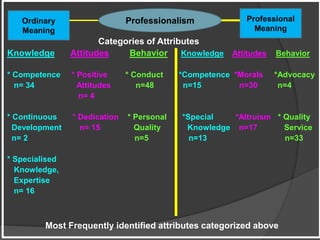
The mind map following denotes these categories
& key attributes:-
Categories of Attributes
Knowledge Attitudes Behavior Knowledge Attitudes Behavior
* Competence * Positive * Conduct *Competence *Morals *Advocacy
n= 34 Attitudes n=48 n=15 n=30 n=4
n= 4
* Continuous * Dedication * Personal *Special *Altruism * Quality
Development n= 15 Quality Knowledge n=17 Service
n= 2 n=5 n=13 n=33
* Specialised
Knowledge,
Expertise
n= 16
Most Frequently identified attributes categorized above
Ordinary
Meaning
Professional
Meaning
Professionalism
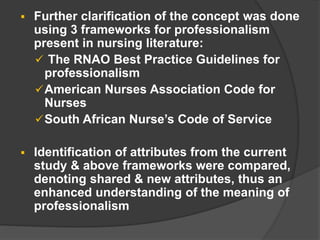
 Further clarification of the concept was done
using 3 frameworks for professionalism
present in nursing literature:
 The RNAO Best Practice Guidelines for
professionalism
American Nurses Association Code for
Nurses
South African Nurse’s Code of Service
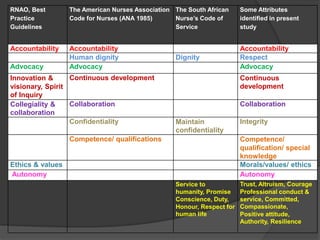
 Identification of attributes from the current
study & above frameworks were compared,
denoting shared & new attributes, thus an
enhanced understanding of the meaning of
professionalism
RNAO, Best
Practice
Guidelines
The American Nurses Association
Code for Nurses (ANA 1985)
The South African
Nurse’s Code of
Service
Some Attributes
identified in present
study
Accountability Accountability Accountability
Human dignity Dignity Respect
Advocacy Advocacy Advocacy
Innovation &
visionary, Spirit
of Inquiry
Continuous development Continuous
development
Collegiality &
collaboration
Collaboration Collaboration
Confidentiality Maintain
confidentiality
Integrity
Competence/ qualifications Competence/
qualification/ special
knowledge
Ethics & values Morals/values/ ethics
Autonomy Autonomy
Service to
humanity, Promise
Conscience, Duty,
Honour, Respect for
human life
Trust, Altruism, Courage
Professional conduct &
service, Committed,
Compassionate,
Positive attitude,
Authority, Resilience
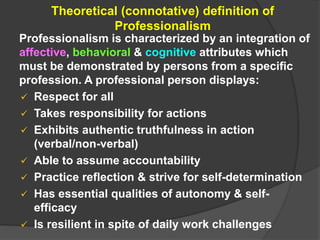
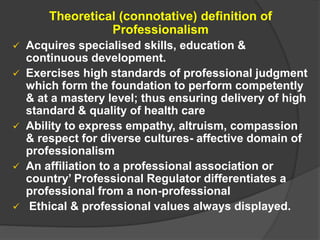
Theoretical (connotative) definition of
Professionalism
Professionalism is characterized by an integration of
affective, behavioral & cognitive attributes which
must be demonstrated by persons from a specific
profession. A professional person displays:
 Respect for all
 Takes responsibility for actions
 Exhibits authentic truthfulness in action
(verbal/non-verbal)
 Able to assume accountability
 Practice reflection & strive for self-determination
 Has essential qualities of autonomy & self-
efficacy
 Is resilient in spite of daily work challenges
Theoretical (connotative) definition of
Professionalism
 Acquires specialised skills, education &
continuous development.
 Exercises high standards of professional judgment
which form the foundation to perform competently
& at a mastery level; thus ensuring delivery of high
standard & quality of health care
 Ability to express empathy, altruism, compassion
& respect for diverse cultures- affective domain of
professionalism
 An affiliation to a professional association or
country’ Professional Regulator differentiates a
professional from a non-professional
 Ethical & professional values always displayed.
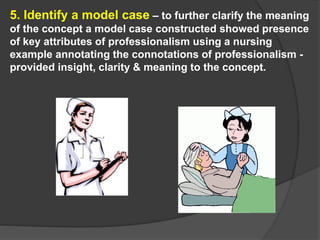
5. Identify a model case – to further clarify the meaning
of the concept a model case constructed showed presence
of key attributes of professionalism using a nursing
example annotating the connotations of professionalism -
provided insight, clarity & meaning to the concept.
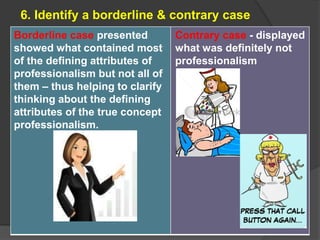
6. Identify a borderline & contrary case
Borderline case presented
showed what contained most
of the defining attributes of
professionalism but not all of
them – thus helping to clarify
thinking about the defining
attributes of the true concept
professionalism.
Contrary case - displayed
what was definitely not
professionalism
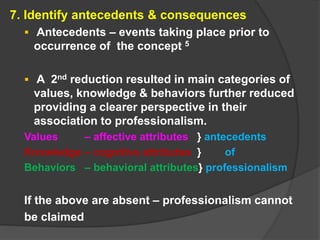
7. Identify antecedents & consequences
 Antecedents – events taking place prior to
occurrence of the concept 5
 A 2nd reduction resulted in main categories of
values, knowledge & behaviors further reduced
providing a clearer perspective in their
association to professionalism.
Values – affective attributes } antecedents
Knowledge – cognitive attributes } of
Behaviors – behavioral attributes} professionalism
If the above are absent – professionalism cannot
be claimed
 Consequences – events occurring due to
presence of the concept. Consequences of
professionalism recognised from all
definitions & cases were as follows:
Expertness
Professional conduct
Exercising high standards of trained
judgement
Learned values
Mastery of knowledge, skill & competency
Consequences help further refine the defining
attributes
8. Empirical Referents - Identification &
description of empirical referents of
professionalism would permit construction of a
denotative (operational) definition of
professionalism in nursing.
On viewing the theoretical definition of
professionalism more extensive work is required
to gain better understanding to identify empirical
referents of professionalism & to construct an
operational definition- a recommendation for
further research.
CONCLUSION
 The meaning of professionalism as a concept featured
more regularly in the medical profession but also
appeared in professions of lawyers, social workers,
teachers, engineers & psychologists.
 This indicates applicability of the concept to different
professions.
 Various professions highlight different attributes
unique to that particular profession.
 Affective attributes like altruism & compassion appear
predominantly in the nursing & medical professions &
not highlighted in engineering & law professions.
 The nursing profession like some health professions
highlight certain attributes distinguishing them from
most other professions.
 Nursing profession – entails working with people every
day, including nurses, doctors, patients, administrative
staff and community members.
 These individuals have a different perspective of the
nurse & what is required of the profession.
 However the defining attributes demonstrated by the
nurse will create a sense of commonality that will guide
other people’s understanding & expectations of
professionalism in nursing.
REFERENCES
1. Karaoz, S. 2005. Turkish nursing students’ perception of caring. Nurse Education
Today, 25:31-40.
2. Lewis-Beck, M.S., Bryman, A. & Liao, T.F. 2004. The Sage Encyclopedia of Social
Science Research Methods. Volume 1. California: SAGE Publications.
3. Mabuda, B.T., Potgieter, E. & Alberts, U.U. 2008. Student nurses’ experiences
during clinical practice in the Limpopo Province. Curationis, 31(1):19-27.
4. Registered Nurses Association of Ontario. 2007. Nursing best practice guidelines
program. Healthy work environments best practice guidelines. Professionalism in
nursing. Toronto: RNAO
5. Van Mook, W.N.K.A., Van Luijk, S.J., De Grave, W., O’Sullivan, H., Wass, V., V.,
Schuwirth, L.W., Van der Vleuten, C.P.M. 2009. Teaching & learning professional
behavior in practice. European Journal of Internal Medicine, 20:105-111.
6. Walker, L.O. & Avant, K.C. Strategies for theory construction in nursing. 5th ed.
Boston: Prentice Hall
7. Waltz, C.F., Strickland, O. & Lenz, E.R. 2010. Measurement in nursing & health
research. 4th ed. New York: Springer Publishing Company.

Professionalism in nursing:a concept analysis

  • 1.
    Professionalism in nursing: aconcept analysis Mrs. S.D. Mottian Prof. Christa Van Der Walt North-West University (Potchefstroom Campus)
  • 2.
    INTRODUCTION  The conceptprofessionalism is multifaceted, & in spite of much research done, it is still poorly conceptualised4.  Poor understanding of the concept within the nursing profession:  Affects adequate development of valid instruments to assess professionalism.  Affects nursing practice, health care service delivery & the image of the profession.
  • 3.
     Unfortunately, professionalismin nursing appears to be deteriorating.  Nursing students entering the profession are at risk of assimilating unprofessional behavior, from their colleagues, which negatively affects quality service delivery.  Nurse educators vital role in facilitating students professional socialization helps in moulding them into the profession during integration of fundamental norms, values & standards governing the profession.
  • 4.
    BACKGROUND  Professionalism isbelieved to occur during the period students are in basic nursing programmes continuing after graduation during practice1  Many role models (educators, clinical educators) other professionals & fellow students shape development of the student’s professional character/ attitude & behaviour 5
  • 5.
     Preparation topractice a profession is complex, requiring students to learn skills and knowledge to take up norms & traditions of the chosen profession.  Students depend on support / guidance/ supervision & care of RN’s in clinical practice to develop into confident & capable practitioners3
  • 6.
     Poor conceptualizationof professionalism limits content & construct validity of measuring instruments.  A better understanding of professionalism enables development of valid measuring instruments, assisting educators to measure growth & development of professionalism or lack thereof during students’ years of training.
  • 7.
    AIM AND OBJECTIVE To define professionalism within the nursing profession.  To conduct a concept analysis of professionalism to construct a connotative (theoretical) definition in nursing.
  • 8.
    METHOD & FINDINGS Aconcept analysis was conducted using the 8 steps recommended by Walker & Avant (2011) based on Wilson’s work (1963). The steps are: 1. Select concept- professionalism was selected 2. Determine purpose of the analysis- The concept professionalism is currently poorly conceptualized.  Assessing the level of professionalism to facilitate professionalism in nurses might lack conceptual clarity.
  • 9.
     Concept analysisaimed to critically analyze the concept professionalism, determine its identifying attributes (connotation) & develop a theoretical definition.  Based on the attributes & definition, empirical indicators can be identified to formulate a denotative definition.  Development of empirical indicators did not fall in the scope of this study & should be addressed in further research.
  • 10.
    3. Identify usesof the concept- Unit of analysis was the definition of professionalism as it appeared in general & professional literature.  A search strategy based on systematic reviews enabled locating many definitions of professionalism as possible in both scientific & non-scientific sources. 4. Determine the defining attributes - Analysis involved deductive & inductive reasoning to theoretically define professionalism & describe attributes of the concept.  This logic reasoning helped generate concluding statements from the empirical data
  • 11.
    Determine the definingattributes  Thematic analysis (qualitative in nature)- resulted in identification of various uses of professionalism & extraction of attributes as it appeared in definitions  This enabled identification of all possible uses of the concept in ordinary & professional literature6,2  Repeated attributes identified were described as the defining attributes of professionalism.
  • 12.
    Determine the definingattributes  Most frequently identified attributes was obtained by quantitative content analysis, involving systematic & objective reduction of the data into categories.  This was primarily deductive in nature, structured & helped refine the key attributes7  Repeated attributes identified in the ordinary & professional meaning of professionalism was further categorized into knowledge, attitudes & behaviors attempting to obtain key attributes. The mind map following denotes these categories & key attributes:-
  • 13.
    Categories of Attributes KnowledgeAttitudes Behavior Knowledge Attitudes Behavior * Competence * Positive * Conduct *Competence *Morals *Advocacy n= 34 Attitudes n=48 n=15 n=30 n=4 n= 4 * Continuous * Dedication * Personal *Special *Altruism * Quality Development n= 15 Quality Knowledge n=17 Service n= 2 n=5 n=13 n=33 * Specialised Knowledge, Expertise n= 16 Most Frequently identified attributes categorized above Ordinary Meaning Professional Meaning Professionalism
  • 14.
     Further clarificationof the concept was done using 3 frameworks for professionalism present in nursing literature:  The RNAO Best Practice Guidelines for professionalism American Nurses Association Code for Nurses South African Nurse’s Code of Service  Identification of attributes from the current study & above frameworks were compared, denoting shared & new attributes, thus an enhanced understanding of the meaning of professionalism
  • 15.
    RNAO, Best Practice Guidelines The AmericanNurses Association Code for Nurses (ANA 1985) The South African Nurse’s Code of Service Some Attributes identified in present study Accountability Accountability Accountability Human dignity Dignity Respect Advocacy Advocacy Advocacy Innovation & visionary, Spirit of Inquiry Continuous development Continuous development Collegiality & collaboration Collaboration Collaboration Confidentiality Maintain confidentiality Integrity Competence/ qualifications Competence/ qualification/ special knowledge Ethics & values Morals/values/ ethics Autonomy Autonomy Service to humanity, Promise Conscience, Duty, Honour, Respect for human life Trust, Altruism, Courage Professional conduct & service, Committed, Compassionate, Positive attitude, Authority, Resilience
  • 16.
    Theoretical (connotative) definitionof Professionalism Professionalism is characterized by an integration of affective, behavioral & cognitive attributes which must be demonstrated by persons from a specific profession. A professional person displays:  Respect for all  Takes responsibility for actions  Exhibits authentic truthfulness in action (verbal/non-verbal)  Able to assume accountability  Practice reflection & strive for self-determination  Has essential qualities of autonomy & self- efficacy  Is resilient in spite of daily work challenges
  • 17.
    Theoretical (connotative) definitionof Professionalism  Acquires specialised skills, education & continuous development.  Exercises high standards of professional judgment which form the foundation to perform competently & at a mastery level; thus ensuring delivery of high standard & quality of health care  Ability to express empathy, altruism, compassion & respect for diverse cultures- affective domain of professionalism  An affiliation to a professional association or country’ Professional Regulator differentiates a professional from a non-professional  Ethical & professional values always displayed.
  • 18.
    5. Identify amodel case – to further clarify the meaning of the concept a model case constructed showed presence of key attributes of professionalism using a nursing example annotating the connotations of professionalism - provided insight, clarity & meaning to the concept.
  • 19.
    6. Identify aborderline & contrary case Borderline case presented showed what contained most of the defining attributes of professionalism but not all of them – thus helping to clarify thinking about the defining attributes of the true concept professionalism. Contrary case - displayed what was definitely not professionalism
  • 20.
    7. Identify antecedents& consequences  Antecedents – events taking place prior to occurrence of the concept 5  A 2nd reduction resulted in main categories of values, knowledge & behaviors further reduced providing a clearer perspective in their association to professionalism. Values – affective attributes } antecedents Knowledge – cognitive attributes } of Behaviors – behavioral attributes} professionalism If the above are absent – professionalism cannot be claimed
  • 21.
     Consequences –events occurring due to presence of the concept. Consequences of professionalism recognised from all definitions & cases were as follows: Expertness Professional conduct Exercising high standards of trained judgement Learned values Mastery of knowledge, skill & competency Consequences help further refine the defining attributes
  • 22.
    8. Empirical Referents- Identification & description of empirical referents of professionalism would permit construction of a denotative (operational) definition of professionalism in nursing. On viewing the theoretical definition of professionalism more extensive work is required to gain better understanding to identify empirical referents of professionalism & to construct an operational definition- a recommendation for further research.
  • 23.
    CONCLUSION  The meaningof professionalism as a concept featured more regularly in the medical profession but also appeared in professions of lawyers, social workers, teachers, engineers & psychologists.  This indicates applicability of the concept to different professions.  Various professions highlight different attributes unique to that particular profession.  Affective attributes like altruism & compassion appear predominantly in the nursing & medical professions & not highlighted in engineering & law professions.
  • 24.
     The nursingprofession like some health professions highlight certain attributes distinguishing them from most other professions.  Nursing profession – entails working with people every day, including nurses, doctors, patients, administrative staff and community members.  These individuals have a different perspective of the nurse & what is required of the profession.  However the defining attributes demonstrated by the nurse will create a sense of commonality that will guide other people’s understanding & expectations of professionalism in nursing.
  • 25.
    REFERENCES 1. Karaoz, S.2005. Turkish nursing students’ perception of caring. Nurse Education Today, 25:31-40. 2. Lewis-Beck, M.S., Bryman, A. & Liao, T.F. 2004. The Sage Encyclopedia of Social Science Research Methods. Volume 1. California: SAGE Publications. 3. Mabuda, B.T., Potgieter, E. & Alberts, U.U. 2008. Student nurses’ experiences during clinical practice in the Limpopo Province. Curationis, 31(1):19-27. 4. Registered Nurses Association of Ontario. 2007. Nursing best practice guidelines program. Healthy work environments best practice guidelines. Professionalism in nursing. Toronto: RNAO 5. Van Mook, W.N.K.A., Van Luijk, S.J., De Grave, W., O’Sullivan, H., Wass, V., V., Schuwirth, L.W., Van der Vleuten, C.P.M. 2009. Teaching & learning professional behavior in practice. European Journal of Internal Medicine, 20:105-111. 6. Walker, L.O. & Avant, K.C. Strategies for theory construction in nursing. 5th ed. Boston: Prentice Hall 7. Waltz, C.F., Strickland, O. & Lenz, E.R. 2010. Measurement in nursing & health research. 4th ed. New York: Springer Publishing Company.