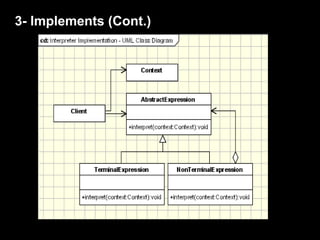
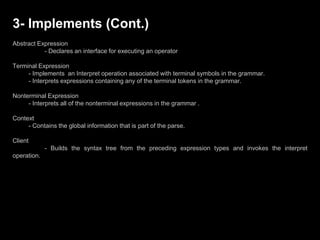
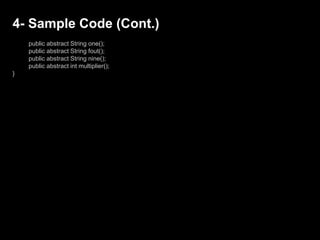
The Interpreter design pattern allows defining a representation for a grammar and an interpreter that uses the representation to interpret sentences in a language. It defines interfaces for terminal and nonterminal expressions and an interpreter context. Terminal expressions interpret terminal tokens while nonterminal expressions interpret nonterminal expressions. The context contains global information used during parsing and interpretation. The pattern is useful for implementing rule engines and adding functionality to composite pattern implementations. It allows embedding domain-specific languages in programs and simplifies changing and extending grammars.