Interpreter Design Pattern
Introduction to Interpreter Pattern
• The Interpreter pattern uses a class to represent each
grammar rule.
• Abstract syntax trees (ASTs) are built using instances
of these classes to interpret expressions.
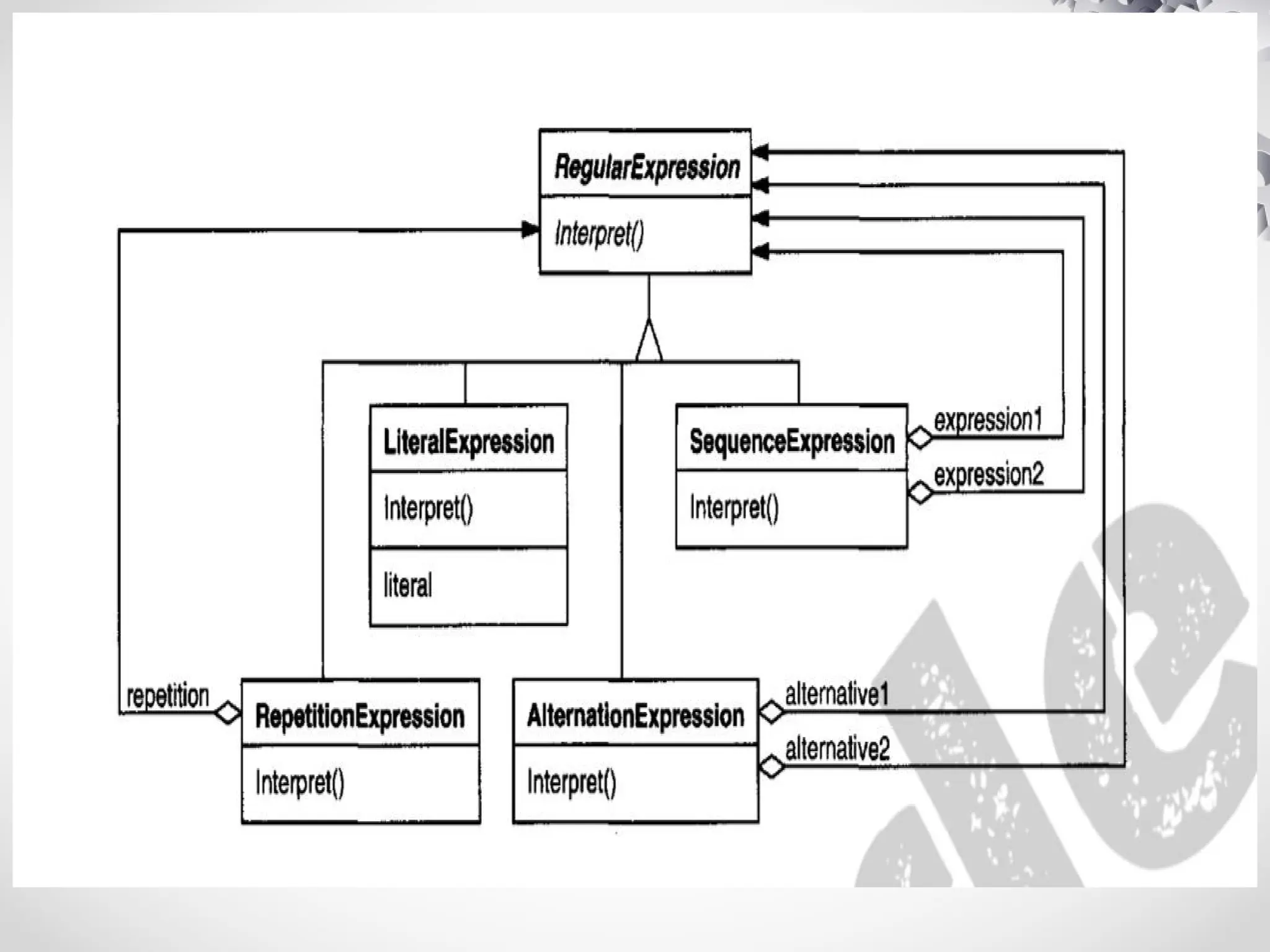
Key Classes in the Grammar
1. AbstractExpression: Base class for grammar rules.
2. LiteralExpression: Matches literal values in the input.
3. AlternationExpression: Matches one of its alternatives.
4. SequenceExpression: Matches a sequence of
subexpressions.
5. RepetitionExpression: Matches repeated occurrences of
an expression.
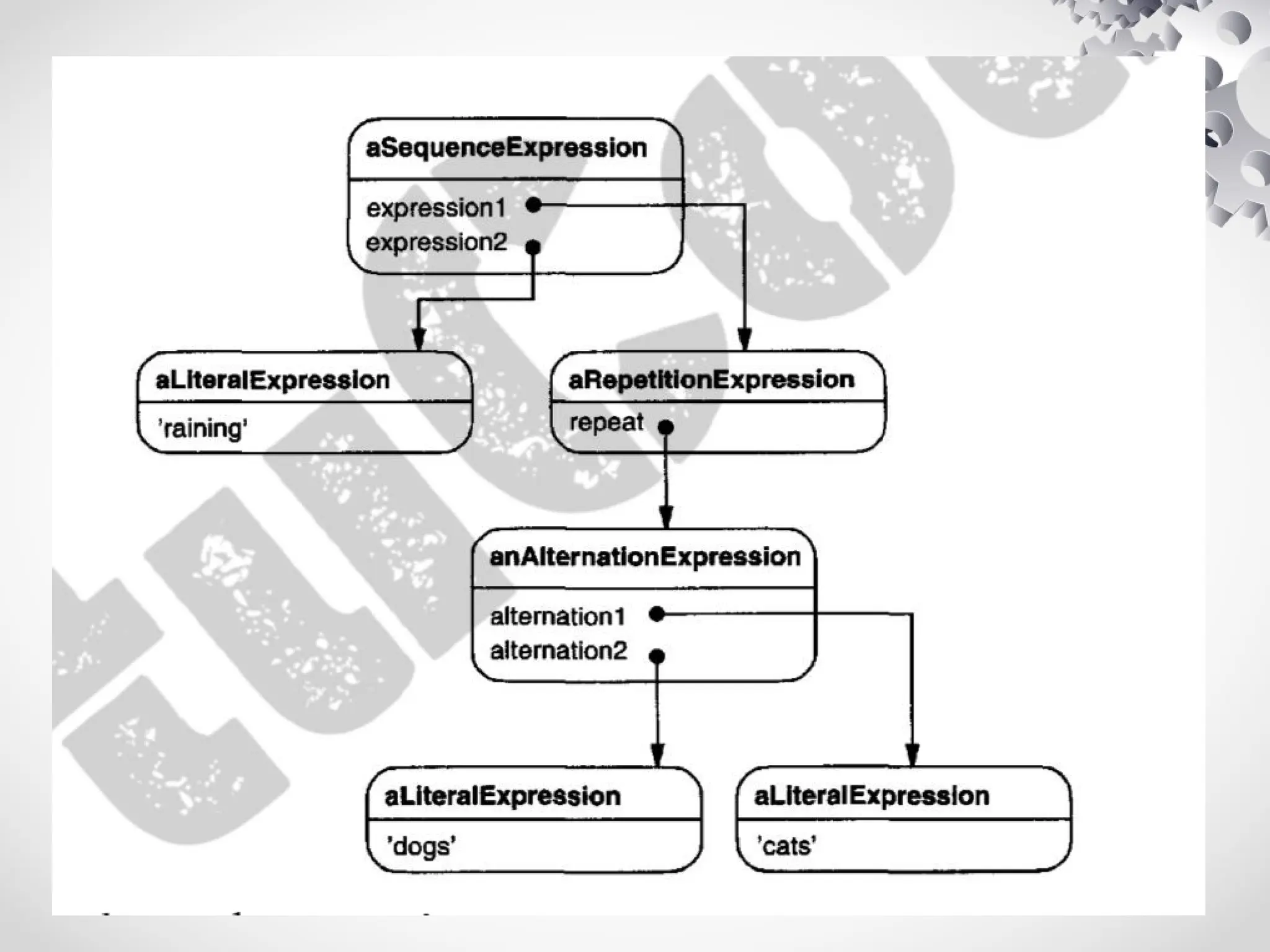
Abstract Syntax Tree Example
• Expression: raining & (dogs | cats)*
• The AST is built using:
• LiteralExpression for 'raining'.
• AlternationExpression for 'dogs | cats'.
• RepetitionExpression for '*'.
Interpret Method in Subclasses
• Each subclass of RegularExpression implements
Interpret:
• - LiteralExpression: Matches the literal value.
• - AlternationExpression: Matches alternatives.
• - RepetitionExpression: Matches repeated
occurrences.
Applicability of Interpreter Pattern
• Use this pattern when:
• Language can be represented as an AST
(Abstract Syntax trees)
• Grammar is simple
• Efficiency is not a critical concern
Structure - Participants
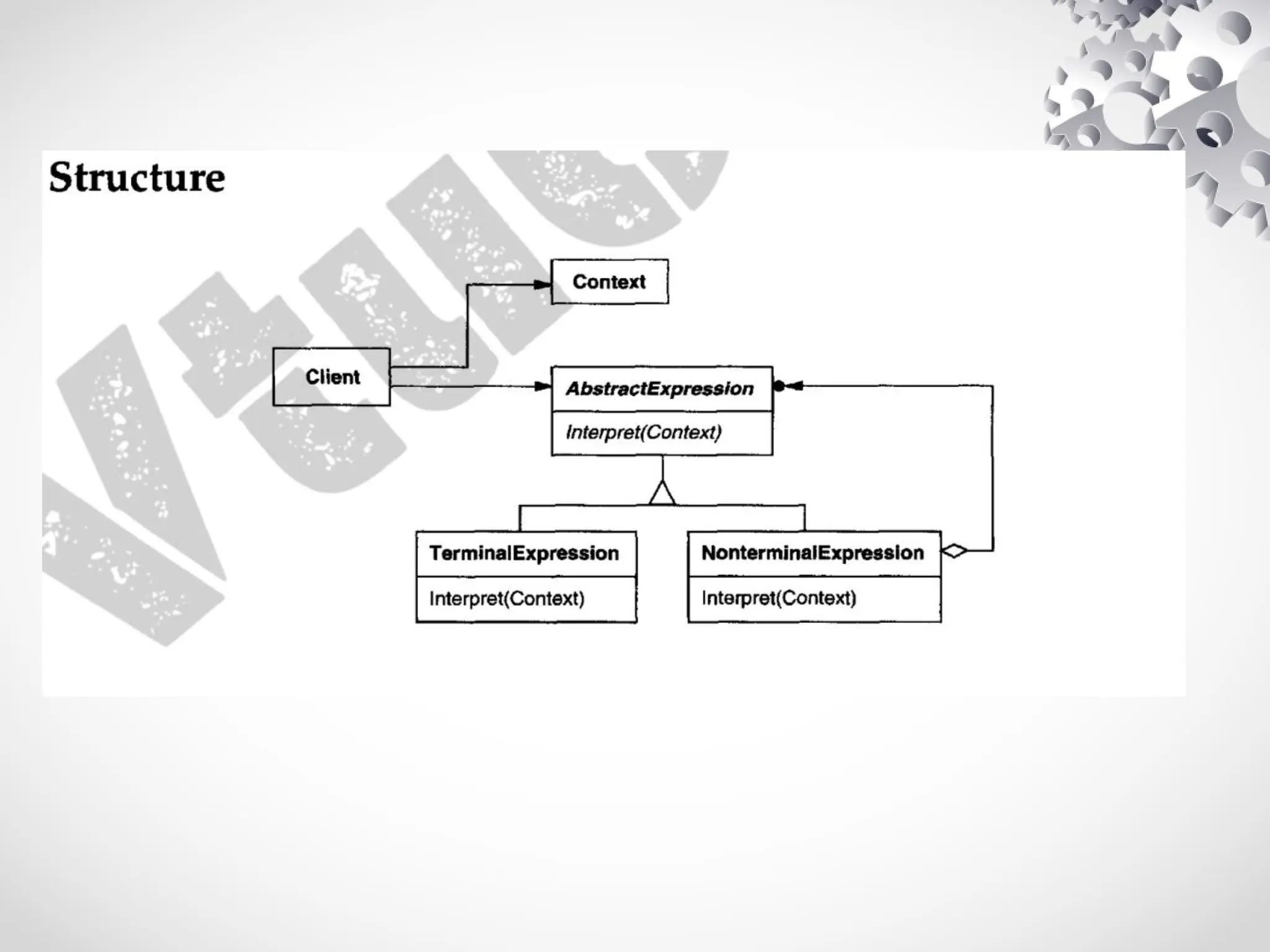
1. AbstractExpression: Declares the Interpret operation.
2. TerminalExpression: Represents terminal symbols.
3. NonterminalExpression: Represents nonterminal rules.
4. Context: Holds global information for the interpreter.
5. Client: Builds the AST and invokes Interpret.
Collaborations
• The Client constructs the AST using
TerminalExpression and NonterminalExpression.
• Context stores interpreter state.
• Interpret operation is recursively called for
subexpressions.
Consequences
Benefits:
• Easy to extend/change grammar.
• Simplifies grammar implementation.
Drawbacks:
• Complex grammars are hard to maintain.
• Inefficient for critical applications.
Implementation Notes
1. Abstract Syntax Tree creation: Requires a parser or client.
2. Visitor Pattern: Useful for multiple interpretations of expressions.
3. Flyweight Pattern: Optimizes shared terminal symbols.
• Example:
• Each LiteralExpression for 'dog' can share a single
instance.
• Context provides substring and state for matching.

Interpreter design pattern ppt (2) (1).pptx

  • 1.
  • 2.
    Introduction to InterpreterPattern • The Interpreter pattern uses a class to represent each grammar rule. • Abstract syntax trees (ASTs) are built using instances of these classes to interpret expressions.
  • 5.
    Key Classes inthe Grammar 1. AbstractExpression: Base class for grammar rules. 2. LiteralExpression: Matches literal values in the input. 3. AlternationExpression: Matches one of its alternatives. 4. SequenceExpression: Matches a sequence of subexpressions. 5. RepetitionExpression: Matches repeated occurrences of an expression.
  • 6.
    Abstract Syntax TreeExample • Expression: raining & (dogs | cats)* • The AST is built using: • LiteralExpression for 'raining'. • AlternationExpression for 'dogs | cats'. • RepetitionExpression for '*'.
  • 7.
    Interpret Method inSubclasses • Each subclass of RegularExpression implements Interpret: • - LiteralExpression: Matches the literal value. • - AlternationExpression: Matches alternatives. • - RepetitionExpression: Matches repeated occurrences.
  • 8.
    Applicability of InterpreterPattern • Use this pattern when: • Language can be represented as an AST (Abstract Syntax trees) • Grammar is simple • Efficiency is not a critical concern
  • 10.
    Structure - Participants 1.AbstractExpression: Declares the Interpret operation. 2. TerminalExpression: Represents terminal symbols. 3. NonterminalExpression: Represents nonterminal rules. 4. Context: Holds global information for the interpreter. 5. Client: Builds the AST and invokes Interpret.
  • 11.
    Collaborations • The Clientconstructs the AST using TerminalExpression and NonterminalExpression. • Context stores interpreter state. • Interpret operation is recursively called for subexpressions.
  • 12.
    Consequences Benefits: • Easy toextend/change grammar. • Simplifies grammar implementation. Drawbacks: • Complex grammars are hard to maintain. • Inefficient for critical applications.
  • 13.
    Implementation Notes 1. AbstractSyntax Tree creation: Requires a parser or client. 2. Visitor Pattern: Useful for multiple interpretations of expressions. 3. Flyweight Pattern: Optimizes shared terminal symbols. • Example: • Each LiteralExpression for 'dog' can share a single instance. • Context provides substring and state for matching.