Presented By
MD. Sad Adnan 162-15-7814
Quazi Zayed Bin Hasan 162-15-7695
Susmita karmakar 162-15-7721
Quazi Zayed Bin Hasan
162-15-7695
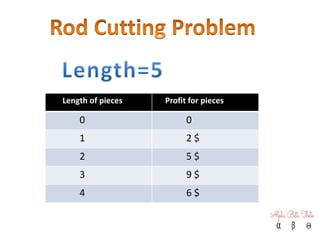
Length of pieces Profit for pieces
0 0
1 2 $
2 5 $
3 9 $
4 6 $
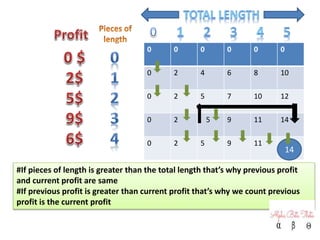
0 0 0 0 0 0
0 2 4 6 8 10
0 2 5 7 10 12
0 2 5 9 11 14
0 2 5 9 11 14
#If pieces of length is greater than the total length that’s why previous profit
and current profit are same
#If previous profit is greater than current profit that’s why we count previous
profit is the current profit
14
MD. Sad Adnan
162-15-7814
Pseudo Code
int priceOfLen[ ] = {0, 2, 5, 9, 6};
int maxProfit( n )
{
for (totalLen  1 to n)
{
tmp  0;
for (partLen  1 to totalLen)
{
thisProfit  priceOfLen[partLen] + maxProfitOfLen[totalLen - partLen];
if (tmp < thisProfit)
{
tmp  thisProfit;
partLenOfLen[totalLen]  partLen;
}
}
maxProfitOfLen[totalLen]  tmp;
}
return maxProfitOfLen[n];
}
Void Divisions( n )
{
while (n > 0)
{
print partLenOfLen[n] ;
n  n - partLenOfLen[n];
}
}
Pseudo Code For Knowing The How We Have To Cut The Rod
0 1 2 3 4 5
priceOfLen[ ]
maxProfitOfLen[ ]
partLenOfLen[ ]
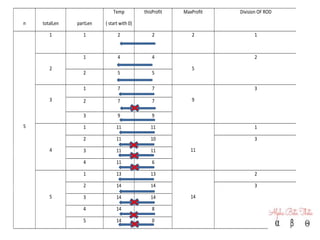
n totalLen partLen
Temp
( start with 0)
thisProfit MaxProfit Division OF ROD
5
1 1 2 2 2 1
2
1 4 4
5
2
2 5 5
3
1 7 7
9
3
2 7 7
3 9 9
4
1 11 11
11
1
2 11 10 3
3 11 11
4 11 6
5
1 13 13
14
2
2 14 14 3
3 14 14
4 14 8
5 14 0
Susmita karmakar
162-15-7721
Time complexity
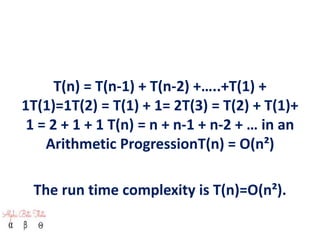
T(n) = T(n-1) + T(n-2) +…..+T(1) +
1T(1)=1T(2) = T(1) + 1= 2T(3) = T(2) + T(1)+
1 = 2 + 1 + 1 T(n) = n + n-1 + n-2 + … in an
Arithmetic ProgressionT(n) = O(n²)
The run time complexity is T(n)=O(n²).
Rod Cutting Problem

Rod Cutting Problem

  • 2.
    Presented By MD. SadAdnan 162-15-7814 Quazi Zayed Bin Hasan 162-15-7695 Susmita karmakar 162-15-7721
  • 3.
    Quazi Zayed BinHasan 162-15-7695
  • 4.
    Length of piecesProfit for pieces 0 0 1 2 $ 2 5 $ 3 9 $ 4 6 $
  • 5.
    0 0 00 0 0 0 2 4 6 8 10 0 2 5 7 10 12 0 2 5 9 11 14 0 2 5 9 11 14 #If pieces of length is greater than the total length that’s why previous profit and current profit are same #If previous profit is greater than current profit that’s why we count previous profit is the current profit 14
  • 7.
  • 8.
    Pseudo Code int priceOfLen[] = {0, 2, 5, 9, 6}; int maxProfit( n ) { for (totalLen  1 to n) { tmp  0; for (partLen  1 to totalLen) { thisProfit  priceOfLen[partLen] + maxProfitOfLen[totalLen - partLen]; if (tmp < thisProfit) { tmp  thisProfit; partLenOfLen[totalLen]  partLen; } } maxProfitOfLen[totalLen]  tmp; } return maxProfitOfLen[n]; }
  • 9.
    Void Divisions( n) { while (n > 0) { print partLenOfLen[n] ; n  n - partLenOfLen[n]; } } Pseudo Code For Knowing The How We Have To Cut The Rod 0 1 2 3 4 5 priceOfLen[ ] maxProfitOfLen[ ] partLenOfLen[ ]
  • 10.
    n totalLen partLen Temp (start with 0) thisProfit MaxProfit Division OF ROD 5 1 1 2 2 2 1 2 1 4 4 5 2 2 5 5 3 1 7 7 9 3 2 7 7 3 9 9 4 1 11 11 11 1 2 11 10 3 3 11 11 4 11 6 5 1 13 13 14 2 2 14 14 3 3 14 14 4 14 8 5 14 0
  • 11.
  • 12.
  • 13.
    T(n) = T(n-1)+ T(n-2) +…..+T(1) + 1T(1)=1T(2) = T(1) + 1= 2T(3) = T(2) + T(1)+ 1 = 2 + 1 + 1 T(n) = n + n-1 + n-2 + … in an Arithmetic ProgressionT(n) = O(n²) The run time complexity is T(n)=O(n²).