INTERPARTICLE
FORCES
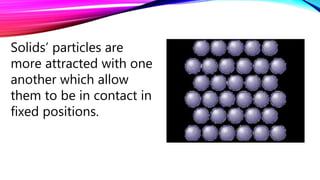
Solids’ particles are
more attracted with one
another which allow
them to be in contact in
fixed positions.
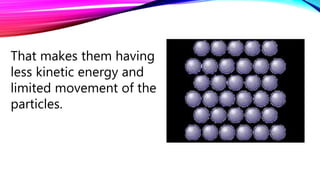
That makes them having
less kinetic energy and
limited movement of the
particles.
An increase in the temperature of a solid brings
about an increase in the kinetic energy of the
particles and may cause them to move about.
Outside or external pressure has very little effect
on the volume of a solid. Solids are therefore said
to be incompressible.
The amount of heat required to completely melt a
solid, once it has reached its melting point is
called its heat of fusion.
SOLID – LIQUID EQUILIBRIUM
Melting point of solid = Freezing point in its liquid state
VAPOR PRESSURE OF A SOLID
Changing from solid to gas without passing the liquid
state is called sublimation.
PROPERTIES
OF
SOLID
• a collection of atoms or molecules that are held
together so that, under constant conditions, they
maintain a defined shape and size
• formed when the temperature of a liquid is low and
the pressure is sufficiently high causing the particles to
come very close to one another
• are not necessarily permanent
• rigid
• particles hardly diffuse
SOLID
ELECTRICAL AND THERMAL
CONDUCTIVITY
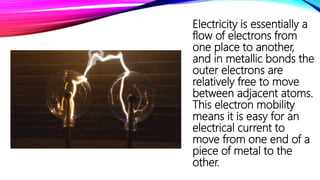
Electricity is essentially a
flow of electrons from
one place to another,
and in metallic bonds the
outer electrons are
relatively free to move
between adjacent atoms.
This electron mobility
means it is easy for an
electrical current to
move from one end of a
piece of metal to the
other.
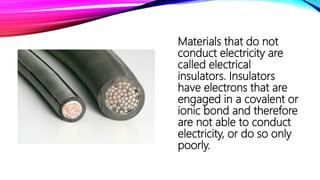
Materials that do not
conduct electricity are
called electrical
insulators. Insulators
have electrons that are
engaged in a covalent or
ionic bond and therefore
are not able to conduct
electricity, or do so only
poorly.
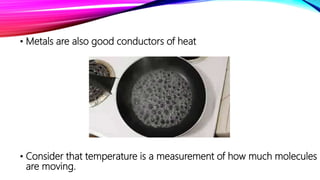
• Metals are also good conductors of heat
• Consider that temperature is a measurement of how much molecules
are moving.
In a network solid, such transfer is more difficult.
Such solids would be expected to have low
conductivity and would be called heat insulators.
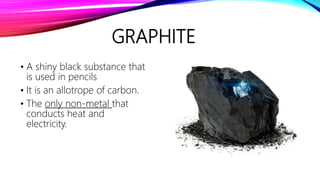
GRAPHITE
• A shiny black substance that
is used in pencils
• It is an allotrope of carbon.
• The only non-metal that
conducts heat and
electricity.
MALLEABILITY
AND DUCTILITY
MALLEABILITY
The ability to hammer a solid into a sheet without breaking it.
DUCTILITY
Refers to whether a solid can be stretched to form a wire.
MELTING POINT
A solid’s melting point depends on the
strength of the interactions between its
components.
For molecular solids, melting means breaking
the weak intermolecular forces, not the strong
covalent bonds that hold the individual
molecules together.
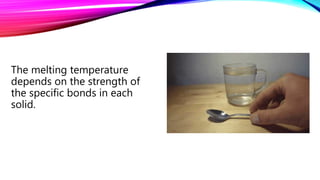
The melting temperature
depends on the strength of
the specific bonds in each
solid.
SOLUBILITY
SOLUBILITY
Is the ability to dissolve the solid into some
type of liquid.
The solid which we refer as “Solute” and the
liquid that do the dissolving is called “Solvent”
UNIVERSAL SOLVENT : WATER
DISSOLVING A SOLID REQUIRES
BREAKING DIFFERENT TYPES OF
BONDS FOR DIFFERENT TYPES OF
SOLIDS
Dissolving a metal requires breaking metallic bonds, and
dissolving a network solid requires breaking covalent bonds. Both
of these types of bonds are strong.
Molecular solids, however, requires breaking only weak
intermolecular forces, not the covalent bonds that actually hold
the individuals together.
DENSITY
DENSITY
Density is the mass of a substance per
unit volume
In other words, density is how close together the molecules of a
substance are or how much mass a substance has in a given space.
Now that we know about the properties
of solid, we can now conclude that the
interparticle forces are responsible for
these properties and the behaviour of
particles.

Interparticle Forces

  • 1.
  • 2.
    Solids’ particles are moreattracted with one another which allow them to be in contact in fixed positions.
  • 3.
    That makes themhaving less kinetic energy and limited movement of the particles.
  • 4.
    An increase inthe temperature of a solid brings about an increase in the kinetic energy of the particles and may cause them to move about.
  • 5.
    Outside or externalpressure has very little effect on the volume of a solid. Solids are therefore said to be incompressible.
  • 6.
    The amount ofheat required to completely melt a solid, once it has reached its melting point is called its heat of fusion.
  • 7.
    SOLID – LIQUIDEQUILIBRIUM Melting point of solid = Freezing point in its liquid state
  • 8.
    VAPOR PRESSURE OFA SOLID Changing from solid to gas without passing the liquid state is called sublimation.
  • 10.
  • 11.
    • a collectionof atoms or molecules that are held together so that, under constant conditions, they maintain a defined shape and size • formed when the temperature of a liquid is low and the pressure is sufficiently high causing the particles to come very close to one another • are not necessarily permanent • rigid • particles hardly diffuse SOLID
  • 12.
  • 13.
    Electricity is essentiallya flow of electrons from one place to another, and in metallic bonds the outer electrons are relatively free to move between adjacent atoms. This electron mobility means it is easy for an electrical current to move from one end of a piece of metal to the other.
  • 14.
    Materials that donot conduct electricity are called electrical insulators. Insulators have electrons that are engaged in a covalent or ionic bond and therefore are not able to conduct electricity, or do so only poorly.
  • 15.
    • Metals arealso good conductors of heat • Consider that temperature is a measurement of how much molecules are moving.
  • 16.
    In a networksolid, such transfer is more difficult. Such solids would be expected to have low conductivity and would be called heat insulators.
  • 17.
    GRAPHITE • A shinyblack substance that is used in pencils • It is an allotrope of carbon. • The only non-metal that conducts heat and electricity.
  • 18.
  • 19.
    MALLEABILITY The ability tohammer a solid into a sheet without breaking it.
  • 20.
    DUCTILITY Refers to whethera solid can be stretched to form a wire.
  • 21.
  • 22.
    A solid’s meltingpoint depends on the strength of the interactions between its components. For molecular solids, melting means breaking the weak intermolecular forces, not the strong covalent bonds that hold the individual molecules together.
  • 23.
    The melting temperature dependson the strength of the specific bonds in each solid.
  • 24.
  • 25.
    SOLUBILITY Is the abilityto dissolve the solid into some type of liquid. The solid which we refer as “Solute” and the liquid that do the dissolving is called “Solvent”
  • 26.
  • 27.
    DISSOLVING A SOLIDREQUIRES BREAKING DIFFERENT TYPES OF BONDS FOR DIFFERENT TYPES OF SOLIDS Dissolving a metal requires breaking metallic bonds, and dissolving a network solid requires breaking covalent bonds. Both of these types of bonds are strong. Molecular solids, however, requires breaking only weak intermolecular forces, not the covalent bonds that actually hold the individuals together.
  • 28.
  • 29.
    DENSITY Density is themass of a substance per unit volume
  • 30.
    In other words,density is how close together the molecules of a substance are or how much mass a substance has in a given space.
  • 31.
    Now that weknow about the properties of solid, we can now conclude that the interparticle forces are responsible for these properties and the behaviour of particles.