ENERGY AND MOLECULAR
ORDER CHANGES
PHASE
CHANGES
S
O
L
I
D
G
A
S
L
I
Q
U
I
D
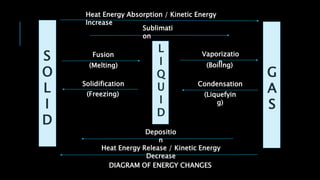
Heat Energy Absorption / Kinetic Energy
Increase
Sublimati
on
Fusion Vaporizatio
n
(Melting) (Boiling)
Solidification Condensation
(Freezing) (Liquefyin
g)
Depositio
n
Heat Energy Release / Kinetic Energy
Decrease
DIAGRAM OF ENERGY CHANGES
MELTING POINT - the temperature at
which the solid melts to form the liquid
FREEZING POINT - the temperature at
which the liquid freezes to form the
solid
EVAPORATION / VAPORIZATION – liquid
particles that overcome the attractive
forces of the neighbouring particles and
escape the process, hence, becoming a
gas
BOILING POINT – when a liquid is heated
in an open container, its vapour pressure
will rise until it equals the pressure of
the atmosphere above the liquid causing
CONDENSATION – the reverse process,
happens when particles in the vapour
pressure are cooled and returns to liquid
SUBLIMATION – the solid phase passes
directly into the gas phase
DEPOSITION – the change from the gas
to the solid phase without passing the
liquid phase; the reverse of sublimation
Reverse phase changes occur at the
same temperature and if they occur at
same rate, the phases are said to
coexist in dynamic equilibrium.
Earning the title, “Triple Point”
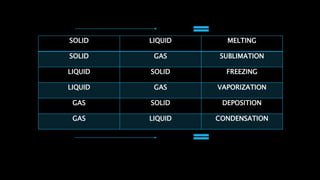
SOLID LIQUID MELTING
SOLID GAS SUBLIMATION
LIQUID SOLID FREEZING
LIQUID GAS VAPORIZATION
GAS SOLID DEPOSITION
GAS LIQUID CONDENSATION

Energy and Molecular Order Changes: Phase Changes

  • 1.
    ENERGY AND MOLECULAR ORDERCHANGES PHASE CHANGES
  • 2.
    S O L I D G A S L I Q U I D Heat Energy Absorption/ Kinetic Energy Increase Sublimati on Fusion Vaporizatio n (Melting) (Boiling) Solidification Condensation (Freezing) (Liquefyin g) Depositio n Heat Energy Release / Kinetic Energy Decrease DIAGRAM OF ENERGY CHANGES
  • 3.
    MELTING POINT -the temperature at which the solid melts to form the liquid FREEZING POINT - the temperature at which the liquid freezes to form the solid
  • 4.
    EVAPORATION / VAPORIZATION– liquid particles that overcome the attractive forces of the neighbouring particles and escape the process, hence, becoming a gas BOILING POINT – when a liquid is heated in an open container, its vapour pressure will rise until it equals the pressure of the atmosphere above the liquid causing
  • 5.
    CONDENSATION – thereverse process, happens when particles in the vapour pressure are cooled and returns to liquid SUBLIMATION – the solid phase passes directly into the gas phase
  • 6.
    DEPOSITION – thechange from the gas to the solid phase without passing the liquid phase; the reverse of sublimation
  • 7.
    Reverse phase changesoccur at the same temperature and if they occur at same rate, the phases are said to coexist in dynamic equilibrium. Earning the title, “Triple Point”
  • 8.
    SOLID LIQUID MELTING SOLIDGAS SUBLIMATION LIQUID SOLID FREEZING LIQUID GAS VAPORIZATION GAS SOLID DEPOSITION GAS LIQUID CONDENSATION