A Study of Internet-based Survey Methodology --Where can we go?   Ke Huixin, Huang Gang Beijing Broadcasting Institute Email: hxke@public.bta.net.cn [email_address]
Part 1 Background of Internet   survey’s quiet rising Part 2 Adoption and application of    Internet survey in china Part 3 Present Obstacles and    problems Part 4 Orientations and frameworks    of future research
Part 1 Background of Internet    survey’s quiet rising   1 Impulse from the market  2 Obstacles of traditional survey  3 Advantages of Internet survey  4 External conditions and circumstance
1 Impulse from the market China’s entry of WTO  Customers’  request to the timeliness, universality and low-cost of market information  New current of marketing modes  Impulse from E-business and change of commercial modes Trend of economic globalization …………………
2 Obstacles of traditional survey Data quality descends Cost of face-to-face interviews at home ascends Response rates of face-to-face interviews at home descends Quoted prices declines  Profit decreases while operation increases Internet-based survey goes up in the world
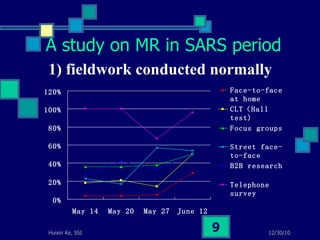
A study on MR in SARS period Conducted by CMRA By telephone interviews From May 12 to June 12, 2003 Once a week, four times in total 95 companies responded 31 cities covered
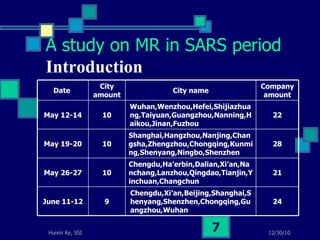
Introduction A study on MR in SARS period 24 Chengdu,Xi’an,Beijing,Shanghai,Shenyang,Shenzhen,Chongqing,Guangzhou,Wuhan 9 June 11-12 21 Chengdu,Ha’erbin,Dalian,Xi’an,Nanchang,Lanzhou,Qingdao,Tianjin,Yinchuan,Changchun 10 May 26-27 28 Shanghai,Hangzhou,Nanjing,Changsha,Zhengzhou,Chongqing,Kunming,Shenyang,Ningbo,Shenzhen 10 May 19-20 22 Wuhan,Wenzhou,Hefei,Shijiazhuang,Taiyuan,Guangzhou,Nanning,Haikou,Jinan,Fuzhou 10 May 12-14 Company amount City name City amount Date
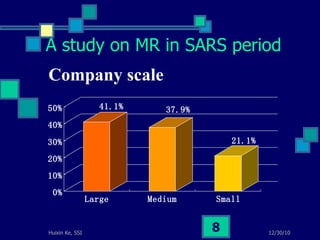
Company scale A study on MR in SARS period
1) fieldwork conducted normally A study on MR in SARS period

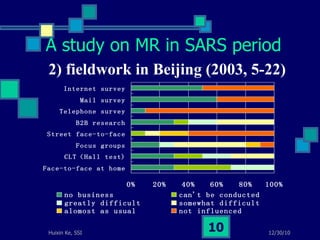
2) fieldwork in Beijing (2003, 5-22) A study on MR in SARS period
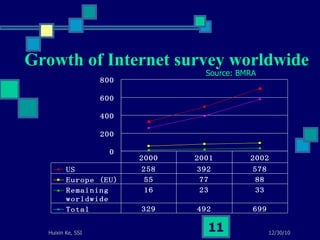
Growth of Internet survey worldwide Source: BMRA
3 Advantages of Internet survey Timeliness Low cost  Little effect of interviewers  longer and more questions than telephone interview More convenient for respondents  Changeability of survey content Multiplicity and flexibility of questionnaire forms  Less artificial interference and higher data quality Anonymity helps getting some certain information Possibility to reach difficult people  Pertinence to Netizens
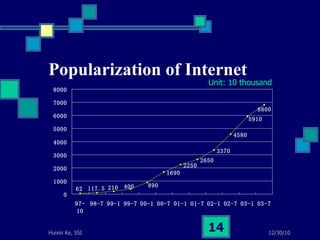
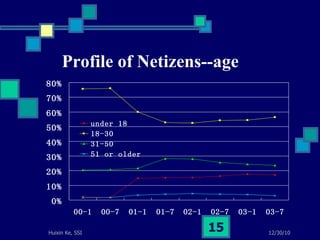
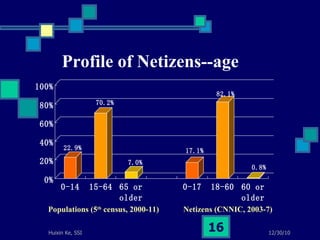
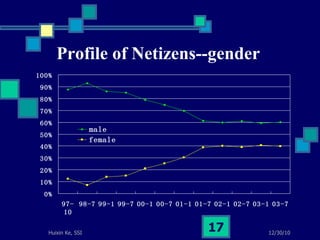
4 External conditions and circumstances Popularization of Internet  Multiplization of Netizens Age Gender Education  Income ……… .
Popularization of Internet Unit: 10 thousand
Profile of Netizens--age
Profile of Netizens--age Populations (5 th  census, 2000-11)  Netizens (CNNIC, 2003-7)
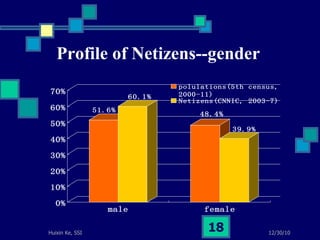
Profile of Netizens--gender
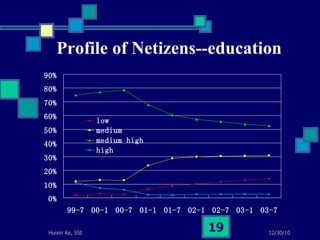
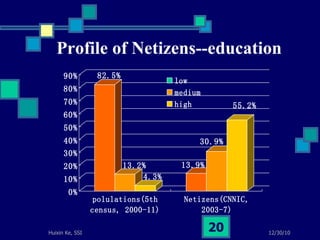
Profile of Netizens--education
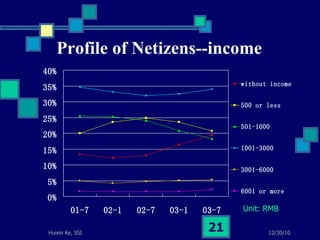
Profile of Netizens--income Unit: RMB
Part 2  Adoption and application    of Internet survey in China   --- A Study on MR Industry Methodology Main findings about Internet-based survey Popularity Adoption history Frequency of adoption Providers characters Way of use Domain of application Survey methods
Methodology Self-administered survey by mail In-depth interviews A Study on MR Industry
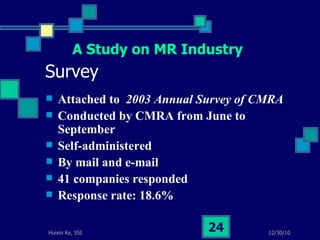
Attached to  2003 Annual Survey of CMRA Conducted by CMRA from June to September Self-administered By mail and e-mail 41 companies responded Response rate: 18.6% A Study on MR Industry Survey
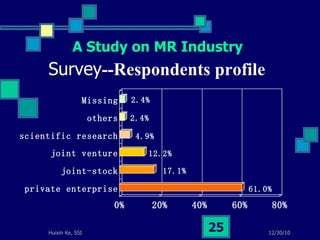
Survey --Respondents profile A Study on MR Industry
In-depth interviews Conducted in September 2003 Interviewees: 4 from MR companies (2 in china, 1 in Japan, 1 in Korea) 2 from counseling company 1 from website company 1 from scientific research institute By face-to-face, telephone and e-mail  A Study on MR Industry
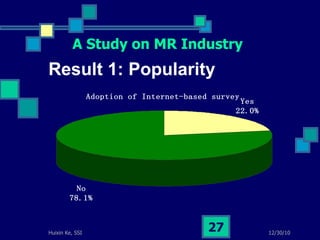
Result 1: Popularity A Study on MR Industry
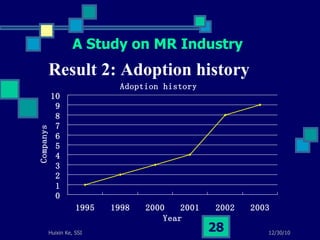
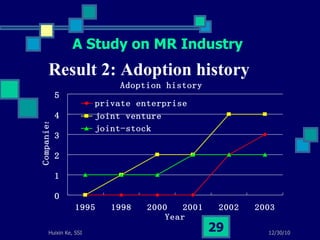
Result 2: Adoption history A Study on MR Industry
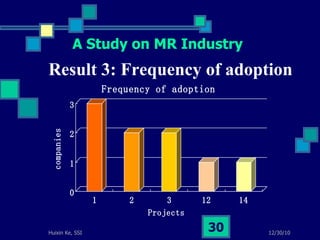
Result 3: Frequency of adoption  A Study on MR Industry
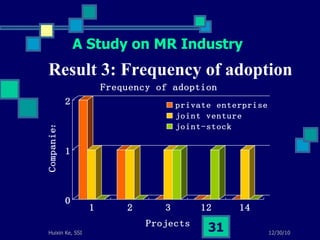
Result 3: Frequency of adoption A Study on MR Industry
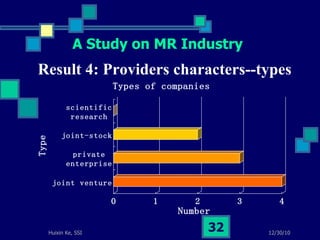
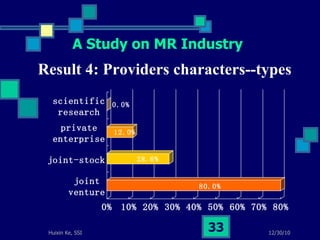
Result 4: Providers characters--types A Study on MR Industry
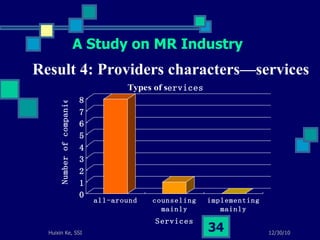
Result 4: Providers characters—services A Study on MR Industry
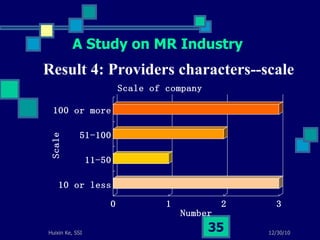
Result 4: Providers characters--scale A Study on MR Industry
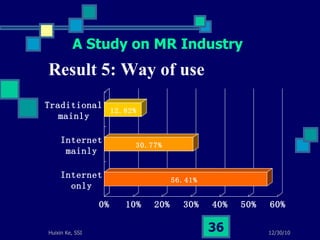
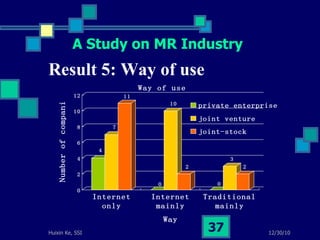
Result 5: Way of use A Study on MR Industry
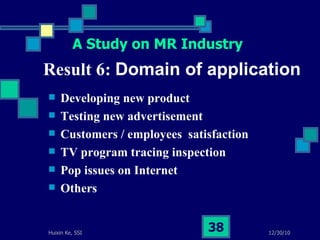
Result 6:  Domain of application Developing new product Testing new advertisement Customers / employees  satisfaction  TV program tracing inspection Pop issues on Internet Others  A Study on MR Industry
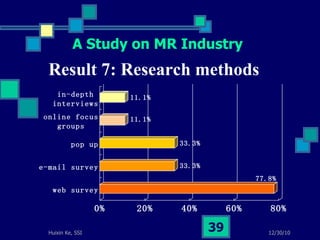
Result 7: Research methods A Study on MR Industry
Part 3 Present Obstacles and    problems Obstacles of external environments Problems or limitations of technology and methodology
Obstacles Customers Insufficient identify with Internet-based survey methodology Netizens Quality, concept, attitude and consciousness Scale and structure MR companies Short of order / market  Restriction in capital, personnel and operation
Problems or limitations Limitations of survey methods   Limited in traditional survey methods Limited in quantificational structural questionnaire survey Copying the traditional questionnaire measures only
Problems or limitations Lack of scientificity in questionnaire survey Authenticity  Representativeness Response rates Lack of study on survey methodologies Research design, questionnaire design, sample design, implementing and data processing……
Part 4  Orientations and    frameworks of future research Orientations of research to various  Internet survey methods Frameworks of research for Internet-based questionnaire survey Whole framework Concrete  framework
Orientations Quicken the development and application of new methods beyond traditional methods Solve the problems rising from the transplant of traditional methods to the Internet research
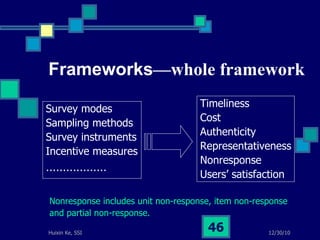
Survey modes Sampling methods Survey instruments Incentive measures ……………… Frameworks —whole framework   Timeliness  Cost  Authenticity  Representativeness Nonresponse Users’ satisfaction Nonresponse includes unit non-response, item non-response  and partial non-response.
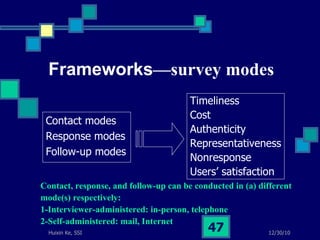
Frameworks —survey modes Contact modes Response modes Follow-up modes Timeliness  Cost  Authenticity  Representativeness Nonresponse Users’ satisfaction Contact, response, and follow-up can be conducted in (a) different  mode(s) respectively: 1-Interviewer-administered: in-person, telephone 2-Self-administered: mail, Internet
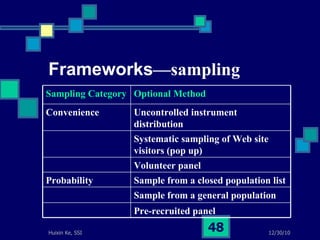
Frameworks —sampling Pre-recruited panel Sample from a general population Sample from a closed population list Probability Volunteer panel Systematic sampling of Web site visitors (pop up) Uncontrolled instrument distribution Convenience Optional Method Sampling Category
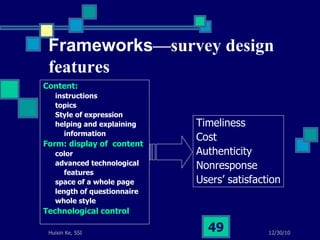
Frameworks —survey design features Content: instructions topics  Style of expression helping and explaining  information Form: display of  content color advanced technological  features space of a whole page length of questionnaire whole style Technological control Timeliness  Cost  Authenticity  Nonresponse Users’ satisfaction
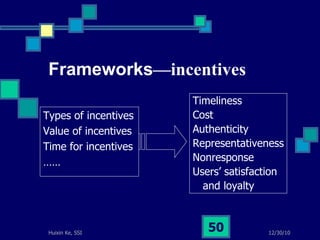
Frameworks —incentives Types of incentives Value of incentives Time for incentives …… Timeliness  Cost  Authenticity  Representativeness Nonresponse Users’ satisfaction  and loyalty
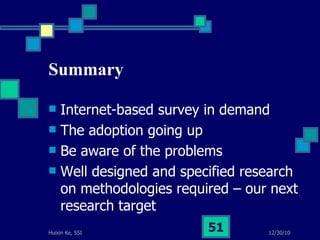
Summary Internet-based survey in demand The adoption going up Be aware of the problems Well designed and specified research on methodologies required – our next research target
Thank you !

网络调查方法研究 -我们该往哪里走

  • 1.
    A Study ofInternet-based Survey Methodology --Where can we go? Ke Huixin, Huang Gang Beijing Broadcasting Institute Email: hxke@public.bta.net.cn [email_address]
  • 2.
    Part 1 Backgroundof Internet survey’s quiet rising Part 2 Adoption and application of Internet survey in china Part 3 Present Obstacles and problems Part 4 Orientations and frameworks of future research
  • 3.
    Part 1 Backgroundof Internet survey’s quiet rising 1 Impulse from the market 2 Obstacles of traditional survey 3 Advantages of Internet survey 4 External conditions and circumstance
  • 4.
    1 Impulse fromthe market China’s entry of WTO Customers’ request to the timeliness, universality and low-cost of market information New current of marketing modes Impulse from E-business and change of commercial modes Trend of economic globalization …………………
  • 5.
    2 Obstacles oftraditional survey Data quality descends Cost of face-to-face interviews at home ascends Response rates of face-to-face interviews at home descends Quoted prices declines Profit decreases while operation increases Internet-based survey goes up in the world
  • 6.
    A study onMR in SARS period Conducted by CMRA By telephone interviews From May 12 to June 12, 2003 Once a week, four times in total 95 companies responded 31 cities covered
  • 7.
    Introduction A studyon MR in SARS period 24 Chengdu,Xi’an,Beijing,Shanghai,Shenyang,Shenzhen,Chongqing,Guangzhou,Wuhan 9 June 11-12 21 Chengdu,Ha’erbin,Dalian,Xi’an,Nanchang,Lanzhou,Qingdao,Tianjin,Yinchuan,Changchun 10 May 26-27 28 Shanghai,Hangzhou,Nanjing,Changsha,Zhengzhou,Chongqing,Kunming,Shenyang,Ningbo,Shenzhen 10 May 19-20 22 Wuhan,Wenzhou,Hefei,Shijiazhuang,Taiyuan,Guangzhou,Nanning,Haikou,Jinan,Fuzhou 10 May 12-14 Company amount City name City amount Date
  • 8.
    Company scale Astudy on MR in SARS period
  • 9.
    1) fieldwork conductednormally A study on MR in SARS period
  • 10.
    2) fieldwork inBeijing (2003, 5-22) A study on MR in SARS period
  • 11.
    Growth of Internetsurvey worldwide Source: BMRA
  • 12.
    3 Advantages ofInternet survey Timeliness Low cost Little effect of interviewers longer and more questions than telephone interview More convenient for respondents Changeability of survey content Multiplicity and flexibility of questionnaire forms Less artificial interference and higher data quality Anonymity helps getting some certain information Possibility to reach difficult people Pertinence to Netizens
  • 13.
    4 External conditionsand circumstances Popularization of Internet Multiplization of Netizens Age Gender Education Income ……… .
  • 14.
    Popularization of InternetUnit: 10 thousand
  • 15.
  • 16.
    Profile of Netizens--agePopulations (5 th census, 2000-11) Netizens (CNNIC, 2003-7)
  • 17.
  • 18.
  • 19.
  • 20.
  • 21.
  • 22.
    Part 2 Adoption and application of Internet survey in China --- A Study on MR Industry Methodology Main findings about Internet-based survey Popularity Adoption history Frequency of adoption Providers characters Way of use Domain of application Survey methods
  • 23.
    Methodology Self-administered surveyby mail In-depth interviews A Study on MR Industry
  • 24.
    Attached to 2003 Annual Survey of CMRA Conducted by CMRA from June to September Self-administered By mail and e-mail 41 companies responded Response rate: 18.6% A Study on MR Industry Survey
  • 25.
    Survey --Respondents profileA Study on MR Industry
  • 26.
    In-depth interviews Conductedin September 2003 Interviewees: 4 from MR companies (2 in china, 1 in Japan, 1 in Korea) 2 from counseling company 1 from website company 1 from scientific research institute By face-to-face, telephone and e-mail A Study on MR Industry
  • 27.
    Result 1: PopularityA Study on MR Industry
  • 28.
    Result 2: Adoptionhistory A Study on MR Industry
  • 29.
    Result 2: Adoptionhistory A Study on MR Industry
  • 30.
    Result 3: Frequencyof adoption A Study on MR Industry
  • 31.
    Result 3: Frequencyof adoption A Study on MR Industry
  • 32.
    Result 4: Providerscharacters--types A Study on MR Industry
  • 33.
    Result 4: Providerscharacters--types A Study on MR Industry
  • 34.
    Result 4: Providerscharacters—services A Study on MR Industry
  • 35.
    Result 4: Providerscharacters--scale A Study on MR Industry
  • 36.
    Result 5: Wayof use A Study on MR Industry
  • 37.
    Result 5: Wayof use A Study on MR Industry
  • 38.
    Result 6: Domain of application Developing new product Testing new advertisement Customers / employees satisfaction TV program tracing inspection Pop issues on Internet Others A Study on MR Industry
  • 39.
    Result 7: Researchmethods A Study on MR Industry
  • 40.
    Part 3 PresentObstacles and problems Obstacles of external environments Problems or limitations of technology and methodology
  • 41.
    Obstacles Customers Insufficientidentify with Internet-based survey methodology Netizens Quality, concept, attitude and consciousness Scale and structure MR companies Short of order / market Restriction in capital, personnel and operation
  • 42.
    Problems or limitationsLimitations of survey methods Limited in traditional survey methods Limited in quantificational structural questionnaire survey Copying the traditional questionnaire measures only
  • 43.
    Problems or limitationsLack of scientificity in questionnaire survey Authenticity Representativeness Response rates Lack of study on survey methodologies Research design, questionnaire design, sample design, implementing and data processing……
  • 44.
    Part 4 Orientations and frameworks of future research Orientations of research to various Internet survey methods Frameworks of research for Internet-based questionnaire survey Whole framework Concrete framework
  • 45.
    Orientations Quicken thedevelopment and application of new methods beyond traditional methods Solve the problems rising from the transplant of traditional methods to the Internet research
  • 46.
    Survey modes Samplingmethods Survey instruments Incentive measures ……………… Frameworks —whole framework Timeliness Cost Authenticity Representativeness Nonresponse Users’ satisfaction Nonresponse includes unit non-response, item non-response and partial non-response.
  • 47.
    Frameworks —survey modesContact modes Response modes Follow-up modes Timeliness Cost Authenticity Representativeness Nonresponse Users’ satisfaction Contact, response, and follow-up can be conducted in (a) different mode(s) respectively: 1-Interviewer-administered: in-person, telephone 2-Self-administered: mail, Internet
  • 48.
    Frameworks —sampling Pre-recruitedpanel Sample from a general population Sample from a closed population list Probability Volunteer panel Systematic sampling of Web site visitors (pop up) Uncontrolled instrument distribution Convenience Optional Method Sampling Category
  • 49.
    Frameworks —survey designfeatures Content: instructions topics Style of expression helping and explaining information Form: display of content color advanced technological features space of a whole page length of questionnaire whole style Technological control Timeliness Cost Authenticity Nonresponse Users’ satisfaction
  • 50.
    Frameworks —incentives Typesof incentives Value of incentives Time for incentives …… Timeliness Cost Authenticity Representativeness Nonresponse Users’ satisfaction and loyalty
  • 51.
    Summary Internet-based surveyin demand The adoption going up Be aware of the problems Well designed and specified research on methodologies required – our next research target
  • 52.

Editor's Notes

  • #7 CMRA is the abbreviation of China Marketing Research Association. http://www.emarketing.net.cn
  • #10 Except telephone survey, most ways of data collection were influenced by SARS, especially face-to-face interviews at home.
  • #11 Telephone surveys and Internet surveys are almost not influenced in SARS period in Beijing in May 22, 2003.
  • #12 BMRA is the abbreviation of British Marketing Research Association. Website: http://www.bmra.org.uk Data soruce: http://www.bmra.org.uk/mrbusiness/index.asp?ezine=91&bsec=48&article=457
  • #20 Low: below senior high school Medium: senior high school Medium high: junior college and college High: postgraduate and above
  • #21 Low: below senior high school Medium: senior high school High: above junior college
  • #26 25 civil enterprises, 7 joint stock companies, and 5 joint ventures responded to our survey.
  • #28 9 of 41 companies that responded to our survey ever conducted Internet survey.
  • #29 Chinese companies first started Internet survey in 1995, but most started in 2002.
  • #30 Joint-stock company fist started Internet survey in 1995, followed by joint venture in 1998, in contrast to civil enterprise in 2002.
  • #31 Most companies have only conducted Internet survey for no more than three times, while two companies have conducted it for 12 and 14 times respectively.
  • #33 横比: 4 of these 9 companies are joint ventures, but none is scientific research institution.
  • #34 纵比: 80% joint ventures, in contrast to 12% civil enterprises, ever conducted Internet survey.
  • #35 Predominantly, 8 of the 9 companies provide all-round services.
  • #37 Internet is the main survey tool when conducting Internet survey projects. About 56% of the Internet survey projects are conducted singly by Internet, while others by both Internet and traditional survey methods.
  • #40 Web survey, followed by e-mail survey and pop up survey, is most popular for data collection in Internet survey projects.