Internet Safety
Staying Safe on the Wild, Wild
Internet
Your Host:
Vicky Yuki, Outreach & Education Coordinator
City of Seattle Community Technology Program
Created by:
David R. Matthews, CISSP, GSEC
Some Sobering Stats
 1 in 4 teens online had unwanted exposure
to sexually explicit pictures
 Approximately 1 in 5 received a sexual
solicitation or approach
 1 in 17 was threatened or harassed
 1 in 33 received an aggressive sexual
solicitation (from someone who asked to meet them
somewhere; called them on the telephone; sent them
regular mail, money or gifts)
**From a year 2000 report by the Center for Missing & Exploited Children
Identity Theft
“Risk of ID theft bonanza as thousands of
credit card slips found dumped in skip ”
BY Miles Brignall & Phillip Inman (Jan 9, 2006)

- The Guardian

 "Thousands of documents revealing the credit
card numbers, addresses, phone numbers and
signatures of guests were dumped in an open
skip ."
 “Each one lists the name, company, home
address and credit card number in full. ”
 “This information in the wrong hands could be
very dangerous. “
What‟s the problem?
“2005 worst year for breaches of computer
security”
By Jon Swartz (Dec. 29, 2005), USA TODAY

 “At least 130 reported breaches have
exposed more than 55 million Americans to
potential ID theft ...”
 “…cybercrime proceeds in 2004 were $105
billion, greater than those of illegal drug
sales.”
What‟s the problem (2)?
“Common sense can halt cyber criminals
- Reputable companies deemed far safer”
BY JUAN ORTEGA (Dec 21, 2005)

- FLORIDA TODAY

 "There are criminals from all over the world
trying to take advantage of this."
 “About one in four Internet users are hit with
e-mail scams every month”
Cyber Crime is Changing
 Hackers used to be in it for the reputation
they could gain. For pride of having beat the
system
 Now it‟s all about the money
 Organized crime is behind most of it
How is identity information
stolen







Burglary of your home, including mail
From your employer or school
From companies you do business with
Obtaining unauthorized credit reports
Stealing wallets, purses, laptops, etc.
Obtaining info from you by “social engineering” or
manipulating you to give up confidential info
 Technology Access - Internet
Risk Mitigation
 If you chat online, only allow connections to
people you know and have met off-line
 Don‟t reveal address, phone, school, sibs
names, especially SSN or Credit Card #s in
profiles
 Only purchase online from reputable and
well known companies
 Don‟t fall for „Phishing‟ schemes
Risk Mitigation (2)
 Don‟t click on links in emails or websites that
you aren‟t sure are legitimate
 Use text based email – not HTML
 Have good Antivirus, Anti-spyware, Antispam, and a software firewall – updated
automatically
 Have a hardware firewall between your
home network and the Internet
Risk Mitigation (3)
 Lock down any wireless access points with
good encryption, etc.
 Carefully examine ATMs before using them
– look around
 Don‟t let your Credit Cards get out of sight at
a restaurant or club
 Shred anything with Personally Identifiable
Information (PII)
 Use a locking mailbox
Quiz Questions (1)
 I receive several offers of pre-approved
credit every week. (5 points) Add 5 points if
you don‟t shred them.

 I carry my Social Security card in my wallet.
(10 points)
Quiz Questions (2)
 My driver‟s license has my Social Security
number on it. (10 points)
 I don‟t have a post office box or a locked,
secured mailbox. (5 points)
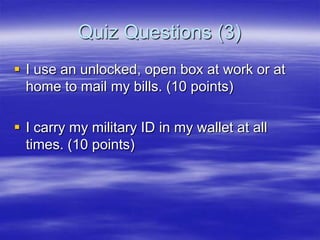
Quiz Questions (3)
 I use an unlocked, open box at work or at
home to mail my bills. (10 points)
 I carry my military ID in my wallet at all
times. (10 points)
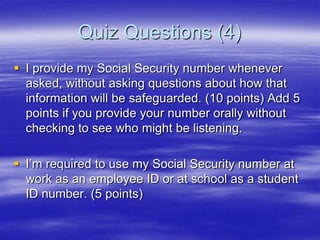
Quiz Questions (4)
 I provide my Social Security number whenever
asked, without asking questions about how that
information will be safeguarded. (10 points) Add 5
points if you provide your number orally without
checking to see who might be listening.
 I‟m required to use my Social Security number at
work as an employee ID or at school as a student
ID number. (5 points)
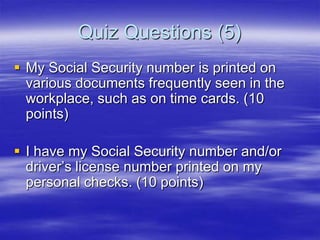
Quiz Questions (5)
 My Social Security number is printed on
various documents frequently seen in the
workplace, such as on time cards. (10
points)
 I have my Social Security number and/or
driver‟s license number printed on my
personal checks. (10 points)
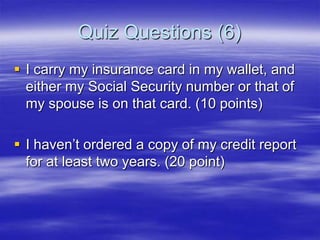
Quiz Questions (6)
 I carry my insurance card in my wallet, and
either my Social Security number or that of
my spouse is on that card. (10 points)

 I haven‟t ordered a copy of my credit report
for at least two years. (20 point)
Quiz Questions (7)
 I don‟t protect my discarded personal, credit, and
financial information from thieves by shredding
them prior to putting them in the trash. (10 points)
 Add your score. It it‟s 100 points or more, you are
at high risk for identity theft. If your score is 50 100, you‟re at average risk, but your risk is higher
if you have good credit. If your score is 0 – 50
points, you have a low risk of being an identity
theft victim.
How to Protect Yourself from
Identity Theft? You Can‟t
 Only Two Ways to Protect Yourself
– Have no personally identifying information
– Never, ever, ever, have it where someone else could
conceivably get access to it
Questions?
Vicky Yuki
Outreach & Education Coordinator
City of Seattle
206-233-7877
vicky.yuki@seattle.gov

Community Technology Internet Safety Presentation

  • 1.
    Internet Safety Staying Safeon the Wild, Wild Internet Your Host: Vicky Yuki, Outreach & Education Coordinator City of Seattle Community Technology Program Created by: David R. Matthews, CISSP, GSEC
  • 2.
    Some Sobering Stats 1 in 4 teens online had unwanted exposure to sexually explicit pictures  Approximately 1 in 5 received a sexual solicitation or approach  1 in 17 was threatened or harassed  1 in 33 received an aggressive sexual solicitation (from someone who asked to meet them somewhere; called them on the telephone; sent them regular mail, money or gifts) **From a year 2000 report by the Center for Missing & Exploited Children
  • 3.
    Identity Theft “Risk ofID theft bonanza as thousands of credit card slips found dumped in skip ” BY Miles Brignall & Phillip Inman (Jan 9, 2006) - The Guardian  "Thousands of documents revealing the credit card numbers, addresses, phone numbers and signatures of guests were dumped in an open skip ."  “Each one lists the name, company, home address and credit card number in full. ”  “This information in the wrong hands could be very dangerous. “
  • 4.
    What‟s the problem? “2005worst year for breaches of computer security” By Jon Swartz (Dec. 29, 2005), USA TODAY  “At least 130 reported breaches have exposed more than 55 million Americans to potential ID theft ...”  “…cybercrime proceeds in 2004 were $105 billion, greater than those of illegal drug sales.”
  • 5.
    What‟s the problem(2)? “Common sense can halt cyber criminals - Reputable companies deemed far safer” BY JUAN ORTEGA (Dec 21, 2005) - FLORIDA TODAY  "There are criminals from all over the world trying to take advantage of this."  “About one in four Internet users are hit with e-mail scams every month”
  • 6.
    Cyber Crime isChanging  Hackers used to be in it for the reputation they could gain. For pride of having beat the system  Now it‟s all about the money  Organized crime is behind most of it
  • 7.
    How is identityinformation stolen       Burglary of your home, including mail From your employer or school From companies you do business with Obtaining unauthorized credit reports Stealing wallets, purses, laptops, etc. Obtaining info from you by “social engineering” or manipulating you to give up confidential info  Technology Access - Internet
  • 8.
    Risk Mitigation  Ifyou chat online, only allow connections to people you know and have met off-line  Don‟t reveal address, phone, school, sibs names, especially SSN or Credit Card #s in profiles  Only purchase online from reputable and well known companies  Don‟t fall for „Phishing‟ schemes
  • 9.
    Risk Mitigation (2) Don‟t click on links in emails or websites that you aren‟t sure are legitimate  Use text based email – not HTML  Have good Antivirus, Anti-spyware, Antispam, and a software firewall – updated automatically  Have a hardware firewall between your home network and the Internet
  • 10.
    Risk Mitigation (3) Lock down any wireless access points with good encryption, etc.  Carefully examine ATMs before using them – look around  Don‟t let your Credit Cards get out of sight at a restaurant or club  Shred anything with Personally Identifiable Information (PII)  Use a locking mailbox
  • 11.
    Quiz Questions (1) I receive several offers of pre-approved credit every week. (5 points) Add 5 points if you don‟t shred them.  I carry my Social Security card in my wallet. (10 points)
  • 12.
    Quiz Questions (2) My driver‟s license has my Social Security number on it. (10 points)  I don‟t have a post office box or a locked, secured mailbox. (5 points)
  • 13.
    Quiz Questions (3) I use an unlocked, open box at work or at home to mail my bills. (10 points)  I carry my military ID in my wallet at all times. (10 points)
  • 14.
    Quiz Questions (4) I provide my Social Security number whenever asked, without asking questions about how that information will be safeguarded. (10 points) Add 5 points if you provide your number orally without checking to see who might be listening.  I‟m required to use my Social Security number at work as an employee ID or at school as a student ID number. (5 points)
  • 15.
    Quiz Questions (5) My Social Security number is printed on various documents frequently seen in the workplace, such as on time cards. (10 points)  I have my Social Security number and/or driver‟s license number printed on my personal checks. (10 points)
  • 16.
    Quiz Questions (6) I carry my insurance card in my wallet, and either my Social Security number or that of my spouse is on that card. (10 points)  I haven‟t ordered a copy of my credit report for at least two years. (20 point)
  • 17.
    Quiz Questions (7) I don‟t protect my discarded personal, credit, and financial information from thieves by shredding them prior to putting them in the trash. (10 points)  Add your score. It it‟s 100 points or more, you are at high risk for identity theft. If your score is 50 100, you‟re at average risk, but your risk is higher if you have good credit. If your score is 0 – 50 points, you have a low risk of being an identity theft victim.
  • 18.
    How to ProtectYourself from Identity Theft? You Can‟t  Only Two Ways to Protect Yourself – Have no personally identifying information – Never, ever, ever, have it where someone else could conceivably get access to it
  • 19.
    Questions? Vicky Yuki Outreach &Education Coordinator City of Seattle 206-233-7877 vicky.yuki@seattle.gov

Editor's Notes

  • #8 Social engineering, in the context of security, is understood to mean the art of manipulating people into performing actions or divulging confidential information.[1] While it is similar to a confidence trick or simple fraud, it is typically trickery or deception for the purpose of information gathering, fraud, or computer system access; in most cases the attacker never comes face-to-face with the victims.
  • #9 Phishing is the act of attempting to acquire information such as usernames, passwords, and credit card details (and sometimes, indirectly, money) by masquerading as a trustworthy entity in an electronic communication.
  • #10 Spyware is a type of malware (malicious software) installed on computers that collects information about users without their knowledge. Mail spam, also known as junk email or unsolicited bulk email (UBE)A computer virus is a computer program that can replicate itself[1] and spread from one computer to another.