


1
Hall 4A
NürnbergMesse, Arbeitstitel, Datum
Chillventa Specialist Forums 2018
Chillventa Fachforen 2018
Sergio Maria Capanelli
10/2018
Internet of cooling
and heating
things
https://www.gartner.com/newsroom/id/3598917
In 2020, connected
objects will generate:
more than 900
exabytes of data
with over 20 billion
connected devices,
69 % increase with
respect to 2016
Connected objects: predictions
Connectivity Internet of things
Internet of Things (IoT) is the inter-networking of physical devices (also referred to
as “connected devices” and “smart devices”), like vehicles, buildings, and other
items embedded with electronics, software, sensors, actuators, and network
connectivity which enable these objects to collect and exchange data.
http://www.cns-me.com/en/ict-service-details/57/iot-and-smart-cities
IoT Services
Descriptive analytics:
describe the current and past situation, converting the data into information
Preventive analytics:
understand what might happen in the future
Prescriptive analytics:
operative/strategic solutions are proposed by the system on the basis of the
analysis performed
Proactive analytics:
automatic implementation of the proposed actions
Machine learning
How machine learning works:
Training and Calibration: collected data are used to learn how machines perform on field.
Test and Results: trained algorithm is tested using new data as input. The output is the
“baseline” definition.
Training and Calibration
hour of the day, outdoor temperature/humidity, EEV
position, fan flow, water temperature, compressor
speed, regulation set-point, etc.
Dataset
Test and Results
Input data
Trained
algorithm
IoT in HVAC systems
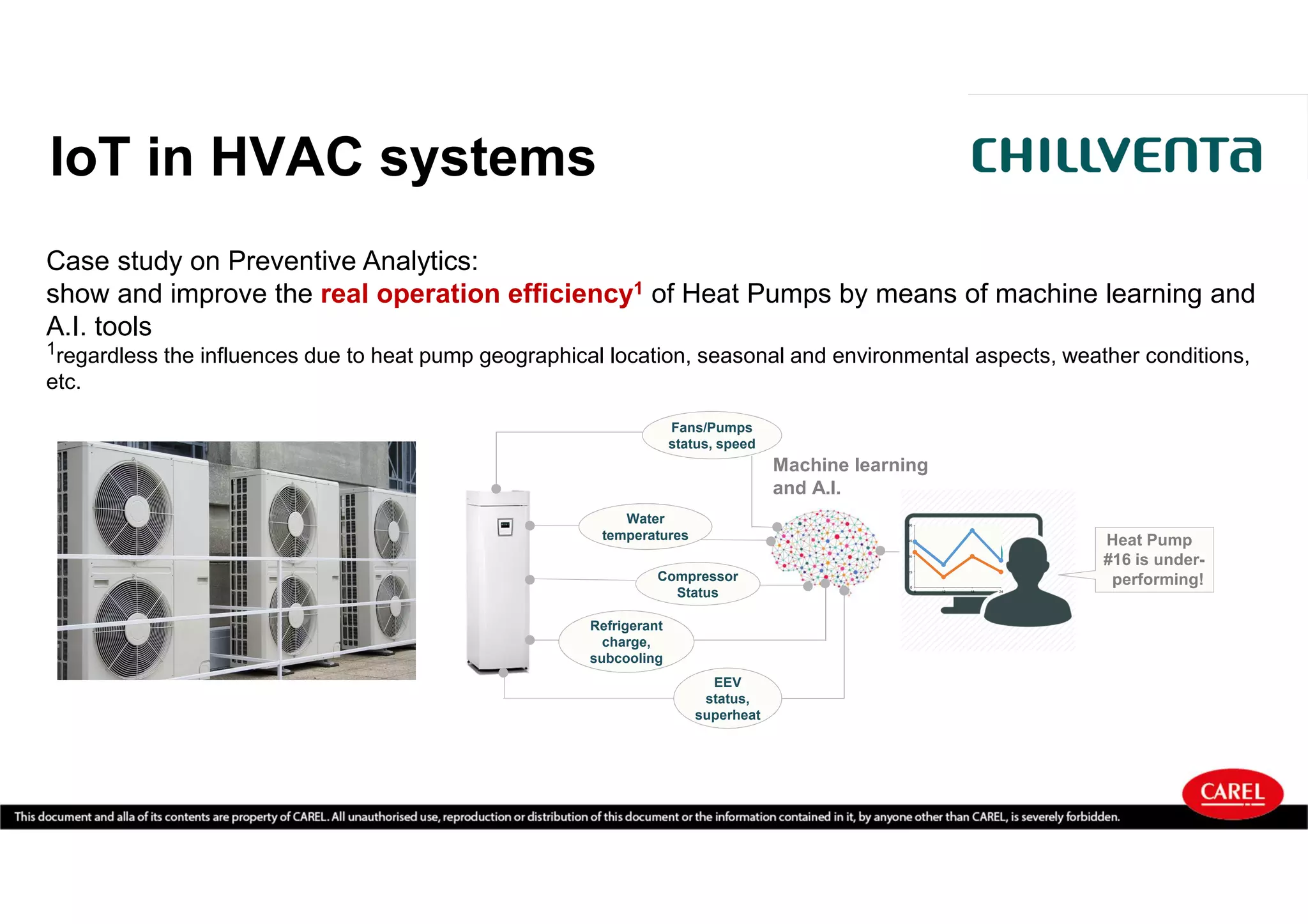
Case study on Preventive Analytics:
show and improve the real operation efficiency1 of Heat Pumps by means of machine learning and
A.I. tools
1regardless the influences due to heat pump geographical location, seasonal and environmental aspects, weather conditions,
etc.
Fans/Pumps
status, speed
Machine learning
and A.I.
0
15
30
45
60
6 12 18 24
Heat Pump
#16 is under-
performing!
Water
temperatures
Compressor
Status
Refrigerant
charge,
subcooling
EEV
status,
superheat
IoT in HVAC systems
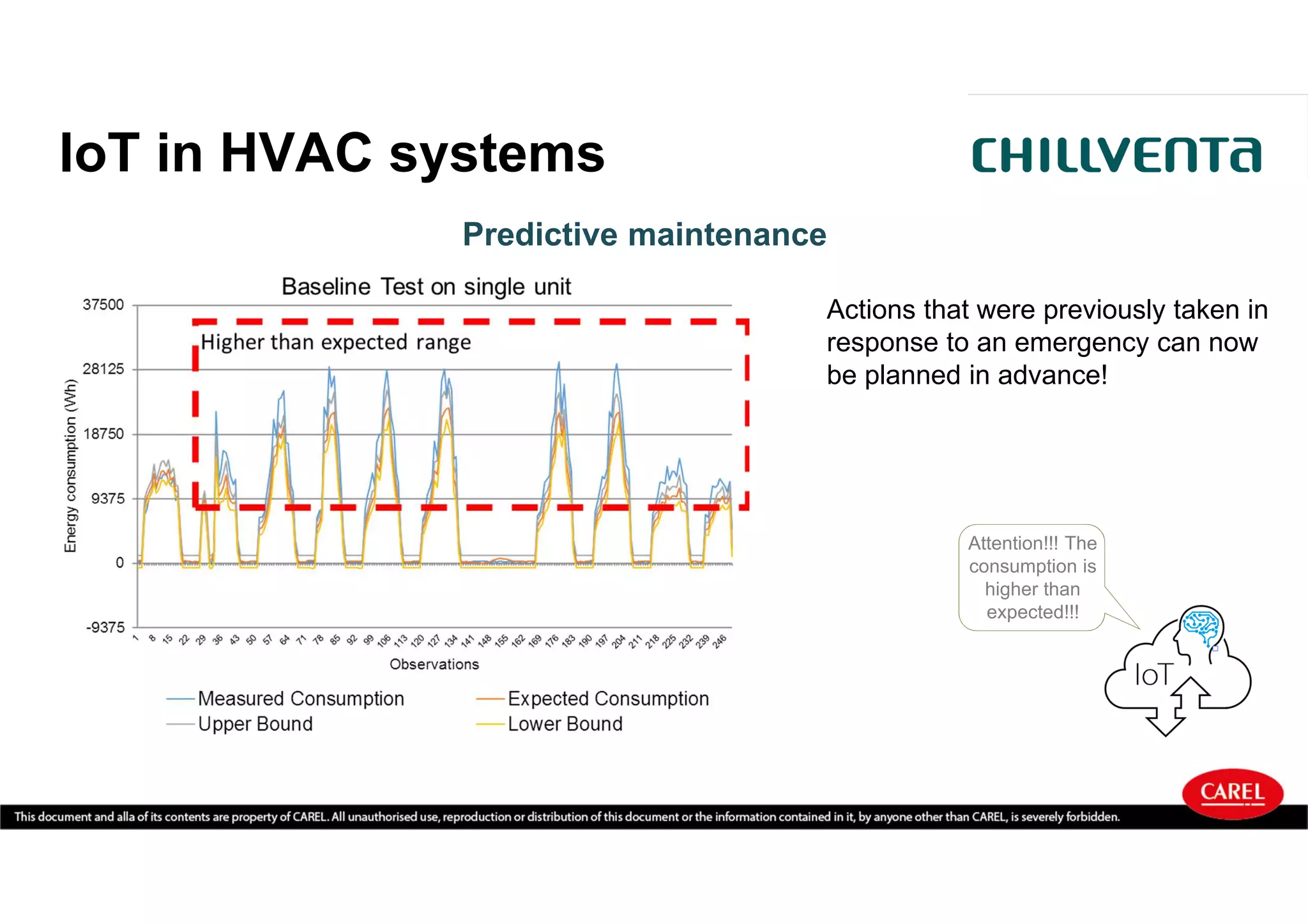
Predictive maintenance
Actions that were previously taken in
response to an emergency can now
be planned in advance!
Attention!!! The
consumption is
higher than
expected!!!
IoT in HVAC systems
Performance optimization
The baseline definition of a trained machine learning algorithm helps in fine-tuning.
Succesful fine-tuning!
Power consumption is
much lower than
baseline.
IoT in HVAC systems
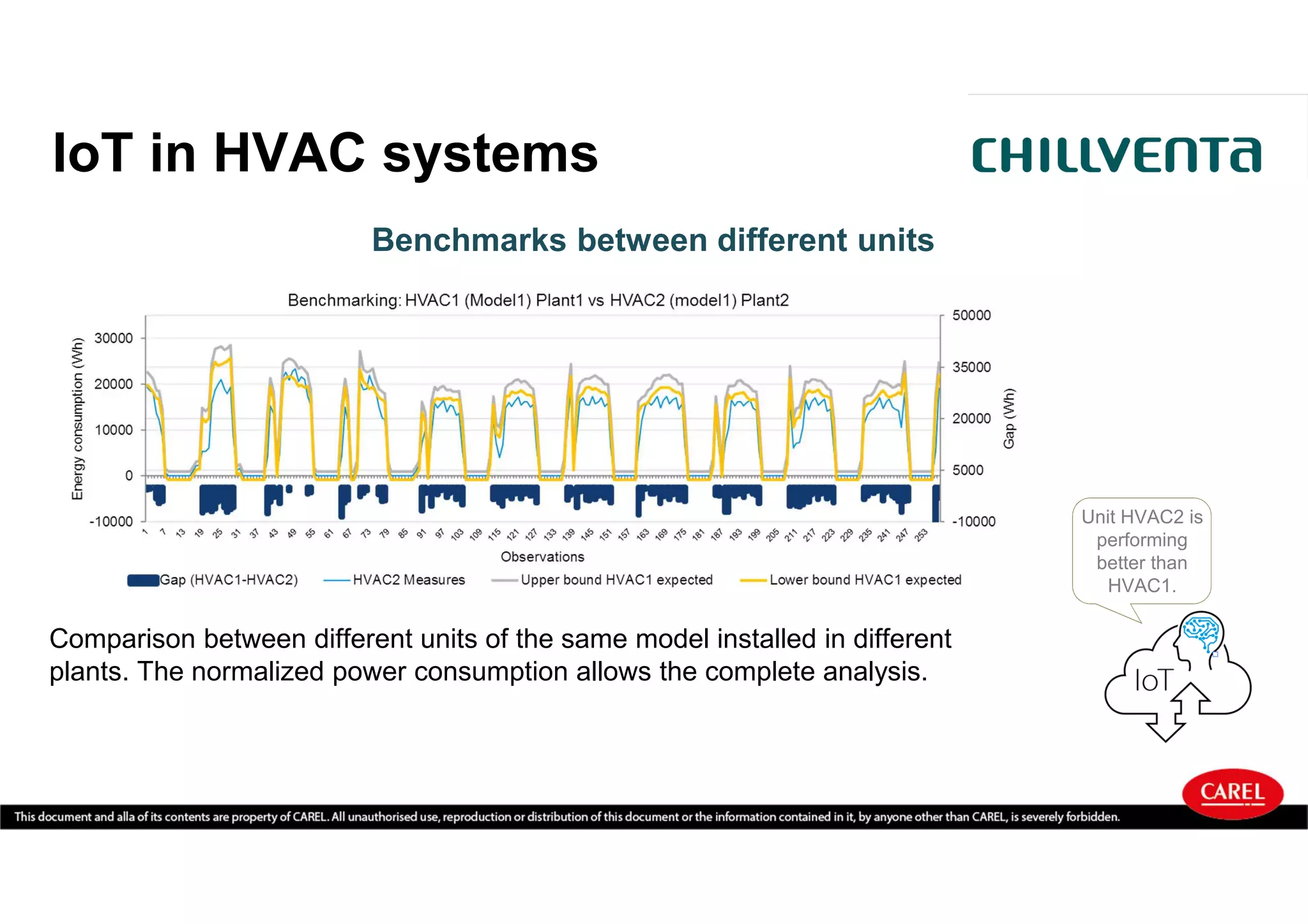
Benchmarks between different units
Comparison between different units of the same model installed in different
plants. The normalized power consumption allows the complete analysis.
Unit HVAC2 is
performing
better than
HVAC1.
IoT in refrigeration systems
Case study:
show and improve the defrost status of supermarket showcases by means of machine learning and
A.I. tools.
Valve opening
Machine learning
and A.I.
The defrost in
showcase #9 is
anomalous!
Air off
temperature
Evaporator
temperature
Setpoint
temperature
IoT in refrigeration systems
ScoreShowcases Height and color: quality of defrost; Length: duration of defrost
IoT in refrigeration systems
• The defrost score indicated that
there was an anomaly in the
system.
• The operator realized that the
probe had been wrongly installed.
• After relocation, the score
became green.
Warning!
Please check defrost
duration and defrost
probe positioning!
IoT in refrigeration systems
Warning! Please
check defrost
frequency!
IoT in refrigeration systems
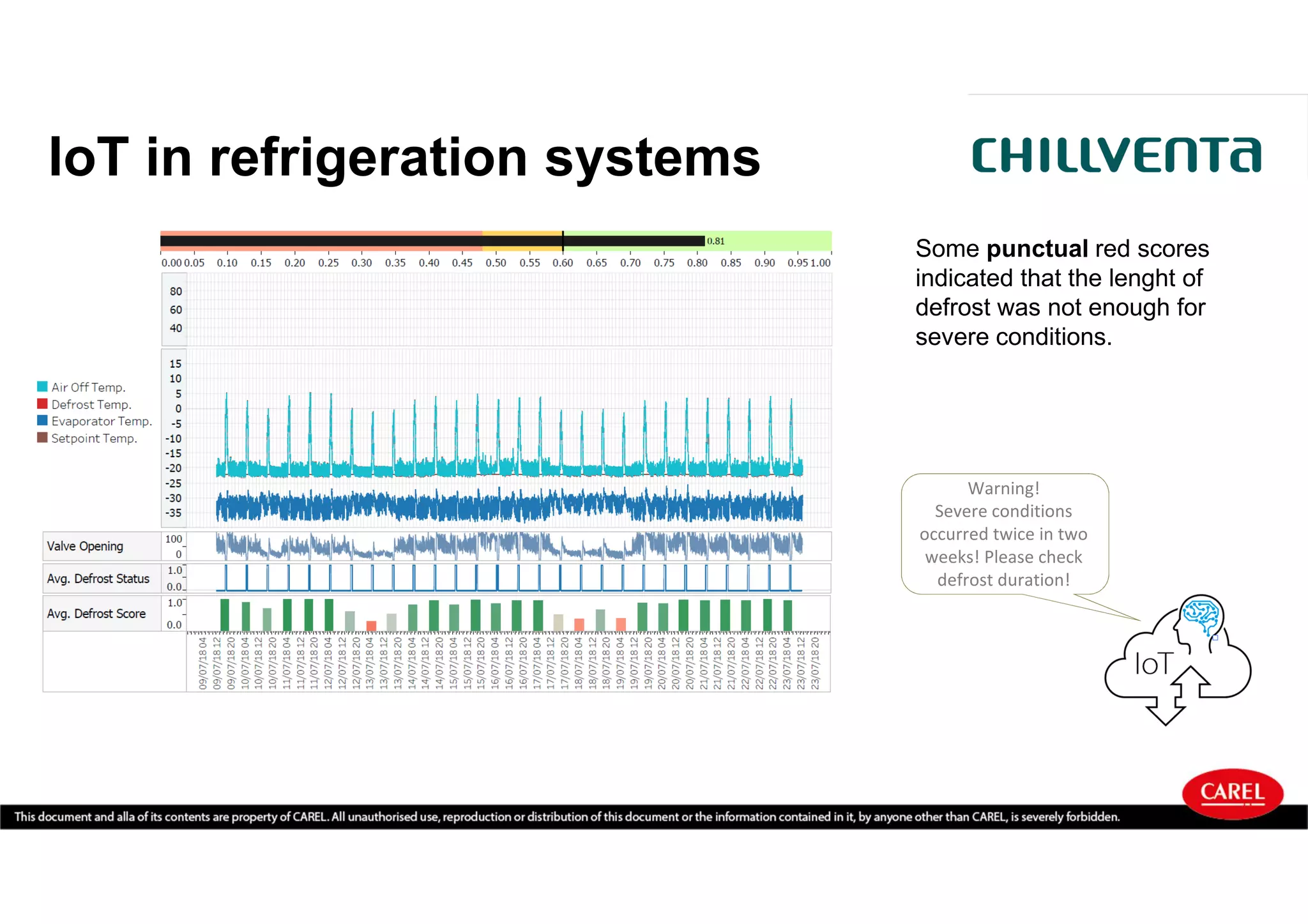
Some punctual red scores
indicated that the lenght of
defrost was not enough for
severe conditions.
Warning!
Severe conditions
occurred twice in two
weeks! Please check
defrost duration!
Challenges
Privacy Security
Energy consumption
of data centresPartnerships Regulations
Quality of connectivity
Conclusions
Connectivity of different devices and machine
learning techniques are being applied to HVAC/R
systems leading to promising results.
The implementation of IoT in HVAC/R systems will
result in important benefits such as energy saving
and prevention of failures.
The fast development of IoT in different sectors
will help to face the challenges that facilitate the
improvement of IoT services in HVAC/R systems.
Thank you for your attention
sergio.capanelli@carel.com
19
Hall 4A
NürnbergMesse, Arbeitstitel, Datum
Chillventa Specialist Forums 2018
Chillventa Fachforen 2018

Internet of cooling and heating things

  • 1.
    1 Hall 4A NürnbergMesse, Arbeitstitel,Datum Chillventa Specialist Forums 2018 Chillventa Fachforen 2018
  • 2.
    Sergio Maria Capanelli 10/2018 Internetof cooling and heating things
  • 3.
    https://www.gartner.com/newsroom/id/3598917 In 2020, connected objectswill generate: more than 900 exabytes of data with over 20 billion connected devices, 69 % increase with respect to 2016 Connected objects: predictions
  • 4.
    Connectivity Internet ofthings Internet of Things (IoT) is the inter-networking of physical devices (also referred to as “connected devices” and “smart devices”), like vehicles, buildings, and other items embedded with electronics, software, sensors, actuators, and network connectivity which enable these objects to collect and exchange data. http://www.cns-me.com/en/ict-service-details/57/iot-and-smart-cities
  • 5.
    IoT Services Descriptive analytics: describethe current and past situation, converting the data into information Preventive analytics: understand what might happen in the future Prescriptive analytics: operative/strategic solutions are proposed by the system on the basis of the analysis performed Proactive analytics: automatic implementation of the proposed actions
  • 6.
    Machine learning How machinelearning works: Training and Calibration: collected data are used to learn how machines perform on field. Test and Results: trained algorithm is tested using new data as input. The output is the “baseline” definition. Training and Calibration hour of the day, outdoor temperature/humidity, EEV position, fan flow, water temperature, compressor speed, regulation set-point, etc. Dataset Test and Results Input data Trained algorithm
  • 7.
    IoT in HVACsystems Case study on Preventive Analytics: show and improve the real operation efficiency1 of Heat Pumps by means of machine learning and A.I. tools 1regardless the influences due to heat pump geographical location, seasonal and environmental aspects, weather conditions, etc. Fans/Pumps status, speed Machine learning and A.I. 0 15 30 45 60 6 12 18 24 Heat Pump #16 is under- performing! Water temperatures Compressor Status Refrigerant charge, subcooling EEV status, superheat
  • 8.
    IoT in HVACsystems Predictive maintenance Actions that were previously taken in response to an emergency can now be planned in advance! Attention!!! The consumption is higher than expected!!!
  • 9.
    IoT in HVACsystems Performance optimization The baseline definition of a trained machine learning algorithm helps in fine-tuning. Succesful fine-tuning! Power consumption is much lower than baseline.
  • 10.
    IoT in HVACsystems Benchmarks between different units Comparison between different units of the same model installed in different plants. The normalized power consumption allows the complete analysis. Unit HVAC2 is performing better than HVAC1.
  • 11.
    IoT in refrigerationsystems Case study: show and improve the defrost status of supermarket showcases by means of machine learning and A.I. tools. Valve opening Machine learning and A.I. The defrost in showcase #9 is anomalous! Air off temperature Evaporator temperature Setpoint temperature
  • 12.
    IoT in refrigerationsystems ScoreShowcases Height and color: quality of defrost; Length: duration of defrost
  • 13.
    IoT in refrigerationsystems • The defrost score indicated that there was an anomaly in the system. • The operator realized that the probe had been wrongly installed. • After relocation, the score became green. Warning! Please check defrost duration and defrost probe positioning!
  • 14.
    IoT in refrigerationsystems Warning! Please check defrost frequency!
  • 15.
    IoT in refrigerationsystems Some punctual red scores indicated that the lenght of defrost was not enough for severe conditions. Warning! Severe conditions occurred twice in two weeks! Please check defrost duration!
  • 16.
    Challenges Privacy Security Energy consumption ofdata centresPartnerships Regulations Quality of connectivity
  • 17.
    Conclusions Connectivity of differentdevices and machine learning techniques are being applied to HVAC/R systems leading to promising results. The implementation of IoT in HVAC/R systems will result in important benefits such as energy saving and prevention of failures. The fast development of IoT in different sectors will help to face the challenges that facilitate the improvement of IoT services in HVAC/R systems.
  • 18.
    Thank you foryour attention sergio.capanelli@carel.com
  • 19.
    19 Hall 4A NürnbergMesse, Arbeitstitel,Datum Chillventa Specialist Forums 2018 Chillventa Fachforen 2018