Recent Trends in IOT
By Dr. Manisha R. Dhage
 IOT TECHNOLOGY: A More Connected World
 As machines get smaller, it becomes easier to produce.
 Industries have shifted away from a monolithic, single-device model in favor
of a more modular, microservices approach.
 Each device may have its own individual utility as well, and it may benefit
the entire network. This is the core of IoT technology.

 IOT TECHNOLOGY’S GROWTH
 According to Mordor Intelligence, the IoT technology market value is expected to rise
to $1.39 trillion by 2026.
 Reasons of growth
 The COVID-19 pandemic .
 Businesses are racing to develop better artificial intelligence solutions
which requires network of advanced sensors and edge computers.
 IoT networks can accomplish some tasks more efficiently than
centralized solutions.
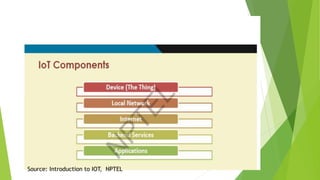
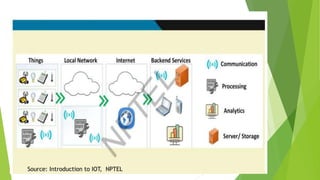
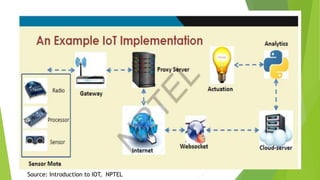
Source: Introduction to IOT, NPTEL
Implementation IoT with Raspberry Pi
Internet Of
Things
 Creating an interactive environment
 Network of devices connected
togethe
r
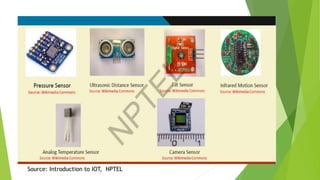
Sensor
11
 Electronic element
 Converts physical quantity into electrical
signals
 Can be analog or digital
Source: Introduction to IOT, NPTEL
Actuator
13
 Mechanical/Electro-mechanical device
 Converts energy into motion
 Mainly used to provide controlled motion to
other components
System Overview
14
 Sensor and actuator interfaced with Raspberry Pi
 Read data from the sensor
 Control the actuator according to the reading from the
sensor
 Connect the actuator to a device
System Overview (contd..)
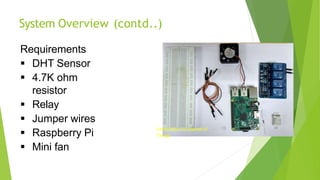
Requirements
 DHT Sensor
 4.7K ohm
resistor
 Relay
 Jumper wires
 Raspberry Pi
 Mini fan
Introduction to Internet of
Things
15
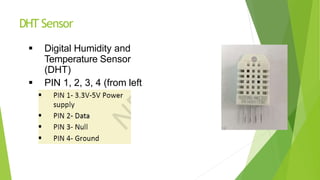
DHT Sensor
 Digital Humidity and
Temperature Sensor
(DHT)
 PIN 1, 2, 3, 4 (from left
to right)
16
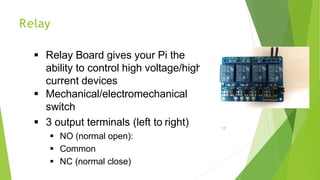
Relay
 Relay Board gives your Pi the
ability to control high voltage/high
current devices
 Mechanical/electromechanical
switch
 3 output terminals (left to right)
 NO (normal open):
 Common
 NC (normal close)
17
Temperature Dependent Auto Cooling System
Sensor interface with Raspberry
Pi
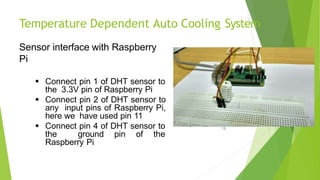
 Connect pin 1 of DHT sensor to
the 3.3V pin of Raspberry Pi
 Connect pin 2 of DHT sensor to
any input pins of Raspberry Pi,
here we have used pin 11
 Connect pin 4 of DHT sensor to
the ground pin of the
Raspberry Pi
18
Temperature Dependent Auto Cooling System
(contd..)
Relay interface with Raspberry Pi
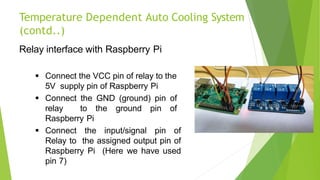
 Connect the VCC pin of relay to the
5V supply pin of Raspberry Pi
 Connect the GND (ground) pin of
relay to the ground pin of
Raspberry Pi
 Connect the input/signal pin of
Relay to the assigned output pin of
Raspberry Pi (Here we have used
pin 7)
19
Temperature Dependent Auto Cooling System
(contd..)
20
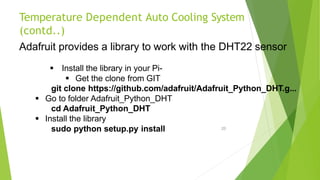
Adafruit provides a library to work with the DHT22 sensor
 Install the library in your Pi-
 Get the clone from GIT
git clone https://github.com/adafruit/Adafruit_Python_DHT.g...
 Go to folder Adafruit_Python_DHT
cd Adafruit_Python_DHT
 Install the library
sudo python setup.py install
Program: DHT22 with Pi
21
import RPi.GPIO as
GPIO from time
import sleep import
Adafruit_DHT
#importing the Adafruit
library
# create an instance of the sensor
type
GPIO.setmode(GPIO.BOARD)
GPIO.setwarnings(False)
sensor = Adafruit_DHT.AM2302
print (‘Getting data from the
sensor’)
#humidity and temperature are 2 variables that store the values received from
the sensor
humidity, temperature = Adafruit_DHT.read_retry(sensor,17)
print ('Temp={0:0.1f}*C humidity={1:0.1f}%'.format(temperature, humidity))
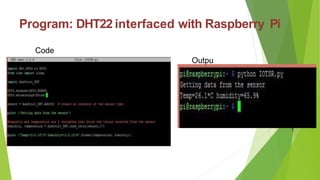
Program: DHT22 interfaced with Raspberry Pi
Code
Outpu
t
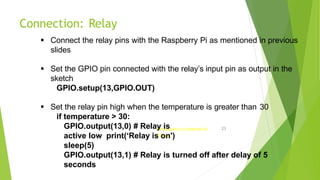
Connection: Relay
Introduction to Internet of
Things
23
 Connect the relay pins with the Raspberry Pi as mentioned in previous
slides
 Set the GPIO pin connected with the relay’s input pin as output in the
sketch
GPIO.setup(13,GPIO.OUT)
 Set the relay pin high when the temperature is greater than 30
if temperature > 30:
GPIO.output(13,0) # Relay is
active low print(‘Relay is on')
sleep(5)
GPIO.output(13,1) # Relay is turned off after delay of 5
seconds
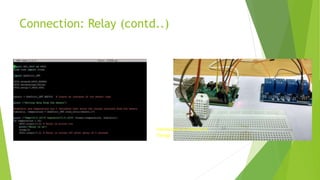
Connection: Relay (contd..)
Introduction to Internet of
Things
24
Connection: Fan
25
 Connect the Li-po battery in series with the fan
 NO terminal of the relay -> positive terminal of the Fan.
 Common terminal of the relay -> Positive terminal of the battery
 Negative terminal of the battery -> Negative terminal of the fan.
 Run the existing code. The fan should operate when the surrounding temperature is greater than the
threshold value in the sketch
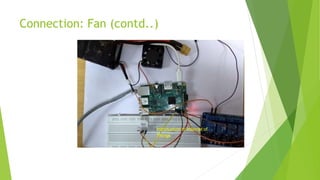
Connection: Fan (contd..)
Introduction to Internet of
Things
26
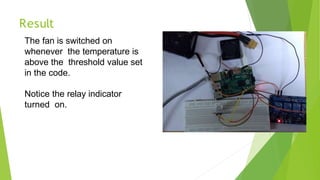
Result
The fan is switched on
whenever the temperature is
above the threshold value set
in the code.
Notice the relay indicator
turned on.
27
 LIMITED PRODUCTION: THE CHIP SHORTAGE
 Due to high demand and low supply of valuable semiconductor chips, IoT solutions
have become more expensive to produce.
 Some businesses are choosing to order their semiconductor inventories far in
advance.
 According to Forrester the semiconductor shortage in 2022 will limit the growth of IoT
markets by 10 to 15%.
 In February of 2022, the European Union passed the European Chips Act,
resolve the supply chain shortage.
Trends
AIoT – Artificial Intelligence &
IoT Technology
 Artificial intelligence and IoT have a mutualistic relationship.
 AI is benefitted by IoT with distributed data, and IoT is benefitted by AI with
advanced management.
 Network of data
 Research and Markets reports sate that AI in IoT technology will reach a value of $14,799
million by 2026.
 High quality data like live data from IoT sensors important for machine learning
 Ex. predictive maintenance of equipment in factory
 VISUAL INSPECTION: AI AND IOT WORK TOGETHER
 Visual inspection is another area where IoT technology and machine learning synergize
to enrich industrial and distribution industries.
 https://youtu.be/KezqhMo2P4M
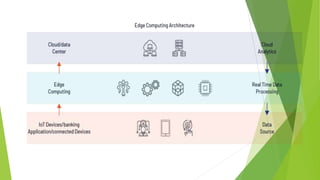
Edge Computing
 Edge computing is the ability to collect and analyze data
where it is collected.
 Low Latency & Security
 Ex. financial organizations
 Ex. Aautonomous cars
 According to Gartner survey currently only
10% data is processed outside traditional data
centre or cloud and it will reach 75% by 2025.
Benefits of Edge Computing
Wearable IoT Technology
 THE FUTURE OF IOT SMARTWATCHES AND WRISTBANDS
 wearable IoT technology has immense potential to aid in medical roles
 These devices can perform tasks such as automatically alerting others in case
of emergencies and gathering of continuous health records.
 AR AND VR
 If IoT technology can provide devices with real-time contextual data, then it’s
clear how this can greatly benefit the performance of AR and VR devices.
 Ex. Doctors performing surgery aided by head-mounted AR, where wearables
and other sensors provide data to the surgeon.
 A distribution center worker using AR on a mobile device to locate the position
of an item in a warehouse, where IoT devices help locate the item and send
directions to the worker.
 https://youtu.be/I8vYrAUb0BQ
Smart cities and Smart Homes
Introduction
 A Smart City is-
 An urban system
 Uses Information & Communication Technology (ICT)
 Makes infrastructure more interactive, accessible and efficient.
 Need for Smart Cities arose due to-
 Rapidly growing urban population
 Fast depleting natural resources
 Changes in environment and climate
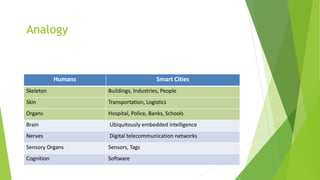
Analogy
Humans Smart Cities
Skeleton Buildings, Industries, People
Skin Transportation, Logistics
Organs Hospital, Police, Banks, Schools
Brain Ubiquitously embedded intelligence
Nerves Digital telecommunication networks
Sensory Organs Sensors, Tags
Cognition Software
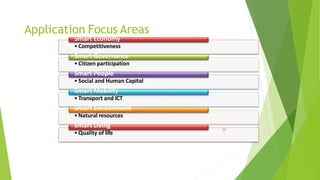
Application Focus Areas
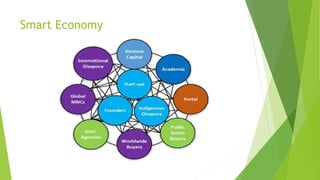
Smart Economy
• Competitiveness
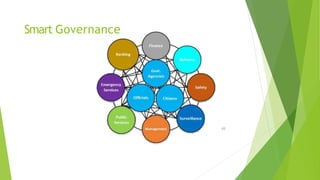
Smart Governance
• Citizen participation
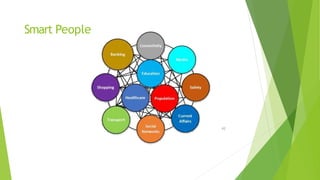
Smart People
• Social and Human Capital
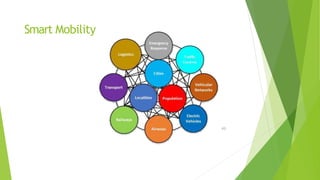
Smart Mobility
• Transport and ICT
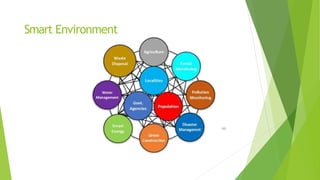
Smart Environment
• Natural resources
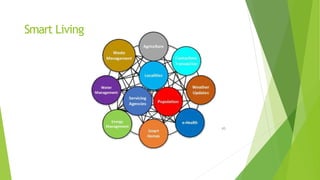
Smart Living
• Quality of life
39
Smart Economy
Smart Governance
41
Smart People
42
Smart Mobility
43
Smart Environment
44
Smart Living
45
Current Focus Areas
46
 Smart Homes
 Health monitoring.
 Conservation of resources (e.g.
electricity, water, fuel).
 Security and safety.
 Smart Parking Lots
 Auto routing of vehicles to empty slots.
 Auto charging for services provided.
 Detection of vacant slots in the parking
lot.
Current Focus Areas (contd.)
47
 Smart Vehicles
 Assistance to drivers during bad weather or low-visibility.
 Detection of bad driving patterns or driving under the influence of substances.
 Auto alert generation during crashes.
 Self diagnostics.
 Smart Health
 Low cost, portable, at-home medical diagnosis kits.
 Remote check-ups and diagnosis.
 On-body sensors for effortless and accurate health monitoring.
 Auto alert generation in case of emergency medical episodes (e.g. Heart attacks,
seizures).
Current Focus Areas (contd.)
48
 Pollution and Calamity Monitoring
 Monitoring for weather or man-made based calamities.
 Alert generation in case of above-threshold pollutants in the air or water.
 Resource reallocation and rerouting of services in the event of calamities.
 Smart Energy
 Smart metering systems.
 Smart energy allocation and distribution system.
 Incorporation of traditional and renewable sources of energy in the same
grid.
Current Focus Areas (contd.)
49
 Smart Agriculture
 Automatic detection of plant water stress.
 Monitoring of crop health status.
 Auto detection of crop infection.
 Auto application of fertilizers and pesticides.
 Scheduling harvesting and arranging proper transfer of harvests to
warehouses or markets.
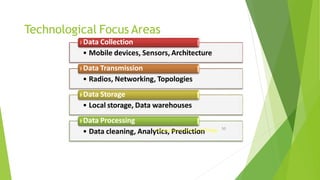
Technological Focus Areas
Data Collection
• Mobile devices, Sensors, Architecture
Data Transmission
• Radios, Networking, Topologies
Data Storage
• Local storage, Data warehouses
Data Processing
• Data cleaning, Analytics, Prediction
50
Introduction to Internet of Things
IoTChallenges in Smart Cities
51
Introduction to Internet of Things
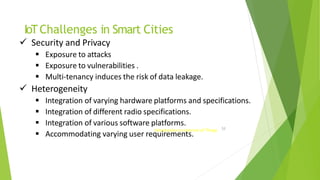
 Security and Privacy
 Exposure to attacks
 Exposure to vulnerabilities .
 Multi-tenancy induces the risk of data leakage.
 Heterogeneity
 Integration of varying hardware platforms and specifications.
 Integration of different radio specifications.
 Integration of various software platforms.
 Accommodating varying user requirements.
IoTChallenges in Smart Cities (contd.)
52
Introduction to Internet of Things
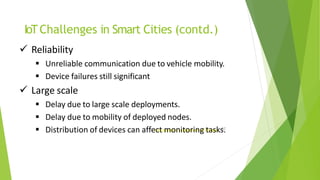
 Reliability
 Unreliable communication due to vehicle mobility.
 Device failures still significant
 Large scale
 Delay due to large scale deployments.
 Delay due to mobility of deployed nodes.
 Distribution of devices can affect monitoring tasks.
IoTChallenges in Smart Cities (contd.)
53
Introduction to Internet of Things
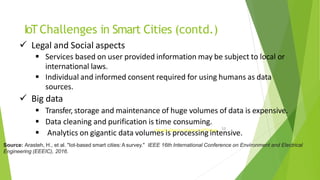
 Legal and Social aspects
 Services based on user provided information may be subject to local or
international laws.
 Individual and informed consent required for using humans as data
sources.
 Big data
 Transfer, storage and maintenance of huge volumes of data is expensive.
 Data cleaning and purification is time consuming.
 Analytics on gigantic data volumes is processing intensive.
Source: Arasteh, H., et al. "Iot-based smart cities:A survey." IEEE 16th International Conference on Environment and Electrical
Engineering (EEEIC), 2016.
IoTChallenges in Smart Cities (contd.)
54
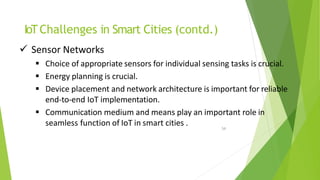
 Sensor Networks
 Choice of appropriate sensors for individual sensing tasks is crucial.
 Energy planning is crucial.
 Device placement and network architecture is important for reliable
end-to-end IoT implementation.
 Communication medium and means play an important role in
seamless function of IoT in smart cities .
55

Recent Trends in IOT (1).pptx

  • 1.
    Recent Trends inIOT By Dr. Manisha R. Dhage
  • 2.
     IOT TECHNOLOGY:A More Connected World  As machines get smaller, it becomes easier to produce.  Industries have shifted away from a monolithic, single-device model in favor of a more modular, microservices approach.  Each device may have its own individual utility as well, and it may benefit the entire network. This is the core of IoT technology.  IOT TECHNOLOGY’S GROWTH  According to Mordor Intelligence, the IoT technology market value is expected to rise to $1.39 trillion by 2026.  Reasons of growth  The COVID-19 pandemic .  Businesses are racing to develop better artificial intelligence solutions which requires network of advanced sensors and edge computers.  IoT networks can accomplish some tasks more efficiently than centralized solutions.
  • 3.
  • 4.
  • 5.
  • 6.
  • 7.
  • 8.
  • 9.
  • 10.
    Implementation IoT withRaspberry Pi Internet Of Things  Creating an interactive environment  Network of devices connected togethe r
  • 11.
    Sensor 11  Electronic element Converts physical quantity into electrical signals  Can be analog or digital
  • 12.
  • 13.
    Actuator 13  Mechanical/Electro-mechanical device Converts energy into motion  Mainly used to provide controlled motion to other components
  • 14.
    System Overview 14  Sensorand actuator interfaced with Raspberry Pi  Read data from the sensor  Control the actuator according to the reading from the sensor  Connect the actuator to a device
  • 15.
    System Overview (contd..) Requirements DHT Sensor  4.7K ohm resistor  Relay  Jumper wires  Raspberry Pi  Mini fan Introduction to Internet of Things 15
  • 16.
    DHT Sensor  DigitalHumidity and Temperature Sensor (DHT)  PIN 1, 2, 3, 4 (from left to right) 16
  • 17.
    Relay  Relay Boardgives your Pi the ability to control high voltage/high current devices  Mechanical/electromechanical switch  3 output terminals (left to right)  NO (normal open):  Common  NC (normal close) 17
  • 18.
    Temperature Dependent AutoCooling System Sensor interface with Raspberry Pi  Connect pin 1 of DHT sensor to the 3.3V pin of Raspberry Pi  Connect pin 2 of DHT sensor to any input pins of Raspberry Pi, here we have used pin 11  Connect pin 4 of DHT sensor to the ground pin of the Raspberry Pi 18
  • 19.
    Temperature Dependent AutoCooling System (contd..) Relay interface with Raspberry Pi  Connect the VCC pin of relay to the 5V supply pin of Raspberry Pi  Connect the GND (ground) pin of relay to the ground pin of Raspberry Pi  Connect the input/signal pin of Relay to the assigned output pin of Raspberry Pi (Here we have used pin 7) 19
  • 20.
    Temperature Dependent AutoCooling System (contd..) 20 Adafruit provides a library to work with the DHT22 sensor  Install the library in your Pi-  Get the clone from GIT git clone https://github.com/adafruit/Adafruit_Python_DHT.g...  Go to folder Adafruit_Python_DHT cd Adafruit_Python_DHT  Install the library sudo python setup.py install
  • 21.
    Program: DHT22 withPi 21 import RPi.GPIO as GPIO from time import sleep import Adafruit_DHT #importing the Adafruit library # create an instance of the sensor type GPIO.setmode(GPIO.BOARD) GPIO.setwarnings(False) sensor = Adafruit_DHT.AM2302 print (‘Getting data from the sensor’) #humidity and temperature are 2 variables that store the values received from the sensor humidity, temperature = Adafruit_DHT.read_retry(sensor,17) print ('Temp={0:0.1f}*C humidity={1:0.1f}%'.format(temperature, humidity))
  • 22.
    Program: DHT22 interfacedwith Raspberry Pi Code Outpu t
  • 23.
    Connection: Relay Introduction toInternet of Things 23  Connect the relay pins with the Raspberry Pi as mentioned in previous slides  Set the GPIO pin connected with the relay’s input pin as output in the sketch GPIO.setup(13,GPIO.OUT)  Set the relay pin high when the temperature is greater than 30 if temperature > 30: GPIO.output(13,0) # Relay is active low print(‘Relay is on') sleep(5) GPIO.output(13,1) # Relay is turned off after delay of 5 seconds
  • 24.
  • 25.
    Connection: Fan 25  Connectthe Li-po battery in series with the fan  NO terminal of the relay -> positive terminal of the Fan.  Common terminal of the relay -> Positive terminal of the battery  Negative terminal of the battery -> Negative terminal of the fan.  Run the existing code. The fan should operate when the surrounding temperature is greater than the threshold value in the sketch
  • 26.
  • 27.
    Result The fan isswitched on whenever the temperature is above the threshold value set in the code. Notice the relay indicator turned on. 27
  • 28.
     LIMITED PRODUCTION:THE CHIP SHORTAGE  Due to high demand and low supply of valuable semiconductor chips, IoT solutions have become more expensive to produce.  Some businesses are choosing to order their semiconductor inventories far in advance.  According to Forrester the semiconductor shortage in 2022 will limit the growth of IoT markets by 10 to 15%.  In February of 2022, the European Union passed the European Chips Act, resolve the supply chain shortage.
  • 29.
  • 30.
    AIoT – ArtificialIntelligence & IoT Technology  Artificial intelligence and IoT have a mutualistic relationship.  AI is benefitted by IoT with distributed data, and IoT is benefitted by AI with advanced management.  Network of data  Research and Markets reports sate that AI in IoT technology will reach a value of $14,799 million by 2026.  High quality data like live data from IoT sensors important for machine learning  Ex. predictive maintenance of equipment in factory  VISUAL INSPECTION: AI AND IOT WORK TOGETHER  Visual inspection is another area where IoT technology and machine learning synergize to enrich industrial and distribution industries.  https://youtu.be/KezqhMo2P4M
  • 33.
    Edge Computing  Edgecomputing is the ability to collect and analyze data where it is collected.  Low Latency & Security  Ex. financial organizations  Ex. Aautonomous cars  According to Gartner survey currently only 10% data is processed outside traditional data centre or cloud and it will reach 75% by 2025.
  • 35.
  • 36.
    Wearable IoT Technology THE FUTURE OF IOT SMARTWATCHES AND WRISTBANDS  wearable IoT technology has immense potential to aid in medical roles  These devices can perform tasks such as automatically alerting others in case of emergencies and gathering of continuous health records.  AR AND VR  If IoT technology can provide devices with real-time contextual data, then it’s clear how this can greatly benefit the performance of AR and VR devices.  Ex. Doctors performing surgery aided by head-mounted AR, where wearables and other sensors provide data to the surgeon.  A distribution center worker using AR on a mobile device to locate the position of an item in a warehouse, where IoT devices help locate the item and send directions to the worker.  https://youtu.be/I8vYrAUb0BQ
  • 37.
    Smart cities andSmart Homes Introduction  A Smart City is-  An urban system  Uses Information & Communication Technology (ICT)  Makes infrastructure more interactive, accessible and efficient.  Need for Smart Cities arose due to-  Rapidly growing urban population  Fast depleting natural resources  Changes in environment and climate
  • 38.
    Analogy Humans Smart Cities SkeletonBuildings, Industries, People Skin Transportation, Logistics Organs Hospital, Police, Banks, Schools Brain Ubiquitously embedded intelligence Nerves Digital telecommunication networks Sensory Organs Sensors, Tags Cognition Software
  • 39.
    Application Focus Areas SmartEconomy • Competitiveness Smart Governance • Citizen participation Smart People • Social and Human Capital Smart Mobility • Transport and ICT Smart Environment • Natural resources Smart Living • Quality of life 39
  • 40.
  • 41.
  • 42.
  • 43.
  • 44.
  • 45.
  • 46.
    Current Focus Areas 46 Smart Homes  Health monitoring.  Conservation of resources (e.g. electricity, water, fuel).  Security and safety.  Smart Parking Lots  Auto routing of vehicles to empty slots.  Auto charging for services provided.  Detection of vacant slots in the parking lot.
  • 47.
    Current Focus Areas(contd.) 47  Smart Vehicles  Assistance to drivers during bad weather or low-visibility.  Detection of bad driving patterns or driving under the influence of substances.  Auto alert generation during crashes.  Self diagnostics.  Smart Health  Low cost, portable, at-home medical diagnosis kits.  Remote check-ups and diagnosis.  On-body sensors for effortless and accurate health monitoring.  Auto alert generation in case of emergency medical episodes (e.g. Heart attacks, seizures).
  • 48.
    Current Focus Areas(contd.) 48  Pollution and Calamity Monitoring  Monitoring for weather or man-made based calamities.  Alert generation in case of above-threshold pollutants in the air or water.  Resource reallocation and rerouting of services in the event of calamities.  Smart Energy  Smart metering systems.  Smart energy allocation and distribution system.  Incorporation of traditional and renewable sources of energy in the same grid.
  • 49.
    Current Focus Areas(contd.) 49  Smart Agriculture  Automatic detection of plant water stress.  Monitoring of crop health status.  Auto detection of crop infection.  Auto application of fertilizers and pesticides.  Scheduling harvesting and arranging proper transfer of harvests to warehouses or markets.
  • 50.
    Technological Focus Areas DataCollection • Mobile devices, Sensors, Architecture Data Transmission • Radios, Networking, Topologies Data Storage • Local storage, Data warehouses Data Processing • Data cleaning, Analytics, Prediction 50 Introduction to Internet of Things
  • 51.
    IoTChallenges in SmartCities 51 Introduction to Internet of Things  Security and Privacy  Exposure to attacks  Exposure to vulnerabilities .  Multi-tenancy induces the risk of data leakage.  Heterogeneity  Integration of varying hardware platforms and specifications.  Integration of different radio specifications.  Integration of various software platforms.  Accommodating varying user requirements.
  • 52.
    IoTChallenges in SmartCities (contd.) 52 Introduction to Internet of Things  Reliability  Unreliable communication due to vehicle mobility.  Device failures still significant  Large scale  Delay due to large scale deployments.  Delay due to mobility of deployed nodes.  Distribution of devices can affect monitoring tasks.
  • 53.
    IoTChallenges in SmartCities (contd.) 53 Introduction to Internet of Things  Legal and Social aspects  Services based on user provided information may be subject to local or international laws.  Individual and informed consent required for using humans as data sources.  Big data  Transfer, storage and maintenance of huge volumes of data is expensive.  Data cleaning and purification is time consuming.  Analytics on gigantic data volumes is processing intensive. Source: Arasteh, H., et al. "Iot-based smart cities:A survey." IEEE 16th International Conference on Environment and Electrical Engineering (EEEIC), 2016.
  • 54.
    IoTChallenges in SmartCities (contd.) 54  Sensor Networks  Choice of appropriate sensors for individual sensing tasks is crucial.  Energy planning is crucial.  Device placement and network architecture is important for reliable end-to-end IoT implementation.  Communication medium and means play an important role in seamless function of IoT in smart cities .
  • 55.

Editor's Notes

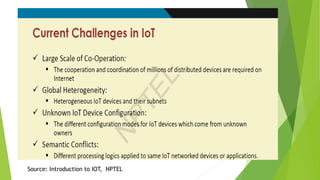
  • #3 The COVID-19 pandemic accelerated the advancement of remote monitoring, smart home devices, and data analysis solutions. -Businesses are racing to develop better artificial intelligence solutions. These often require a network of advanced sensors and edge computers within the scope of IoT. --IoT networks can accomplish some tasks more efficiently than centralized solutions.
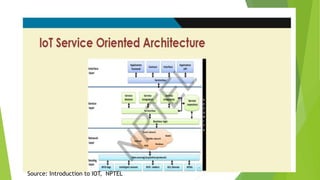
  • #4 LoWPAN Gateway (in IoT) - LoWPAN is an acronym of Low power Wireless Personal Area Networks. The LoWPAN IoT gateway functions as a border router in a LoWPAN network, connecting a wireless IPv6 network to the Internet
  • #29 In February of 2022, the European Union passed the European Chips Act, a combination of public and private investments to support efforts to resolve the supply chain shortage.
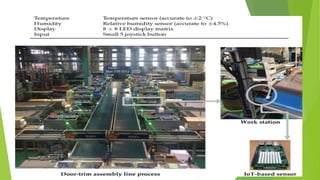
  • #31 ----One of the most fascinating use cases of IoT technology is to support artificial intelligence software. -----Since artificial intelligence technologies are heavily data driven, IoT sensors are an immense asset to the machine learning data pipeline. Research and Markets reports that AI in IoT technology will reach a value of $14,799 million by 2026. High quality data is extremely important for the success of machine learning techniques. AI can compound the benefits of IoT by adding human-like awareness and decision-making to the environment at hand to ultimately increase efficiency and improve processes. For example, live data from IoT sensors monitoring factory equipment can help manufacturing-based machine learning algorithms determine when equipment needs to be serviced in the future, a practice called predictive maintenance.
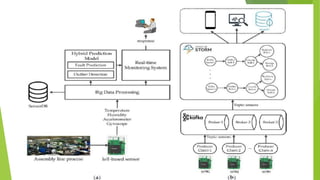
  • #33 Figure 1. Architecture of the real-time monitoring system in an assembly line process (a) and system design for big data processing (b). Apache Kafka is a distributed event store and stream-processing platform.  for handling real-time data feeds. Apache Storm has many use cases: realtime analytics, online machine learning, continuous computation, distributed RPC, ETL, and more.
  • #34 ------One of the top benefits of implementing edge computing is the ability to collect and analyze data where it is collected, catching and correcting problems that might not be identified as quickly if the data were to be sent to a central server or cloud for processing and analysis -----Real time applications depend on edge computing. Instead of calculating everything at a central source, edge networks process information closer to the user and lighten the load of the entire network for all users. Security----If data can be processed on an edge device instead of being transmitted to a central server, there are fewer opportunities for it to be intercepted by hackers. ----ex. A classic example of the application of edge computing is in autonomous cars, where terabytes of data are generated every day and decisions need to be made in milliseconds for a smooth user experience. ----  to maximize operational efficiency, improve performance and safety, automate all core business processes, and ensure “always on” availability.
  • #36 safety.– Automatically stopping machinery from operating while someone is in a restricted area at a factory is one way that IoT edge computing can be used to protect people from harm.
  • #37 ---wearable IoT technology has immense potential to aid in medical roles due to its ability to keep track of patient vitals. ----If IoT technology can provide devices with real-time contextual data, then it’s clear how this can greatly benefit the performance of AR and VR devices.