GOOGLE SMART CONTACT LENS
SHABEEB C
CSE A
61
LMES18CS119
● Google project announced by GOOGLE in January 2014.
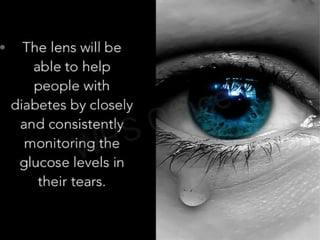
● The project aims to assist people with diabetes by constantly measuring
the glucose level.
GOOGLE SMART CONTACT LENS
DESIGN
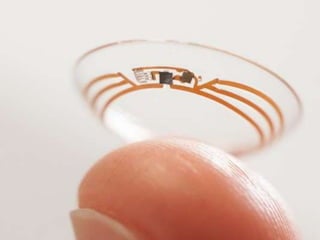
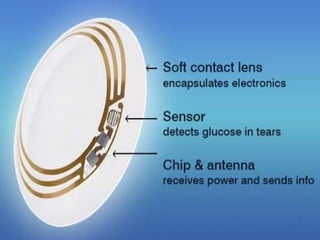
● The lens consist of a wireless chip and a miniaturized glucose sensor.
● A tiny pinhole in the lens allow the tear fluid to seep in to the sensor to
measure blood sugar levels.
● Both the sensors are embedded between two soft layers of the lens material.
● The electronics lies outside of both the pupil and iris so there is no damage to
the eye.
● There is a wireless antenna inside the lens that is thinner than a human hair
which will act as a controller to communicate information to the wireless
device.
● The antenna will gather read and analyze data.Power will be drawn from the
device which will communicate data via the wireless technology
RFID(Radio frequency identification).
● Plans to add small LED lights that could warn the wearer by lightning up
when the glucose levels have crossed above or below.
ADVANTAGES
● It is a simple and painless method.
● Continues glucose monitoring.
● Accurate reading - ensures efficiency and safe use.
● Reusable ( cost effective solution).
● Researchers have proven that the contact lens is less painful and time
consuming for diabetic than traditional finger pricking.
CHALLENGES
● Challenges presented by such a technology are that the LED Lights contain
the toxic metal ARSENIC.
● The performance of contact lenses in windy environment and teary eyes is
unknown.
CONCLUSION
● New technology.
● Continuousmonitoring.
● Non-invasive.
● Mobility for patients.
● Emerging markets.
THANK YOU

Google smart contact lens

  • 1.
    GOOGLE SMART CONTACTLENS SHABEEB C CSE A 61 LMES18CS119
  • 2.
    ● Google projectannounced by GOOGLE in January 2014. ● The project aims to assist people with diabetes by constantly measuring the glucose level. GOOGLE SMART CONTACT LENS
  • 6.
    DESIGN ● The lensconsist of a wireless chip and a miniaturized glucose sensor. ● A tiny pinhole in the lens allow the tear fluid to seep in to the sensor to measure blood sugar levels. ● Both the sensors are embedded between two soft layers of the lens material. ● The electronics lies outside of both the pupil and iris so there is no damage to the eye.
  • 7.
    ● There isa wireless antenna inside the lens that is thinner than a human hair which will act as a controller to communicate information to the wireless device. ● The antenna will gather read and analyze data.Power will be drawn from the device which will communicate data via the wireless technology RFID(Radio frequency identification). ● Plans to add small LED lights that could warn the wearer by lightning up when the glucose levels have crossed above or below.
  • 8.
    ADVANTAGES ● It isa simple and painless method. ● Continues glucose monitoring. ● Accurate reading - ensures efficiency and safe use. ● Reusable ( cost effective solution). ● Researchers have proven that the contact lens is less painful and time consuming for diabetic than traditional finger pricking.
  • 9.
    CHALLENGES ● Challenges presentedby such a technology are that the LED Lights contain the toxic metal ARSENIC. ● The performance of contact lenses in windy environment and teary eyes is unknown.
  • 10.
    CONCLUSION ● New technology. ●Continuousmonitoring. ● Non-invasive. ● Mobility for patients. ● Emerging markets.
  • 11.