Internet Decency Legislation


                      Terrance Garmon
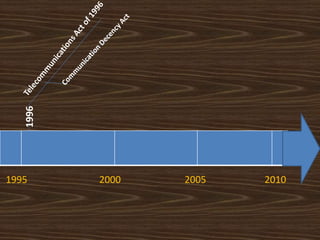
1996


1995      2000   2005   2010
Telecommunication Act of 1996
      •   Primary Purpose: to reduce regulation and encourage
          the “rapid deployment of new telecommunication
          technologies.”

      •   Originally for Telephone, T.V. and Radio

      •   Internet started to become more popular

      •   Congress saw potential of Internet as a medium for
          educational and political discourse, and as a result
          wanted to enact legislation that would promote the
          development of the internet

      •   Congress also saw how easy it was for users to access
          sexually explicit sites without knowing the user‟s age

      •   As a result, title V of the Act was created to address
          decency on the internet
The Communications Decency Act
        of 1996 (CDA)

 •   The 1st notable attempt by the US Congress to regulate
     pornographic material on the internet.

 • Did 2 things:
    • 1.) Attempted to regulate both indecency (when available to
       children) and obscenity in cyberspace.
    • 2.) Section 230 of the Act has been interpreted to say that
       operators of Internet services are not to be construed as
       publishers (and thus not legally liable for the words of third
       parties who use their services).
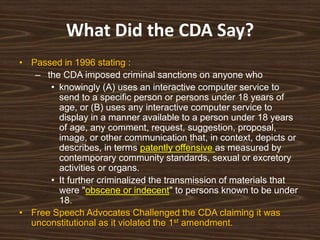
What Did the CDA Say?
• Passed in 1996 stating :
   – the CDA imposed criminal sanctions on anyone who
      • knowingly (A) uses an interactive computer service to
        send to a specific person or persons under 18 years of
        age, or (B) uses any interactive computer service to
        display in a manner available to a person under 18 years
        of age, any comment, request, suggestion, proposal,
        image, or other communication that, in context, depicts or
        describes, in terms patently offensive as measured by
        contemporary community standards, sexual or excretory
        activities or organs.
      • It further criminalized the transmission of materials that
        were "obscene or indecent" to persons known to be under
        18.
• Free Speech Advocates Challenged the CDA claiming it was
  unconstitutional as it violated the 1st amendment.
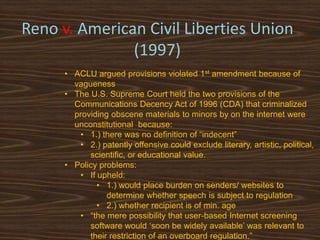
Reno v. American Civil Liberties Union
               (1997)
      • ACLU argued provisions violated 1st amendment because of
        vagueness
      • The U.S. Supreme Court held the two provisions of the
        Communications Decency Act of 1996 (CDA) that criminalized
        providing obscene materials to minors by on the internet were
        unconstitutional because:
         • 1.) there was no definition of “indecent”
         • 2.) patently offensive could exclude literary, artistic, political,
            scientific, or educational value.
      • Policy problems:
         • If upheld:
              • 1.) would place burden on senders/ websites to
                 determine whether speech is subject to regulation
              • 2.) whether recipient is of min. age
         • “the mere possibility that user-based Internet screening
            software would „soon be widely available‟ was relevant to
            their restriction of an overboard regulation.”
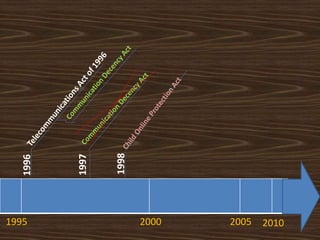
1998
          1997
   1996


1995                    2000   2005   2010
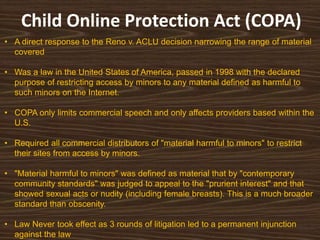
Child Online Protection Act (COPA)
• A direct response to the Reno v. ACLU decision narrowing the range of material
  covered

• Was a law in the United States of America, passed in 1998 with the declared
  purpose of restricting access by minors to any material defined as harmful to
  such minors on the Internet.

• COPA only limits commercial speech and only affects providers based within the
  U.S.

• Required all commercial distributors of "material harmful to minors" to restrict
  their sites from access by minors.

• "Material harmful to minors" was defined as material that by "contemporary
  community standards" was judged to appeal to the "prurient interest" and that
  showed sexual acts or nudity (including female breasts). This is a much broader
  standard than obscenity.

• Law Never took effect as 3 rounds of litigation led to a permanent injunction
  against the law
Ashcroft v. American Civil Liberties
           Union (2004)
 Legislation
 – Round 1= remanded back to circuit ct (1998-2002)
 – Round 2= upheld injunction, likely unconstitutional (2003-2004)
     • Supreme ct of Ashcroft
         – It prevented online publishers from publishing some
           material that adults had a right to access - and because it
           did not use the least restrictive means possible to protect
           children (the court found that blocking software installed
           on home computers by parents would do as good a job
           without preventing free speech).
         – For similar reasons, the panel found that the act was
           unconstitutionally "overbroad" - that is, it applied to too
           much protected material.
 – Round 3= permanent enjoinment of law granted and upheld on
   appeal and denied review in Supreme ct, which killed the bill.
   (2007-2009)
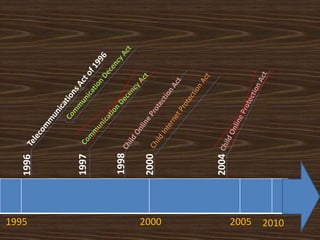
1995
       1996


       1997


       1998

       2000


2000
2005
2010   2004
Children’s Internet Protection Act
              (CIPA)
   What is it?
          -The Children‟s Internet Protection Act (CIPA) is a federal
          law enacted by Congress to address concerns about
          access to offensive content over the Internet on school
          and library computers.

          -CIPA imposes certain types of requirements on any
          school or library that receives certain types of federal
          funding.

          -In passing CIPA, Congress required libraries and K-12
          schools using these discounts (sometimes called "E-Rate
          discounts") on Internet access and internal connections to
          purchase and use a "technology protection measure" on
          every computer connected to the Internet.
What CIPA Requires
Schools and libraries subject to CIPA may not receive the federal funding unless:
        1.) they certify that they have an Internet safety policy that includes
        technology protection measures.
        2.) The protection measures must block or filter Internet access to pictures
        that are: (a) obscene; (b) child pornography; or (c) harmful to minors (for
        computers that are accessed by minors).
        3.) Before adopting this Internet safety policy, schools and libraries must
        provide reasonable notice and hold at least one public hearing or meeting
        to address the proposal.
        4.) Adopt and enforce a policy to monitor online activities of minors.
        5.) required to adopt and implement an Internet safety policy addressing:
                 (a) access by minors to inappropriate matter on the Internet; (b)
                 the safety and security of minors when using electronic mail, chat
                 rooms and other forms of direct electronic communications; (c)
                 unauthorized access, including so-called “hacking,” and other
                 unlawful activities by minors online; (d) unauthorized disclosure, u
                 se, and dissemination of personal information regarding minors;
                 and (e) measures restricting minors‟ access to materials harmful
                 to them.
What Else Does it Require?
• Schools and libraries are required to certify that they have their
  safety policies and technology in place before receiving funding.
• CIPA does not affect funding for schools and libraries receiving
  discounts only for telecommunications, such as telephone service.

• An authorized person may disable the blocking or filtering measure
  during use by an adult to enable access for bona fide research or
  other lawful purposes.

• Schools and libraries that do not receive (E-Rate discounts) or only
  receive discounts for telecommunication services and not for Internet
  access or internal connections, do not have any obligation to filter
  under CIPA.

• As of 2007 approximately one third of libraries had chosen to forego
  federal E-Rate and certain types of LSTA funds so they would not be
  required to filter the Internet access of their patrons and staff.
United States v. American Library
             Association (2003)
•   Challenged the Constitutionality of Act
     – Argued 1.) Did not help disadvantaged schools and libraries improve
       economically
     – 2.) that "no filtering software successfully differentiates constitutionally
       protected speech from illegal speech on the Internet.“

•   Found:
     – That it is not possible for a public library to comply with CIPA without
        blocking a very substantial amount of constitutionally protected speech,
        in violation of the First Amendment."

     – Upon appeal to the U.S. Supreme Court, however, the law was
       upheld as constitutional as a condition imposed on institutions in
       exchange for government funding

•   Upheld and made it clear that the constitutionality of CIPA would be
    upheld only "if, as the Government represents, a librarian will unblock
    filtered material or disable the Internet software filter without significant
    delay on an adult user's request."
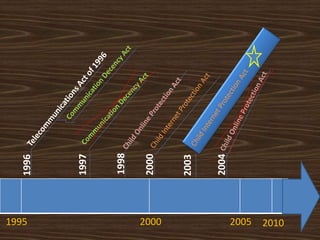
1995
       1996


       1997


       1998

       2000


2000
       2003


2005
2010   2004

Internet decency legislation

  • 1.
  • 2.
    1996 1995 2000 2005 2010
  • 3.
    Telecommunication Act of1996 • Primary Purpose: to reduce regulation and encourage the “rapid deployment of new telecommunication technologies.” • Originally for Telephone, T.V. and Radio • Internet started to become more popular • Congress saw potential of Internet as a medium for educational and political discourse, and as a result wanted to enact legislation that would promote the development of the internet • Congress also saw how easy it was for users to access sexually explicit sites without knowing the user‟s age • As a result, title V of the Act was created to address decency on the internet
  • 4.
    The Communications DecencyAct of 1996 (CDA) • The 1st notable attempt by the US Congress to regulate pornographic material on the internet. • Did 2 things: • 1.) Attempted to regulate both indecency (when available to children) and obscenity in cyberspace. • 2.) Section 230 of the Act has been interpreted to say that operators of Internet services are not to be construed as publishers (and thus not legally liable for the words of third parties who use their services).
  • 5.
    What Did theCDA Say? • Passed in 1996 stating : – the CDA imposed criminal sanctions on anyone who • knowingly (A) uses an interactive computer service to send to a specific person or persons under 18 years of age, or (B) uses any interactive computer service to display in a manner available to a person under 18 years of age, any comment, request, suggestion, proposal, image, or other communication that, in context, depicts or describes, in terms patently offensive as measured by contemporary community standards, sexual or excretory activities or organs. • It further criminalized the transmission of materials that were "obscene or indecent" to persons known to be under 18. • Free Speech Advocates Challenged the CDA claiming it was unconstitutional as it violated the 1st amendment.
  • 6.
    Reno v. AmericanCivil Liberties Union (1997) • ACLU argued provisions violated 1st amendment because of vagueness • The U.S. Supreme Court held the two provisions of the Communications Decency Act of 1996 (CDA) that criminalized providing obscene materials to minors by on the internet were unconstitutional because: • 1.) there was no definition of “indecent” • 2.) patently offensive could exclude literary, artistic, political, scientific, or educational value. • Policy problems: • If upheld: • 1.) would place burden on senders/ websites to determine whether speech is subject to regulation • 2.) whether recipient is of min. age • “the mere possibility that user-based Internet screening software would „soon be widely available‟ was relevant to their restriction of an overboard regulation.”
  • 7.
    1998 1997 1996 1995 2000 2005 2010
  • 8.
    Child Online ProtectionAct (COPA) • A direct response to the Reno v. ACLU decision narrowing the range of material covered • Was a law in the United States of America, passed in 1998 with the declared purpose of restricting access by minors to any material defined as harmful to such minors on the Internet. • COPA only limits commercial speech and only affects providers based within the U.S. • Required all commercial distributors of "material harmful to minors" to restrict their sites from access by minors. • "Material harmful to minors" was defined as material that by "contemporary community standards" was judged to appeal to the "prurient interest" and that showed sexual acts or nudity (including female breasts). This is a much broader standard than obscenity. • Law Never took effect as 3 rounds of litigation led to a permanent injunction against the law
  • 9.
    Ashcroft v. AmericanCivil Liberties Union (2004) Legislation – Round 1= remanded back to circuit ct (1998-2002) – Round 2= upheld injunction, likely unconstitutional (2003-2004) • Supreme ct of Ashcroft – It prevented online publishers from publishing some material that adults had a right to access - and because it did not use the least restrictive means possible to protect children (the court found that blocking software installed on home computers by parents would do as good a job without preventing free speech). – For similar reasons, the panel found that the act was unconstitutionally "overbroad" - that is, it applied to too much protected material. – Round 3= permanent enjoinment of law granted and upheld on appeal and denied review in Supreme ct, which killed the bill. (2007-2009)
  • 10.
    1995 1996 1997 1998 2000 2000 2005 2010 2004
  • 11.
    Children’s Internet ProtectionAct (CIPA) What is it? -The Children‟s Internet Protection Act (CIPA) is a federal law enacted by Congress to address concerns about access to offensive content over the Internet on school and library computers. -CIPA imposes certain types of requirements on any school or library that receives certain types of federal funding. -In passing CIPA, Congress required libraries and K-12 schools using these discounts (sometimes called "E-Rate discounts") on Internet access and internal connections to purchase and use a "technology protection measure" on every computer connected to the Internet.
  • 12.
    What CIPA Requires Schoolsand libraries subject to CIPA may not receive the federal funding unless: 1.) they certify that they have an Internet safety policy that includes technology protection measures. 2.) The protection measures must block or filter Internet access to pictures that are: (a) obscene; (b) child pornography; or (c) harmful to minors (for computers that are accessed by minors). 3.) Before adopting this Internet safety policy, schools and libraries must provide reasonable notice and hold at least one public hearing or meeting to address the proposal. 4.) Adopt and enforce a policy to monitor online activities of minors. 5.) required to adopt and implement an Internet safety policy addressing: (a) access by minors to inappropriate matter on the Internet; (b) the safety and security of minors when using electronic mail, chat rooms and other forms of direct electronic communications; (c) unauthorized access, including so-called “hacking,” and other unlawful activities by minors online; (d) unauthorized disclosure, u se, and dissemination of personal information regarding minors; and (e) measures restricting minors‟ access to materials harmful to them.
  • 13.
    What Else Doesit Require? • Schools and libraries are required to certify that they have their safety policies and technology in place before receiving funding. • CIPA does not affect funding for schools and libraries receiving discounts only for telecommunications, such as telephone service. • An authorized person may disable the blocking or filtering measure during use by an adult to enable access for bona fide research or other lawful purposes. • Schools and libraries that do not receive (E-Rate discounts) or only receive discounts for telecommunication services and not for Internet access or internal connections, do not have any obligation to filter under CIPA. • As of 2007 approximately one third of libraries had chosen to forego federal E-Rate and certain types of LSTA funds so they would not be required to filter the Internet access of their patrons and staff.
  • 14.
    United States v.American Library Association (2003) • Challenged the Constitutionality of Act – Argued 1.) Did not help disadvantaged schools and libraries improve economically – 2.) that "no filtering software successfully differentiates constitutionally protected speech from illegal speech on the Internet.“ • Found: – That it is not possible for a public library to comply with CIPA without blocking a very substantial amount of constitutionally protected speech, in violation of the First Amendment." – Upon appeal to the U.S. Supreme Court, however, the law was upheld as constitutional as a condition imposed on institutions in exchange for government funding • Upheld and made it clear that the constitutionality of CIPA would be upheld only "if, as the Government represents, a librarian will unblock filtered material or disable the Internet software filter without significant delay on an adult user's request."
  • 15.
    1995 1996 1997 1998 2000 2000 2003 2005 2010 2004