Internet Decency LegislationTerrance Garmon
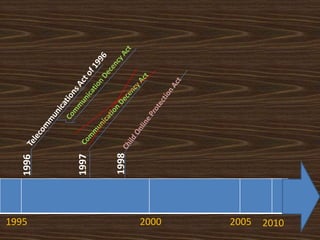
Communication Decency ActTelecommunications Act of 199619961995200020052010
Telecommunication Act of 1996Primary Purpose: to reduce regulation and encourage the “rapid deployment of new telecommunication technologies.”Originally for Telephone, T.V. and RadioInternet started to become more popularCongress saw potential of Internet as a medium for educational and political discourse, and as a result wanted to enact legislation that would promote the development of the internetCongress also saw how easy it was for users to access sexually explicit sites without knowing the user’s ageAs a result, title V of the Act was created to address decency on the internet
The Communications Decency Act of 1996 (CDA)The 1st notable attempt by the US Congress to regulate pornographic material on the internet.
Did 2 things:
1.) Attempted to regulate both indecency (when available to children) and obscenity in cyberspace.
2.) Section 230 of the Act has been interpreted to say that operators of Internet services are not to be construed as publishers (and thus not legally liable for the words of third parties who use their services).What Did the CDA Say?Passed in 1996 stating : the CDA imposed criminal sanctions on anyone whoknowingly (A) uses an interactive computer service to send to a specific person or persons under 18 years of age, or (B) uses any interactive computer service to display in a manner available to a person under 18 years of age, any comment, request, suggestion, proposal, image, or other communication that, in context, depicts or describes, in terms patently offensive as measured by contemporary community standards, sexual or excretory activities or organs.It further criminalized the transmission of materials that were "obscene or indecent" to persons known to beunder 18.Free Speech Advocates Challenged the CDA claiming it was unconstitutional as it violated the 1st amendment.
Reno v. American Civil Liberties Union (1997)ACLU argued provisions violated 1st amendment because of vagueness
The U.S. Supreme Court held thetwo provisions of the Communications Decency Act of 1996 (CDA) that criminalized providing obscene materials to minors by on the internet were unconstitutional  because:
1.) there was no definition of “indecent”
2.) patently offensive could exclude literary, artistic, political, scientific, or educational value.
Policy problems:
If upheld:
1.) would place burden on senders/ websites to determine whether speech is subject to regulation
2.) whether recipient is of min. age

Internet decency legislation

  • 1.
  • 2.
    Communication Decency ActTelecommunicationsAct of 199619961995200020052010
  • 3.
    Telecommunication Act of1996Primary Purpose: to reduce regulation and encourage the “rapid deployment of new telecommunication technologies.”Originally for Telephone, T.V. and RadioInternet started to become more popularCongress saw potential of Internet as a medium for educational and political discourse, and as a result wanted to enact legislation that would promote the development of the internetCongress also saw how easy it was for users to access sexually explicit sites without knowing the user’s ageAs a result, title V of the Act was created to address decency on the internet
  • 4.
    The Communications DecencyAct of 1996 (CDA)The 1st notable attempt by the US Congress to regulate pornographic material on the internet.
  • 5.
  • 6.
    1.) Attempted toregulate both indecency (when available to children) and obscenity in cyberspace.
  • 7.
    2.) Section 230of the Act has been interpreted to say that operators of Internet services are not to be construed as publishers (and thus not legally liable for the words of third parties who use their services).What Did the CDA Say?Passed in 1996 stating : the CDA imposed criminal sanctions on anyone whoknowingly (A) uses an interactive computer service to send to a specific person or persons under 18 years of age, or (B) uses any interactive computer service to display in a manner available to a person under 18 years of age, any comment, request, suggestion, proposal, image, or other communication that, in context, depicts or describes, in terms patently offensive as measured by contemporary community standards, sexual or excretory activities or organs.It further criminalized the transmission of materials that were "obscene or indecent" to persons known to beunder 18.Free Speech Advocates Challenged the CDA claiming it was unconstitutional as it violated the 1st amendment.
  • 8.
    Reno v. AmericanCivil Liberties Union (1997)ACLU argued provisions violated 1st amendment because of vagueness
  • 9.
    The U.S. SupremeCourt held thetwo provisions of the Communications Decency Act of 1996 (CDA) that criminalized providing obscene materials to minors by on the internet were unconstitutional because:
  • 10.
    1.) there wasno definition of “indecent”
  • 11.
    2.) patently offensivecould exclude literary, artistic, political, scientific, or educational value.
  • 12.
  • 13.
  • 14.
    1.) would placeburden on senders/ websites to determine whether speech is subject to regulation
  • 15.
    2.) whether recipientis of min. age