Children’s Internet Protection Act
Executive Summary The Children’s Internet Protection Act (CIPA) is intended to prevent children from accessing adult-oriented content from libraries and schools by forcing them to utilize content filtering software on their computers. This policy brief is intended to inform district and building-level administrators about CIPA.
Why? “ In September 2003, kids ages 2-11 spent average of six hours and 39 minutes online; this September, that average had increased 41 percent to nearly 9 hours and 24 minutes.”  “ Teens spend even more time online, increasing 27 percent from an average of 21 hours and 4 minutes in September 2003 to 26 hours and 48 minutes in September of this year.” Bausch & Han, 2006
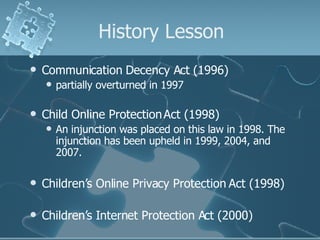
History Lesson Communication Decency Act (1996) partially overturned in 1997 Child Online Protection Act (1998) An injunction was placed on this law in 1998. The injunction has been upheld in 1999, 2004, and 2007. Children’s Online Privacy Protection Act (1998) Children’s Internet Protection Act (2000)
ALA vs. US American Libraries Association challenged CIPA in US District Court Originally deemed unconstitutional (2002) Decision overruled by the US Supreme Court (2003)
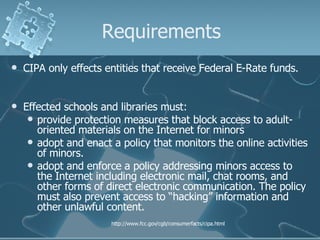
Requirements CIPA only effects entities that receive Federal E-Rate funds. Effected schools and libraries must: provide protection measures that block access to adult-oriented materials on the Internet for minors adopt and enact a policy that monitors the online activities of minors. adopt and enforce a policy addressing minors access to the Internet including electronic mail, chat rooms, and other forms of direct electronic communication. The policy must also prevent access to “hacking” information and other unlawful content. http://www.fcc.gov/cgb/consumerfacts/cipa.html

CIPA Overview

  • 1.
  • 2.
    Executive Summary TheChildren’s Internet Protection Act (CIPA) is intended to prevent children from accessing adult-oriented content from libraries and schools by forcing them to utilize content filtering software on their computers. This policy brief is intended to inform district and building-level administrators about CIPA.
  • 3.
    Why? “ InSeptember 2003, kids ages 2-11 spent average of six hours and 39 minutes online; this September, that average had increased 41 percent to nearly 9 hours and 24 minutes.” “ Teens spend even more time online, increasing 27 percent from an average of 21 hours and 4 minutes in September 2003 to 26 hours and 48 minutes in September of this year.” Bausch & Han, 2006
  • 4.
    History Lesson CommunicationDecency Act (1996) partially overturned in 1997 Child Online Protection Act (1998) An injunction was placed on this law in 1998. The injunction has been upheld in 1999, 2004, and 2007. Children’s Online Privacy Protection Act (1998) Children’s Internet Protection Act (2000)
  • 5.
    ALA vs. USAmerican Libraries Association challenged CIPA in US District Court Originally deemed unconstitutional (2002) Decision overruled by the US Supreme Court (2003)
  • 6.
    Requirements CIPA onlyeffects entities that receive Federal E-Rate funds. Effected schools and libraries must: provide protection measures that block access to adult-oriented materials on the Internet for minors adopt and enact a policy that monitors the online activities of minors. adopt and enforce a policy addressing minors access to the Internet including electronic mail, chat rooms, and other forms of direct electronic communication. The policy must also prevent access to “hacking” information and other unlawful content. http://www.fcc.gov/cgb/consumerfacts/cipa.html

Editor's Notes

  • #2 Signed into law in December 2001