How does the USA maintain power / influence today?
International Organisations Decision Making on a Global Scale
Learning Objectives To understand what  Inter-governmental Organisations are and what they do To understand the impact of IGOs To assess the role of IGOs in promoting superpowers
International Organisations or Intergovernmental Organisations - IGOs Make  key  decisions about  World economy Conflicts Environmental issues Small number of  key players  on IGOs Often created by superpowers post war as a way to promote cooperation and reduce conflict Critics say created  by  superpowers  for  superpowers Some key IGOs include United Nations, NATO & Davos Group Who are likely to be the key players?
Power in IGOs Big  overlap  in membership of IGOs USA, EU  dominate many – allows IGOs focus to follow their interests Often have a  veto Lot of mutual support – has effect of a  block vote   USA and EU work together to  promote or block  policies they favour
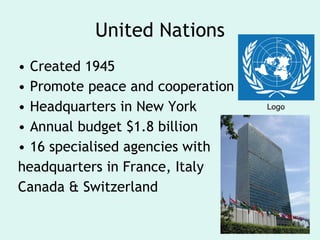
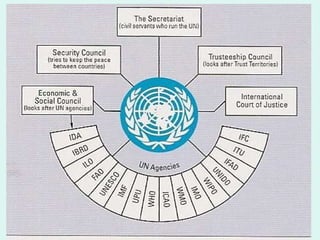
United Nations Created 1945 Promote peace and cooperation Headquarters in New York Annual budget $1.8 billion 16 specialised agencies with headquarters in France, Italy Canada & Switzerland Logo
 
The UN General Assembly The  core institution  of the UN Each country represented there by their ambassador Discuss international issues to try to  resolve conflict by political means One member one vote Decisions made by simple  majority Debate issues such as international conflicts, disarmament, human rights, refugee issues etc Decisions are  NOT legally binding  but they have the weight of international opinion
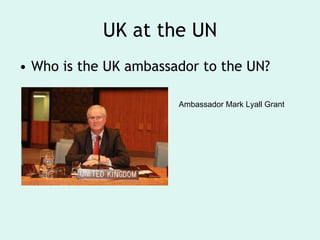
UK at the UN Who is the UK ambassador to the UN? Ambassador Mark Lyall Grant
The UN Security Council Under UN Charter the Security Council has the main responsibility to  maintain international peace  and security USA, UK, France, China & Russia – 5  Permanent members  of 15 nation council 10 others rotate on a 2 year cycle The General Assembly make recommendations but the security council  can direct nations  to take action It can apply sanctions Send countries to The International Court Send peace keeping troops They have a VETO – a right to reject resolutions. To be effective ALL must agree How can the security council be seen to be a form of political imperialism?
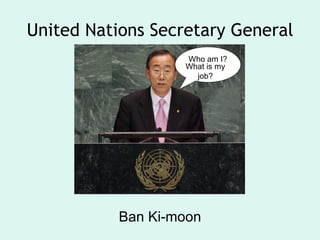
United Nations Secretary General Ban Ki-moon Who am I? What is my job?
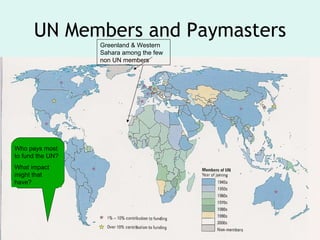
UN Members and Paymasters Who pays most to fund the UN? What impact might that have? Greenland & Western Sahara among the few non UN members
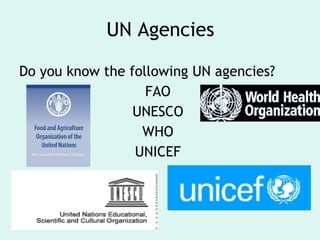
UN Agencies Do you know the following UN agencies? FAO  UNESCO  WHO  UNICEF
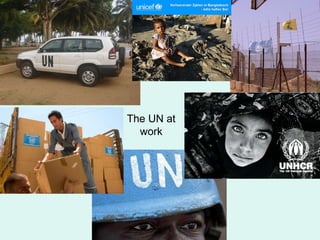
The UN at work
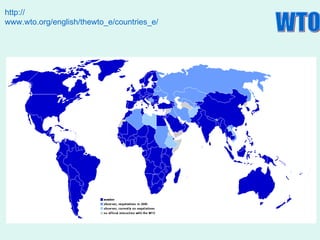
Controller of trade The World Trade Organization (WTO) is an intergovernmental organization based in Geneva, Switzerland that " deals with the rules of trade between nations at a global or near-global level. "  Born in 1995 under the Marrakesh Agreement, the WTO continues the liberalization process started by the now defunct General Agreement on Tariffs and Trade (GATT from 1947) and is currently comprised of 153 countries.
The WTO’s overriding objective is to help trade flow smoothly, freely, fairly and predictably. It does this by: Administering trade agreements Acting as a forum for trade negotiations Settling trade disputes Reviewing national trade policies Assisting developing countries in trade policy issues, through technical assistance and training programmes Cooperating with other international organizations
The WTO has nearly 150 members, accounting for over 97% of world trade. Around 30 others are negotiating membership. Decisions are made by the entire membership. This is typically by consensus. A majority vote is also possible but it has never been used in the WTO, and was extremely rare under the WTO’s predecessor, GATT. The WTO’s agreements have been ratified in all members’ parliaments. The WTO’s top level decision-making body is the  Ministerial Conference  which meets at least once every two years. Below this is the  General Council  (normally ambassadors and heads of delegation in Geneva, but sometimes officials sent from members’ capitals) which meets several times a year in the Geneva headquarters. The General Council also meets as the Trade Policy Review Body and the Dispute Settlement Body. At the next level, the  Goods Council, Services Council and Intellectual Property (TRIPS) Council  report to the General Council. Numerous  specialized committees, working groups  and  working parties  deal with the individual agreements and other areas such as the environment, development, membership applications and regional trade agreements.
Free trade has come to dominate trading, since WTO in 50s They removed  Tax and tariffs on imports Quotas (numbers of) on imports Subsidies for domestic producers On certain items This has resulted in huge growth in trade and wealth, some nations have benefited whereas others have lost out. In Asia most have benefited but most African nations have seen trade decline Reasons for this are-  that trade is mainly in hands of TNCs- who have chosen to invest in China and India not Sub Saharan African nations In Asia free trade zones have been set up to attract by offering tax breaks, non union areas and limited regulation Many African nations are unattractive to TNC investment due to poor infrastructure
WTO http:// www.wto.org/english/thewto_e/countries_e/org6_map_e.htm
Trade has become freer but it’s still just an illusion for many nations Much of ‘global’ trade takes place within trade blocs- powerful ones like NAFTA and the EU, in these blocks there are no tariffs so bigger profit can be made Countries not involved in trade blocs always lose out as they have taxes and tariffs to pay
What is the IMF?  The IMF ( International Monetary Fund ) formed in 1944 Stabilise currencies after WW2 Created by  44 rich countries  to help those in debt Intended to prevent poverty & so  limit  the spread of  communism In 2009 has 185 members
Not  all members are  equal The  G20  have  70%  of the votes The  USA has 17%  of votes as the biggest investor EU nations have 25% while  BRICS have 9.7% Most of the poorest  African nations  have  1%  between them How does the IMF work? Is it right that the BRIC nations have so little voting power?
IMF  reflects  US & EU  interests Used £ to promote fight against communism But  imposed conditions  that led to LEDCs to have to cut health & education budgets so they could cut their debt Why do some people think the IMF is a tool of economic Imperialism?
The world bank Formed in same place and at time of IMF First loan was to France for post war reconstruction Mainly used today for natural disasters and humanitarian emergencies In the 50s helped finance post colonial states In 70s and 80s developed bad reputation for funding environmentally damaging projects or lending amounts countries could not afford to repay Now its aim is to eliminate poverty achieving MDG number 1- reducing debt Controlled in same way as IMF, by proportional votes, meaning a western centred ideology and balance in favour of them
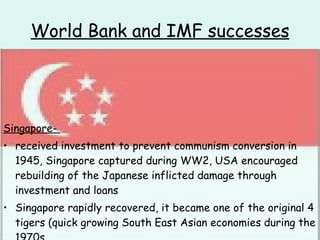
Singapore-  received investment to prevent communism conversion in 1945, Singapore captured during WW2, USA encouraged rebuilding of the Japanese inflicted damage through investment and loans Singapore rapidly recovered, it became one of the original 4 tigers (quick growing South East Asian economies during the 1970s World Bank and IMF successes
Japan-  devastated at end of WW2 Allies wanted to encourage Japan’s recovery as they were worried USSR would try to invade and instil communism, so Japan did Gained loans and grants from the world bank and IMF Handed back territory acquired after 1894 Put right to vote in place removing the emperor system of governance Forbade Japan to ever lead war overseas or maintain an army Broke up powerful interest groups There was social unrest BUT Japan experienced rapid recovery, living standards were raised and political situation stabilised By the 1970s Japan overtook USSR as world’s second largest economy
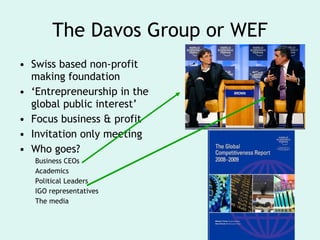
The Davos Group or WEF Swiss based non-profit making foundation ‘ Entrepreneurship in the global public interest’ Focus business & profit Invitation only meeting Who goes? Business CEOs Academics Political Leaders IGO representatives The media
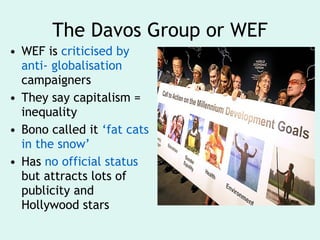
The Davos Group or WEF WEF is  criticised by anti- globalisation  campaigners They say capitalism = inequality Bono called it  ‘fat cats in the snow’ Has  no official status  but attracts lots of publicity and Hollywood stars
Question Outline the positives and negatives of IGOs Without these IGOs the USA would have a lot less power? discuss

Lesson4 internationalorganisations

  • 1.
    How does theUSA maintain power / influence today?
  • 2.
    International Organisations DecisionMaking on a Global Scale
  • 3.
    Learning Objectives Tounderstand what Inter-governmental Organisations are and what they do To understand the impact of IGOs To assess the role of IGOs in promoting superpowers
  • 4.
    International Organisations orIntergovernmental Organisations - IGOs Make key decisions about World economy Conflicts Environmental issues Small number of key players on IGOs Often created by superpowers post war as a way to promote cooperation and reduce conflict Critics say created by superpowers for superpowers Some key IGOs include United Nations, NATO & Davos Group Who are likely to be the key players?
  • 5.
    Power in IGOsBig overlap in membership of IGOs USA, EU dominate many – allows IGOs focus to follow their interests Often have a veto Lot of mutual support – has effect of a block vote USA and EU work together to promote or block policies they favour
  • 6.
    United Nations Created1945 Promote peace and cooperation Headquarters in New York Annual budget $1.8 billion 16 specialised agencies with headquarters in France, Italy Canada & Switzerland Logo
  • 7.
  • 8.
    The UN GeneralAssembly The core institution of the UN Each country represented there by their ambassador Discuss international issues to try to resolve conflict by political means One member one vote Decisions made by simple majority Debate issues such as international conflicts, disarmament, human rights, refugee issues etc Decisions are NOT legally binding but they have the weight of international opinion
  • 9.
    UK at theUN Who is the UK ambassador to the UN? Ambassador Mark Lyall Grant
  • 10.
    The UN SecurityCouncil Under UN Charter the Security Council has the main responsibility to maintain international peace and security USA, UK, France, China & Russia – 5 Permanent members of 15 nation council 10 others rotate on a 2 year cycle The General Assembly make recommendations but the security council can direct nations to take action It can apply sanctions Send countries to The International Court Send peace keeping troops They have a VETO – a right to reject resolutions. To be effective ALL must agree How can the security council be seen to be a form of political imperialism?
  • 11.
    United Nations SecretaryGeneral Ban Ki-moon Who am I? What is my job?
  • 12.
    UN Members andPaymasters Who pays most to fund the UN? What impact might that have? Greenland & Western Sahara among the few non UN members
  • 13.
    UN Agencies Doyou know the following UN agencies? FAO UNESCO WHO UNICEF
  • 14.
  • 15.
    Controller of tradeThe World Trade Organization (WTO) is an intergovernmental organization based in Geneva, Switzerland that " deals with the rules of trade between nations at a global or near-global level. "  Born in 1995 under the Marrakesh Agreement, the WTO continues the liberalization process started by the now defunct General Agreement on Tariffs and Trade (GATT from 1947) and is currently comprised of 153 countries.
  • 16.
    The WTO’s overridingobjective is to help trade flow smoothly, freely, fairly and predictably. It does this by: Administering trade agreements Acting as a forum for trade negotiations Settling trade disputes Reviewing national trade policies Assisting developing countries in trade policy issues, through technical assistance and training programmes Cooperating with other international organizations
  • 17.
    The WTO hasnearly 150 members, accounting for over 97% of world trade. Around 30 others are negotiating membership. Decisions are made by the entire membership. This is typically by consensus. A majority vote is also possible but it has never been used in the WTO, and was extremely rare under the WTO’s predecessor, GATT. The WTO’s agreements have been ratified in all members’ parliaments. The WTO’s top level decision-making body is the Ministerial Conference which meets at least once every two years. Below this is the General Council (normally ambassadors and heads of delegation in Geneva, but sometimes officials sent from members’ capitals) which meets several times a year in the Geneva headquarters. The General Council also meets as the Trade Policy Review Body and the Dispute Settlement Body. At the next level, the Goods Council, Services Council and Intellectual Property (TRIPS) Council report to the General Council. Numerous specialized committees, working groups and working parties deal with the individual agreements and other areas such as the environment, development, membership applications and regional trade agreements.
  • 18.
    Free trade hascome to dominate trading, since WTO in 50s They removed Tax and tariffs on imports Quotas (numbers of) on imports Subsidies for domestic producers On certain items This has resulted in huge growth in trade and wealth, some nations have benefited whereas others have lost out. In Asia most have benefited but most African nations have seen trade decline Reasons for this are- that trade is mainly in hands of TNCs- who have chosen to invest in China and India not Sub Saharan African nations In Asia free trade zones have been set up to attract by offering tax breaks, non union areas and limited regulation Many African nations are unattractive to TNC investment due to poor infrastructure
  • 19.
  • 20.
    Trade has becomefreer but it’s still just an illusion for many nations Much of ‘global’ trade takes place within trade blocs- powerful ones like NAFTA and the EU, in these blocks there are no tariffs so bigger profit can be made Countries not involved in trade blocs always lose out as they have taxes and tariffs to pay
  • 21.
    What is theIMF? The IMF ( International Monetary Fund ) formed in 1944 Stabilise currencies after WW2 Created by 44 rich countries to help those in debt Intended to prevent poverty & so limit the spread of communism In 2009 has 185 members
  • 22.
    Not allmembers are equal The G20 have 70% of the votes The USA has 17% of votes as the biggest investor EU nations have 25% while BRICS have 9.7% Most of the poorest African nations have 1% between them How does the IMF work? Is it right that the BRIC nations have so little voting power?
  • 23.
    IMF reflects US & EU interests Used £ to promote fight against communism But imposed conditions that led to LEDCs to have to cut health & education budgets so they could cut their debt Why do some people think the IMF is a tool of economic Imperialism?
  • 24.
    The world bankFormed in same place and at time of IMF First loan was to France for post war reconstruction Mainly used today for natural disasters and humanitarian emergencies In the 50s helped finance post colonial states In 70s and 80s developed bad reputation for funding environmentally damaging projects or lending amounts countries could not afford to repay Now its aim is to eliminate poverty achieving MDG number 1- reducing debt Controlled in same way as IMF, by proportional votes, meaning a western centred ideology and balance in favour of them
  • 25.
    Singapore- receivedinvestment to prevent communism conversion in 1945, Singapore captured during WW2, USA encouraged rebuilding of the Japanese inflicted damage through investment and loans Singapore rapidly recovered, it became one of the original 4 tigers (quick growing South East Asian economies during the 1970s World Bank and IMF successes
  • 26.
    Japan- devastatedat end of WW2 Allies wanted to encourage Japan’s recovery as they were worried USSR would try to invade and instil communism, so Japan did Gained loans and grants from the world bank and IMF Handed back territory acquired after 1894 Put right to vote in place removing the emperor system of governance Forbade Japan to ever lead war overseas or maintain an army Broke up powerful interest groups There was social unrest BUT Japan experienced rapid recovery, living standards were raised and political situation stabilised By the 1970s Japan overtook USSR as world’s second largest economy
  • 27.
    The Davos Groupor WEF Swiss based non-profit making foundation ‘ Entrepreneurship in the global public interest’ Focus business & profit Invitation only meeting Who goes? Business CEOs Academics Political Leaders IGO representatives The media
  • 28.
    The Davos Groupor WEF WEF is criticised by anti- globalisation campaigners They say capitalism = inequality Bono called it ‘fat cats in the snow’ Has no official status but attracts lots of publicity and Hollywood stars
  • 29.
    Question Outline thepositives and negatives of IGOs Without these IGOs the USA would have a lot less power? discuss