Role of International Organizations
• The three principal bodies responsible for regulating
international economic affairs – the International
Monetary Fund (IMF), the World Bank and the World
Trade Organisation (WTO) – play a central role in
defining and reinforcing how the global economy
works.
The United Nations
Main Aims:
Tolerance and friendship among all nation,
racial or religious groups.
Maintenance of peace
When did it begin?
• The United Nations is made up of 192 countries
from around the world. It is often called the UN.
• It was set up in 1945, after the Second World War,
as a way of bringing people together and to avoid
further wars.
• It started with 51 countries. The United Kingdom is
one of the original members. Germany did not join
until 1973.
What does the UN do?
• The UN aims to ensure that people don’t suffer
from hunger and homelessness.
• It has a special section called Unicef that tries to
help children.
• The UN has a convention on children's rights. They
would like it to be followed by all countries, as a set
of rules about the
treatment of children.
Why is it important to have an organisation
that is bigger than any one country?
• Stops governments
mistreating people
• Helps stop wars between
countries
• Looks after all the
world's young people
Why might the UN have problems getting all
countries to treat children fairly?
• Some countries use
children in their armies
• Many children work in
factories
• Poor countries can't
afford to provide schools
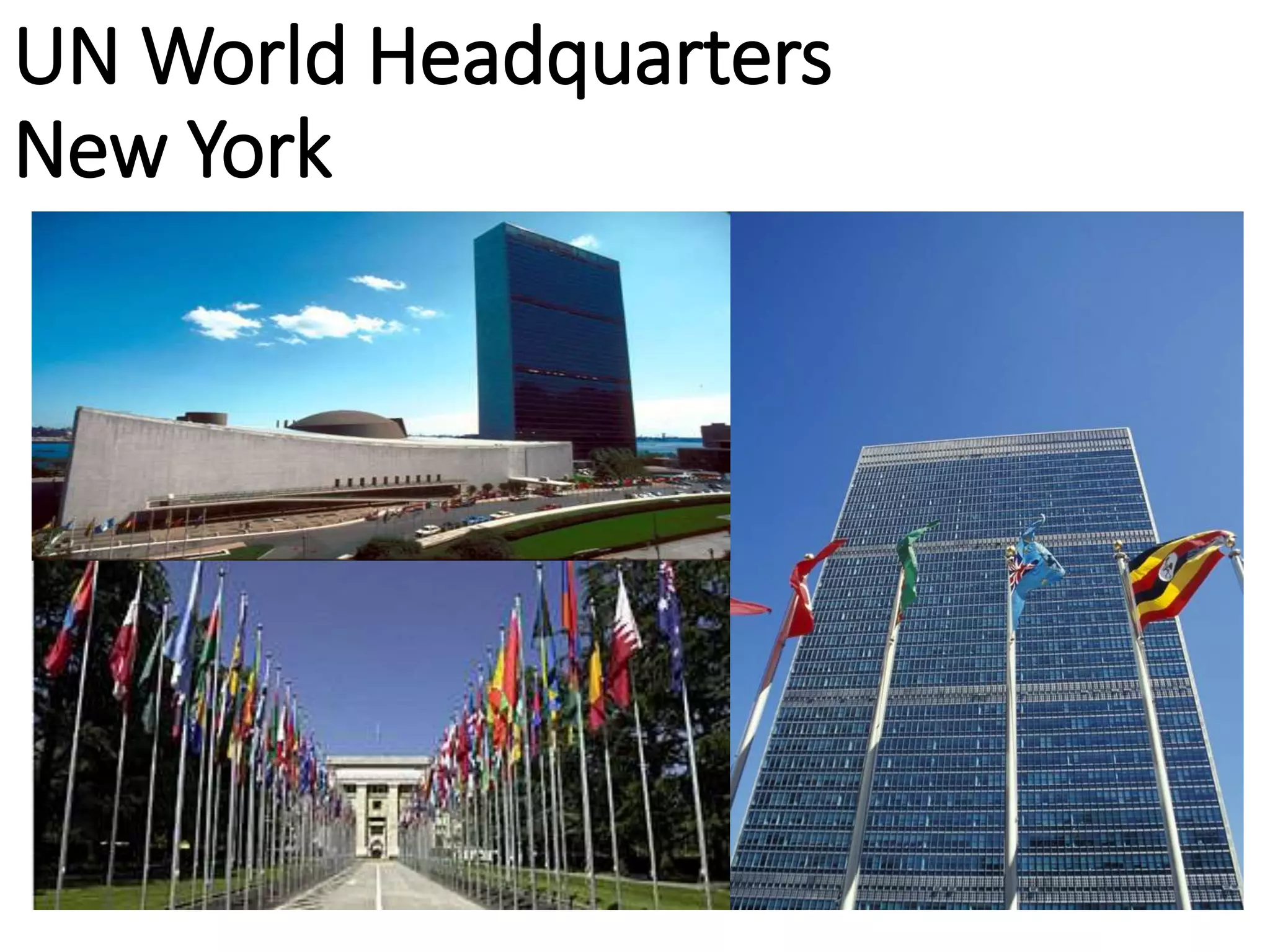
UN World Headquarters
New York
Role of International Organizations
• The World Bank and the IMF were created at the
Bretton Woods conference in 1944, where finance
ministers from the countries emerging victorious from
the Second World War met to design a new
architecture for the modern international
economy. The IMF was created to help stabilize
currency exchange rates between nations and to come
to the aid of countries with temporary liquidity needs.
The WTO was set up in 1995 to determine and enforce
the rules regulating international trade.
Role of International Organizations
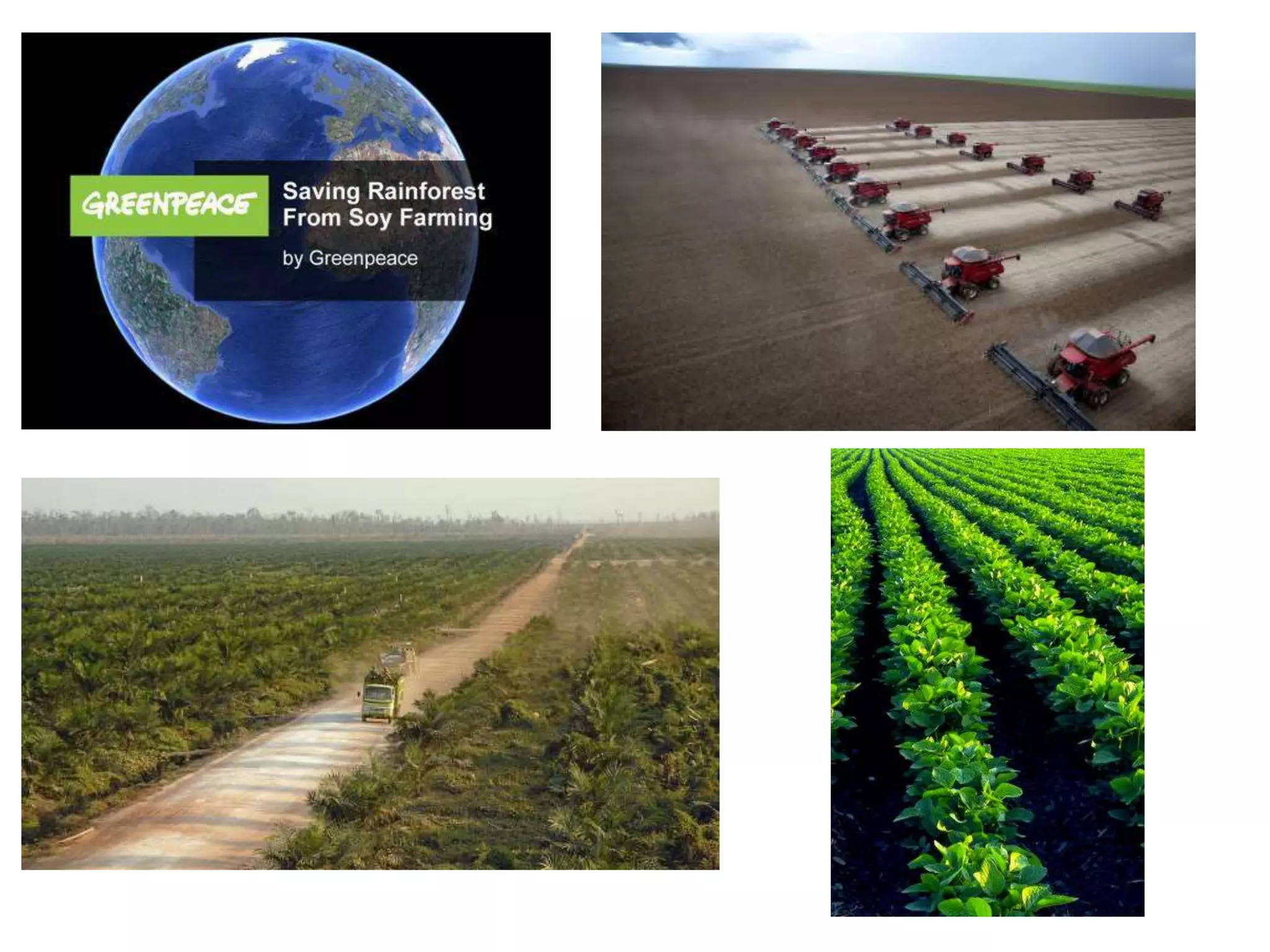
Both the World Bank and the IMF provide support and
finance for many industrial projects that displace human
populations, increase fossil fuel dependence and erode
natural eco-systems. The Bank, for example, is currently
backing oil palm plantations in Indonesia, a major
source of deforestation, as well as financing
monocultural soya plantations in Amazonia, even
though soya is destructive of Brazil's rich agricultural
lands.
Role of International Organizations
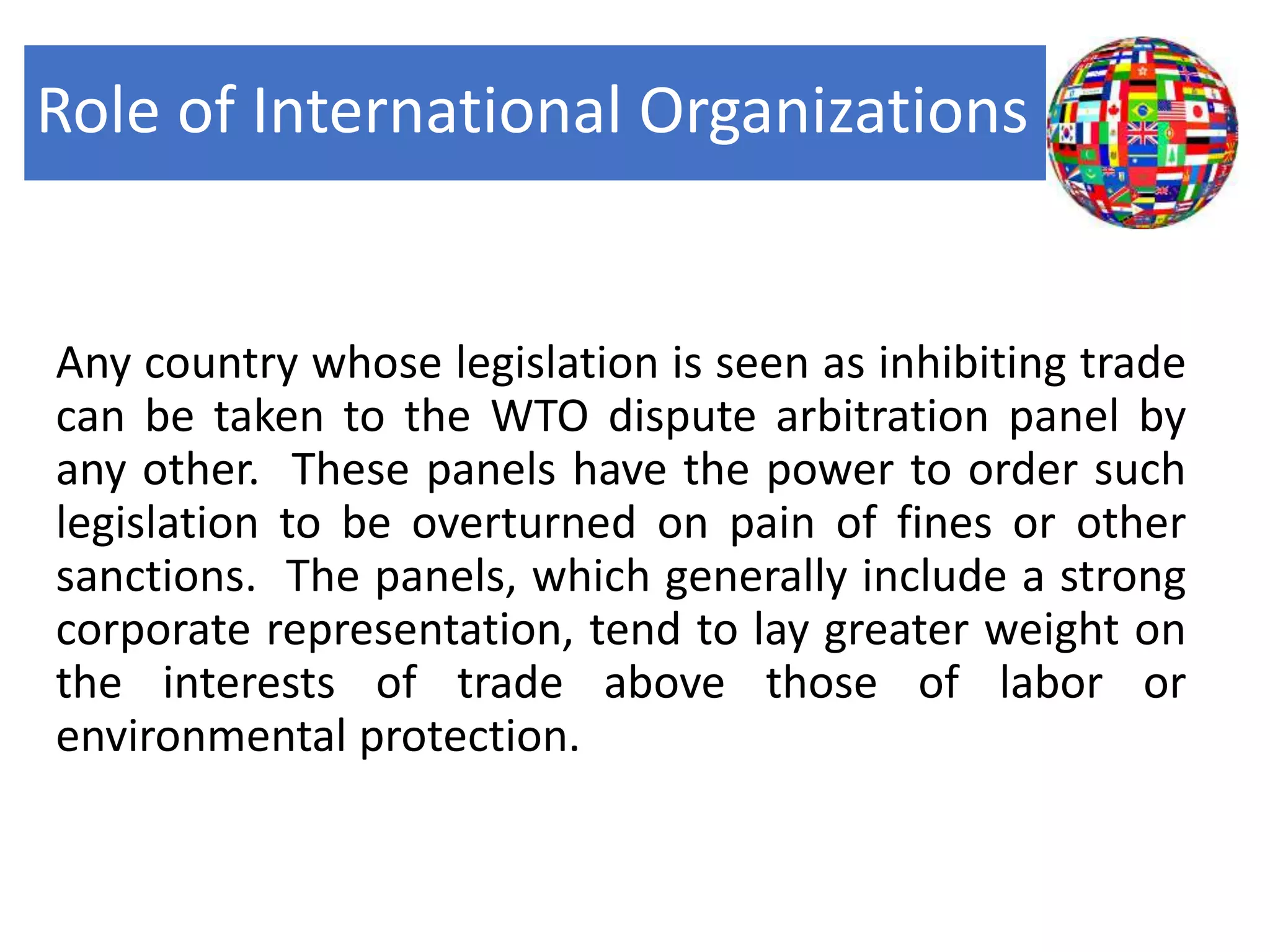
Any country whose legislation is seen as inhibiting trade
can be taken to the WTO dispute arbitration panel by
any other. These panels have the power to order such
legislation to be overturned on pain of fines or other
sanctions. The panels, which generally include a strong
corporate representation, tend to lay greater weight on
the interests of trade above those of labor or
environmental protection.
Role of International Organizations
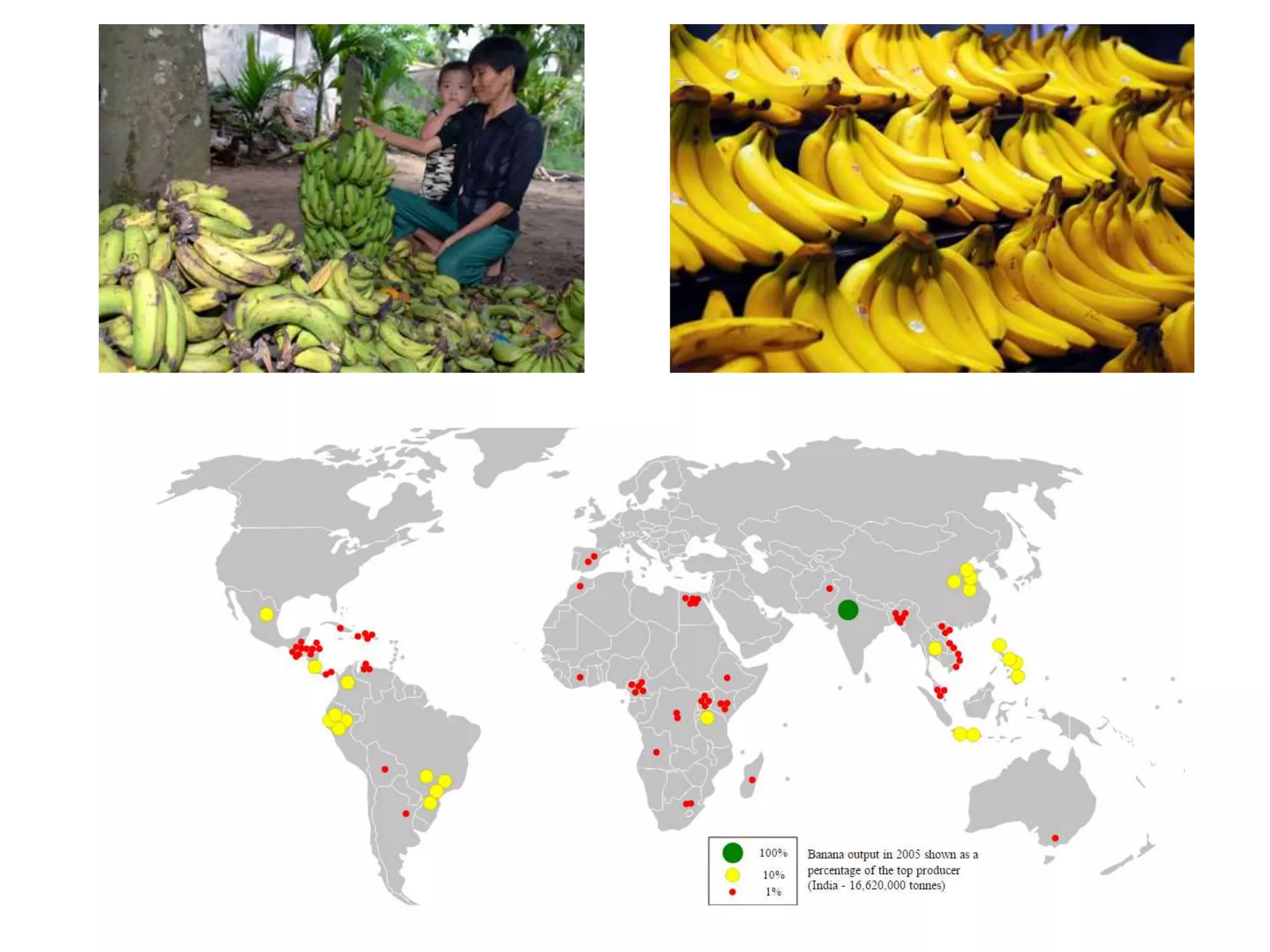
By way of example, WTO panels have ruled illegal EU
bans on the imports of genetically modified foods and
hormone-injected beef, both from the US. It similarly
ruled that the preferential access granted by the
European Union to bananas grown on family farms in its
partner ACP (African, Caribbean and Pacific) countries
constituted an unfair impediment to trade with large-
scale, monocultural, US corporate banana producers in
Latin America.
Together, these bodies constitute a powerful force
protecting and further reinforcing the corporate-
dominated global economy.
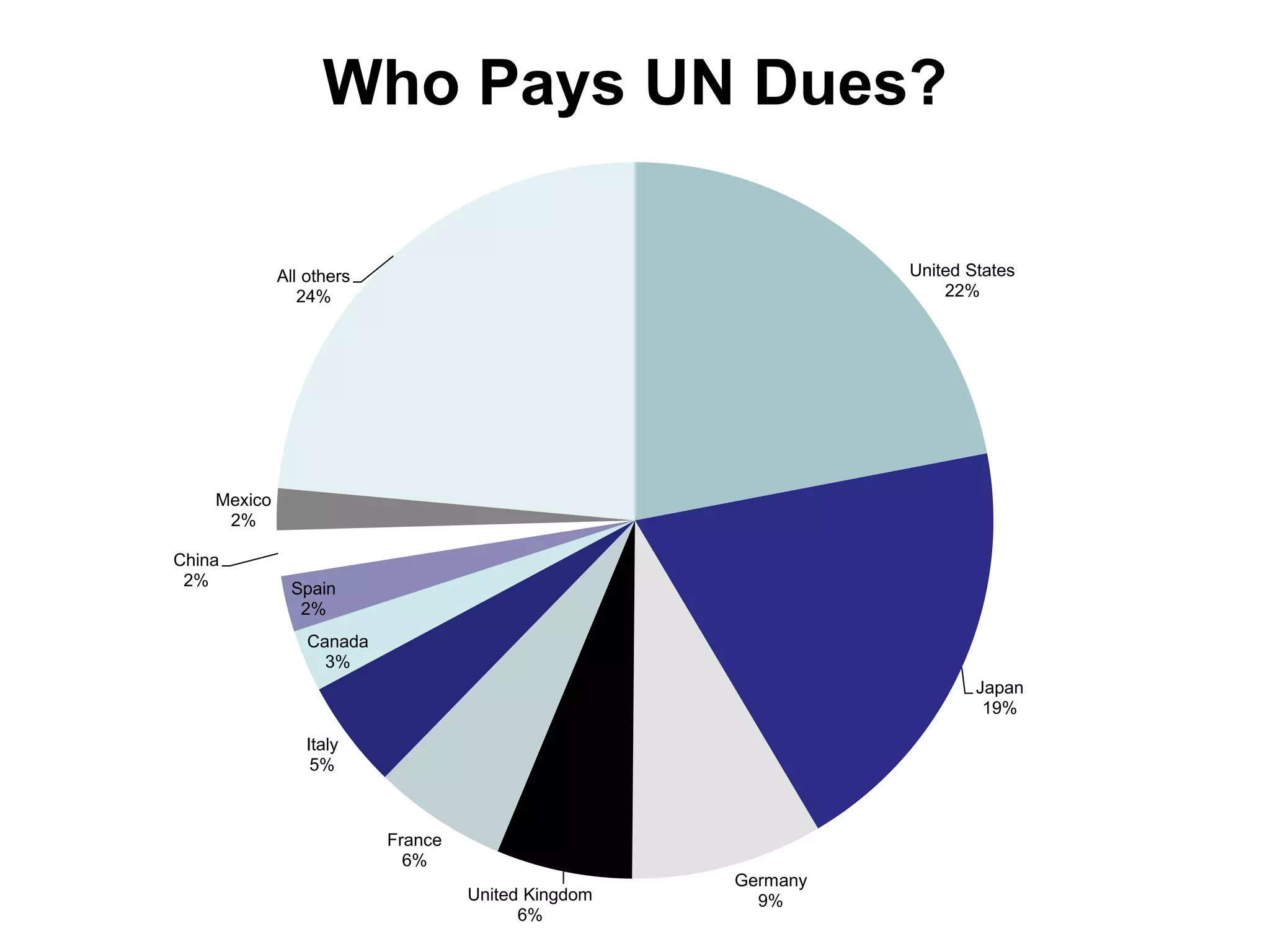
United States
22%
Japan
19%
Germany
9%United Kingdom
6%
France
6%
Italy
5%
Canada
3%
Spain
2%
China
2%
Mexico
2%
All others
24%
Who Pays UN Dues?
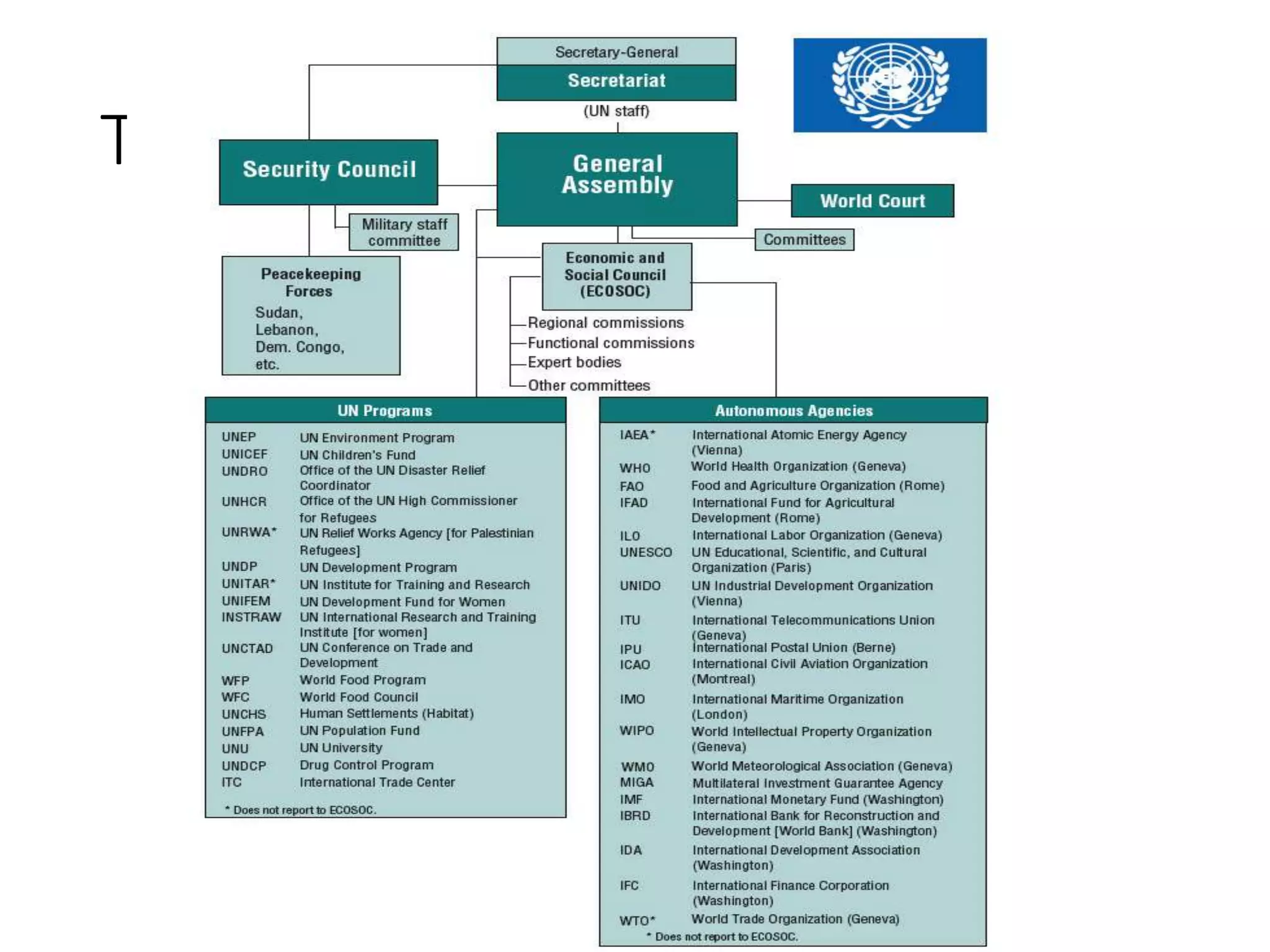
Structure of the UN
• World Court / ICJ
• National delegations to the UN, headed by
ambassadors from member states, work and
meet together at the UN headquarters in NYC.
• Universality of membership
• Five great powers each have a veto over
substantive decisions of the Security Council.
• Mechanism for collective security
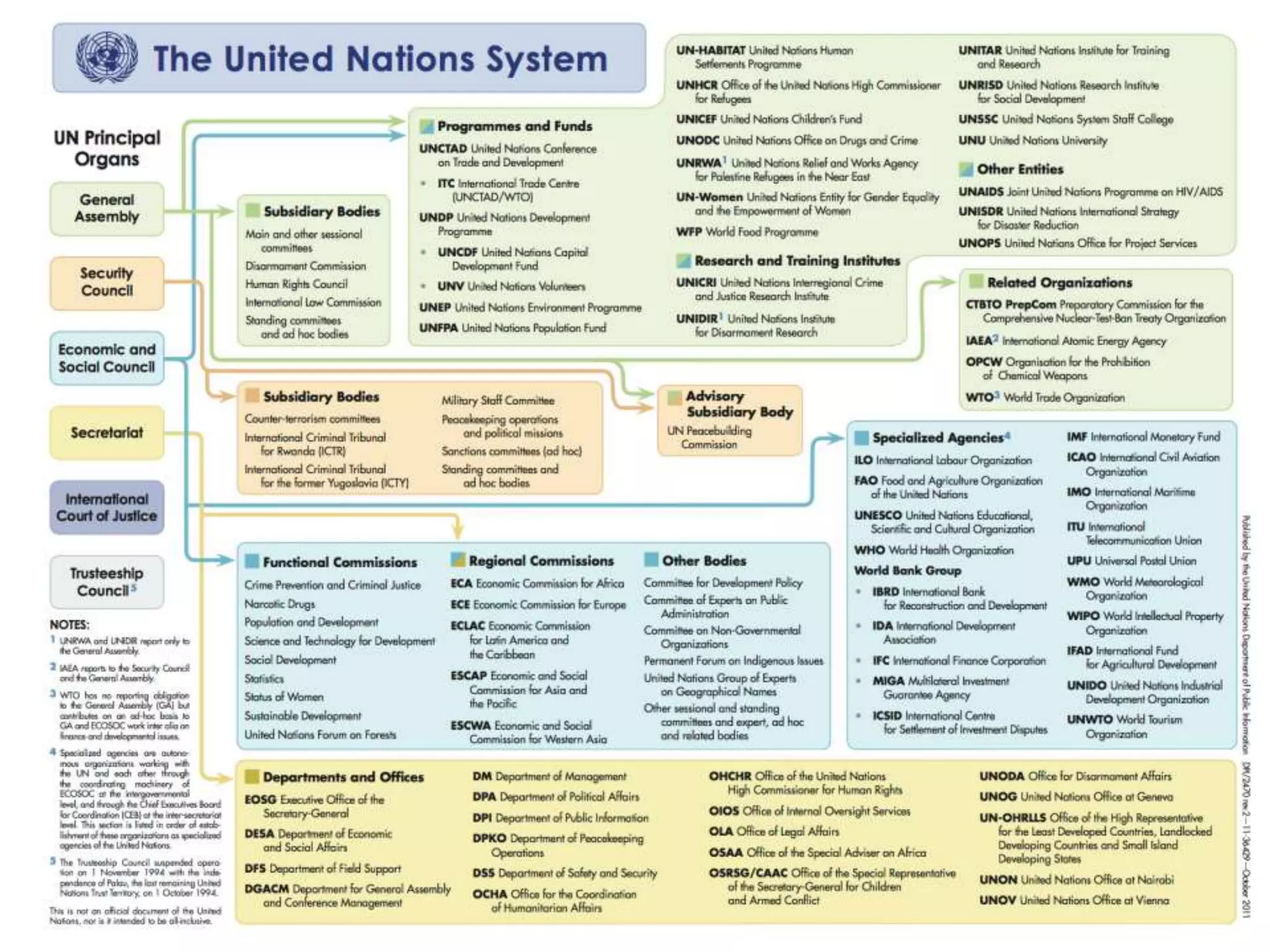
Parts of the United Nations
1. The General Assembly – the ‘town meeting’ of the world.
2. UN Security Council – maintains world peace (most
powerful branch)
3. Economic and Social Council - works with the UN’s
economic, cultural, health and educational activities.
4. Trusteeship Council - territories
5. ICJ – International Court of Justice
6. The Secretariat – administrative duties and can bring any
topic before the SC.
International Court of Justice
The Hague, Netherlands
The General Assembly
Inside UN Headquarters
Table 7.2
List of International Organizations
http://en.wikipedia.org/wiki/List_of_environmental_organizations
List of International Organizations
UN Security Council
• Made up of 15 countries:
• The “Permanent Five” countries
• 10 non-permanent countries (elected every two
years)
• The strong-arm of the UN
• Maintains international peace
• How does it do this:
• Recommends peaceful negotiations (peace talks)
• Can use Economic Sanctions
• Can use Military Sanctions
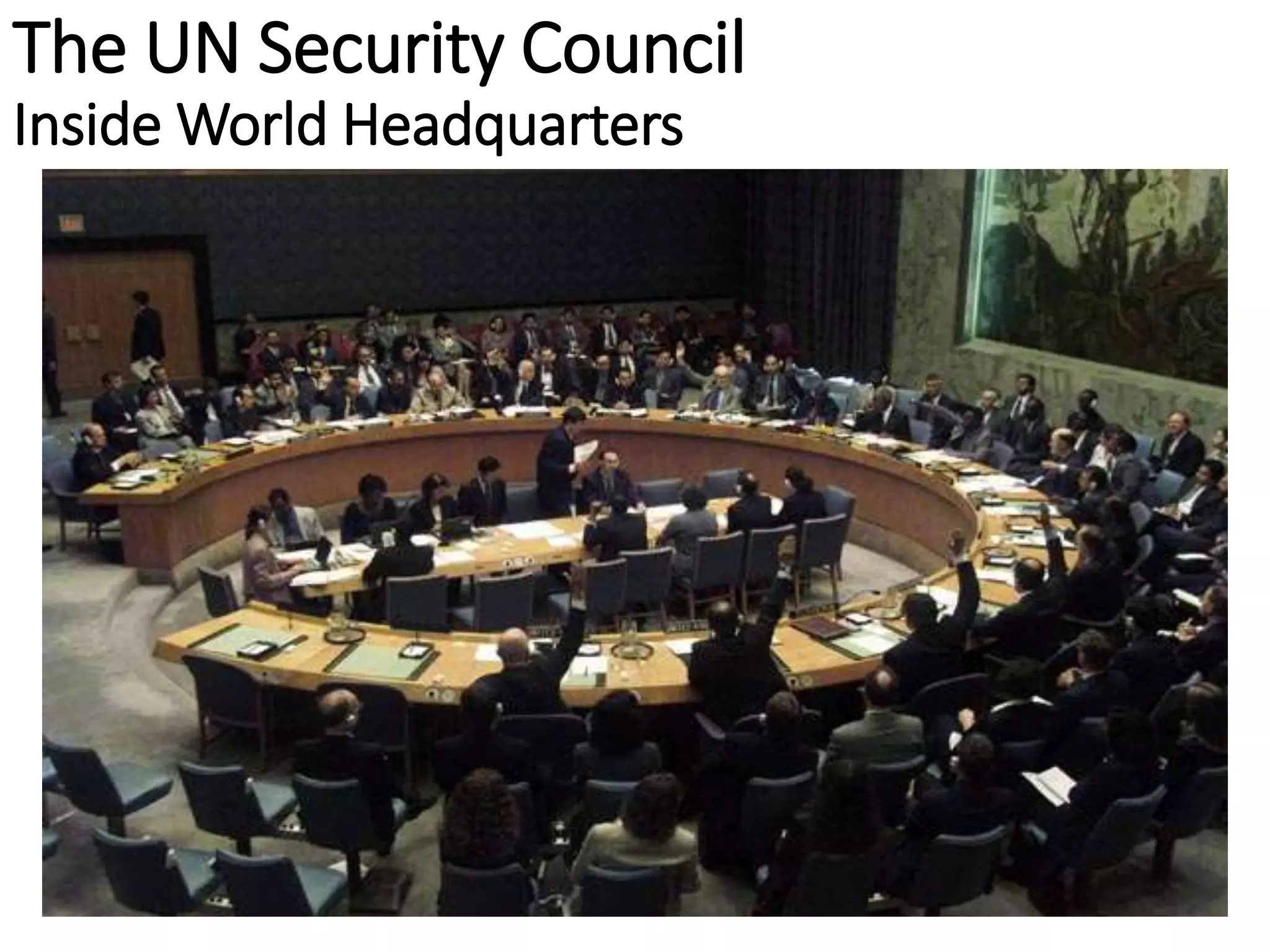
The UN Security Council
Inside World Headquarters
Security Council Speaking on a
Solution for Haiti’s Violence
Sanctions
•Sanctions are used to punish a country for
violating international law. They can be
used to force a country to follow a law.
•In order for sanctions to be used by the
UN Security Council, ALL FIVE permanent
members must have a unanimous vote.
Types of Sanctions
•Diplomatic Sanctions – removal of all
political ties (like embassies)
•Economic Sanctions – ban on all trade
with a country (except food)
•Military Sanctions – using a military to
force compliance.
Military Sanctions
• UN Peacekeepers – a group of armed soldiers sent to a
hostile area to promote peace. They ARE NOT COMBAT
TROOPS.
• These soldiers maintain peace.
• They don’t go on combat missions.
• They are not an ‘army’
• UN Military Force – an army made up of soldiers from more
than one UN country that can serve as combat troops.
• They are not very effective and are not used very often.
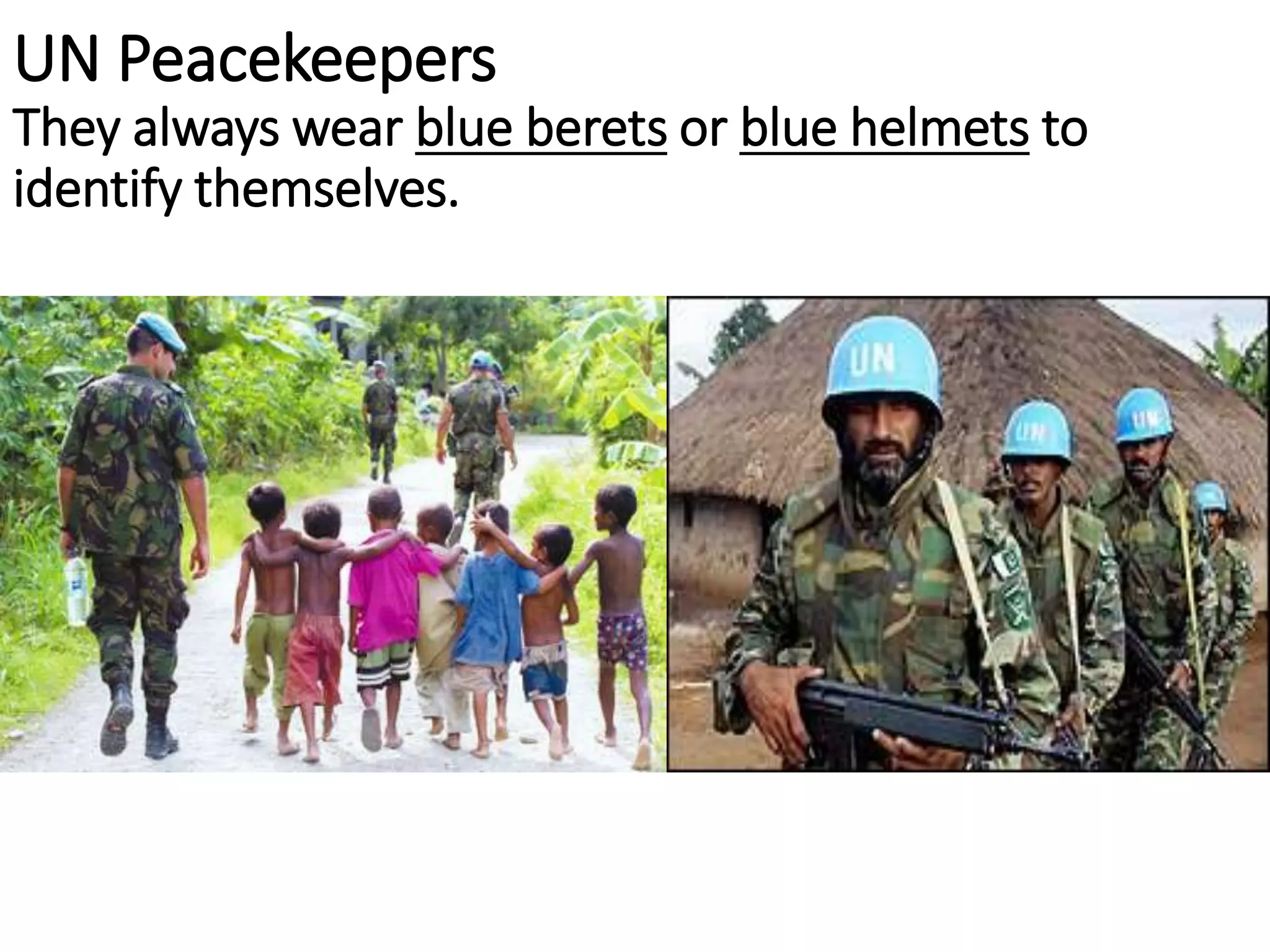
UN Peacekeepers
They always wear blue berets or blue helmets to
identify themselves.
Major UN Missions
• East Timor (Asia) – the UN supervised the independence of
this country
• Iraq (Middle East) – UN tried to cut all trade with Iraq after it
failed to comply with international law, but some nations
continued to trade with them.
• Somalia (Africa) – UN humanitarian mission to get food and
supplies to people in need
• Haiti (Caribbean) – UN helped strengthen government,
army, and hold elections
Strengths of the UN
•Provides a forum for almost all of the world’s
nations to discuss international issues
•Humanitarian efforts
• AIDS
• Landmine removal
• Food and supply organization
•Peacekeeping forces
•Will get involved with messes that no one else
will
Weaknesses of the UN
• Sanctions are only effective if ALL countries follow them
(Iraq example)
• Military force is rarely used and is usually ineffective
• ALL permanent members of the security council have to
vote unanimously (one country can stop a sanction)
• Inadequate funding by member nations
• 14 Countries Pay 85% of the subscriptions (membership fee)
• Big gap between developing and industrialized nations

Unit 7

  • 2.
    Role of InternationalOrganizations • The three principal bodies responsible for regulating international economic affairs – the International Monetary Fund (IMF), the World Bank and the World Trade Organisation (WTO) – play a central role in defining and reinforcing how the global economy works.
  • 3.
    The United Nations MainAims: Tolerance and friendship among all nation, racial or religious groups. Maintenance of peace
  • 4.
    When did itbegin? • The United Nations is made up of 192 countries from around the world. It is often called the UN. • It was set up in 1945, after the Second World War, as a way of bringing people together and to avoid further wars. • It started with 51 countries. The United Kingdom is one of the original members. Germany did not join until 1973.
  • 5.
    What does theUN do? • The UN aims to ensure that people don’t suffer from hunger and homelessness. • It has a special section called Unicef that tries to help children. • The UN has a convention on children's rights. They would like it to be followed by all countries, as a set of rules about the treatment of children.
  • 6.
    Why is itimportant to have an organisation that is bigger than any one country? • Stops governments mistreating people • Helps stop wars between countries • Looks after all the world's young people
  • 7.
    Why might theUN have problems getting all countries to treat children fairly? • Some countries use children in their armies • Many children work in factories • Poor countries can't afford to provide schools
  • 8.
  • 9.
    Role of InternationalOrganizations • The World Bank and the IMF were created at the Bretton Woods conference in 1944, where finance ministers from the countries emerging victorious from the Second World War met to design a new architecture for the modern international economy. The IMF was created to help stabilize currency exchange rates between nations and to come to the aid of countries with temporary liquidity needs. The WTO was set up in 1995 to determine and enforce the rules regulating international trade.
  • 10.
    Role of InternationalOrganizations Both the World Bank and the IMF provide support and finance for many industrial projects that displace human populations, increase fossil fuel dependence and erode natural eco-systems. The Bank, for example, is currently backing oil palm plantations in Indonesia, a major source of deforestation, as well as financing monocultural soya plantations in Amazonia, even though soya is destructive of Brazil's rich agricultural lands.
  • 12.
    Role of InternationalOrganizations Any country whose legislation is seen as inhibiting trade can be taken to the WTO dispute arbitration panel by any other. These panels have the power to order such legislation to be overturned on pain of fines or other sanctions. The panels, which generally include a strong corporate representation, tend to lay greater weight on the interests of trade above those of labor or environmental protection.
  • 13.
    Role of InternationalOrganizations By way of example, WTO panels have ruled illegal EU bans on the imports of genetically modified foods and hormone-injected beef, both from the US. It similarly ruled that the preferential access granted by the European Union to bananas grown on family farms in its partner ACP (African, Caribbean and Pacific) countries constituted an unfair impediment to trade with large- scale, monocultural, US corporate banana producers in Latin America. Together, these bodies constitute a powerful force protecting and further reinforcing the corporate- dominated global economy.
  • 18.
  • 19.
    Structure of theUN • World Court / ICJ • National delegations to the UN, headed by ambassadors from member states, work and meet together at the UN headquarters in NYC. • Universality of membership • Five great powers each have a veto over substantive decisions of the Security Council. • Mechanism for collective security
  • 20.
    Parts of theUnited Nations 1. The General Assembly – the ‘town meeting’ of the world. 2. UN Security Council – maintains world peace (most powerful branch) 3. Economic and Social Council - works with the UN’s economic, cultural, health and educational activities. 4. Trusteeship Council - territories 5. ICJ – International Court of Justice 6. The Secretariat – administrative duties and can bring any topic before the SC.
  • 21.
    International Court ofJustice The Hague, Netherlands
  • 22.
  • 23.
  • 24.
    List of InternationalOrganizations http://en.wikipedia.org/wiki/List_of_environmental_organizations
  • 25.
    List of InternationalOrganizations
  • 26.
    UN Security Council •Made up of 15 countries: • The “Permanent Five” countries • 10 non-permanent countries (elected every two years) • The strong-arm of the UN • Maintains international peace • How does it do this: • Recommends peaceful negotiations (peace talks) • Can use Economic Sanctions • Can use Military Sanctions
  • 27.
    The UN SecurityCouncil Inside World Headquarters
  • 28.
    Security Council Speakingon a Solution for Haiti’s Violence
  • 29.
    Sanctions •Sanctions are usedto punish a country for violating international law. They can be used to force a country to follow a law. •In order for sanctions to be used by the UN Security Council, ALL FIVE permanent members must have a unanimous vote.
  • 30.
    Types of Sanctions •DiplomaticSanctions – removal of all political ties (like embassies) •Economic Sanctions – ban on all trade with a country (except food) •Military Sanctions – using a military to force compliance.
  • 31.
    Military Sanctions • UNPeacekeepers – a group of armed soldiers sent to a hostile area to promote peace. They ARE NOT COMBAT TROOPS. • These soldiers maintain peace. • They don’t go on combat missions. • They are not an ‘army’ • UN Military Force – an army made up of soldiers from more than one UN country that can serve as combat troops. • They are not very effective and are not used very often.
  • 32.
    UN Peacekeepers They alwayswear blue berets or blue helmets to identify themselves.
  • 33.
    Major UN Missions •East Timor (Asia) – the UN supervised the independence of this country • Iraq (Middle East) – UN tried to cut all trade with Iraq after it failed to comply with international law, but some nations continued to trade with them. • Somalia (Africa) – UN humanitarian mission to get food and supplies to people in need • Haiti (Caribbean) – UN helped strengthen government, army, and hold elections
  • 34.
    Strengths of theUN •Provides a forum for almost all of the world’s nations to discuss international issues •Humanitarian efforts • AIDS • Landmine removal • Food and supply organization •Peacekeeping forces •Will get involved with messes that no one else will
  • 35.
    Weaknesses of theUN • Sanctions are only effective if ALL countries follow them (Iraq example) • Military force is rarely used and is usually ineffective • ALL permanent members of the security council have to vote unanimously (one country can stop a sanction) • Inadequate funding by member nations • 14 Countries Pay 85% of the subscriptions (membership fee) • Big gap between developing and industrialized nations