International Marketing
DEFINITION OF INTERNATIONAL MARKETINGDEFINITION OF INTERNATIONAL MARKETING
Cateora (1997) defines international
marketing as performance of business
activities that direct the flow of company's
goods and services to consumers in more
than one nation for profit.
Jain (1989) refers to international marketing
as exchanges across national boundaries for
the satisfaction of human needs and wants.
INTERNATIONAL TRADEINTERNATIONAL TRADE
 International trade is a term that basically deals with the
movement of goods and services between countries distinct
from normal corporate transactions involving buyers and
sellers in different countries.
 The international trade primarily reflects macro or aggregate
supplies and demand in different countries.
INTERNATIONAL BUSINESSINTERNATIONAL BUSINESS
 International business may be defined as those business
transactions among individuals, firms or corporate entities in
private or public sector that -result in movement of goods or
services across national boundaries.
Foreign MarketingForeign Marketing International MarketingInternational Marketing
Multinational MarketingMultinational Marketing Global MarketingGlobal Marketing
Methods & practices used in
the home market & also
applied in overseas markets
with little adaptation.
Differentiation in country
markets by way of developing
or acquiring new brands.
Developing local products
depending upon country needs.
Consolidation of operations on
regional basis to take
advantages of economies of
scale.
Product standardization is
within regions but not across
them.
Refers to the use of a single
marketing method across the
international markets with little
adaptation.
Opportunity for transfer of
products, brands and other
ideas across subsidiaries
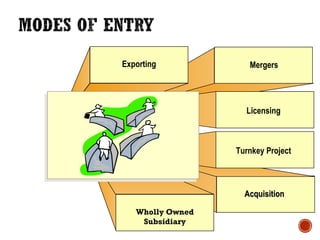
Exporting Mergers
Licensing
Turnkey Project
Wholly Owned
Subsidiary
AcquisitionAcquisition
INTERNAL (CONTROLLABLE)
ENVIRONMENT
The internal environment of a firm decides its competence to do
business in foreign countries. It is also called as the
controllable component of international business environment
because the Company can control it
ELEMENTS OF INTERNAL ENVIRONMENTELEMENTS OF INTERNAL ENVIRONMENT
 Mission
 Strategy
 Operations
EXTERNAL (UNCONTROLLABLE)
ENVIRONMENT
External environment refers to the overall international
conditions which influence the conduct of business
ELEMENTS OF EXTERNAL ENVIRONMENTELEMENTS OF EXTERNAL ENVIRONMENT
 Economic environment
 Political environment
 Legal and regulatory environment
 Cultural environment
 Demographic environment
 Technological environment
ECONOMIC ENVIRONMENT
 Stage of Economic Development
 Level of Income & Development
 Inflation
 Balance of Payments
 Availability of Human & Physical resources.
 Economic Policies
POLITICAL ENVIRONMENT
 Types of Political System
 Political Instability
 Political Risk
LEGAL AND REGULATORY ENVIRONMENT
 International Law & Conflict of Laws
 Patents & Trademarks
 Conflict Resolutions
 Tariff mechanism
 Documentation & formalities (China v/s India)
CULTURAL ENVIRONMENTCULTURAL ENVIRONMENT
 Centralized v/s decentralized decision-making (America v/s
Japan)
 Safety v/s Risk
 High v/s Low organizational Loyalty
 Language
 Customs & Rituals
DEMOGRAPHIC ENVIRONMENTDEMOGRAPHIC ENVIRONMENT
 Population Size
 Age Distribution
 Education & Occupation
TECHNOLOGICAL ENVIRONMENTTECHNOLOGICAL ENVIRONMENT
 Innovation in Technology
 Adoption of Technology
 The actual name is International Bank for Reconstruction &
Development (IBRD)
 Established on 1st
July 1944, Headquarter is at Washington.
 Every country is eligible for membership, currently 184
members are there. Membership can be withdrawn any time.
To assist in the reconstruction &
development of the territories of its member
governments by facilitating investment of
capital for productive purpose.
To promote foreign private investment by
guarantees of or through participation in
loans & other investments of capital for
productive purpose.
 To make loans for productive purposes out of its own resources
or out of funds borrowed by it where private capital is not
available on reasonable time
 To promote the long range growth of international trade and
the maintenance of the balance of payments of its members.
 By granting or participating in direct loans out of its own funds
 By granting loans out of the funds raised in the market of a
member or otherwise borrowed by the bank
 By guaranteeing whole or part loans made by the investors
 Project for which the loan is asked has been
carefully examined by a competent committee
as regards the merits of the proposal.
 Borrower has the reasonable prospects for
repayment of loan.
 Loan is meant for productive purposes.
 Except in special circumstances the loan is
meant to finance the foreign exchange
requirements of specific projects of
reconstruction and development
 Defining priorities among different projects
 Modification in the technical plans for projects designed
reduce its cost or make it more efficient.
 Administrative or organisational arrangements for a projects
or as to plans for its financing.
 A multi-governmental association organized in
1945 to promote exchange rate stability and to
facilitate the international flow of currencies.
 184 members
 An the time of formation an International
monetary fund was created, each members
quota in fund determines its subscriptions to the
fund, its drawing rights and voting power.
 To promote currency convertibility with stability in exchange
rates.
 To facilitate international trade, expansion and balanced
growth.
 Provide funds to members to adjust their balance of trade.
Works as an advisor on monetary & fiscal
policies to its member countries
Provides short term financial assistance to
take care of balance of payment problems.
It functions as a common pool of funds to
assist the member countries in time of need.
It also works as a consultancy organisation to
train executives of Reserve Banks and Fiscal
Services Department employees of member
countries.
A organisation through which group of
countries negotiate trading agreements and
which has authority to oversee trade disputes
among countries.
From 1947 to 1994, GATT (General
Agreements of Tariffs & Trade) was taking
care of globe business environment. WTO is
successor of GATT with head office at
Geneva in Switzerland.
 Make optimum utilisation of world’s resources
for improving the incoming & living standards,
promoting employment & expanding production
and trade activities amongst various countries.
 Encourage sustainable development and ensure
that environmental care and development
activities go together.
 Efforts should be made that developing
countries and also poor countries get an
opportunity to have a share in the growth in the
world trade.
 Implementation & monitoring multilateral and bilateral trade
agreements which are essence of WTO.
 To keep a track of trade related activities in world.
 WTO have various expert committees and sub-committees for
different categories to review various subjects and also to
work as consultants.
It arranges visits of its expert committees to
various countries for training & development
activities
WTO settles trade disputes between
different countries.
It reviews & advice trade policies of different
countries.
It covers all the commodities that are
internationally traded and have formulated
rules & procedures for each category as a
guideline to member countries.
30
Visit us online at
www.TheStockker.com

International marketing - Module 1

  • 1.
  • 2.
    DEFINITION OF INTERNATIONALMARKETINGDEFINITION OF INTERNATIONAL MARKETING Cateora (1997) defines international marketing as performance of business activities that direct the flow of company's goods and services to consumers in more than one nation for profit. Jain (1989) refers to international marketing as exchanges across national boundaries for the satisfaction of human needs and wants.
  • 3.
    INTERNATIONAL TRADEINTERNATIONAL TRADE International trade is a term that basically deals with the movement of goods and services between countries distinct from normal corporate transactions involving buyers and sellers in different countries.  The international trade primarily reflects macro or aggregate supplies and demand in different countries.
  • 4.
    INTERNATIONAL BUSINESSINTERNATIONAL BUSINESS International business may be defined as those business transactions among individuals, firms or corporate entities in private or public sector that -result in movement of goods or services across national boundaries.
  • 5.
    Foreign MarketingForeign MarketingInternational MarketingInternational Marketing Multinational MarketingMultinational Marketing Global MarketingGlobal Marketing Methods & practices used in the home market & also applied in overseas markets with little adaptation. Differentiation in country markets by way of developing or acquiring new brands. Developing local products depending upon country needs. Consolidation of operations on regional basis to take advantages of economies of scale. Product standardization is within regions but not across them. Refers to the use of a single marketing method across the international markets with little adaptation. Opportunity for transfer of products, brands and other ideas across subsidiaries
  • 6.
    Exporting Mergers Licensing Turnkey Project WhollyOwned Subsidiary AcquisitionAcquisition
  • 7.
    INTERNAL (CONTROLLABLE) ENVIRONMENT The internalenvironment of a firm decides its competence to do business in foreign countries. It is also called as the controllable component of international business environment because the Company can control it
  • 8.
    ELEMENTS OF INTERNALENVIRONMENTELEMENTS OF INTERNAL ENVIRONMENT  Mission  Strategy  Operations
  • 9.
    EXTERNAL (UNCONTROLLABLE) ENVIRONMENT External environmentrefers to the overall international conditions which influence the conduct of business
  • 10.
    ELEMENTS OF EXTERNALENVIRONMENTELEMENTS OF EXTERNAL ENVIRONMENT  Economic environment  Political environment  Legal and regulatory environment  Cultural environment  Demographic environment  Technological environment
  • 11.
    ECONOMIC ENVIRONMENT  Stageof Economic Development  Level of Income & Development  Inflation  Balance of Payments  Availability of Human & Physical resources.  Economic Policies
  • 12.
    POLITICAL ENVIRONMENT  Typesof Political System  Political Instability  Political Risk
  • 13.
    LEGAL AND REGULATORYENVIRONMENT  International Law & Conflict of Laws  Patents & Trademarks  Conflict Resolutions  Tariff mechanism  Documentation & formalities (China v/s India)
  • 14.
    CULTURAL ENVIRONMENTCULTURAL ENVIRONMENT Centralized v/s decentralized decision-making (America v/s Japan)  Safety v/s Risk  High v/s Low organizational Loyalty  Language  Customs & Rituals
  • 15.
    DEMOGRAPHIC ENVIRONMENTDEMOGRAPHIC ENVIRONMENT Population Size  Age Distribution  Education & Occupation
  • 16.
    TECHNOLOGICAL ENVIRONMENTTECHNOLOGICAL ENVIRONMENT Innovation in Technology  Adoption of Technology
  • 17.
     The actualname is International Bank for Reconstruction & Development (IBRD)  Established on 1st July 1944, Headquarter is at Washington.  Every country is eligible for membership, currently 184 members are there. Membership can be withdrawn any time.
  • 18.
    To assist inthe reconstruction & development of the territories of its member governments by facilitating investment of capital for productive purpose. To promote foreign private investment by guarantees of or through participation in loans & other investments of capital for productive purpose.
  • 19.
     To makeloans for productive purposes out of its own resources or out of funds borrowed by it where private capital is not available on reasonable time  To promote the long range growth of international trade and the maintenance of the balance of payments of its members.
  • 20.
     By grantingor participating in direct loans out of its own funds  By granting loans out of the funds raised in the market of a member or otherwise borrowed by the bank  By guaranteeing whole or part loans made by the investors
  • 21.
     Project forwhich the loan is asked has been carefully examined by a competent committee as regards the merits of the proposal.  Borrower has the reasonable prospects for repayment of loan.  Loan is meant for productive purposes.  Except in special circumstances the loan is meant to finance the foreign exchange requirements of specific projects of reconstruction and development
  • 22.
     Defining prioritiesamong different projects  Modification in the technical plans for projects designed reduce its cost or make it more efficient.  Administrative or organisational arrangements for a projects or as to plans for its financing.
  • 23.
     A multi-governmentalassociation organized in 1945 to promote exchange rate stability and to facilitate the international flow of currencies.  184 members  An the time of formation an International monetary fund was created, each members quota in fund determines its subscriptions to the fund, its drawing rights and voting power.
  • 24.
     To promotecurrency convertibility with stability in exchange rates.  To facilitate international trade, expansion and balanced growth.  Provide funds to members to adjust their balance of trade.
  • 25.
    Works as anadvisor on monetary & fiscal policies to its member countries Provides short term financial assistance to take care of balance of payment problems. It functions as a common pool of funds to assist the member countries in time of need. It also works as a consultancy organisation to train executives of Reserve Banks and Fiscal Services Department employees of member countries.
  • 26.
    A organisation throughwhich group of countries negotiate trading agreements and which has authority to oversee trade disputes among countries. From 1947 to 1994, GATT (General Agreements of Tariffs & Trade) was taking care of globe business environment. WTO is successor of GATT with head office at Geneva in Switzerland.
  • 27.
     Make optimumutilisation of world’s resources for improving the incoming & living standards, promoting employment & expanding production and trade activities amongst various countries.  Encourage sustainable development and ensure that environmental care and development activities go together.  Efforts should be made that developing countries and also poor countries get an opportunity to have a share in the growth in the world trade.
  • 28.
     Implementation &monitoring multilateral and bilateral trade agreements which are essence of WTO.  To keep a track of trade related activities in world.  WTO have various expert committees and sub-committees for different categories to review various subjects and also to work as consultants.
  • 29.
    It arranges visitsof its expert committees to various countries for training & development activities WTO settles trade disputes between different countries. It reviews & advice trade policies of different countries. It covers all the commodities that are internationally traded and have formulated rules & procedures for each category as a guideline to member countries.
  • 30.
    30 Visit us onlineat www.TheStockker.com