Business Environment Sem II Unit 4
International
Environment
Prof. Karishma Shetty
GATT- General Agreeement on Tarrifs & Trade
GATT is a treaty created following the conclusion of World War II.
The General Agreement on Tarrifs and Trade was implemented to regulate world
trade to aid in economic recovery after the war.
The GATT was transformed into World Trade Organization (WTO) in January 1995.
The GATT was a multilateral treaty signed by 96 governments called as contracting
parties.
GATT was neither a court of justice nor an organization, it was a forum where
contracting parties met from time to time to solve and discuss their trade
problems and also negotiated to enlarge their trade. It was a permanent
international organization having a permanent Council of Representatives with
headquarters at Geneva
Main Objectives of the GATT
1) Expansion of production activities.
2) Growth and liberalization of foreign trade.
3) Ensure all round economic prosperity.
4) Raising the standard of living of people.
5) Ensuring full employment.
6) Optimum use of resources of the world.
7) Growth in the volume of real income and effective demand.
Disadvantage of GATT
-No authority to conduct the sphere of trade .
-The members of the GATT were diversified in nature due to
varied economic and political motives , no uniformity .
- Less benefits for the LDC’S as trade was restrictive .
WORLD TRADE ORGANIZATION
• The Uruguay round of GATT gave birth to world trade organization .
• Contrary to the temporary nature of GATT ,WTO is a permanent
organization which is approved by participating countries .
• The important objectives of WTO are –
○ - To improve the standard of living of people in the member countries
○ - To ensure full employment .
○ - To enlarge production and trade of goods .
○ - To increase the trade of services
○ To ensure optimum utilization of resources and protect the
environment & accept the concept of sustainable environment .
Objectives of WTO
● To implement the new world trade system as visualized in the agreement;
● To promote world trade in a manner that benefits every country;
● To ensure that developing countries secure a better balance in the sharing of the advantages resulting from
the expansion of international trade corresponding to their developmental needs;
● To demolish all hurdles to an open world trading system and usher in international economic renaissance
because the world trade is an effective instrument to foster economic growth;
● To enhance competitiveness among all trading partners so as to benefit consumers and help in global
integration;
● To increase the level of production and productivity with a view to ensuring level of employment in the world;
● To expand and utilize world resources to the best;
● To improve the level of living for the global population and speed up economic development of the member
nations.
ADVANTAGES of WTO
• HELPS TO PROMOTE PEACE WITHIN NATIONS
• DISPUTES ARE HANDLED CONSTRUCTIVELY
• FREE TRADE CUTS COST OF LIVING
• RAISES INCOME & STIMULATES ECONOMIC GROWTH
• MORE CHOICE OF PRODUCTS
• HAS INCREASED IMPORTS AND EXPORTS
• ENCOURAGES GOOD GOVERNANCE
• GORVERNMENTS ARE SHIELDED FROM LOBBYING
• RULES MAKES LIFE EASIER FOR ALL
Cons of WTO
1. The WTO is fundamentally undemocratic
2. The WTO does not promote global justice
3. The WTO Privatized Essential Services
4. The WTO Is Destroying the Environment
5. The WTO tramples labour and human rights
6. The WTO is Killing People
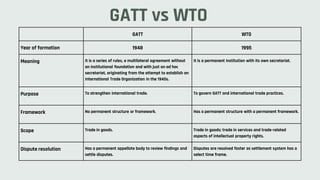
GATT vs WTO
GATT WTO
Year of formation 1948 1995
Meaning It is a series of rules, a multilateral agreement without
an institutional foundation and with just an ad hoc
secretariat, originating from the attempt to establish an
International Trade Organization in the 1940s.
It is a permanent institution with its own secretariat.
Purpose To strengthen international trade. To govern GATT and international trade practices.
Framework No permanent structure or framework. Has a permanent structure with a permanent framework.
Scope Trade in goods. Trade in goods; trade in services and trade-related
aspects of intellectual property rights.
Dispute resolution Has a permanent appellate body to review findings and
settle disputes.
Disputes are resolved faster as settlement system has a
select time frame.
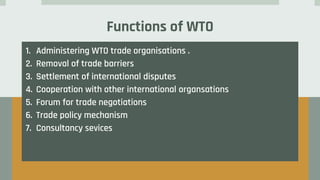
Functions of WTO
1. Administering WTO trade organisations .
2. Removal of trade barriers
3. Settlement of international disputes
4. Cooperation with other international organsations
5. Forum for trade negotiations
6. Trade policy mechanism
7. Consultancy sevices
LPG MODEL
The new economic liberalization policy ie
Liberalization,,Privatization & Globalization was
passed in the year 1991
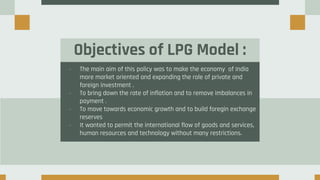
Objectives of LPG Model :
- The main aim of this policy was to make the economy of India
more market oriented and expanding the role of private and
foreign investment .
- To bring down the rate of inflation and to remove imbalances in
payment .
- To move towards economic growth and to build foregin exchange
reserves
- It wanted to permit the international flow of goods and services,
human resources and technology without many restrictions.
Features of New Economic policy 1991
- Delicensing .
- Entry to private sector
- Disinvestment
- Liberalization of foreign policy
- Liberalization in technical area
- Setting up of foreign investment promotion board
- Setting up of small scale industries .
Major components of new economic
policy
- Liberalization- refers to end of licence ,quota & many more restrictions,
liberalization in import & export ,freedom in movement of goods and services
- Privatization- refers to any process that reduces the involvement of the state &
transfer of ownership from the public sector to the private sector .It gives greater
role to private sector & reduces the role of public sector.
- Globalization - It is the spread of products , technology , information and jobs
across nations ,It is defined as the set of processes - economic, social, cultural,
technological that contributes to the relationship between societies and
individuals around the world .
Merits of MNCs
- Economic development for developing countries
- Technology transfer
- Industrial growth
- Marketing opportunities
- Work culture
- Export promotion
- Research & Development
Demerits of MNCs
- Problems of technology
- Political interference
- Self interest of developed countries
- Outflow of foreigh exchange
- Exploitation
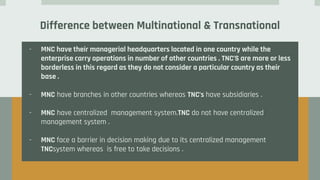
Difference between Multinational & Transnational
- MNC have their managerial headquarters located in one country while the
enterprise carry operations in number of other countries . TNC’S are more or less
borderless in this regard as they do not consider a particular country as their
base .
- MNC have branches in other countries whereas TNC’s have subsidiaries .
- MNC have centralized management system.TNC do not have centralized
management system .
- MNC face a barrier in decision making due to its centralized management
TNCsystem whereas is free to take decisions .
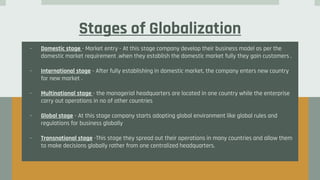
Stages of Globalization
- Domestic stage - Market entry - At this stage company develop their business model as per the
domestic market requirement .when they establish the domestic market fully they gain customers .
- International stage - After fully establishing in domestic market, the company enters new country
for new market .
- Multinational stage - the managerial headquarters are located in one country while the enterprise
carry out operations in no of other countries
- Global stage - At this stage company starts adopting global environment like global rules and
regulations for business globally
- Transnational stage -This stage they spread out their operations in many countries and allow them
to make decisions globally rather from one centralized headquarters.
FDI
FOREIGN DIRECT INVESTMENT
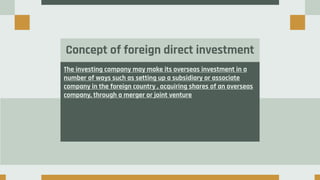
Concept of foreign direct investment
The investing company may make its overseas investment in a
number of ways such as setting up a subsidiary or associate
company in the foreign country , acquiring shares of an overseas
company, through a merger or joint venture
Foreign Direct Investment- FDI
- Foreign Direct Investment is an investment in a business by an investor from another country
for which the foreign investor has control over the company .
- FDI plays an important role in foreign trade .
- It is one of the ways of Globalization .
- It has opened doors to number of business sectors to increase foregin investment and grow
internationally .
- The investing company may make its overseas investments in a number of ways such as
setting up a associate company in the foreign country, acquiring shares of an overseas
company,through a merger or a joint venture .
Role & Functions of Foreign Direct
Investment
- Economic growth - encourages use of foreigh technology in production of goods
and services in the foreign country.
- Foreign Exchange reserves
- Technology transfer
- Revenue for the government
- Employment generation
- Standard of living
- Eliminate poverty
- Integrating into global economy
Challenges faced by international
business
1. Uncertainty
2. Globalization
3. Innovation
4. Government Policy & Regulation
5. Technology
6. Diversity
7. Complexity
8. Information Overload
9. Supply Chains

INTERNATIONAL ENVIRONMENT

  • 1.
    Business Environment SemII Unit 4 International Environment Prof. Karishma Shetty
  • 2.
    GATT- General Agreeementon Tarrifs & Trade GATT is a treaty created following the conclusion of World War II. The General Agreement on Tarrifs and Trade was implemented to regulate world trade to aid in economic recovery after the war. The GATT was transformed into World Trade Organization (WTO) in January 1995. The GATT was a multilateral treaty signed by 96 governments called as contracting parties. GATT was neither a court of justice nor an organization, it was a forum where contracting parties met from time to time to solve and discuss their trade problems and also negotiated to enlarge their trade. It was a permanent international organization having a permanent Council of Representatives with headquarters at Geneva
  • 3.
    Main Objectives ofthe GATT 1) Expansion of production activities. 2) Growth and liberalization of foreign trade. 3) Ensure all round economic prosperity. 4) Raising the standard of living of people. 5) Ensuring full employment. 6) Optimum use of resources of the world. 7) Growth in the volume of real income and effective demand.
  • 4.
    Disadvantage of GATT -Noauthority to conduct the sphere of trade . -The members of the GATT were diversified in nature due to varied economic and political motives , no uniformity . - Less benefits for the LDC’S as trade was restrictive .
  • 5.
    WORLD TRADE ORGANIZATION •The Uruguay round of GATT gave birth to world trade organization . • Contrary to the temporary nature of GATT ,WTO is a permanent organization which is approved by participating countries . • The important objectives of WTO are – ○ - To improve the standard of living of people in the member countries ○ - To ensure full employment . ○ - To enlarge production and trade of goods . ○ - To increase the trade of services ○ To ensure optimum utilization of resources and protect the environment & accept the concept of sustainable environment .
  • 6.
    Objectives of WTO ●To implement the new world trade system as visualized in the agreement; ● To promote world trade in a manner that benefits every country; ● To ensure that developing countries secure a better balance in the sharing of the advantages resulting from the expansion of international trade corresponding to their developmental needs; ● To demolish all hurdles to an open world trading system and usher in international economic renaissance because the world trade is an effective instrument to foster economic growth; ● To enhance competitiveness among all trading partners so as to benefit consumers and help in global integration; ● To increase the level of production and productivity with a view to ensuring level of employment in the world; ● To expand and utilize world resources to the best; ● To improve the level of living for the global population and speed up economic development of the member nations.
  • 7.
    ADVANTAGES of WTO •HELPS TO PROMOTE PEACE WITHIN NATIONS • DISPUTES ARE HANDLED CONSTRUCTIVELY • FREE TRADE CUTS COST OF LIVING • RAISES INCOME & STIMULATES ECONOMIC GROWTH • MORE CHOICE OF PRODUCTS • HAS INCREASED IMPORTS AND EXPORTS • ENCOURAGES GOOD GOVERNANCE • GORVERNMENTS ARE SHIELDED FROM LOBBYING • RULES MAKES LIFE EASIER FOR ALL
  • 8.
    Cons of WTO 1.The WTO is fundamentally undemocratic 2. The WTO does not promote global justice 3. The WTO Privatized Essential Services 4. The WTO Is Destroying the Environment 5. The WTO tramples labour and human rights 6. The WTO is Killing People
  • 9.
    GATT vs WTO GATTWTO Year of formation 1948 1995 Meaning It is a series of rules, a multilateral agreement without an institutional foundation and with just an ad hoc secretariat, originating from the attempt to establish an International Trade Organization in the 1940s. It is a permanent institution with its own secretariat. Purpose To strengthen international trade. To govern GATT and international trade practices. Framework No permanent structure or framework. Has a permanent structure with a permanent framework. Scope Trade in goods. Trade in goods; trade in services and trade-related aspects of intellectual property rights. Dispute resolution Has a permanent appellate body to review findings and settle disputes. Disputes are resolved faster as settlement system has a select time frame.
  • 10.
    Functions of WTO 1.Administering WTO trade organisations . 2. Removal of trade barriers 3. Settlement of international disputes 4. Cooperation with other international organsations 5. Forum for trade negotiations 6. Trade policy mechanism 7. Consultancy sevices
  • 11.
    LPG MODEL The neweconomic liberalization policy ie Liberalization,,Privatization & Globalization was passed in the year 1991
  • 12.
    Objectives of LPGModel : - The main aim of this policy was to make the economy of India more market oriented and expanding the role of private and foreign investment . - To bring down the rate of inflation and to remove imbalances in payment . - To move towards economic growth and to build foregin exchange reserves - It wanted to permit the international flow of goods and services, human resources and technology without many restrictions.
  • 13.
    Features of NewEconomic policy 1991 - Delicensing . - Entry to private sector - Disinvestment - Liberalization of foreign policy - Liberalization in technical area - Setting up of foreign investment promotion board - Setting up of small scale industries .
  • 14.
    Major components ofnew economic policy - Liberalization- refers to end of licence ,quota & many more restrictions, liberalization in import & export ,freedom in movement of goods and services - Privatization- refers to any process that reduces the involvement of the state & transfer of ownership from the public sector to the private sector .It gives greater role to private sector & reduces the role of public sector. - Globalization - It is the spread of products , technology , information and jobs across nations ,It is defined as the set of processes - economic, social, cultural, technological that contributes to the relationship between societies and individuals around the world .
  • 15.
    Merits of MNCs -Economic development for developing countries - Technology transfer - Industrial growth - Marketing opportunities - Work culture - Export promotion - Research & Development
  • 16.
    Demerits of MNCs -Problems of technology - Political interference - Self interest of developed countries - Outflow of foreigh exchange - Exploitation
  • 17.
    Difference between Multinational& Transnational - MNC have their managerial headquarters located in one country while the enterprise carry operations in number of other countries . TNC’S are more or less borderless in this regard as they do not consider a particular country as their base . - MNC have branches in other countries whereas TNC’s have subsidiaries . - MNC have centralized management system.TNC do not have centralized management system . - MNC face a barrier in decision making due to its centralized management TNCsystem whereas is free to take decisions .
  • 18.
    Stages of Globalization -Domestic stage - Market entry - At this stage company develop their business model as per the domestic market requirement .when they establish the domestic market fully they gain customers . - International stage - After fully establishing in domestic market, the company enters new country for new market . - Multinational stage - the managerial headquarters are located in one country while the enterprise carry out operations in no of other countries - Global stage - At this stage company starts adopting global environment like global rules and regulations for business globally - Transnational stage -This stage they spread out their operations in many countries and allow them to make decisions globally rather from one centralized headquarters.
  • 19.
  • 20.
    Concept of foreigndirect investment The investing company may make its overseas investment in a number of ways such as setting up a subsidiary or associate company in the foreign country , acquiring shares of an overseas company, through a merger or joint venture
  • 21.
    Foreign Direct Investment-FDI - Foreign Direct Investment is an investment in a business by an investor from another country for which the foreign investor has control over the company . - FDI plays an important role in foreign trade . - It is one of the ways of Globalization . - It has opened doors to number of business sectors to increase foregin investment and grow internationally . - The investing company may make its overseas investments in a number of ways such as setting up a associate company in the foreign country, acquiring shares of an overseas company,through a merger or a joint venture .
  • 22.
    Role & Functionsof Foreign Direct Investment - Economic growth - encourages use of foreigh technology in production of goods and services in the foreign country. - Foreign Exchange reserves - Technology transfer - Revenue for the government - Employment generation - Standard of living - Eliminate poverty - Integrating into global economy
  • 23.
    Challenges faced byinternational business 1. Uncertainty 2. Globalization 3. Innovation 4. Government Policy & Regulation 5. Technology 6. Diversity 7. Complexity 8. Information Overload 9. Supply Chains