

International Classification of
Functioning
Dr Athul c Soman
International Classification of Functioning,
Disability and Health (ICF
The endorsement of the ICF by the 54th
World Health Assembly in May 2001
• Mirrors an important shift in the
understanding of health and disability by
the WHO. The ICF acknowledges that
every human being can experience a
decrement in health and thereby
experience some disability.
• With the ICF,
WHO responds to the need for a unified, international, and
standardized language for describing and classifying health
and health-related domains. The ICF is WHO’s framework
for health and disability. It is the conceptual basis for the
definition,measurement, and policy formulations for health
and disability.
Accordingly, it covers the entire lifespan. It is integrative and
not merely medical or social. Similarly, it addresses human
functioning and not merely disability. It is multidimensional
and interactive, and rejects the linear linkage between health
condition and functioning. It is also etiologically neutral which
means functioning is understood descriptively and not caused
by diagnosis. It adopts the parity approach which does not recognize
an inherent distinction or asymmetry between mental
and physical functioning.
Aims of ICF
• To provide a scientific basis for consequences of
health conditions
• To establish a common language to improve
communications
• To permit comparison of data across:
– countries
– health care disciplines
– services
– time
• To provide a systematic coding scheme for health
information systems
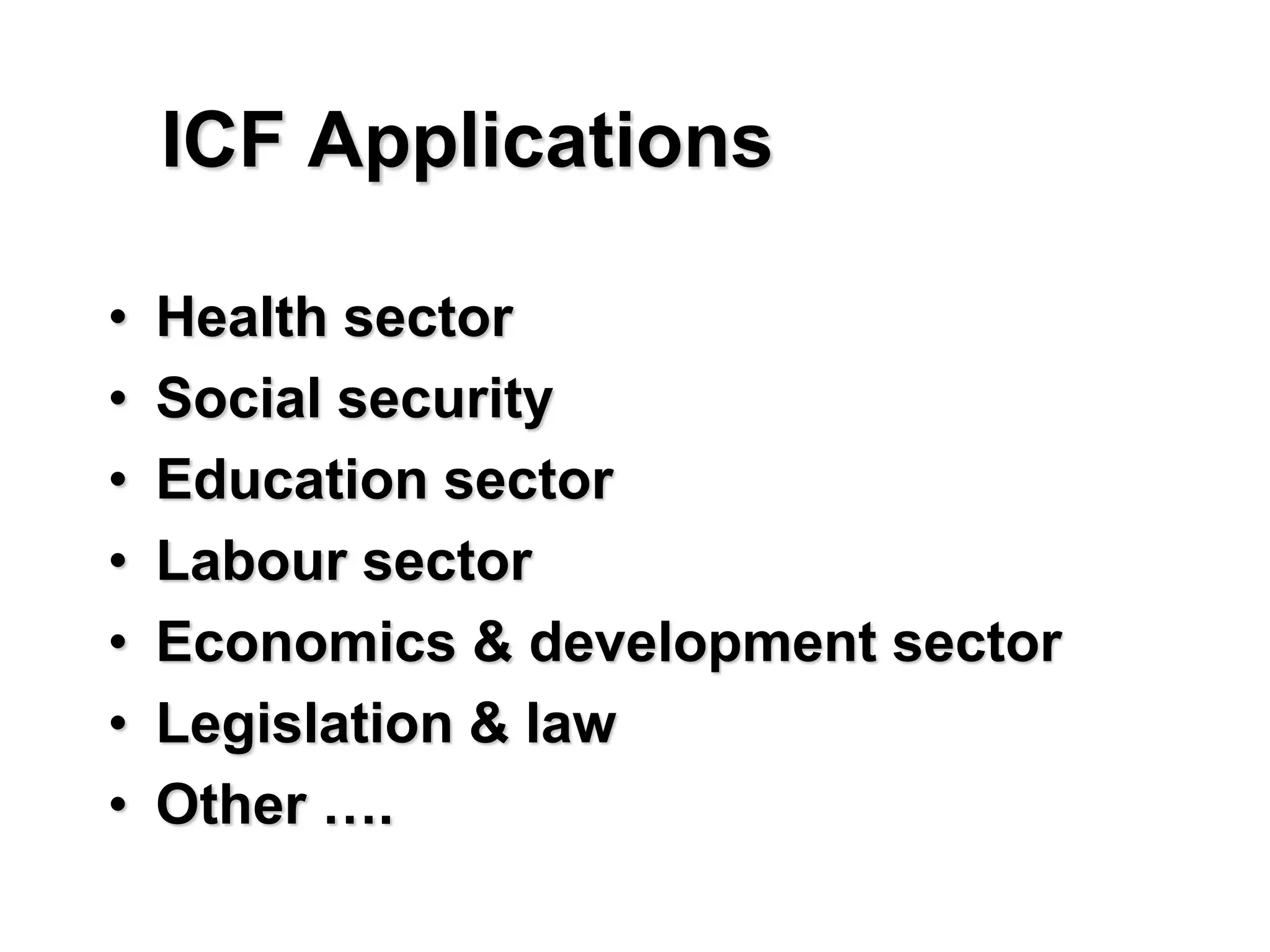
ICF Applications
• Health sector
• Social security
• Education sector
• Labour sector
• Economics & development sector
• Legislation & law
• Other ….
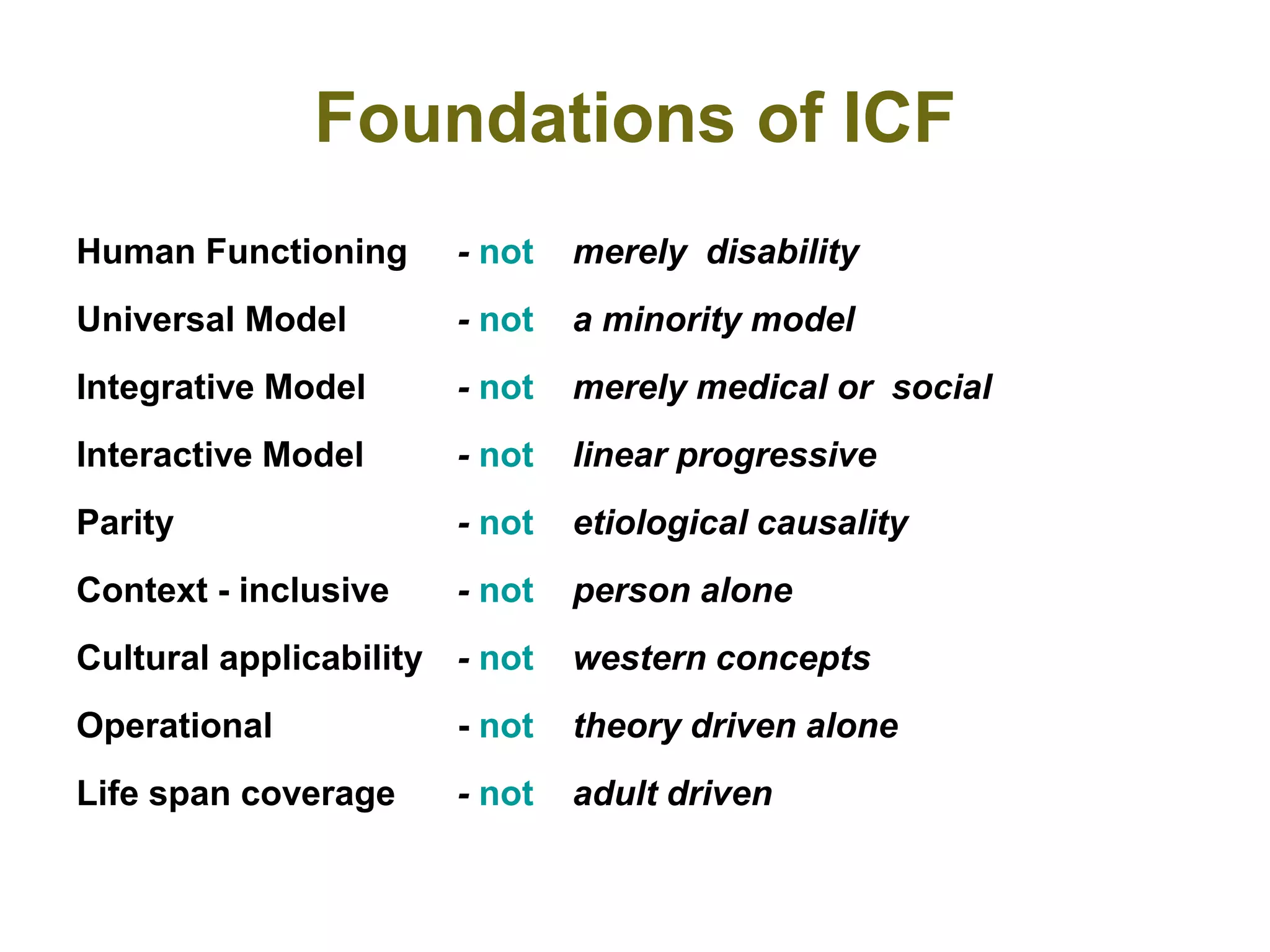
Foundations of ICF
Human Functioning - not merely disability
Universal Model - not a minority model
Integrative Model - not merely medical or social
Interactive Model - not linear progressive
Parity - not etiological causality
Context - inclusive - not person alone
Cultural applicability - not western concepts
Operational - not theory driven alone
Life span coverage - not adult driven
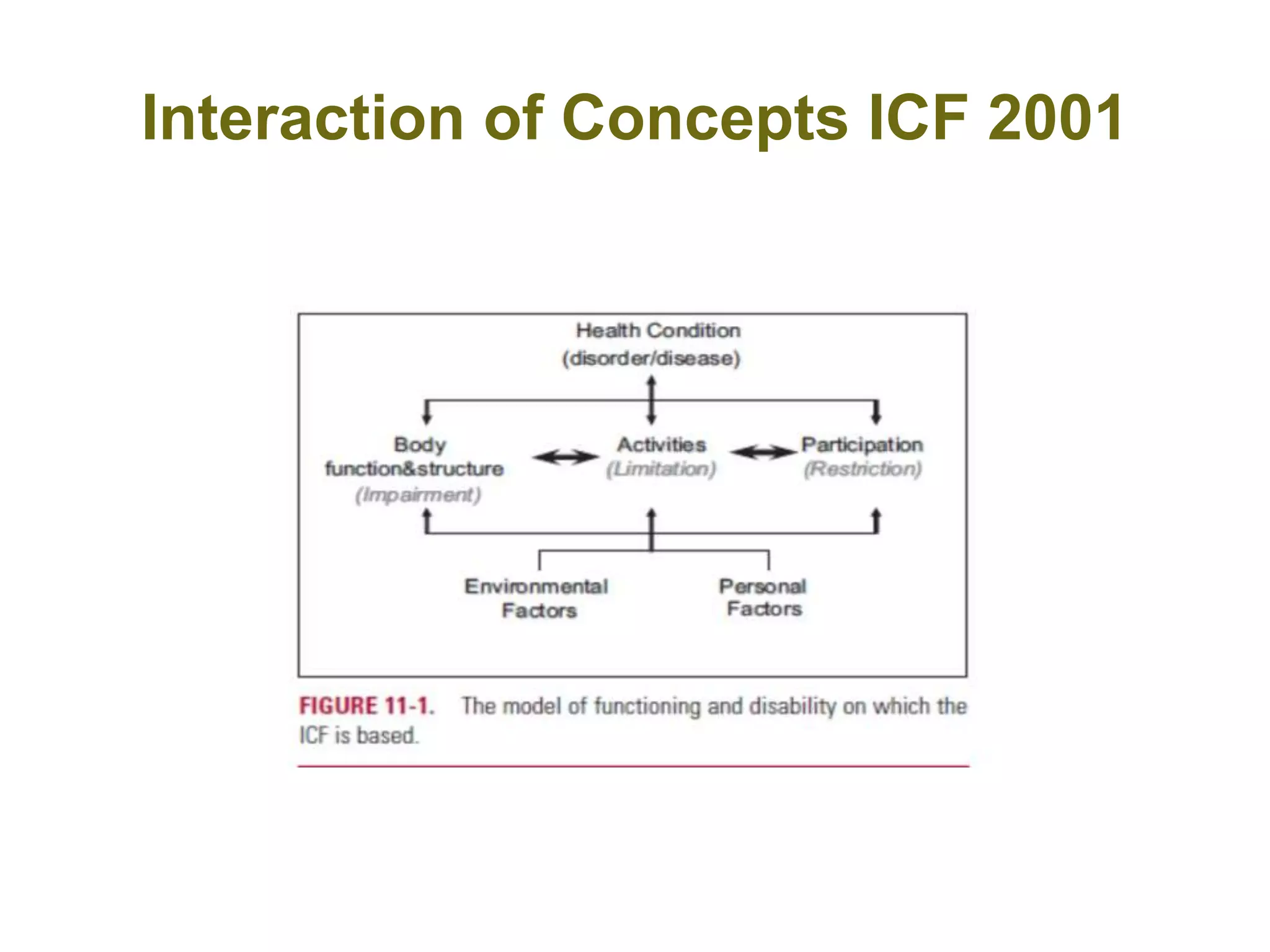
Interaction of Concepts ICF 2001
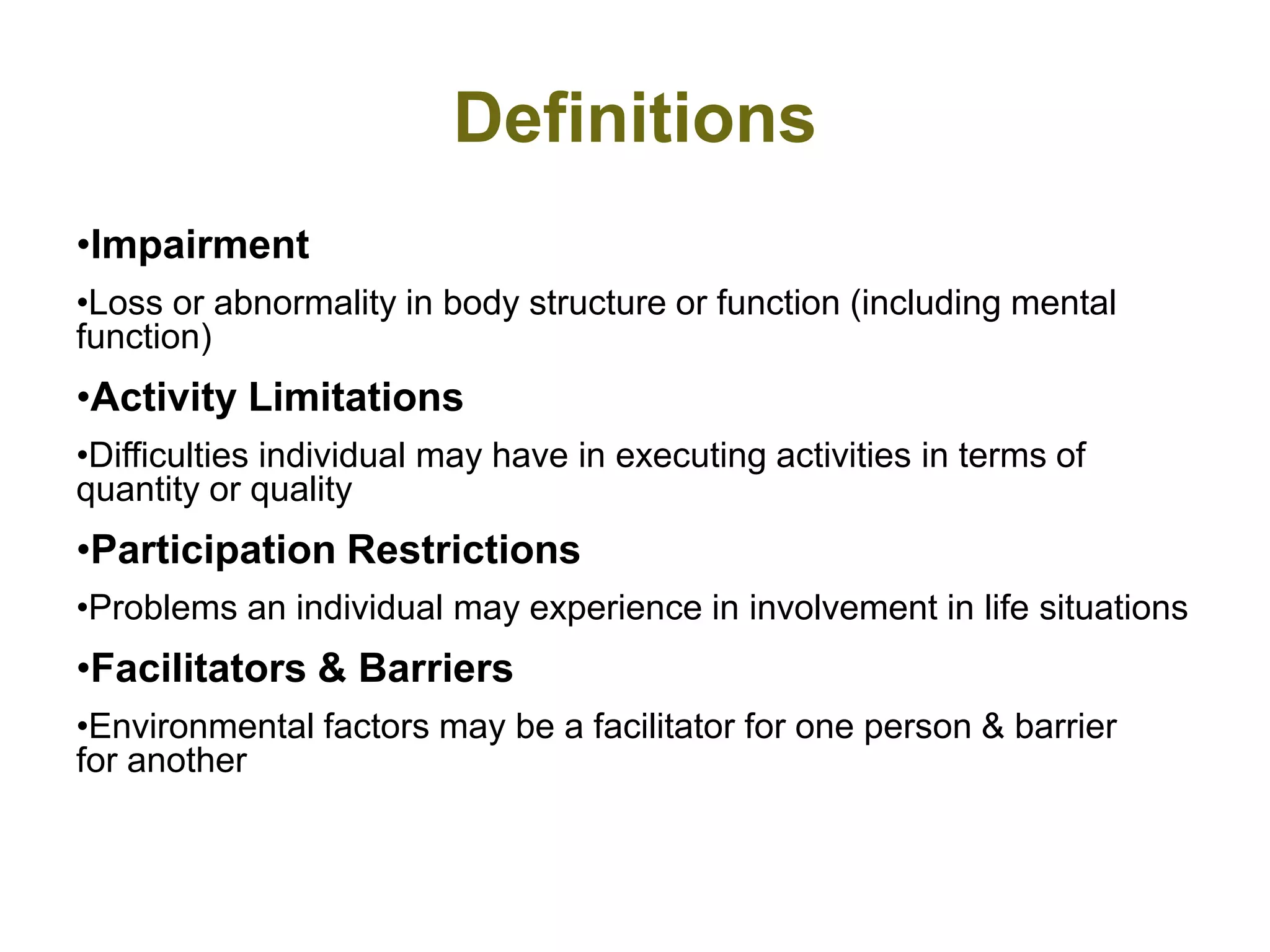
Definitions
•Impairment
•Loss or abnormality in body structure or function (including mental
function)
•Activity Limitations
•Difficulties individual may have in executing activities in terms of
quantity or quality
•Participation Restrictions
•Problems an individual may experience in involvement in life situations
•Facilitators & Barriers
•Environmental factors may be a facilitator for one person & barrier
for another
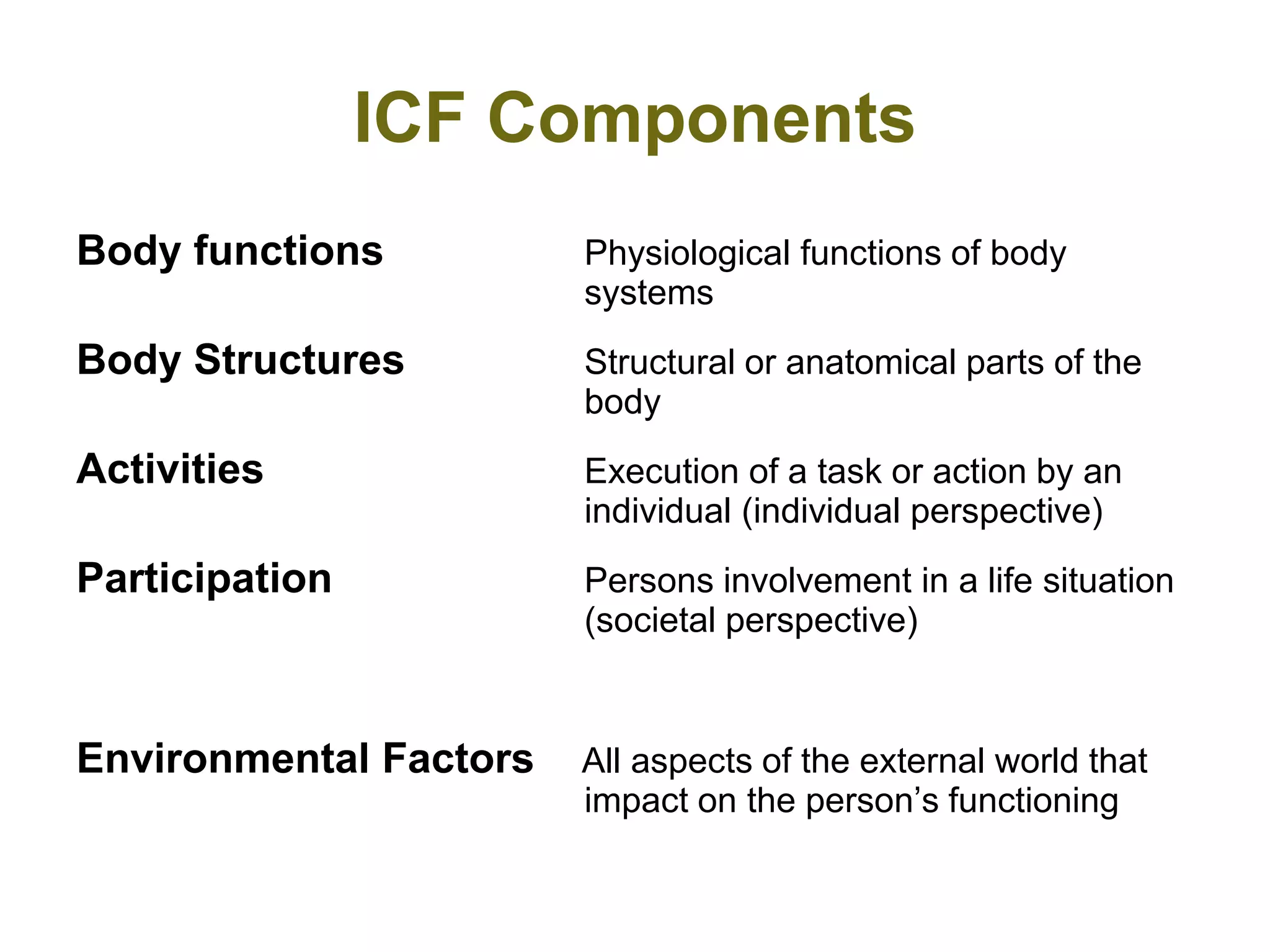
ICF Components
Body functions Physiological functions of body
systems
Body Structures Structural or anatomical parts of the
body
Activities Execution of a task or action by an
individual (individual perspective)
Participation Persons involvement in a life situation
(societal perspective)
Environmental Factors All aspects of the external world that
impact on the person’s functioning
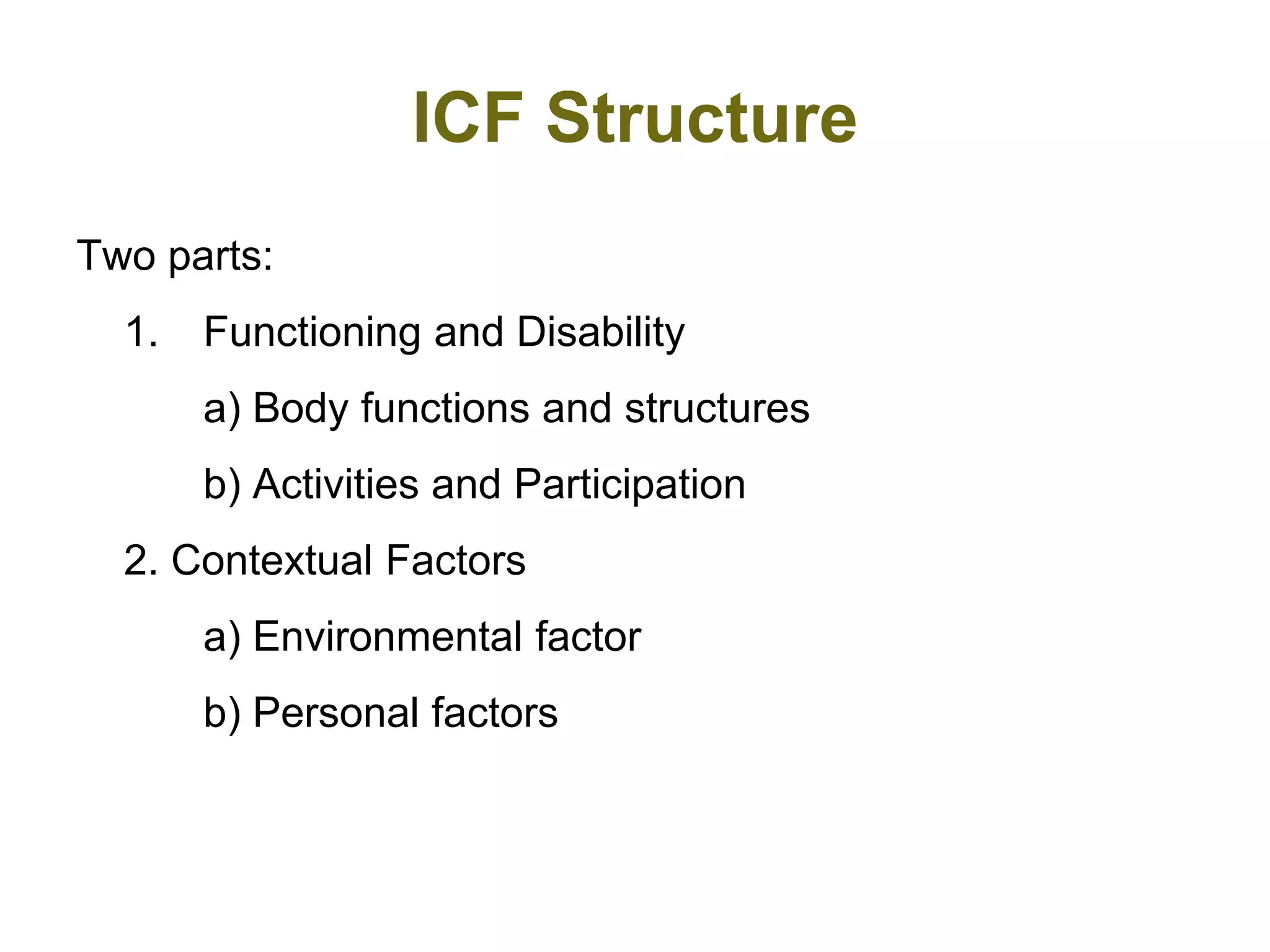
ICF Structure
Two parts:
1. Functioning and Disability
a) Body functions and structures
b) Activities and Participation
2. Contextual Factors
a) Environmental factor
b) Personal factors
12
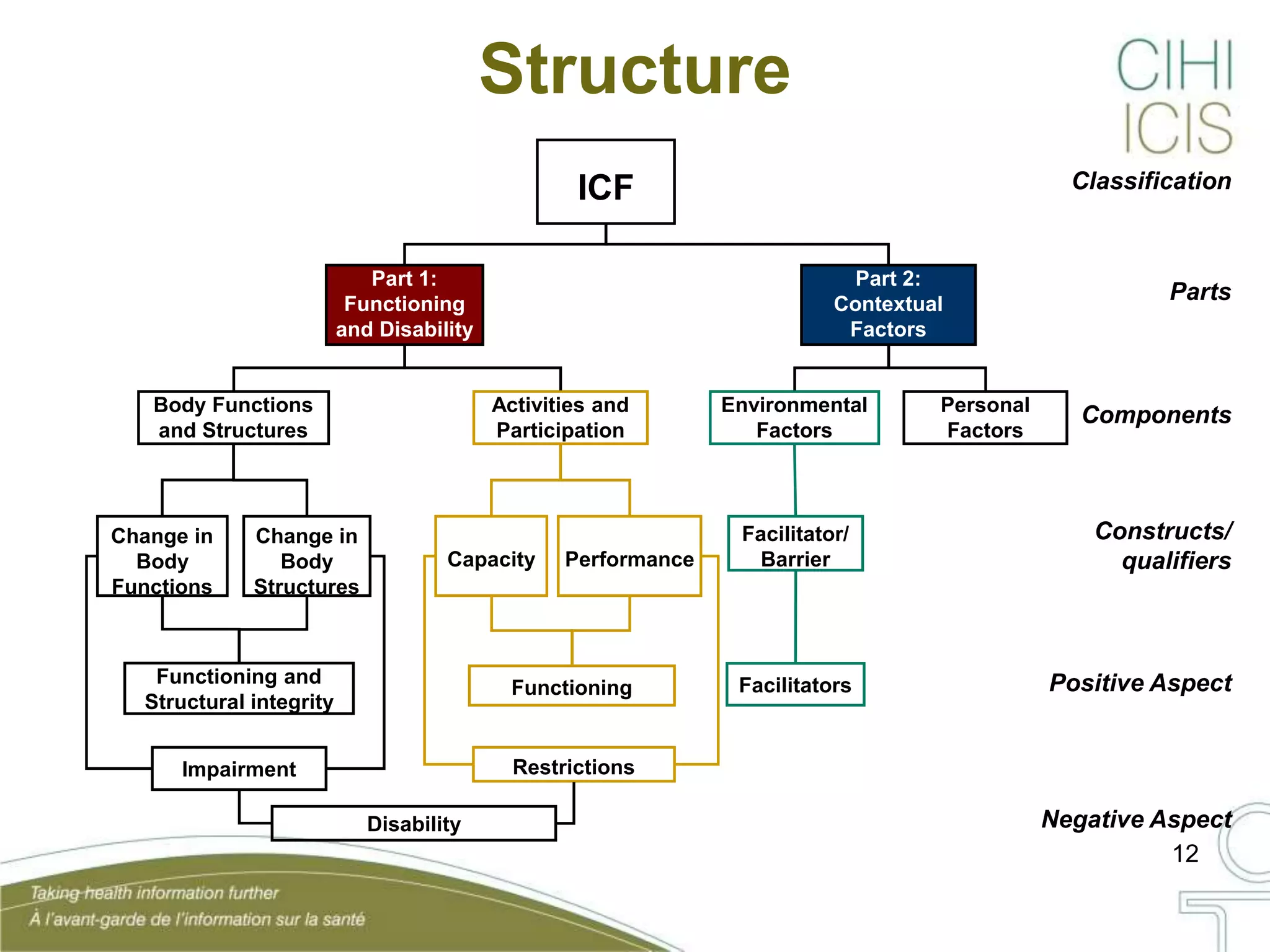
Structure
Classification
Parts
Components
Constructs/
qualifiers
Positive Aspect
ICF
Part 1:
Functioning
and Disability
Part 2:
Contextual
Factors
Body Functions
and Structures
Activities and
Participation
Environmental
Factors
Personal
Factors
Change in
Body
Structures
Capacity Performance
Facilitator/
Barrier
Facilitators
Change in
Body
Functions
Functioning and
Structural integrity
Functioning
Impairment Restrictions
Disability Negative Aspect
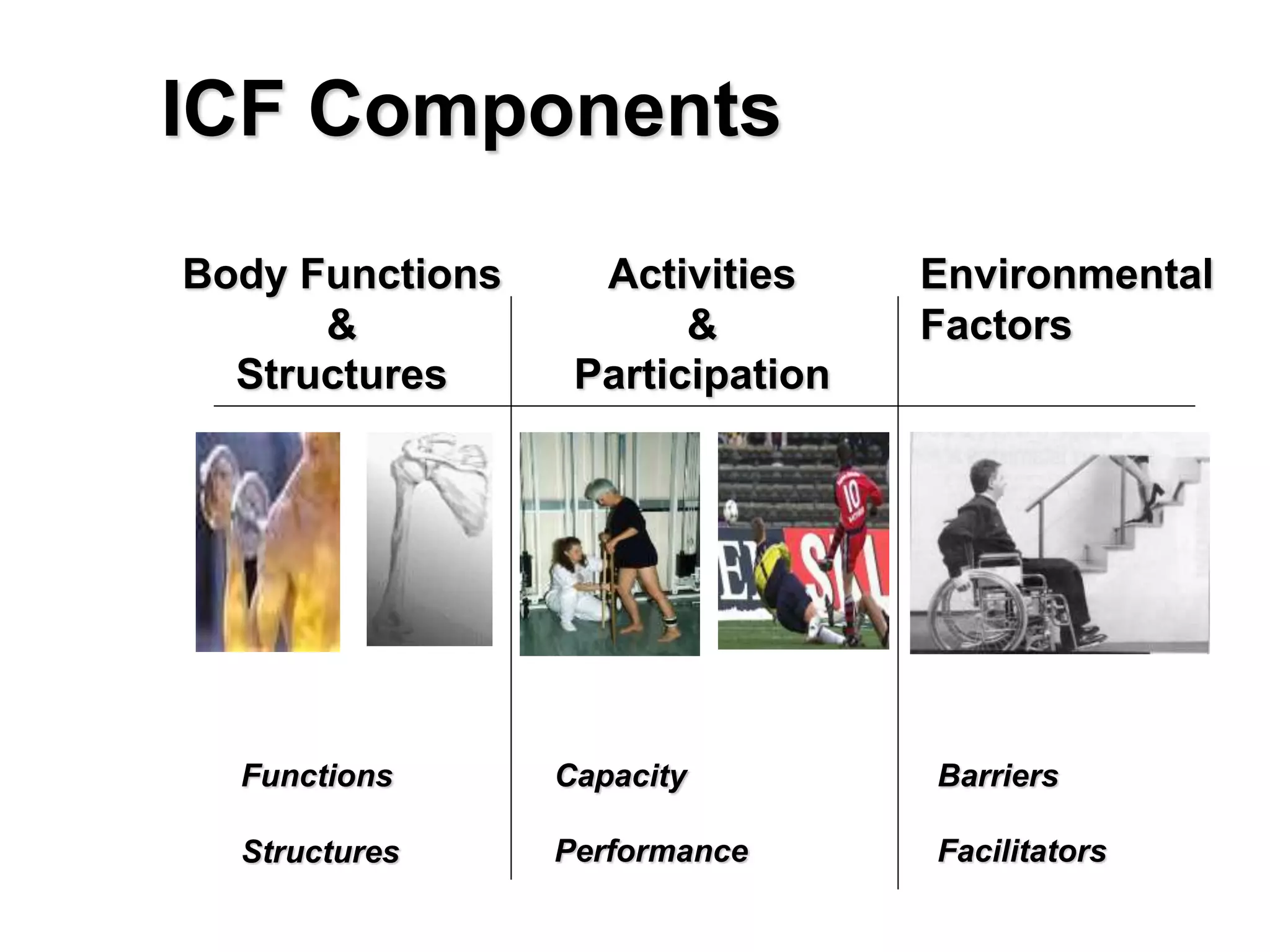
ICF Components
Body Functions
&
Structures
Activities
&
Participation
Environmental
Factors
Barriers
Facilitators
Functions
Structures
Capacity
Performance
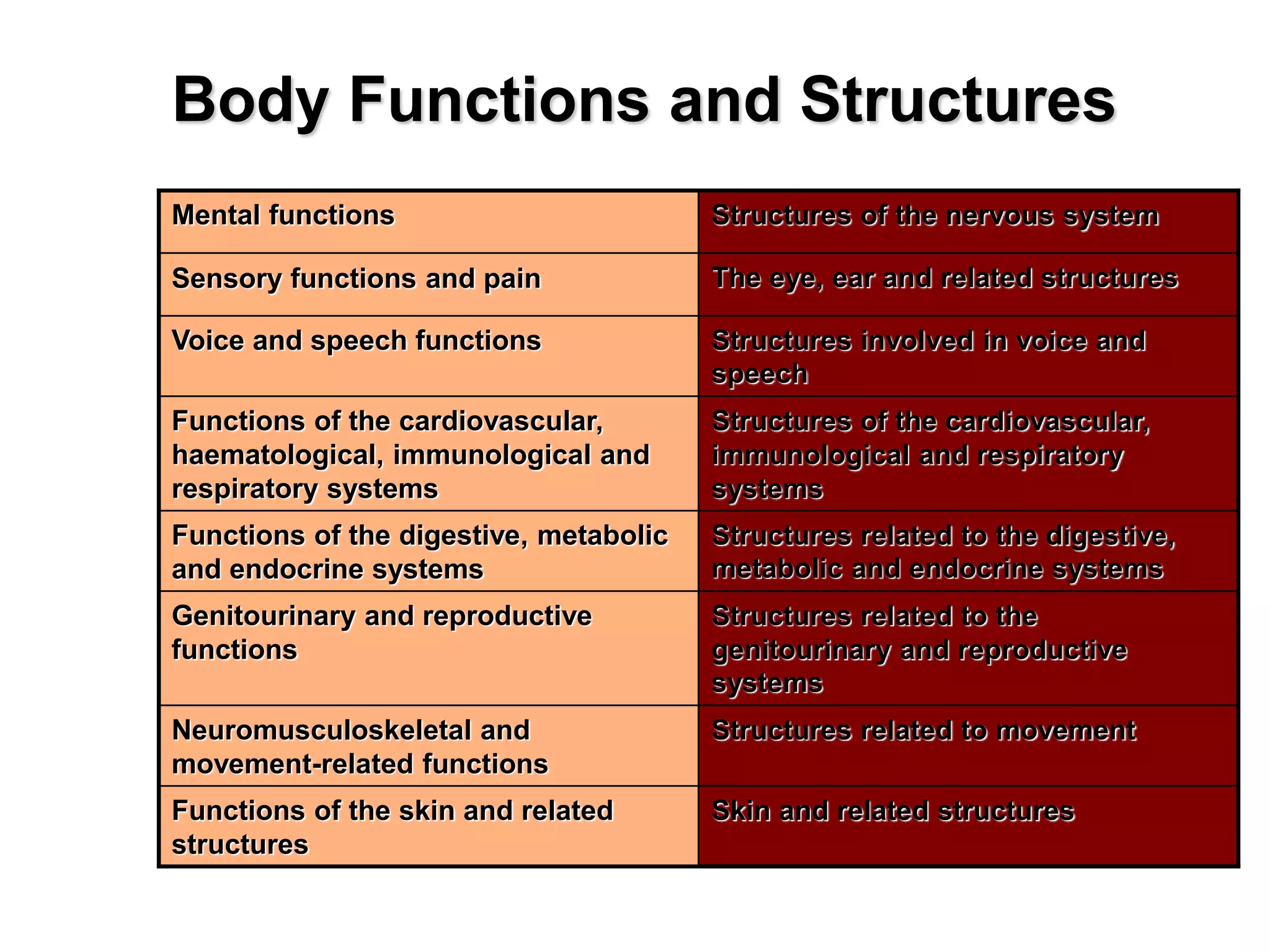
Body Functions and Structures
Skin and related structuresFunctions of the skin and related
structures
Structures related to movementNeuromusculoskeletal and
movement-related functions
Structures related to the
genitourinary and reproductive
systems
Genitourinary and reproductive
functions
Structures related to the digestive,
metabolic and endocrine systems
Functions of the digestive, metabolic
and endocrine systems
Structures of the cardiovascular,
immunological and respiratory
systems
Functions of the cardiovascular,
haematological, immunological and
respiratory systems
Structures involved in voice and
speech
Voice and speech functions
The eye, ear and related structuresSensory functions and pain
Structures of the nervous systemMental functions
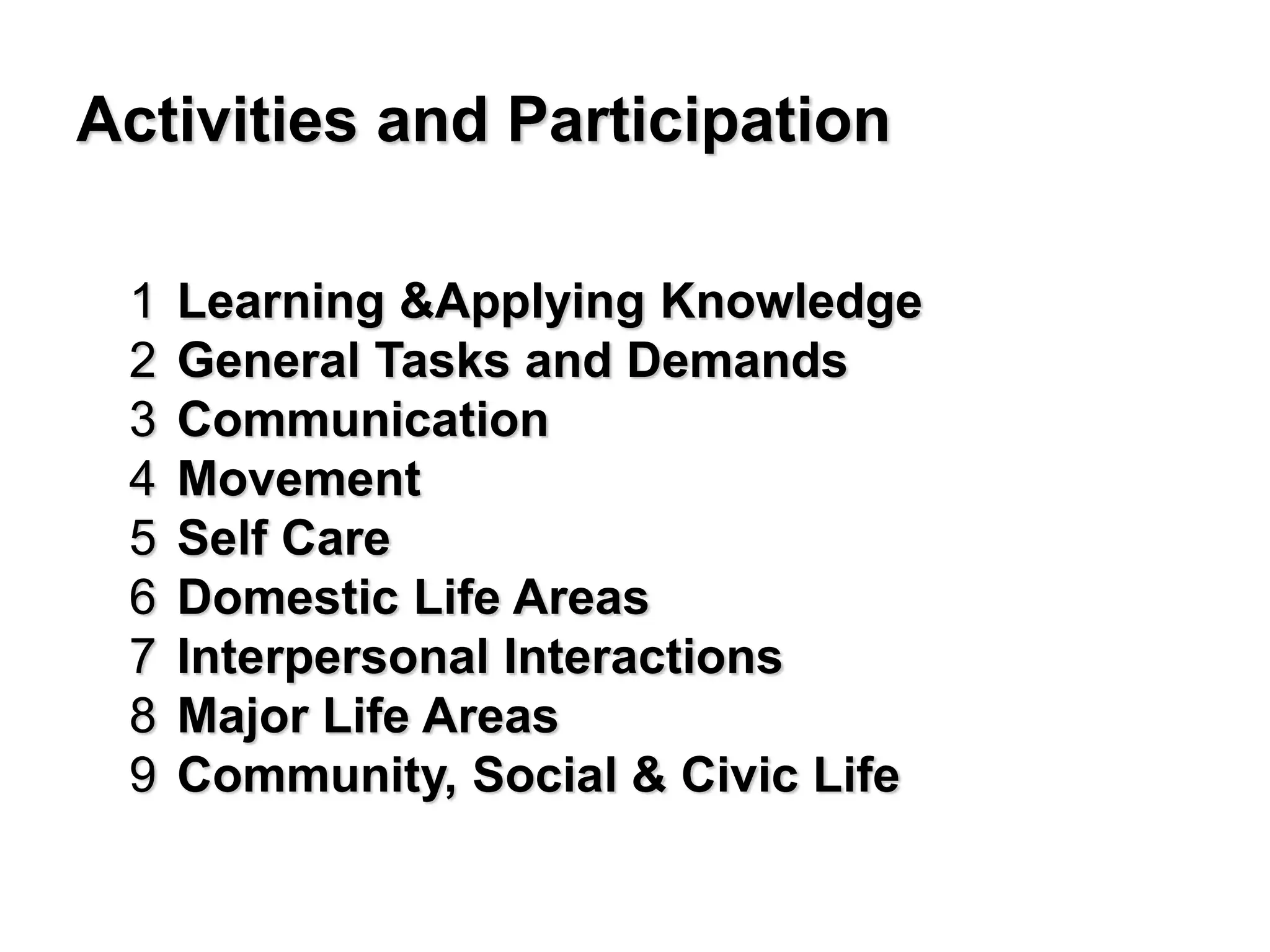
Activities and Participation
1 Learning &Applying Knowledge
2 General Tasks and Demands
3 Communication
4 Movement
5 Self Care
6 Domestic Life Areas
7 Interpersonal Interactions
8 Major Life Areas
9 Community, Social & Civic Life
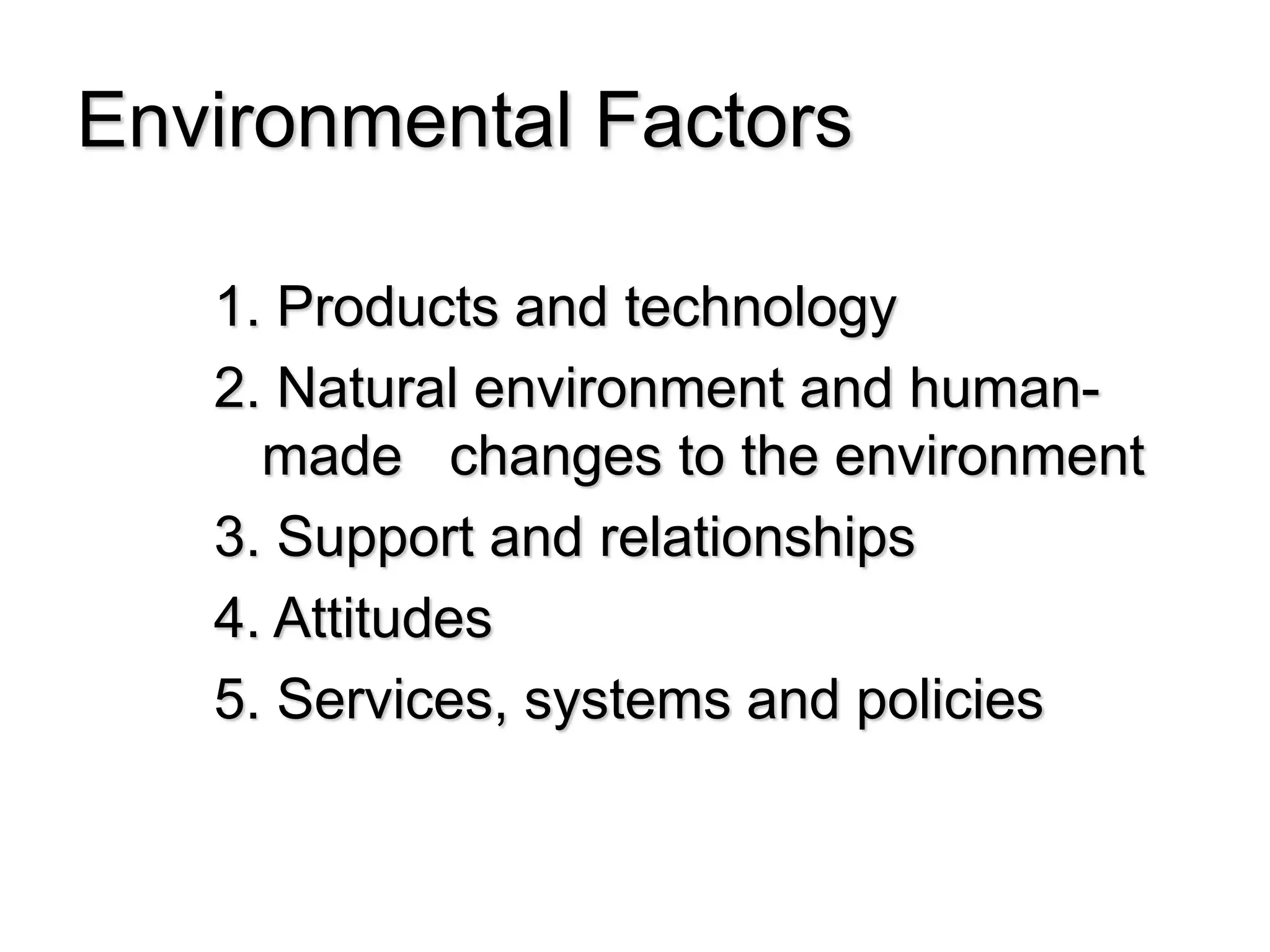
Environmental Factors
1. Products and technology
2. Natural environment and human-
made changes to the environment
3. Support and relationships
4. Attitudes
5. Services, systems and policies
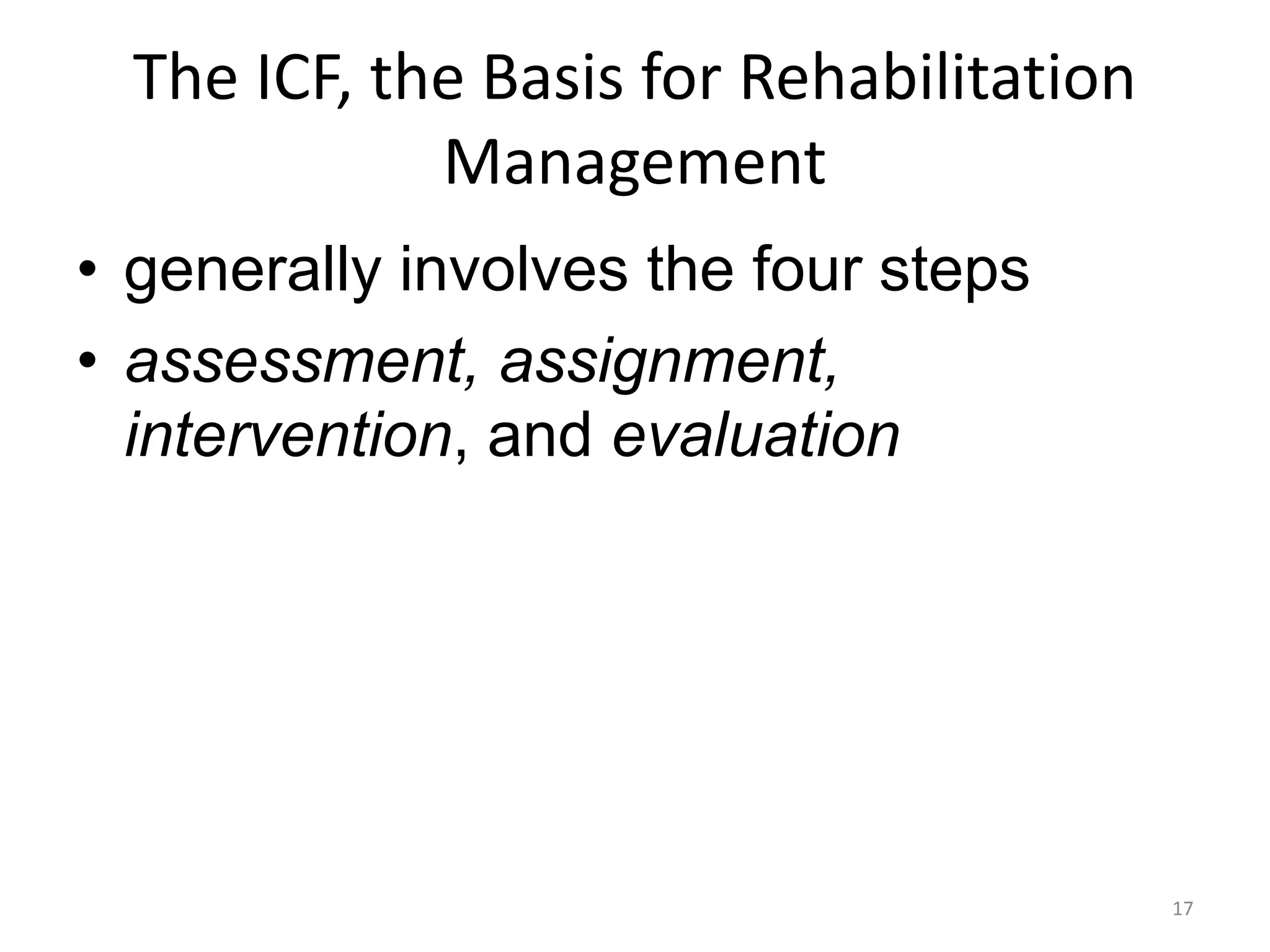
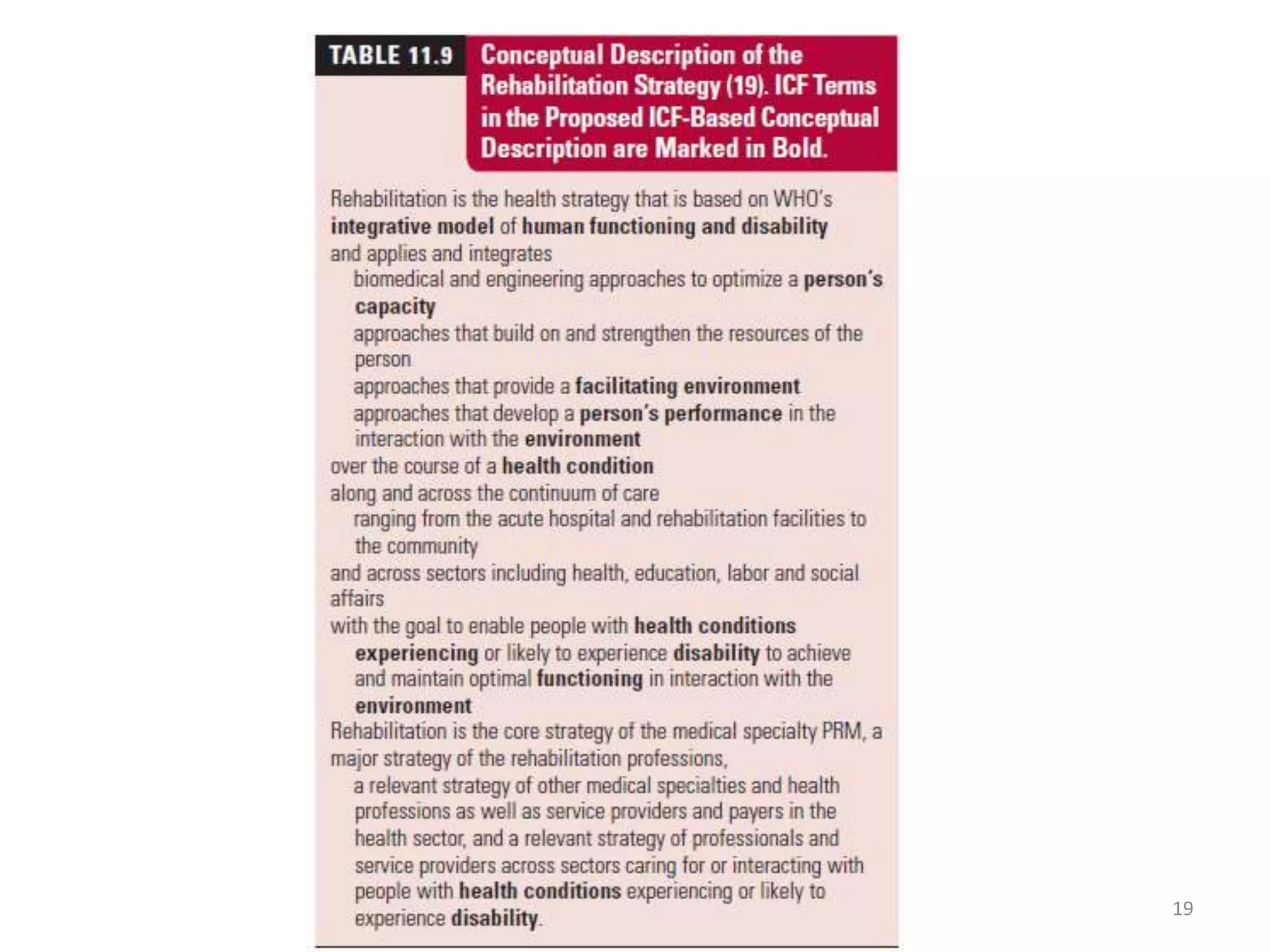
The ICF, the Basis for Rehabilitation
Management
• generally involves the four steps
• assessment, assignment,
intervention, and evaluation
17
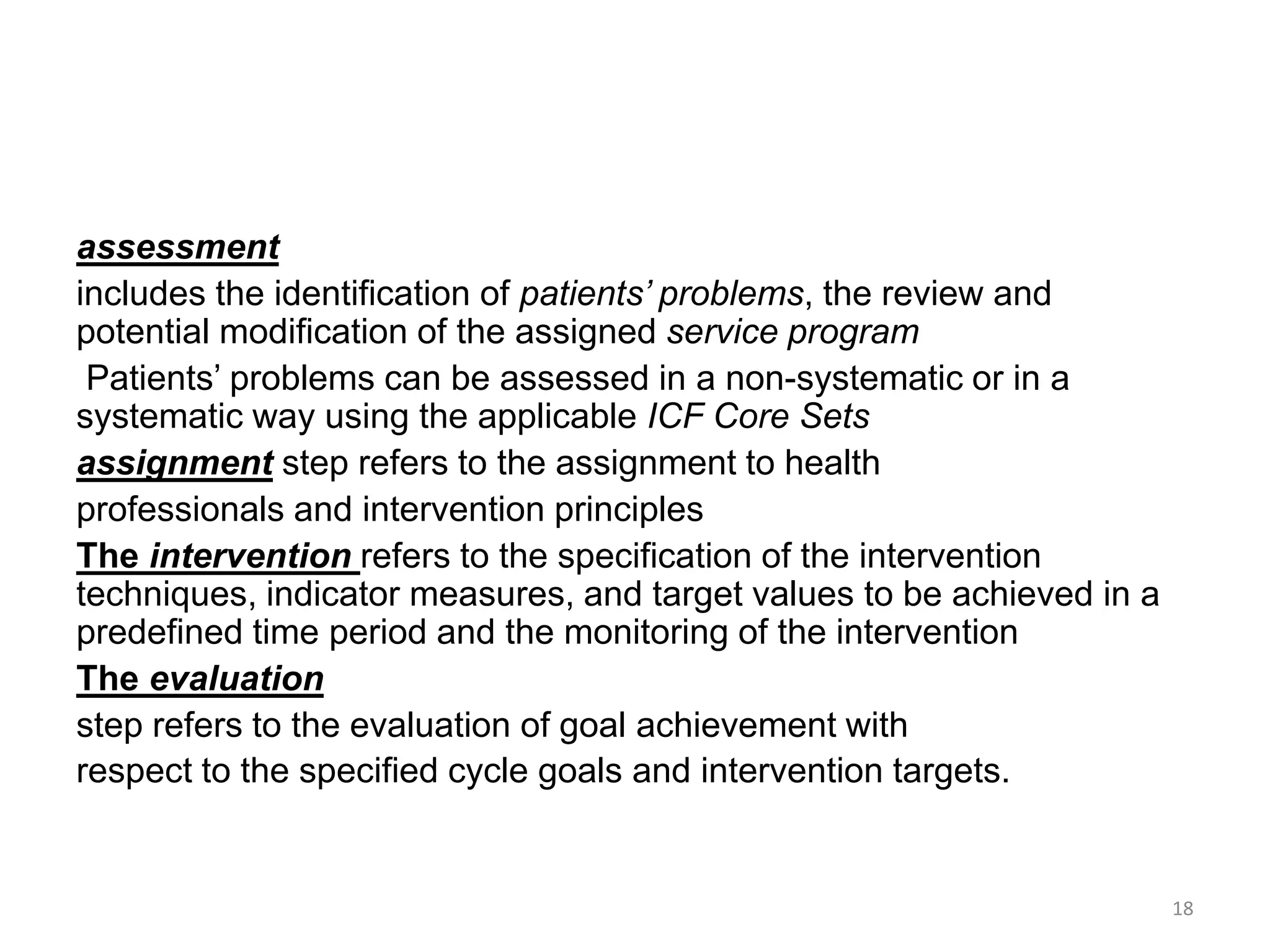
assessment
includes the identification of patients’ problems, the review and
potential modification of the assigned service program
Patients’ problems can be assessed in a non-systematic or in a
systematic way using the applicable ICF Core Sets
assignment step refers to the assignment to health
professionals and intervention principles
The intervention refers to the specification of the intervention
techniques, indicator measures, and target values to be achieved in a
predefined time period and the monitoring of the intervention
The evaluation
step refers to the evaluation of goal achievement with
respect to the specified cycle goals and intervention targets.
18
19
ICF Applications
• Health sector
• Social security
• Education sector
• Labour sector
• Economics & development sector
• Legislation & law
• Other ….
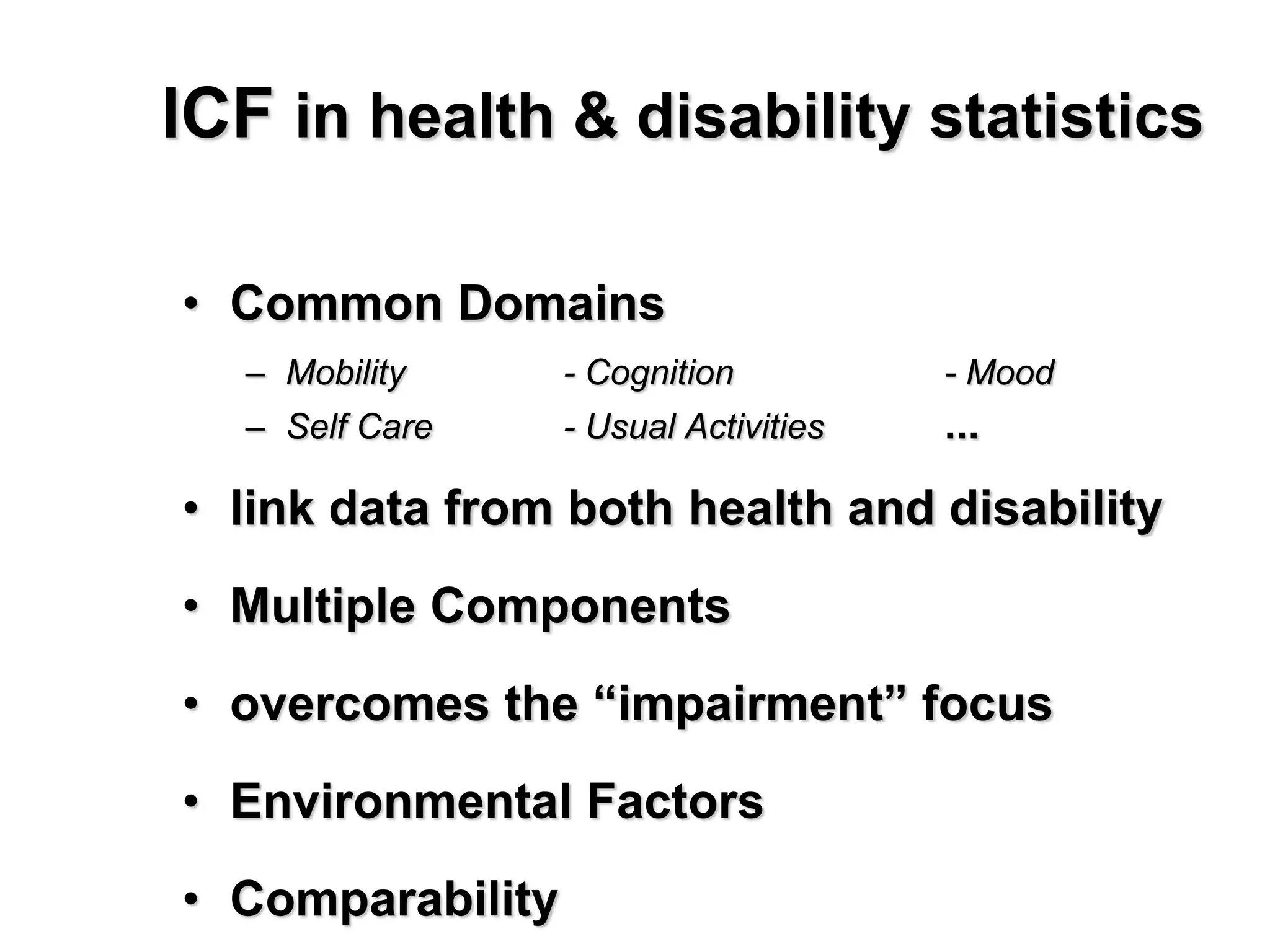
ICF in health & disability statistics
• Common Domains
– Mobility - Cognition - Mood
– Self Care - Usual Activities ...
• link data from both health and disability
• Multiple Components
• overcomes the “impairment” focus
• Environmental Factors
• Comparability
• Needs assessment
• Outcome assessment
• Utilization patterns
• Comparison of different interventions
• Consumer satisfaction
• Service performance
– outcomes
– cost-effectiveness
• Electronic records
• Clinical terminology
ICF in clinical practice & management
ICF in policy making
• assessment of population health
• impact of disability
–economic
–social
• evidence-base for policy makers on
different policy interventions
–responsiveness of services
–efficiency
–performance assessment
ICF research applications
• joint assessment of disease and functioning
– description of association
– intervention response & synchrony of change
– explanatory power on:
• utilization
• needs
• costs
• outcomes
– Cost-effectiveness of interventions
– Unified approaches
Thank u
25

International classification of functioning by athul

  • 1.
  • 2.
    International Classification ofFunctioning, Disability and Health (ICF The endorsement of the ICF by the 54th World Health Assembly in May 2001 • Mirrors an important shift in the understanding of health and disability by the WHO. The ICF acknowledges that every human being can experience a decrement in health and thereby experience some disability.
  • 3.
    • With theICF, WHO responds to the need for a unified, international, and standardized language for describing and classifying health and health-related domains. The ICF is WHO’s framework for health and disability. It is the conceptual basis for the definition,measurement, and policy formulations for health and disability.
  • 4.
    Accordingly, it coversthe entire lifespan. It is integrative and not merely medical or social. Similarly, it addresses human functioning and not merely disability. It is multidimensional and interactive, and rejects the linear linkage between health condition and functioning. It is also etiologically neutral which means functioning is understood descriptively and not caused by diagnosis. It adopts the parity approach which does not recognize an inherent distinction or asymmetry between mental and physical functioning.
  • 5.
    Aims of ICF •To provide a scientific basis for consequences of health conditions • To establish a common language to improve communications • To permit comparison of data across: – countries – health care disciplines – services – time • To provide a systematic coding scheme for health information systems
  • 6.
    ICF Applications • Healthsector • Social security • Education sector • Labour sector • Economics & development sector • Legislation & law • Other ….
  • 7.
    Foundations of ICF HumanFunctioning - not merely disability Universal Model - not a minority model Integrative Model - not merely medical or social Interactive Model - not linear progressive Parity - not etiological causality Context - inclusive - not person alone Cultural applicability - not western concepts Operational - not theory driven alone Life span coverage - not adult driven
  • 8.
  • 9.
    Definitions •Impairment •Loss or abnormalityin body structure or function (including mental function) •Activity Limitations •Difficulties individual may have in executing activities in terms of quantity or quality •Participation Restrictions •Problems an individual may experience in involvement in life situations •Facilitators & Barriers •Environmental factors may be a facilitator for one person & barrier for another
  • 10.
    ICF Components Body functionsPhysiological functions of body systems Body Structures Structural or anatomical parts of the body Activities Execution of a task or action by an individual (individual perspective) Participation Persons involvement in a life situation (societal perspective) Environmental Factors All aspects of the external world that impact on the person’s functioning
  • 11.
    ICF Structure Two parts: 1.Functioning and Disability a) Body functions and structures b) Activities and Participation 2. Contextual Factors a) Environmental factor b) Personal factors
  • 12.
    12 Structure Classification Parts Components Constructs/ qualifiers Positive Aspect ICF Part 1: Functioning andDisability Part 2: Contextual Factors Body Functions and Structures Activities and Participation Environmental Factors Personal Factors Change in Body Structures Capacity Performance Facilitator/ Barrier Facilitators Change in Body Functions Functioning and Structural integrity Functioning Impairment Restrictions Disability Negative Aspect
  • 13.
  • 14.
    Body Functions andStructures Skin and related structuresFunctions of the skin and related structures Structures related to movementNeuromusculoskeletal and movement-related functions Structures related to the genitourinary and reproductive systems Genitourinary and reproductive functions Structures related to the digestive, metabolic and endocrine systems Functions of the digestive, metabolic and endocrine systems Structures of the cardiovascular, immunological and respiratory systems Functions of the cardiovascular, haematological, immunological and respiratory systems Structures involved in voice and speech Voice and speech functions The eye, ear and related structuresSensory functions and pain Structures of the nervous systemMental functions
  • 15.
    Activities and Participation 1Learning &Applying Knowledge 2 General Tasks and Demands 3 Communication 4 Movement 5 Self Care 6 Domestic Life Areas 7 Interpersonal Interactions 8 Major Life Areas 9 Community, Social & Civic Life
  • 16.
    Environmental Factors 1. Productsand technology 2. Natural environment and human- made changes to the environment 3. Support and relationships 4. Attitudes 5. Services, systems and policies
  • 17.
    The ICF, theBasis for Rehabilitation Management • generally involves the four steps • assessment, assignment, intervention, and evaluation 17
  • 18.
    assessment includes the identificationof patients’ problems, the review and potential modification of the assigned service program Patients’ problems can be assessed in a non-systematic or in a systematic way using the applicable ICF Core Sets assignment step refers to the assignment to health professionals and intervention principles The intervention refers to the specification of the intervention techniques, indicator measures, and target values to be achieved in a predefined time period and the monitoring of the intervention The evaluation step refers to the evaluation of goal achievement with respect to the specified cycle goals and intervention targets. 18
  • 19.
  • 20.
    ICF Applications • Healthsector • Social security • Education sector • Labour sector • Economics & development sector • Legislation & law • Other ….
  • 21.
    ICF in health& disability statistics • Common Domains – Mobility - Cognition - Mood – Self Care - Usual Activities ... • link data from both health and disability • Multiple Components • overcomes the “impairment” focus • Environmental Factors • Comparability
  • 22.
    • Needs assessment •Outcome assessment • Utilization patterns • Comparison of different interventions • Consumer satisfaction • Service performance – outcomes – cost-effectiveness • Electronic records • Clinical terminology ICF in clinical practice & management
  • 23.
    ICF in policymaking • assessment of population health • impact of disability –economic –social • evidence-base for policy makers on different policy interventions –responsiveness of services –efficiency –performance assessment
  • 24.
    ICF research applications •joint assessment of disease and functioning – description of association – intervention response & synchrony of change – explanatory power on: • utilization • needs • costs • outcomes – Cost-effectiveness of interventions – Unified approaches
  • 25.