An Introduction to the
International Classification
of Functioning, Disability,
and Health
Disablement
 The term "disablement," as it is being used in this special
issue of Physical Therapy, refers to the various impact(s)
of chronic and acute conditions on the functioning of
specific body systems, on basic human performance,
and on people's functioning in necessary, usual,
expected, and personally desired roles in society.'
 "Disablement," therefore, is a global term that reflects all
the diverse consequences that disease, injury, or
congenital abnormalities may have on human
functioning at many different levels. The term
"disablement" does not distinguish among the different
types of consequences.
Enablement
 Enablement in the context of the
workplace is the act of enabling all
employees to do their jobs - even if they
have an impairment, illness, neurodiversity
or other disability.
 People with disabilities including
neurodiversities often feel disadvantaged
in the workplace. Our job as employers is
to remove significant barriers to enable
everyone to do their jobs as effectively as
What is the ICF?
 A framework for describing the facets
of human functioning that may be
affected by a health condition
 A classification system – not a
measurement tool
Where did the ICF come from?
 Developed by the World Health
Organization (WHO)
 Large international and
multidisciplinary participation
 Extensive field testing
The Aims of the ICF
 To provide a scientific basis for the
consequences of health conditions
 To establish a common language to
improve communications
 To permit comparisons of data across:
– Countries
– Health care disciplines
– Services
– Time
 To provide a systematic coding scheme
for health information systems
Human Functioning
 ICF does not measure disability
– It describes people’s functional abilities in
various domains
 Health conditions that affect functional
status are not part of classification system
 Disability is not an “all or nothing” concept
– There is a wide range of functional limitations
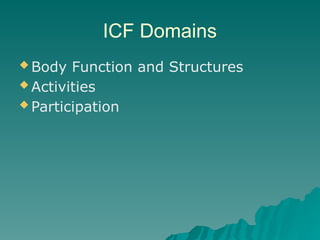
ICF Domains
 Body Function and Structures
 Activities
 Participation
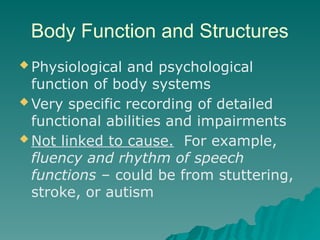
Body Function and Structures
 Physiological and psychological
function of body systems
 Very specific recording of detailed
functional abilities and impairments
 Not linked to cause. For example,
fluency and rhythm of speech
functions – could be from stuttering,
stroke, or autism
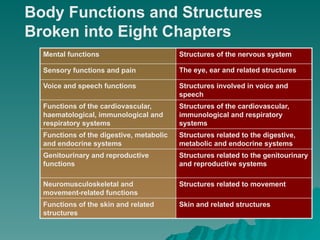
Body Functions and Structures
Broken into Eight Chapters
Skin and related structures
Functions of the skin and related
structures
Structures related to movement
Neuromusculoskeletal and
movement-related functions
Structures related to the genitourinary
and reproductive systems
Genitourinary and reproductive
functions
Structures related to the digestive,
metabolic and endocrine systems
Functions of the digestive, metabolic
and endocrine systems
Structures of the cardiovascular,
immunological and respiratory
systems
Functions of the cardiovascular,
haematological, immunological and
respiratory systems
Structures involved in voice and
speech
Voice and speech functions
The eye, ear and related structures
Sensory functions and pain
Structures of the nervous system
Mental functions
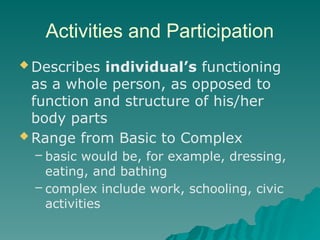
Activities and Participation
 Describes individual’s functioning
as a whole person, as opposed to
function and structure of his/her
body parts
 Range from Basic to Complex
– basic would be, for example, dressing,
eating, and bathing
– complex include work, schooling, civic
activities
Activities and Participation (cont.)
 UN Washington Group approach
– Activities – tasks an individual can do that
require multiple body functions
– Participation – higher order activities that
involve integration in the community
 WHO approach
– Activities – what people can do inherently
without assistance or barriers
– Participation – functioning taking into account
the impact of barriers and facilitators in the
environment
Activities and Participation (cont.)
 What is most important is that there
are a range of activities going from
basic to complex that describe a
person’s ability to live independently
and be integrated into their
communities
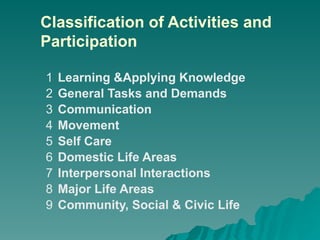
Classification of Activities and
Participation
1 Learning &Applying Knowledge
2 General Tasks and Demands
3 Communication
4 Movement
5 Self Care
6 Domestic Life Areas
7 Interpersonal Interactions
8 Major Life Areas
9 Community, Social & Civic Life
Universal Model vs. Minority Model
 Universal Model -- everyone has a
range of functional abilities
– A continuum of functioning
– Multidimensional
– Even those without what is commonly
perceived as “a disability” have functional
needs
 A Minority Model is categorical and uni-
dimensional. People are classified based
on certain impairment groups without
reference to their functioning at the
activity and participation levels
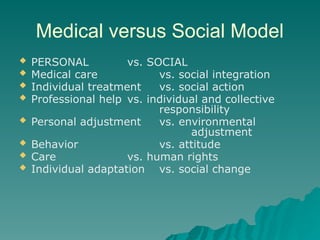
Medical versus Social Model
 PERSONAL vs. SOCIAL
 Medical care vs. social integration
 Individual treatment vs. social action
 Professional help vs. individual and collective
responsibility
 Personal adjustment vs. environmental
adjustment
 Behavior vs. attitude
 Care vs. human rights
 Individual adaptation vs. social change
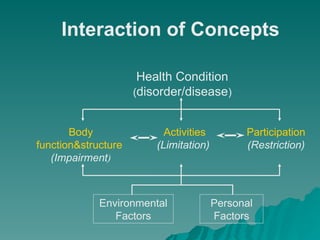
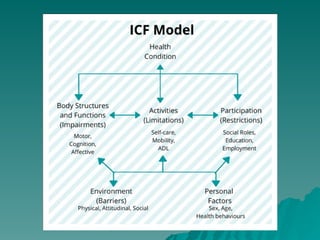
Health Condition
(disorder/disease)
Interaction of Concepts
Environmental
Factors
Personal
Factors
Body
function&structure
(Impairment)
Activities
(Limitation)
Participation
(Restriction)
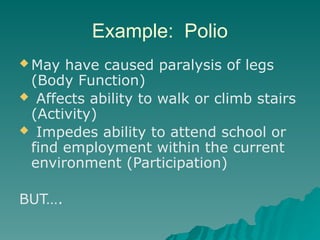
Example: Polio
 May have caused paralysis of legs
(Body Function)
 Affects ability to walk or climb stairs
(Activity)
 Impedes ability to attend school or
find employment within the current
environment (Participation)
BUT….
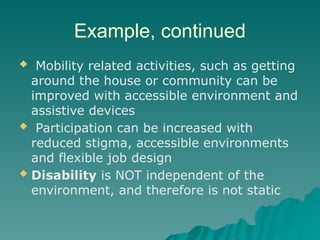
Example, continued
 Mobility related activities, such as getting
around the house or community can be
improved with accessible environment and
assistive devices
 Participation can be increased with
reduced stigma, accessible environments
and flexible job design
 Disability is NOT independent of the
environment, and therefore is not static
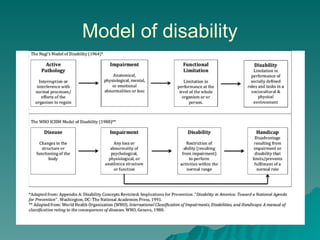
Model of disability
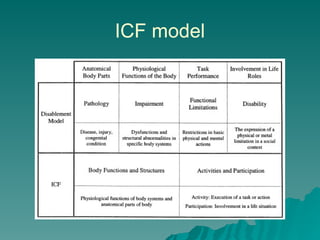
ICF model
BENEFITS OF USING ICF
MODEL
• To help with selecting an appropriate combination of outcome
measures.
• To assist with selecting a tool in developing comprehensive
outcome measures.
• To describe patterns of disability.
• To inform about the magnitude, the location and the nature
of any functioning problem.
• To highlight the strengths and weaknesses of an individual
patient.
• To describe changes in a patient’s functional profiles over
time.
USE OF ICF MODEL
 WHO uses and acknowledges ICF
presently.
https://www.who.int/standards/classifi
cations/international-classification-of-f
unctioning-disability-and-health
ICF checklist
THANK YOU

ICF model of disability physiotherapy.ppt

  • 1.
    An Introduction tothe International Classification of Functioning, Disability, and Health
  • 2.
    Disablement  The term"disablement," as it is being used in this special issue of Physical Therapy, refers to the various impact(s) of chronic and acute conditions on the functioning of specific body systems, on basic human performance, and on people's functioning in necessary, usual, expected, and personally desired roles in society.'  "Disablement," therefore, is a global term that reflects all the diverse consequences that disease, injury, or congenital abnormalities may have on human functioning at many different levels. The term "disablement" does not distinguish among the different types of consequences.
  • 3.
    Enablement  Enablement inthe context of the workplace is the act of enabling all employees to do their jobs - even if they have an impairment, illness, neurodiversity or other disability.  People with disabilities including neurodiversities often feel disadvantaged in the workplace. Our job as employers is to remove significant barriers to enable everyone to do their jobs as effectively as
  • 4.
    What is theICF?  A framework for describing the facets of human functioning that may be affected by a health condition  A classification system – not a measurement tool
  • 5.
    Where did theICF come from?  Developed by the World Health Organization (WHO)  Large international and multidisciplinary participation  Extensive field testing
  • 6.
    The Aims ofthe ICF  To provide a scientific basis for the consequences of health conditions  To establish a common language to improve communications  To permit comparisons of data across: – Countries – Health care disciplines – Services – Time  To provide a systematic coding scheme for health information systems
  • 7.
    Human Functioning  ICFdoes not measure disability – It describes people’s functional abilities in various domains  Health conditions that affect functional status are not part of classification system  Disability is not an “all or nothing” concept – There is a wide range of functional limitations
  • 8.
    ICF Domains  BodyFunction and Structures  Activities  Participation
  • 9.
    Body Function andStructures  Physiological and psychological function of body systems  Very specific recording of detailed functional abilities and impairments  Not linked to cause. For example, fluency and rhythm of speech functions – could be from stuttering, stroke, or autism
  • 10.
    Body Functions andStructures Broken into Eight Chapters Skin and related structures Functions of the skin and related structures Structures related to movement Neuromusculoskeletal and movement-related functions Structures related to the genitourinary and reproductive systems Genitourinary and reproductive functions Structures related to the digestive, metabolic and endocrine systems Functions of the digestive, metabolic and endocrine systems Structures of the cardiovascular, immunological and respiratory systems Functions of the cardiovascular, haematological, immunological and respiratory systems Structures involved in voice and speech Voice and speech functions The eye, ear and related structures Sensory functions and pain Structures of the nervous system Mental functions
  • 11.
    Activities and Participation Describes individual’s functioning as a whole person, as opposed to function and structure of his/her body parts  Range from Basic to Complex – basic would be, for example, dressing, eating, and bathing – complex include work, schooling, civic activities
  • 12.
    Activities and Participation(cont.)  UN Washington Group approach – Activities – tasks an individual can do that require multiple body functions – Participation – higher order activities that involve integration in the community  WHO approach – Activities – what people can do inherently without assistance or barriers – Participation – functioning taking into account the impact of barriers and facilitators in the environment
  • 13.
    Activities and Participation(cont.)  What is most important is that there are a range of activities going from basic to complex that describe a person’s ability to live independently and be integrated into their communities
  • 14.
    Classification of Activitiesand Participation 1 Learning &Applying Knowledge 2 General Tasks and Demands 3 Communication 4 Movement 5 Self Care 6 Domestic Life Areas 7 Interpersonal Interactions 8 Major Life Areas 9 Community, Social & Civic Life
  • 15.
    Universal Model vs.Minority Model  Universal Model -- everyone has a range of functional abilities – A continuum of functioning – Multidimensional – Even those without what is commonly perceived as “a disability” have functional needs  A Minority Model is categorical and uni- dimensional. People are classified based on certain impairment groups without reference to their functioning at the activity and participation levels
  • 16.
    Medical versus SocialModel  PERSONAL vs. SOCIAL  Medical care vs. social integration  Individual treatment vs. social action  Professional help vs. individual and collective responsibility  Personal adjustment vs. environmental adjustment  Behavior vs. attitude  Care vs. human rights  Individual adaptation vs. social change
  • 17.
    Health Condition (disorder/disease) Interaction ofConcepts Environmental Factors Personal Factors Body function&structure (Impairment) Activities (Limitation) Participation (Restriction)
  • 18.
    Example: Polio  Mayhave caused paralysis of legs (Body Function)  Affects ability to walk or climb stairs (Activity)  Impedes ability to attend school or find employment within the current environment (Participation) BUT….
  • 19.
    Example, continued  Mobilityrelated activities, such as getting around the house or community can be improved with accessible environment and assistive devices  Participation can be increased with reduced stigma, accessible environments and flexible job design  Disability is NOT independent of the environment, and therefore is not static
  • 20.
  • 21.
  • 24.
    BENEFITS OF USINGICF MODEL • To help with selecting an appropriate combination of outcome measures. • To assist with selecting a tool in developing comprehensive outcome measures. • To describe patterns of disability. • To inform about the magnitude, the location and the nature of any functioning problem. • To highlight the strengths and weaknesses of an individual patient. • To describe changes in a patient’s functional profiles over time.
  • 25.
    USE OF ICFMODEL  WHO uses and acknowledges ICF presently. https://www.who.int/standards/classifi cations/international-classification-of-f unctioning-disability-and-health ICF checklist
  • 26.

Editor's Notes

  • #1 1) Building large knowledge kit on Disability and Development -- Background info on many sectors, good practices 2) Today we are addressing Disability Data Collection --growing demand for information on disability 3) Disability Data Collection is important to: a) Generate prevalence measures b) Understand the connection between Disability, poverty, other MDGs, and development in general c) Construct indicators and methods for monitoring and evaluating projects for their effectiveness in reaching disabled people 4) More and more work is being done – findings Ecuador, India, Vietnam -- still need to work on comparability and interpretation 5) End product – layered tool on the design and implementation of quantitative data collection 6) Today’s purpose Present information Get feedback on toolkit design – both content and presentation
  • #6 Framework with which to think about functioning and how when goes about defining disability